

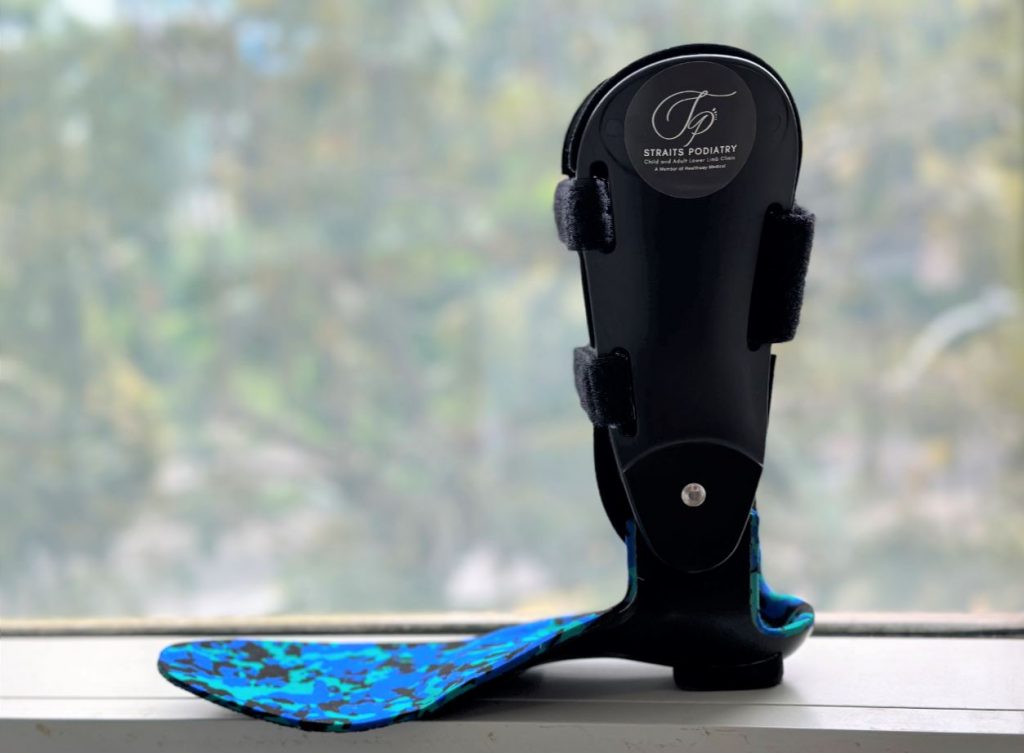


Ankle-Foot Orthosis (AFO) is a medical device that supports and controls the foot and ankle. AFO is used primarily to stabilize our lower limb structure, thereby reducing stress on the structure, and improving our gait functions. Like customised foot orthoses, AFO can be made specific to a condition and there are several designs that a Podiatrist can prescribe.
The key difference between AFO and customised foot orthoses is that AFO can provide higher control of ankle joint motion in all directions when walking. Hence, AFO is often used in more severe conditions, such as foot drop or late-stage posterior tibial tendon dysfunction.
AFO can be broken down into three components, the ankle splint, the hinge, and a foot orthosis. All components are fully customised to ensure an accurate fit. By changing the design of the components, we are able to prescribe the ideal device for your condition.
Conditions that are managed with AFO include:
There are various types of AFO in the market and many traditional designs are too rigid and do not provide great comfort when worn. Therefore, it is crucial to have an AFO that is comfortable and does not limit your daily activity.
At Straits Podiatry, our AFOs are versatile and will not hinder necessary movements when walking or running. It is imperative that we preserve these necessary movements so that patients can perform rehabilitative exercises during their road to recovery.
Before fabrication, a physical cast will be taken and each patient will need to undergo a thorough biomechanical assessment, which includes:
Quality assurance is our promise.
Share this with someone you know