
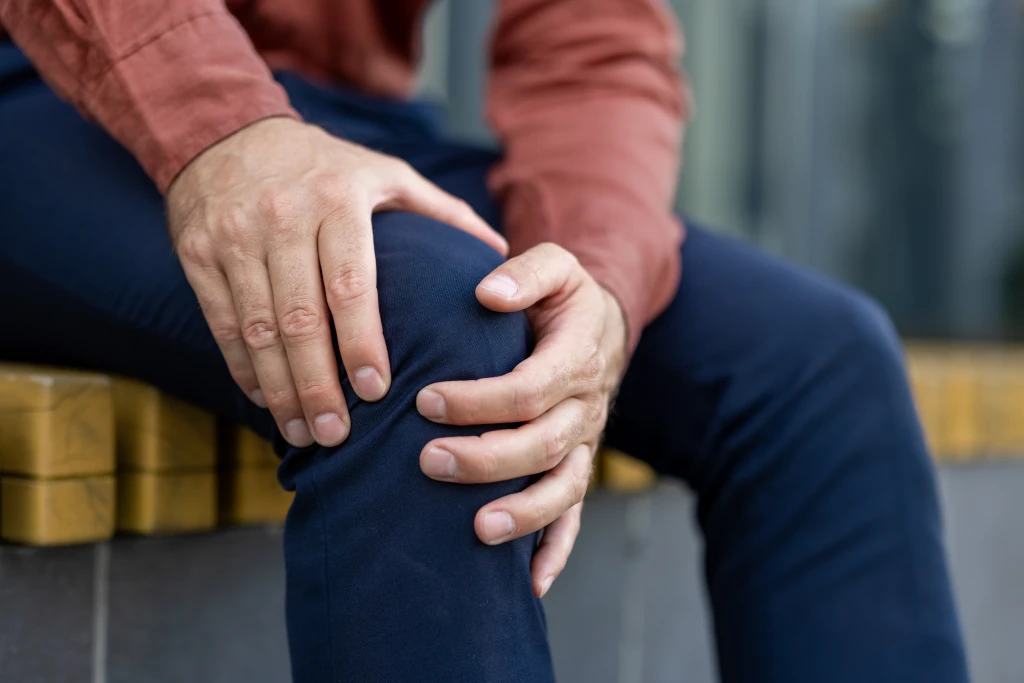
You start the day with stiff knees that take a few minutes to ease, your knees ache after a longer walk, and a small click or grinding sensation has crept in when going up stairs. Bending fully to garden or pick something off the floor has become harder than it used to be. For many Singaporeans, especially in the over-50 group, this is the early picture of knee osteoarthritis settling in.
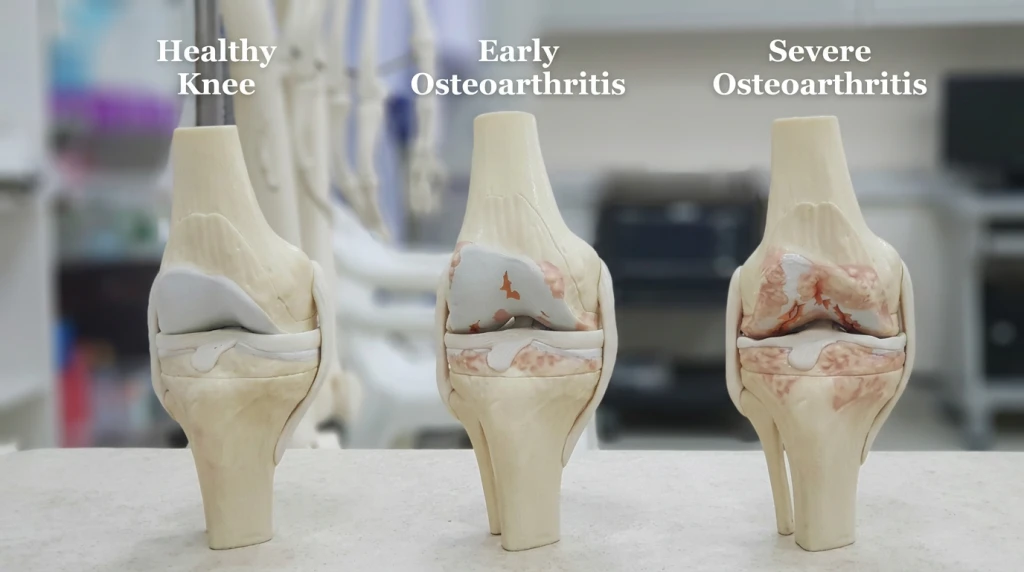
Knee osteoarthritis is a degenerative joint condition where the cartilage that lines the knee thins out and the joint space narrows over time. As the protective surface wears, the underlying bone responds with stiffness, swelling, and at times bony spurs that can be felt around the knee. While age is a major factor, not everyone develops it at the same rate, and previous injury, body weight, and how the lower limb loads the knee all influence how the joint wears.
Symptoms of Knee Osteoarthritis
Knee osteoarthritis tends to settle in gradually. The pattern of symptoms is often as informative as the symptoms themselves:
- Aching pain in or around the knee, worse after activity such as walking, standing, or stairs.
- Morning stiffness that eases within thirty minutes of moving around.
- Stiffness after sitting for long periods, often called the “gel” feeling.
- Swelling around the knee, sometimes after a longer day on the feet.
- Clicking, grinding, or a crunching sensation during movement.
- Reduced range of motion when fully straightening or bending the knee.
- A feeling that the knee is “giving way” on uneven ground.
Types of Knee Osteoarthritis
Two broad categories are commonly described. Primary knee osteoarthritis is the age-related wear of the joint that develops without a single identifiable cause, often driven by cumulative load, genetics, and time. Secondary knee osteoarthritis develops as a consequence of another factor, such as previous knee injury, post-surgical change, inflammatory joint disease, or significant malalignment of the lower limb. The distinction matters because secondary osteoarthritis often has a contributing factor that can still be modified.
Causes of Knee Osteoarthritis
What Causes Knee Osteoarthritis?
The knee joint sits between the thighbone (femur) and shinbone (tibia), with cartilage lining each surface and a small amount of joint fluid keeping movement smooth. When that cartilage thins out, the underlying bone takes more load and responds with inflammation, pain, and over time, bony spurs and joint space narrowing. The wear is influenced by load, alignment, and the strength of the muscles supporting the joint.
- Cumulative age-related wear on the cartilage surface.
- Previous knee injury, including ligament tears, meniscus injuries, or fractures around the knee.
- Sustained excess body weight that increases compressive load through the joint.
- Lower-limb malalignment such as knock knees, bow legs, or significant foot pronation.
- Repetitive high-impact activity over many years without recovery.
- Inflammatory arthritis affecting the same joint.
Who Carries a Higher Baseline Risk?
- People over the age of 60.
- Women, who develop knee osteoarthritis more commonly than men, particularly after menopause. Pooled prevalence is about 22% in women compared with 12% in men.
- People with a family history of osteoarthritis.
- People with a previous knee injury or knee surgery.
- People carrying excess body weight.
- People with longstanding knock knees, bow legs, or pronounced foot pronation.
Conditions Commonly Mistaken for Knee Osteoarthritis
Knee pain in the over-50 group does not always come from osteoarthritis. Several other conditions share its symptoms, and a clinical assessment, with imaging where indicated, is what sorts them out.
Degenerative meniscus tear
A degenerative meniscus tear can cause pain, clicking, and stiffness that closely resemble osteoarthritis, and the two often coexist in older knees. The distinction is that a meniscus tear tends to produce more localised joint-line tenderness and mechanical catching, whereas osteoarthritis pain is usually more diffuse and linked to activity load and stiffness after rest.
Rheumatoid arthritis and inflammatory arthropathies
Rheumatoid arthritis and other inflammatory arthropathies can mimic the joint pain and swelling of osteoarthritis. They behave differently, though: inflammatory arthritis typically involves several joints, is often symmetrical, and produces prolonged morning stiffness that eases as the day goes on, while osteoarthritis tends to be more localised and worsens with use.
Patellofemoral pain
Patellofemoral pain arises from the joint between the kneecap and the thigh bone and can be mistaken for early osteoarthritis. It differs in where the pain sits and what provokes it: patellofemoral pain is felt around or behind the kneecap and is aggravated by stairs, squatting, and prolonged sitting, rather than the deeper, load-related joint pain of osteoarthritis.
Referred pain from the hip or lower back
Pain arising in the hip joint or the lower back can be referred to the knee and felt as if the knee itself is the problem. The clue is that the knee examination is often unremarkable while hip or spine movements reproduce the symptoms, which is why the assessment looks beyond the knee when the local findings do not fit.
Treating and Preventing Knee Osteoarthritis
Knee osteoarthritis is managed by reducing the load the joint has to absorb and supporting the structures around it, so the cartilage that remains is protected and the joint stays as functional as possible. There is no treatment that reverses cartilage loss, but a well-structured care plan can ease pain, slow progression, and keep people active.
A common starting point is staying active with joint-friendly exercise. Walking, swimming, cycling, and resistance work for the quadriceps and gluteal muscles help offload the joint and maintain function. The misconception that activity worsens osteoarthritis is one of the more harmful ones, because deconditioning makes the knee feel worse, not better. Weight management, where relevant, takes meaningful load off the joint with every step.
Where lower-limb alignment is contributing, addressing how the foot loads through the knee can ease pressure on the worn part of the joint. Footwear that cushions and supports the foot helps reduce the impact through the knee during weight-bearing activity. Where conservative care no longer controls symptoms, joint injections or, in end-stage cases, joint replacement surgery with an orthopaedic surgeon may be considered. The podiatry role is the conservative, biomechanical side. Surgical decisions sit with the orthopaedic team.
Have Your Knee Osteoarthritis Managed at Straits Podiatry
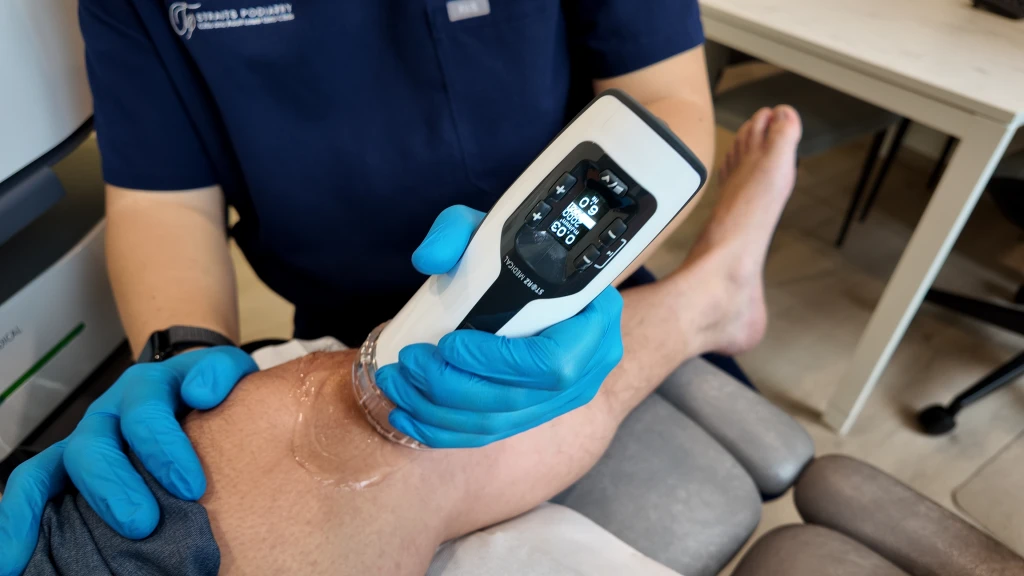
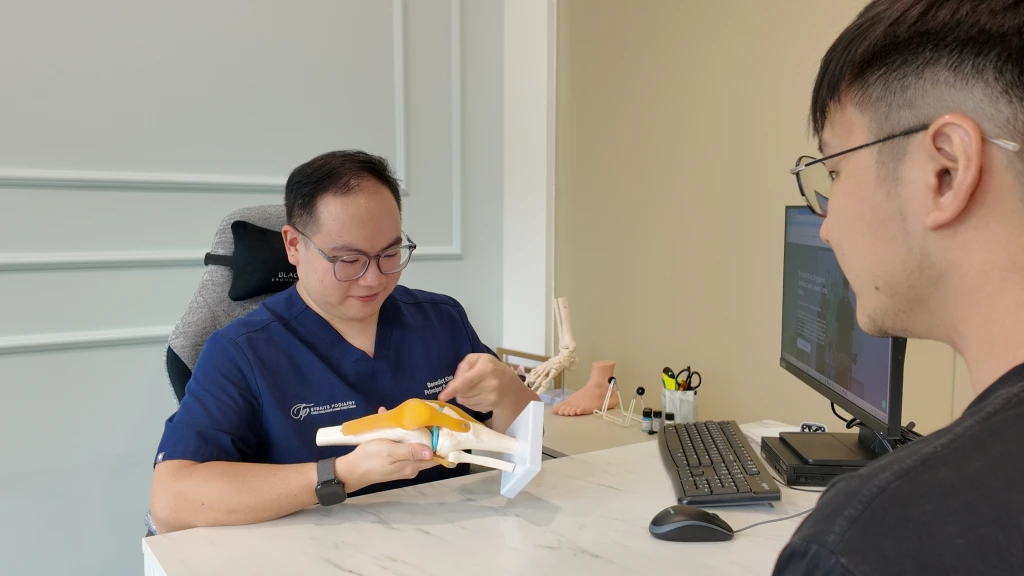
At Straits Podiatry, knee osteoarthritis care begins with a gait analysis and a lower-limb biomechanical review to identify how the foot and ankle are loading the knee. From there, care may involve custom foot orthoses and footwear adjustments to redistribute load, focused shockwave therapy and magnetotransduction therapy (EMTT) to ease pain and stimulate cellular repair, and physiotherapy support for strengthening and mobility.
Speak with Straits Podiatry or book a consultation for an assessment and a tailored approach to manage your knee osteoarthritis.
Frequently Asked Questions About Knee Osteoarthritis
Will exercise worsen my knee osteoarthritis?
In most cases, the opposite is true. Avoiding activity tends to weaken the muscles that support the knee, which then makes the joint feel less stable and more painful. Joint-friendly exercise such as walking on level ground, swimming, cycling, and strength work for the quadriceps and glutes generally improves pain and function. The activities that tend to provoke symptoms are repetitive high-impact ones, deep squats, and long stair climbs. A graded programme with a clinician helps find what your knee tolerates.
Can custom orthotics help with knee osteoarthritis?
Custom foot orthotics can help where the way the foot is loading is contributing to pressure on the worn part of the knee. For example, where the wear is on the inner side of the knee and the foot is rolling in significantly, orthoses can shift some of the load away from that compartment. The benefit depends on the individual pattern of wear and biomechanics, which is why a gait analysis matters before prescription.
When does knee osteoarthritis need surgery?
Surgery becomes a reasonable consideration when conservative care no longer controls pain, when function is significantly limited despite activity modification, footwear, orthoses, physiotherapy, and weight management, or when imaging shows end-stage joint changes. The most common surgical option is total or partial knee replacement, performed by an orthopaedic surgeon. The decision is theirs to make, not a podiatrist’s. The podiatry role is the conservative side, and where surgery becomes appropriate, referral to an orthopaedic specialist is the next step.
Is knee osteoarthritis the same as wear and tear?
“Wear and tear” is a common shorthand, but it can be misleading. The cartilage does thin out over time, yet the process is not just mechanical. Inflammation, bone changes, muscle conditioning, and how the joint is loaded all influence how the condition progresses. Two people of the same age and weight can have very different experiences. That is why a care plan that addresses load, alignment, and conditioning tends to do more than rest alone.
What activities aggravate knee osteoarthritis?
The activities that tend to provoke symptoms are repetitive high-impact loading (running on hard surfaces, jumping sports), deep squatting and lunging that compresses the joint at end range, prolonged stair climbing or descending (descending is usually more provocative because the kneecap takes higher load), kneeling on hard floors, and long periods of standing or walking on unforgiving surfaces. Carrying additional body weight raises the load through the knee with every step. Wearing shoes that have collapsed midsoles or no cushioning can also raise impact. The activities to keep doing are the low-impact ones that maintain quadriceps, glute, and calf strength, such as walking on level ground, swimming, cycling, and structured strength work, since stronger muscles offload the joint. The line between “useful load” and “aggravating load” is individual, so a clinical assessment and a graded plan usually delivers better long-term outcomes than blanket activity restriction.