
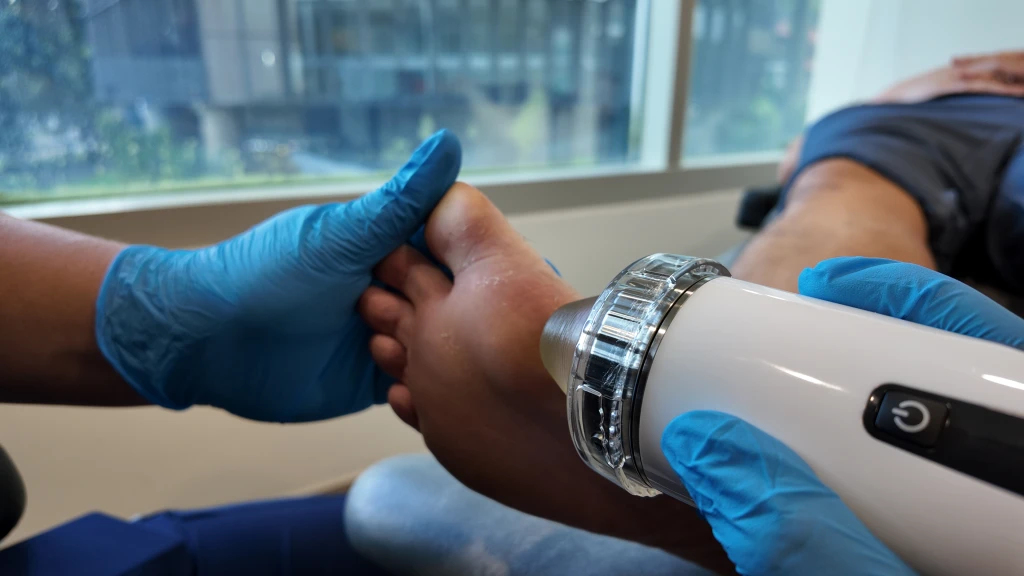
If you have had heel pain for 4 to 6 months and stretches, insoles, and rest are not getting you back to running, focused shockwave therapy is one of the most evidence-supported next steps. It is the treatment we use most often in clinic for chronic plantar fasciitis, insertional Achilles tendinopathy, and other stubborn tendon and bone conditions that have not responded to conservative care.
We have written this page so that by the time you finish, you will know whether focused extracorporeal shockwave therapy (ESWT) is the right next step for your condition, how it differs from the radial pressure wave therapy most clinics offer, what a session feels like, how many you will need, and what realistic improvement looks like.
What Is Focused Shockwave Therapy?
Focused extracorporeal shockwave therapy, or ESWT, is a non-invasive treatment that delivers high-amplitude acoustic sound waves through a focused applicator into a specific point of injured tissue. The waves travel from the applicator into the deeper layers of soft tissue and bone, converging at a focal point that can sit up to 12 cm (about 5 inches, deeper than the width of your hand) below the skin surface.
At that focal point, the energy of the waves creates a controlled microtrauma in the injured tissue. The body’s response to that controlled microtrauma is what produces the therapeutic effect. Blood flow to the area increases. Growth factors are released. The natural healing cascade that had stalled in a chronic injury is restarted. Over the following weeks, the tissue begins to remodel and repair.
The principle is called mechanotransduction. Mechanical pressure from the sound waves is converted into biochemical signals at the cell level. Those signals trigger the same healing cascade your body would mount for a fresh injury, but applied to tissue that had been stuck in a chronic state for months or years.
Focused ESWT is different from radial pressure wave therapy in three important ways. Focused ESWT generates higher peak energy. It penetrates deeper into the tissue. And it targets a precise focal point rather than dispersing energy across a broad area. Both have a role in podiatric practice, but they treat different problems and are not substitutes for each other.
Conditions Managed With Focused Shockwave Therapy
Focused ESWT has the strongest evidence and the longest clinical track record for the following conditions. These are also the conditions we use it for most frequently at Straits Podiatry.
Tendon conditions:
- Plantar fasciitis, particularly chronic cases that have not responded to 3 months of conservative care
- Achilles tendinopathy, both insertional and mid-portion
- Posterior tibial tendinopathy
- Jumper’s knee (patellar tendinopathy)
- Runner’s knee
Bone and bony attachment conditions:
- Heel spur with associated heel pain
- Sesamoiditis
- Shin splints
- Haglund’s deformity and the insertional Achilles changes that come with it
- Delayed bone healing in selected stress fracture cases, including some calcaneal stress fractures where the bone response has plateaued
Joint and soft tissue conditions:
- Plantar plate injury
- Knee osteoarthritis-related pain (selected cases)
Wounds and post-surgical:
- Diabetic foot ulcers that have stalled despite standard wound care
- Post-surgical wounds where healing has slowed
If your condition is not on this list, that does not necessarily mean ESWT will not help. It means we would assess the specific case and decide whether focused ESWT, radial pressure wave therapy, magnetotransduction therapy, or a combination is the right approach for you.
What to Expect During a Focused Shockwave Therapy Session
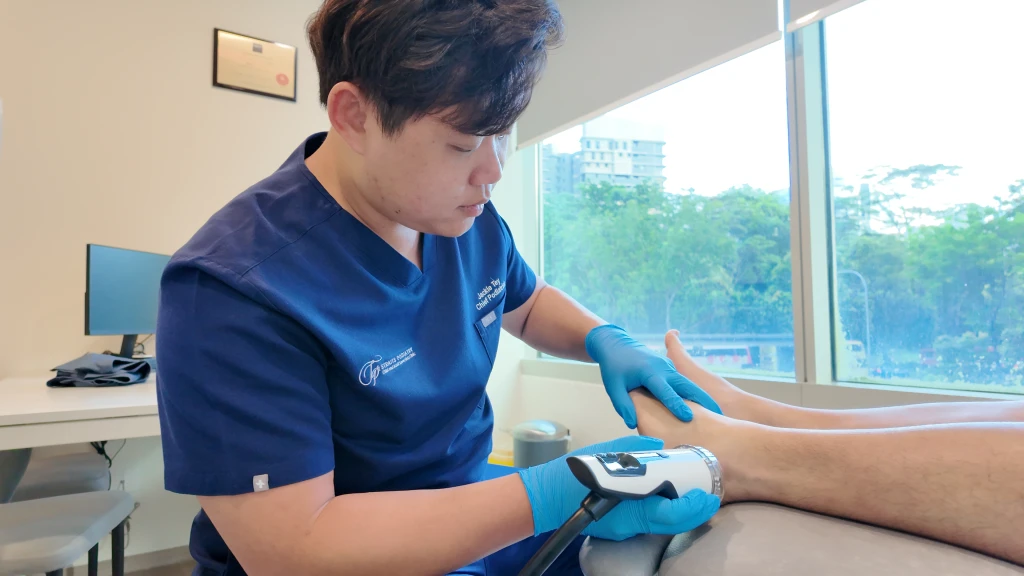
A standard session takes 15 to 20 minutes. After we locate the exact treatment area on examination, we apply ultrasound gel to your skin to help the sound waves transmit efficiently into the tissue. The applicator is then placed over the injured area and held in position while the focused waves are delivered.
You will feel a strong tapping pressure through the treatment area. Most patients describe it as a deep, drumming sensation rather than a sharp pain. We adjust the energy level based on your tolerance and we monitor your response throughout the session. Some discomfort during treatment is expected; if it is too much, we step the energy down. (Stepping the energy down too far reduces effectiveness, so there is a balance we discuss with you in real time.)
Immediately after the session, you may feel mild soreness, slight redness, or occasional small bruising at the treatment site. These usually settle within 24 to 48 hours. You can walk out of the clinic and continue your normal day. There is no recovery time off work or off everyday activities.
How Many Sessions Do I Need and When Will I Feel Better?
The standard protocol for most chronic tendon and bone conditions is 3 to 5 weekly sessions. Some conditions need up to 6 sessions, and bone-related cases sometimes need a longer course with periodic reassessment.
Most patients notice meaningful improvement around session 2 to 3. The full therapeutic effect continues to develop for 4 to 12 weeks after the final session, because the body’s healing response keeps progressing well after the treatment course has ended. The change you feel in week 6 is often more than the change you felt in week 2.
Realistic expectations matter. Focused ESWT is not an injection that masks pain. It is a stimulus that asks the body to heal. Improvement is gradual, and the trajectory continues to build well after the sessions are done. We tell patients to evaluate the result at 3 months from the end of the course, not at the end of the course itself.
Focused ESWT vs Radial Pressure Wave Therapy
If you have been told that “shockwave therapy did not work for you,” the most important question to ask is which type of shockwave you actually had.
In the Singapore market, many clinics offer only radial pressure wave therapy and market it under the umbrella term “shockwave therapy.” Radial pressure wave devices are simpler to acquire and operate, which is part of why they are more widely available. Focused ESWT requires a larger equipment investment, more space, and more specialised operator training to deliver well, which is why fewer clinics offer it.
The problem is that the two modalities are not the same. Radial pressure wave therapy is technically a pressure wave, not a true shockwave. It delivers lower peak energy, reaches a shallower depth, and disperses across a broader area rather than targeting a focal point. For superficial muscle work, trigger points, and sports recovery, it is the right tool. For chronic plantar fasciitis, insertional Achilles tendinopathy, deep tendon conditions, and bone-related cases, it is usually not enough on its own.
When a chronic heel or tendon condition gets treated with radial pressure wave therapy as if it were focused ESWT, the result is often a frustrated patient who has done 6 sessions and feels marginal improvement. The treatment failed because the modality did not match the condition, not because shockwave therapy does not work.
The practical comparison:
| Feature | Focused ESWT | Radial Pressure Wave |
|---|---|---|
| Type of energy | Focused acoustic shockwaves at high peak energy | Ballistic pressure waves at lower energy |
| Depth of effect | Up to 12 cm (about 5 inches) | Up to 5 cm (about 2 inches) |
| Area of treatment | Precise focal point | Dispersed across a broader area |
| Best for | Deep tendons, bone-related conditions, chronic tendinopathy, chronic plantar fasciitis, Achilles tendinopathy | Muscles, trigger points, superficial myofascial work, sports recovery between training cycles |
| Common pitfall in Singapore | Limited availability, fewer clinics offer it | Often applied to conditions that need focused ESWT instead |
Choosing the right modality for the condition is the decision that determines whether treatment actually works. For most chronic heel and tendon cases that come to us at Straits Podiatry, focused ESWT is the primary tool. Where additional depth or a different tissue stimulus is needed, we may combine focused ESWT with magnetotransduction therapy (EMTT) for cases that have plateaued.
When Is Focused Shockwave Therapy Not Suitable?
Focused ESWT should be avoided in the following situations:
- Pregnancy
- Active cancer at the treatment area (history of cancer requires clinical judgement)
- Bleeding disorders such as haemophilia or severe thalassaemia, and while on strong blood thinners (anticoagulation needs case-by-case assessment)
- Untreated acute infection at the treatment site
It is also not the right first-line treatment for very acute injuries (within the first 1 to 2 weeks of onset). Shockwave is most effective on chronic and subacute injuries where the body’s healing response needs to be restarted, rather than on fresh injuries that are still in their early inflammatory phase.
We go through a full screening before any course of shockwave to confirm that it is appropriate for your case.
Focused Shockwave Therapy at Straits Podiatry
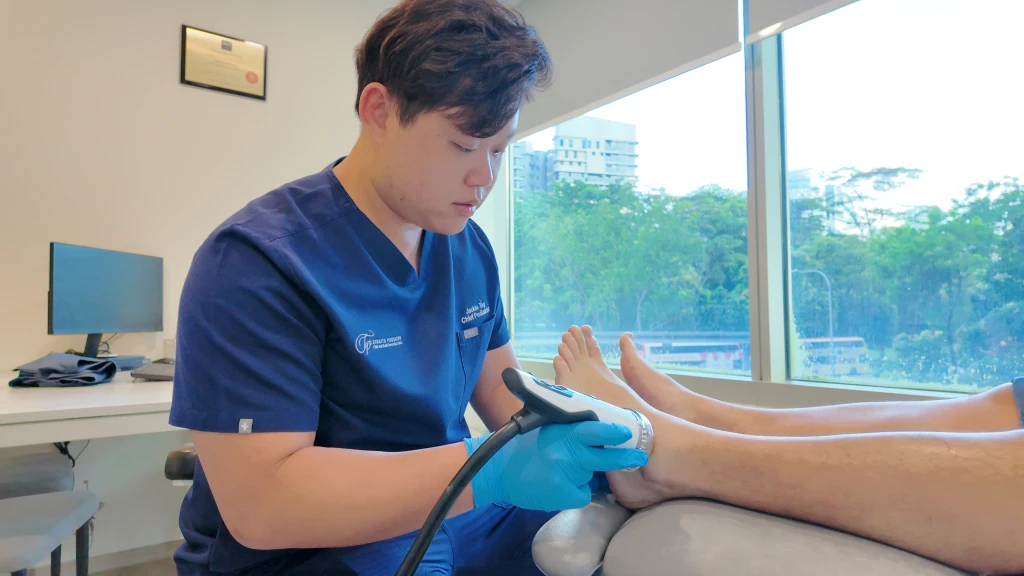
Straits Podiatry offers both focused ESWT and radial pressure wave therapy. Many Singapore clinics offer only the radial modality, which works well for the conditions it fits but cannot match focused ESWT’s depth or focal energy for chronic tendinopathies and bone-related conditions. Having both means we can match the modality to your condition rather than apply a single tool to every case.
Our podiatrists who deliver focused ESWT are certified by the International Society for Medical Shockwave Treatment (ISMST), the global standard for shockwave practice. ISMST certification means the practitioner has completed structured training and clinical case requirements in shockwave delivery. We make a point of mentioning this because it is the most reliable way to identify a shockwave provider whose training extends beyond the device manufacturer’s basic operator course.
The assessment before treatment includes confirming the diagnosis, identifying the specific tissue target, reviewing your previous treatment history, and discussing whether focused ESWT alone or combined with magnetotransduction therapy fits your case.
Focused shockwave therapy is available at all 3 of our Singapore locations: Buona Vista (serving West Singapore), Orchard (serving Central Singapore), and Paya Lebar Square (serving East Singapore). For session pricing, please refer to our prices page.
If you have chronic heel pain or a tendon condition that has not responded to 3 months of conservative care, book a consultation to discuss whether shockwave therapy is the right next step.
Frequently Asked Questions About Focused Shockwave Therapy
Is focused shockwave therapy painful?
You will feel a strong tapping pressure through the treatment area during the session. Most patients describe it as uncomfortable but bearable. We adjust the energy level based on your tolerance and monitor your response throughout. Some mild soreness at the treatment site for 24 to 48 hours after the session is normal and is part of the healing response, not a complication.
How is focused ESWT different from radial pressure wave therapy?
Focused ESWT delivers higher-energy acoustic waves to a precise focal point up to 12 cm deep. It is the appropriate modality for deep tendons, bone-related conditions, and chronic tendinopathies. Radial pressure wave therapy delivers lower-energy pressure pulses across a broader, shallower area up to 5 cm deep, and is more appropriate for superficial muscle problems and trigger points. Most clinics in Singapore offer only radial pressure wave therapy because the device is simpler to acquire and operate. Focused ESWT is the more capable modality for the conditions it is indicated for.
How soon after a session can I return to running or sport?
You can walk and continue daily activities immediately after a session. For running and sport, the standard advice is to reduce intensity for 48 hours after each session and avoid heavily loading the treated area during that window. Beyond that, return to sport is guided by your symptoms and the structured rehabilitation plan we build alongside the shockwave course.
How long does it take to see results from focused shockwave therapy?
Most patients notice meaningful improvement around session 2 to 3 of the course. The full therapeutic effect continues to build for 4 to 12 weeks after the final session, because the underlying healing response keeps progressing. We tell patients to evaluate the overall result at 3 months from the end of the course, not at the end of the course itself.
Who should not have focused shockwave therapy?
Focused ESWT is not appropriate for everyone. The standard contraindications are pregnancy (the focused acoustic wave should not be delivered over the pelvis or abdomen), active malignancy in the treatment area, an active infection at the treatment site, recent corticosteroid injection at the treatment site within the prior six to eight weeks, bleeding disorders or anticoagulant therapy where the bleeding risk is elevated, and the presence of cardiac pacemakers or implanted electronic devices if the treatment area is close to the device. Skeletally immature patients (open growth plates near the treatment area) are usually deferred or treated with a modified protocol, since the long-term effects of focused acoustic waves on growth plates are not yet fully established. Acute soft tissue injuries within the first few weeks are also generally not the right time for ESWT; the modality is better suited to chronic tendinopathies and bone-related conditions that have not responded to a structured period of conservative care. A clinical assessment before the first session screens for these factors and confirms that focused shockwave is the appropriate option for your condition.