
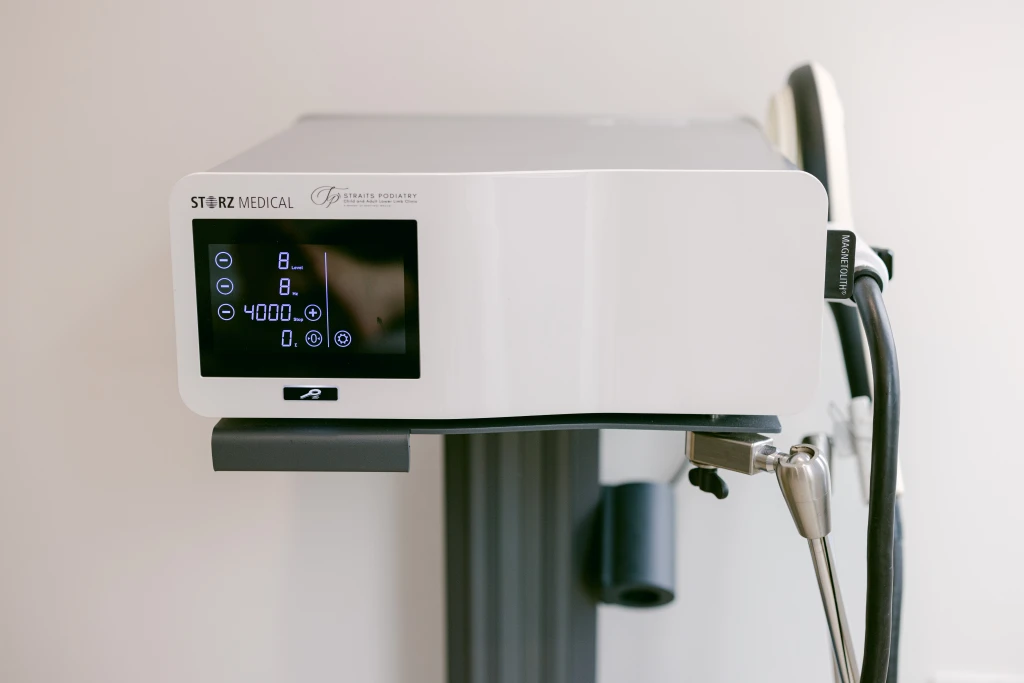
If you have a chronic tendon injury that has not responded to focused shockwave therapy alone, a delayed bone healing case where the body needs more stimulus, or a deep musculoskeletal pain pattern that other modalities cannot reach, magnetotransduction therapy is one of the most useful additions to the Straits Podiatry treatment toolkit.
This page explains what magnetotransduction therapy is, how it differs from shockwave therapy, which conditions it is suited for, and what to expect from a course.
What Is Magnetotransduction Therapy?
Magnetotransduction therapy, also called extracorporeal magnetotransduction therapy or EMTT, is a non-invasive treatment that uses high-frequency pulsed electromagnetic fields delivered through a treatment coil over the affected area. The electromagnetic field penetrates up to about 18 cm (about 7 inches deep into the body), reaching tissue depths that acoustic shockwave therapy cannot.
EMTT is an advanced form of pulsed electromagnetic field (PEMF) therapy. The difference is energy level: EMTT delivers significantly higher peak field strength than older PEMF devices, allowing for shorter treatment times and clinically meaningful effects on deeper tissue. The same principle is at play, but the dose makes the difference.
The principle of action is at the cellular level. The pulsed electromagnetic field changes the way ions move across cell membranes. That altered ion movement triggers a cascade of biological responses including:
- Regulation of inflammation pathways
- Increased cellular regeneration and proliferation
- Improved bone matrix mineralisation in healing fractures
- Acceleration of tissue repair processes
In practical terms, EMTT helps the body’s healing response in conditions where the natural process has slowed or stopped. It is particularly useful for bone-related cases and for deep tendinopathy where focused shockwave therapy may not reach with full effect.
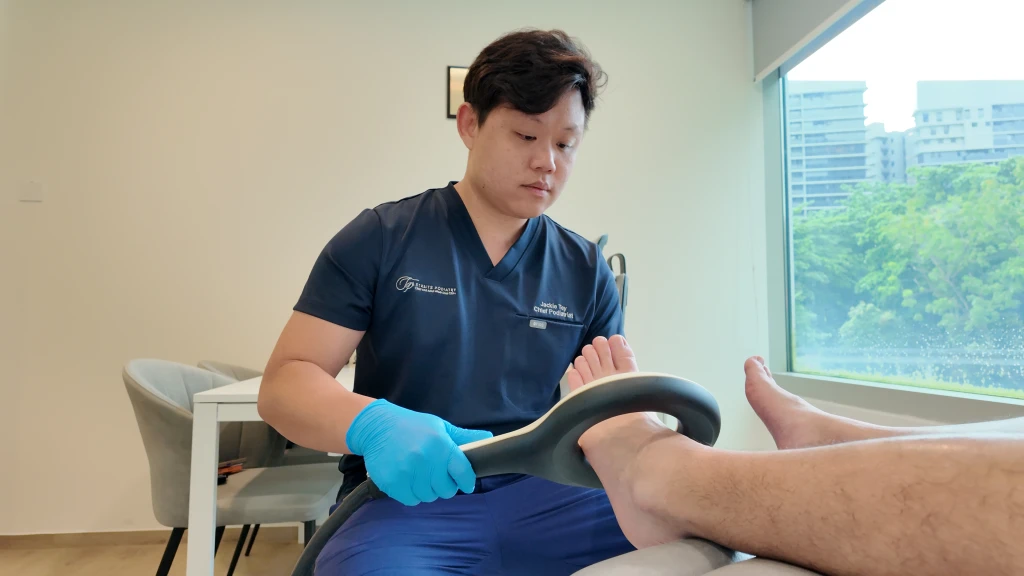
Conditions Managed With Magnetotransduction Therapy
EMTT has the strongest evidence and clinical use for the following.
Bone-related conditions:
- Delayed bone healing in selected calcaneal stress fracture cases and other lower limb stress fractures
- Post-surgical bone healing where the response has slowed
- Osteoarthritis-related joint pain in the knee, ankle, and foot
Deep tendon and joint conditions:
- Achilles tendinopathy, often used in combination with focused ESWT for additional depth
- Posterior tibial tendinopathy
- Plantar fasciitis cases that have not responded fully to a course of focused shockwave alone
- Chronic ankle and foot pain related to degenerative joint changes
- Haglund’s deformity with associated chronic insertional tendon irritation
Chronic pain conditions:
- Chronic lower back pain
- Sciatica and nerve-related pain in the lower limb
- Neuralgia
A common use case at Straits Podiatry is combination therapy. Patients with chronic tendinopathy or bone healing issues who have completed a course of focused ESWT often add EMTT for additional depth and a different stimulus mechanism. The two modalities work through different biological pathways (mechanotransduction versus electromagnetic field-mediated cellular response), which makes them complementary rather than redundant.
What to Expect During an EMTT Session
A session takes about 15 to 20 minutes. We position the treatment coil over the affected area; you generally do not need to remove clothing if the area is accessible through normal clothing. Metallic accessories such as jewellery, watches, and belts with metal buckles need to come off, and the treatment area should be free of metal implants.
You will not feel the electromagnetic field. Unlike shockwave therapy, there is no tapping sensation, no pressure, and no audible noise from the applicator. Most patients describe the session as comfortable, with no significant discomfort during treatment. Some warmth in the treated area is occasionally reported but is mild.
After the session, you can resume normal activities immediately. There is no soreness, no recovery period, and no restriction on training or work. This easy integration into a patient’s schedule is one of the practical advantages of EMTT over more sensation-heavy modalities.
How Many Sessions Do I Need?
The standard protocol is 4 to 8 sessions, typically delivered twice a week initially and then weekly. Bone healing protocols may extend longer (8 to 12 sessions) depending on the case and the reassessment findings along the way.
Improvement is gradual. Most patients notice meaningful change by session 4 to 6, with continued progression for several weeks after the final session as the underlying tissue healing develops. As with focused shockwave therapy, the result at 3 months from the end of the course is typically more than the result at the end of the course itself.
EMTT vs Focused Shockwave Therapy
EMTT and focused shockwave therapy are not substitutes. They work through fundamentally different mechanisms and are best understood as complementary tools.
Focused shockwave therapy delivers focused acoustic energy at a precise focal point in the tissue. The mechanical pressure of those waves triggers a localised healing cascade through mechanotransduction. EMTT delivers a high-frequency pulsed electromagnetic field across a broader treatment area. The electromagnetic field changes the way ions move across cell membranes, triggering a different set of biological responses including improved bone matrix mineralisation and modulation of inflammation pathways.
In practical terms, focused ESWT is the primary tool for most chronic plantar fasciitis and tendinopathy cases. EMTT comes in when the case has plateaued on shockwave alone, when bone healing needs an additional stimulus, or when the target tissue sits deeper than focused ESWT can reach with full effect. Combining the two is common in our clinic for complex chronic cases.
The practical comparison:
| Feature | EMTT | Focused Shockwave (ESWT) |
|---|---|---|
| Type of energy | High-frequency pulsed electromagnetic field | Focused acoustic shockwaves at high peak energy |
| Sensation during treatment | None during treatment; occasional mild warmth | Strong tapping pressure |
| Depth of effect | Up to 18 cm (about 7 inches) | Up to 12 cm (about 5 inches) |
| Best for | Bone healing, deep tendinopathy, chronic cases that have plateaued on shockwave | Chronic plantar fasciitis, Achilles tendinopathy, deep tendons, chronic tendinopathy |
| Typical pairing | Often combined with focused ESWT for added depth and different stimulus | Primary modality for most chronic heel and tendon cases |
A separate modality, radial pressure wave therapy, is sometimes grouped with these but is technically a pressure wave at lower energy and shallower depth. It is the appropriate tool for muscle, trigger point, and superficial work, and not for the deeper tendon or bone conditions that EMTT and focused ESWT are designed for.
When Is EMTT Not Suitable?
EMTT should be avoided in:
- Pregnancy
- Patients with pacemakers, defibrillators, cochlear implants, or other active electronic medical devices
- Patients with metal implants that are not MRI-conditional within or close to the treatment area
- Active cancer at the treatment area
Hearing aids and other portable electronic devices need to be removed before treatment but can be worn immediately after.
We go through a full safety checklist with you before starting treatment to confirm that EMTT is appropriate for your case.
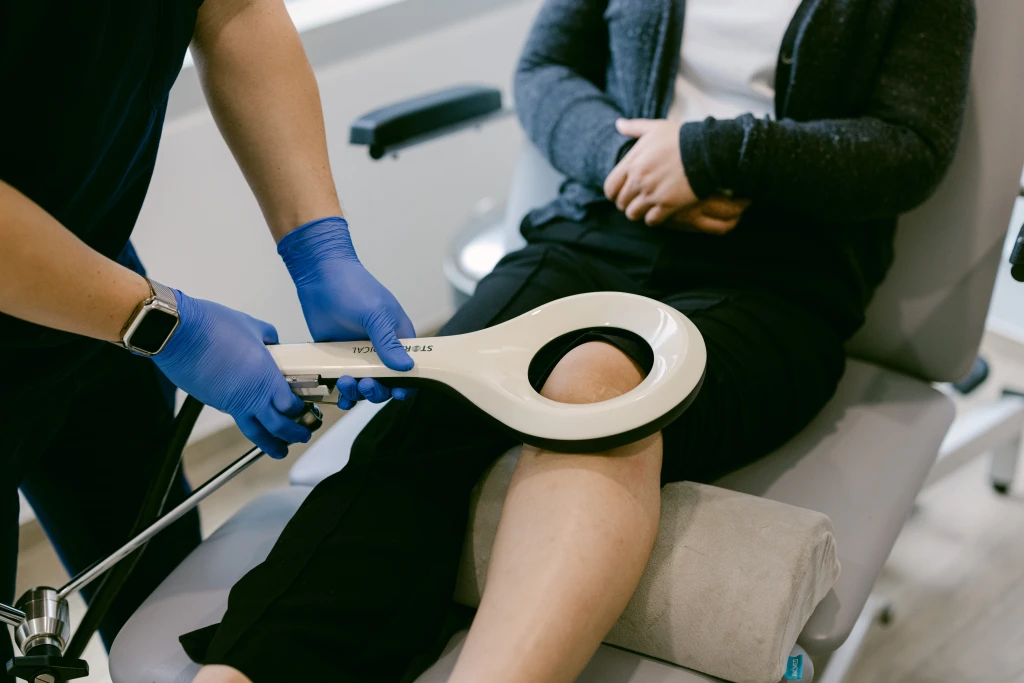
Magnetotransduction Therapy at Straits Podiatry
Straits Podiatry was one of the early adopters of EMTT in Singapore podiatry. We use it both as a standalone treatment for cases where its mechanism is the right match, and in combination with focused shockwave therapy (ESWT) and radial pressure wave therapy for complex chronic cases that need a multi-modal approach.
Our clinical approach is built around matching the modality to the condition. EMTT is not the right tool for every patient. Where the case fits, it is one of the most useful additions to a treatment plan, particularly in bone healing and in tendinopathy that has not responded fully to shockwave alone.
Treatment is available at all 3 of our Singapore locations: Buona Vista (serving West Singapore), Orchard (serving Central Singapore), and Paya Lebar Square (serving East Singapore). For session pricing, please refer to our prices page.
If you have a chronic musculoskeletal condition that has not responded to conventional treatment (including shockwave therapy), book a consultation to discuss whether EMTT may help.
Frequently Asked Questions About EMTT
How long does an EMTT session take?
A typical session is 15 to 20 minutes. You can return to normal activities immediately afterward, with no recovery period required.
Is EMTT painful?
No. Unlike shockwave therapy, EMTT does not produce any tapping or pressure sensation. Most patients feel nothing during treatment. Some report a mild warmth in the treated area, which is normal and not a complication.
How many EMTT sessions will I need?
Most conditions require 4 to 8 sessions, delivered twice a week initially and then weekly. Bone healing cases may need 8 to 12 sessions depending on the response. Your exact treatment plan is built during the initial assessment based on the specific condition and its stage.
Is EMTT the same as PEMF therapy?
EMTT is an advanced form of pulsed electromagnetic field (PEMF) therapy. Both use electromagnetic fields, but EMTT delivers significantly higher peak field strength than traditional PEMF devices. The higher energy allows for shorter treatment times and clinically meaningful effects on deeper tissue. They are related but not interchangeable: most PEMF devices marketed for home use cannot match the energy levels of clinical EMTT.
Can EMTT and shockwave therapy be combined?
Yes. Combining EMTT with focused ESWT is a common protocol at Straits Podiatry for chronic tendinopathy and bone-related cases. The two modalities work through different biological pathways, so combining them adds different stimulus rather than duplicating effort. The combined approach is particularly useful for patients whose chronic tendon or bone condition has plateaued on shockwave alone.
When is EMTT not suitable?
EMTT is not suitable during pregnancy, in patients with pacemakers or other active electronic medical implants, or where there is non-MRI-conditional metal in the treatment area. We go through the full safety checklist with you before starting any course.
How soon will I feel improvement from EMTT?
Improvement is gradual. Most patients notice meaningful change by session 4 to 6 of the course. The underlying healing response continues to develop for several weeks after the final session, so the result at 3 months from the end of the course is typically more than the result at the end of the course itself.