
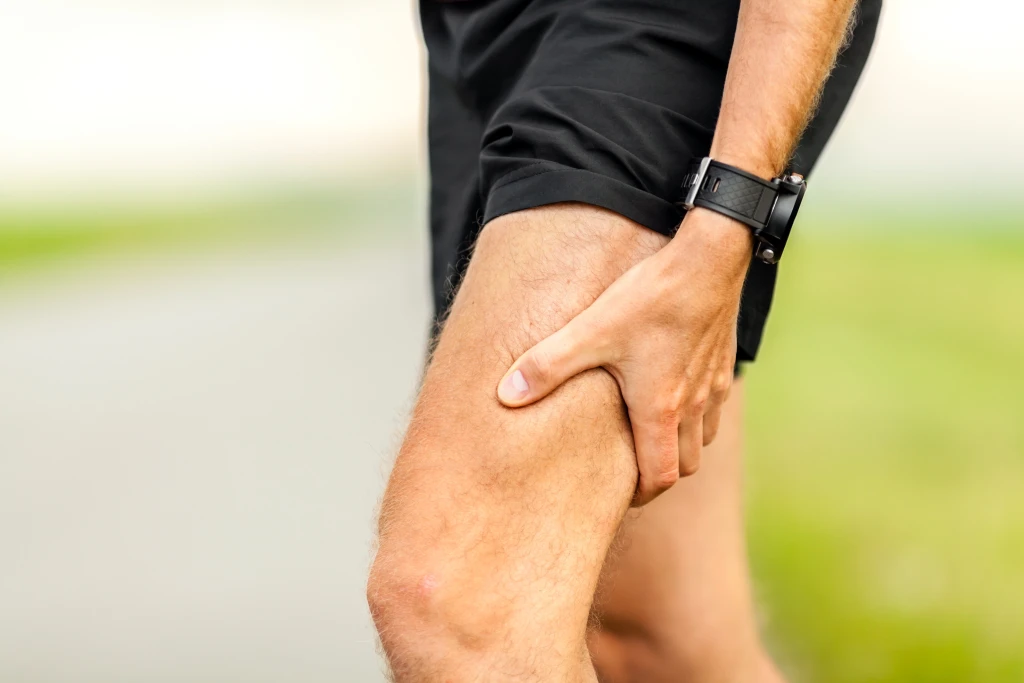
You go to sprint, kick, or accelerate, and a sudden sharp pain grabs the back of your thigh, often with a pulling or popping sensation that stops you in your tracks. Most people can pinpoint the exact moment it happened and find they simply cannot keep running. This is a hamstring strain, an injury to the muscles at the back of the thigh, and it is one of the most common injuries among footballers, sprinters, and recreational sport players in Singapore.
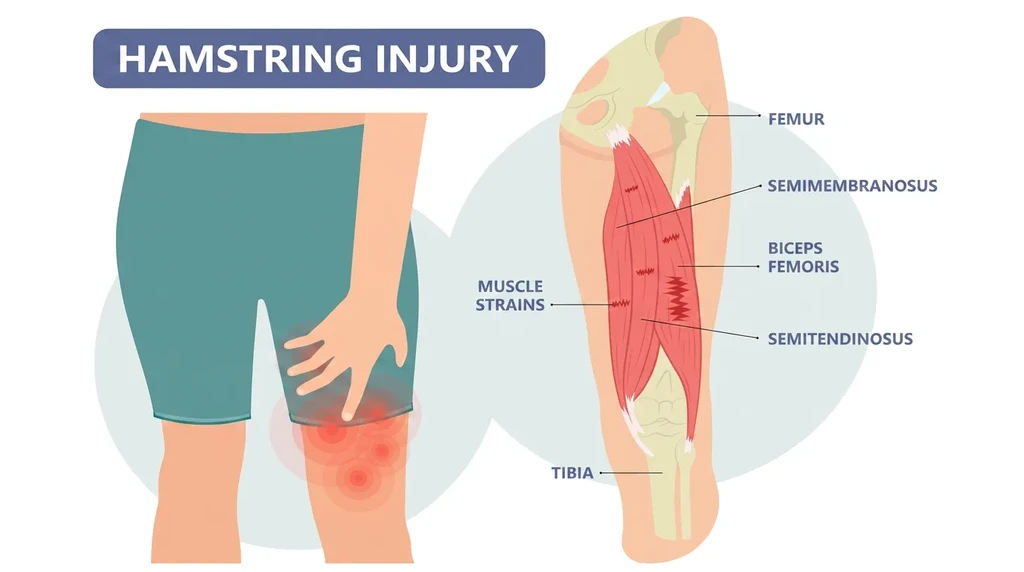
The hamstrings, made up of biceps femoris, semitendinosus, and semimembranosus, work hard across both the hip and knee, which is why they are vulnerable to sudden overload. Like a calf strain, the strain itself is rarely the long-term issue. The bigger problem is recurrence. Hamstring strains have one of the highest re-injury rates of any sports muscle injury, often because rehabilitation stops the moment the pain settles rather than when the muscle is genuinely ready to return. It also sits within the broader picture of posterior leg pain alongside calf, knee, and referred causes.
Symptoms of Hamstring Strain
- Sudden sharp pain at the back of the thigh during a sprint, kick, or lunge.
- Tenderness on direct pressure over the back of the thigh.
- Swelling and, in moderate to severe cases, visible bruising tracking down toward the knee.
- Difficulty fully straightening the knee.
- Pain when running, jumping, or accelerating.
- In severe cases, a palpable gap or defect in the muscle.
Types of Hamstring Strain
Hamstring strains are graded by how much of the muscle is torn.
Grade 1 (mild)
This involves a small number of torn fibres. The patient can usually walk but cannot run or sprint without pain.
Grade 2 (moderate)
This is a partial tear of the muscle, with acute pain, swelling, and a clear effect on walking.
Grade 3 (severe)
This is a major tear or complete rupture, with loss of strength and function and often a visible defect or significant bruising.
Strains can occur in the muscle belly, at the musculotendinous junction, or at the tendon attachment near the sit bone.
Causes of Hamstring Strain
What Causes Hamstring Strain?
Hamstring strains usually happen during high-speed running or kicking, when the muscle is being lengthened while simultaneously contracting hard. The mismatch between load and capacity causes fibres to tear. Common drivers include inadequate warm-up, sudden increases in training volume or sprint exposure, fatigue late in a match or session, tight or weak hamstrings relative to the quadriceps, and weak hip and core control. Underlying biomechanical factors such as a leg length discrepancy or asymmetric pelvic mechanics can also load one hamstring harder than the other.
Who Carries a Higher Baseline Risk?
- Footballers, basketball players, and sprinters.
- Older athletes (re-injury risk rises significantly with age).
- People with a history of previous hamstring or calf injuries.
- Athletes returning to high-intensity sport after a layoff.
- Those with hamstring or hip flexor tightness, or muscular imbalance.
- People with weak core stability or poor pelvic control.
Conditions Commonly Mistaken for Hamstring Strain
Posterior thigh pain is not always a hamstring strain. A few other problems can produce similar pain, and the clue is usually in how the pain started and whether it stays in the thigh. Pain that comes on without a clear sprinting event, or pain that radiates beyond the thigh, deserves a careful clinical assessment.
Referred pain from the lower back or sciatic nerve
Pain from the lower back or an irritated sciatic nerve can be felt in the back of the thigh even though the source sits higher up. It often comes on without a clear sprinting or kicking moment, may radiate below the thigh into the calf or foot, and can carry tingling or numbness. A hamstring strain, by contrast, usually has a distinct moment of injury during a sprint or kick and stays localised to the muscle.
Proximal hamstring tendinopathy
Proximal hamstring tendinopathy is a gradual-onset overuse condition affecting the tendon where the hamstring attaches near the sit bone. The pain builds over weeks rather than striking suddenly, and it is typically felt deep in the buttock or at the base of the thigh, often worse with prolonged sitting or repeated loading. This slow, activity-related pattern separates it from the sudden mid-muscle tear of an acute hamstring strain.
High hamstring avulsion injury
A high hamstring avulsion is a more severe injury in which the tendon pulls away from its bony attachment at the sit bone, sometimes taking a small fragment of bone with it. It often follows a forceful stretch of the loaded muscle and can produce significant bruising, weakness, and difficulty sitting or walking. Because the tissue disruption is greater than a standard strain, it sometimes needs orthopaedic review and imaging to guide the plan.
Treating and Preventing Hamstring Strain
Treatment focuses on settling acute injury, restoring strength and length, and managing the high recurrence risk through a structured return to running.
Conservative treatment
-
Acute-phase care and swelling control. In the first 48 to 72 hours, rest, ice, compression, and elevation help control swelling. Avoid aggressive stretching during the early phase, as this can worsen the tear. As the pain settles, gentle range-of-motion work can be introduced.
-
Physiotherapy and eccentric training. As the pain eases, structured physiotherapy progresses through controlled range-of-motion work, eccentric strengthening (the Nordic hamstring exercise is well evidenced for both treatment and prevention), and graded running and sprint exposure. Rehabilitation needs to continue until the muscle can genuinely handle sport-specific demands, rather than stopping the moment the pain settles.
-
Focused shockwave and radial pressure wave therapy. Extracorporeal shockwave therapy can support healing in stubborn or chronic cases by stimulating blood flow and the natural repair response, helping recovery move to the next stage. Radial pressure wave therapy can release tight surrounding tissue and improve flexibility.
-
Custom orthotics. Where foot mechanics or asymmetric loading is part of the picture, custom orthotics may help balance the load across the lower limb and reduce the tendency for one hamstring to keep taking too much.
-
Long-term prevention and eccentric strength programme. Prevention is largely about training. Build eccentric hamstring strength regularly (Nordic hamstring exercises, Romanian deadlifts), warm up properly before sport, increase sprint exposure gradually, and address hip and core stability. For people returning from injury, completing the full rehab phase before sport is the single most important step in reducing recurrence.
When conservative treatment is not enough
Grade 3 complete ruptures and high hamstring avulsions sometimes need orthopaedic assessment to consider whether surgery is required. Where this pathway applies, referral to an orthopaedic specialist who handles sports-injury surgery is appropriate. After surgery, a structured rehabilitation programme then rebuilds strength, flexibility, and sporting ability in stages.

Have Your Hamstring Strain Managed at Straits Podiatry
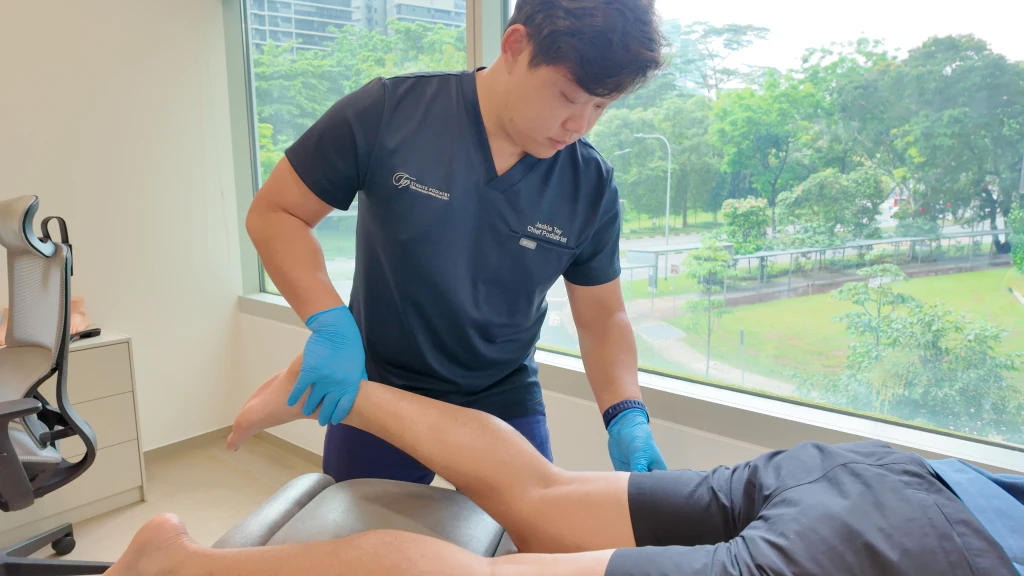
Straits Podiatry assesses hamstring strains with a structured musculoskeletal exam and gait analysis to identify the injury and the loading patterns that contributed. Your plan may include focused shockwave or radial pressure wave therapy for stubborn cases, custom orthotics where foot mechanics or leg-length asymmetry is loading the hamstring abnormally, and a progressive rehabilitation programme with our physiotherapist.
Speak with Straits Podiatry or book a consultation for an assessment and a tailored approach to manage your hamstring strain.
Frequently Asked Questions About Hamstring Strain
How long does a hamstring strain take to heal?
Recovery depends on the grade. Mild Grade 1 strains often settle within two to three weeks. Grade 2 strains typically take four to eight weeks, and severe Grade 3 strains can take three months or longer, with surgical cases extending further. The pain usually settles before the muscle is genuinely ready to return to full sprinting, which is why rehab timelines and pain timelines often disagree.
Can I keep training with a hamstring strain?
Continuing to sprint or kick on a hamstring strain usually makes the tear worse and significantly raises the risk of converting a Grade 1 strain into a Grade 2 or 3 injury. Most athletes benefit from a short period of reduced loading followed by graded rehab. Low-impact cross-training such as cycling or swimming is often tolerated and helps maintain fitness during recovery.
Why does my hamstring keep getting injured?
Hamstring strains have one of the highest recurrence rates in sport, typically because rehabilitation ends when the pain settles rather than when the muscle is genuinely ready. Insufficient eccentric strength, incomplete sprint exposure during rehab, and underlying issues such as hip mobility or pelvic asymmetry are common contributors. A structured prevention programme including Nordic hamstring exercises significantly reduces recurrence risk.
When should I see a podiatrist or doctor about a hamstring strain?
See a clinician if you cannot walk normally after the injury, if there is significant bruising or visible deformity, if pain is severe, or if symptoms have not meaningfully improved after two weeks of self-management. Repeated injuries, pain that radiates into the buttock or down the leg, or pain that started without a clear sprinting event also warrant assessment to rule out other causes.
Do orthotics help with hamstring strain?
Orthotics do not directly heal a hamstring strain, but they can help in specific cases. If foot mechanics, overpronation, or a leg-length difference is loading one hamstring harder than the other, correcting that pattern can reduce the recurrent strain on the injured muscle and lower the chance of re-injury. They work best when combined with structured rehab rather than used in isolation.