

One awkward turn is all it takes for an ankle sprain to happen. You might be stepping off a curb when walking down the street or turning too quickly on the football pitch when the ankle suddenly rolls and pain ensues. The joint can then feel tender, swollen, and unstable, as though it can no longer support movement with the same confidence.
This sense of instability comes from injury to the ligaments that support the ankle joint. When the ankle rolls or twists beyond what it can safely manage, these structures can become overstretched or torn, so what seems like a simple misstep can involve more damage than expected. That is also why an acute ankle sprain should not be brushed off as something that will settle on its own after a short rest: even though it happened in a moment, its effects can continue to dictate how confidently and comfortably you move afterwards, and the symptoms are often the first real sign of how much the sprain is disrupting normal ankle function.
Symptoms of Acute Ankle Sprains
The symptoms of an acute ankle sprain can vary from one injury to another. While some are immediately obvious, others only become clearer after swelling progresses or once the ankle is tested during walking, turning, or weight bearing. Signs to look out for include:
- A pop or snap at the moment the ankle twists.
- Pain around the ankle, especially with weight bearing.
- Swelling that develops around the ankle joint.
- Tenderness when the injured area is touched.
- Bruising that appears around the ankle afterwards.
- Reduced movement when the ankle is bent or turned.
- A sense of weakness or instability when walking.
Types and Grades of Ankle Sprains
Ankle sprains can differ not only in where the injury happens, but also in how severe the ligament damage is. While this page focuses on low ankle sprains, it still helps to first understand the main types of ankle sprains before looking more closely at how low ankle sprains are graded.
Types of Ankle Sprains
When most people think of a sprained ankle, they’re usually thinking of an injury on the outer side of the joint. That’s the most common pattern, but ankle sprains can also affect the inner side of the ankle or the ligaments higher up above the joint.
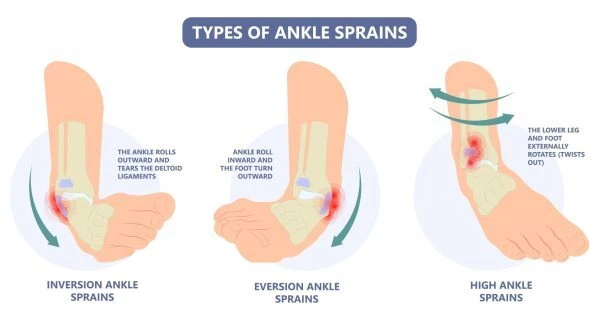
- Inversion ankle sprain: This is the most common type of low ankle sprain. It happens when the ankle rolls outwards and usually injures the lateral ankle ligament complex on the outer side of the ankle.
- Eversion ankle sprain: This is a less common type of low ankle sprain. It happens when the ankle rolls inwards and usually injures the deltoid ligament complex on the inner side of the ankle.
- High ankle sprain: This is a more serious type of ankle sprain that usually happens during collision or high impact sport. It occurs when the ankle is forced upwards and rotated, injuring the ligaments that stabilise our shinbones (tibia and fibula).
Ankle Sprain Grades
Low ankle sprains are also graded by severity, based on how much the ligament has been strained or torn. Greater ligament damage tends to mean more swelling, less stability, and more difficulty using the ankle normally.
- Grade 1: The ligament is stretched or slightly torn. Swelling, tenderness, and stiffness are usually mild, and the ankle still feels largely stable. Walking is often possible, although movement might feel cautious or uncomfortable.
- Grade 2: The ligament is partially torn. Swelling and bruising become more noticeable, and the ankle might feel less secure during walking or turning. Weight bearing is often still possible, but everyday movement is usually more painful.
- Grade 3: The ligament is completely torn. Swelling and bruising are more significant, and the ankle often feels unstable or unable to support weight properly. Walking can become difficult because the joint might give way.
Causes of Acute Ankle Sprains
Once the symptoms and severity of an ankle sprain become clearer, the next question is usually how the injury happened in the first place. In many cases, the answer lies in a sudden movement that rolls or twists the ankle beyond what it can control. At the same time, some people carry a higher baseline risk because of the demands placed on the ankle, the surfaces they move on, the footwear they use, or a history of ankle injury.
What Causes Acute Ankle Sprains
- An awkward step or misstep that causes the ankle to twist suddenly.
- A poor landing after a jump, pivot, or sudden change in direction.
- Walking or running on uneven ground that throws the foot off balance.
- A fall that forces the ankle into an abnormal position under body weight.
- Direct contact that knocks the foot or ankle out of place during movement.
- Fast cutting, turning, or side to side movements that overload ankle control.
Who Carries a Higher Baseline Risk?
- Those with a previous ankle sprain or earlier ankle injury, as the joint might be more vulnerable to rolling again. A systematic review found strong evidence that a previous sprain raises the risk of another.
- People with reduced ankle strength, balance, or flexibility, which can make the ankle harder to control during movement.
- Athletes in sports that involve jumping, pivoting, or sudden direction changes, as these place more stress on the ankle.
- Constant exposure to uneven or unstable ground, as this can make the loss of one’s footing more likely.
- Wearers of poorly fitting shoes or footwear with weak support and grip, which can reduce ankle stability.
- Ladies who frequently wear high heeled shoes, as this type of footwear can place the ankle in a less stable position.

Treating and Preventing Acute Ankle Sprains
Care for an acute ankle sprain is sequenced around the ligament’s healing timeline: settle the injury first, then rebuild the strength, balance, and control that keep the joint stable afterwards. Conservative care is enough for most sprains, and recovery tends to follow the severity of the ligament damage and how stable the ankle feels as loading returns. Rushing back onto an ankle that has not regained its control is the most common reason a sprain lingers or recurs, so the early protection and the later rehabilitation matter equally.
Conservative treatment
Most acute ankle sprains respond to a staged conservative approach that protects the ligaments early, then progressively restores function.
- Activity modification and load management: Reducing or pausing the activities that keep aggravating the ankle, especially running, jumping, or repeated loading through the foot and ankle, gives the injured ligaments the settled environment they need to begin healing.
- RICE for early pain and swelling: In the first few days, the RICE method at home (rest, ice, compression, and elevation) helps manage pain and swelling while the acute inflammation settles.
- Bracing or a supportive boot: An ankle brace supports the joint while the ligaments settle, and in more significant sprains a supportive boot may be used to limit movement through the early phase. For severe ligament damage, an ankle-foot orthosis (AFO) can provide firmer control while the ankle heals.
- Crutches for offloading: Where putting weight through the ankle is too painful, crutches are used for a period to offload the joint until weight bearing becomes more comfortable.
- Anti-inflammatory medication: Anti-inflammatory medication such as non-steroidal anti-inflammatory drugs (NSAIDs), taken only on medical advice, can help relieve pain and swelling in the early stage.
- Rehabilitation and physiotherapy: As recovery progresses, physiotherapy rebuilds strength, flexibility, balance, and control, which is the part of recovery that restores confidence in the joint and reduces the risk of recurrence. The plan reflects the severity of the sprain and how stable the ankle feels as loading returns.
- Custom orthotics for ankle stability: After a sprain, custom orthotics can help support the foot and improve ankle stability as loading returns, particularly where foot posture or alignment leaves the joint more prone to rolling again.
- Focused shockwave therapy and EMTT: Where a sprain is slow to settle or associated tendon or soft-tissue irritation lingers, regenerative therapies such as focused shockwave therapy (ESWT) and extracorporeal magnetotransduction therapy (EMTT) can help stimulate the body’s natural healing response.
When conservative care isn’t enough
When an ankle sprain keeps returning, does not improve as expected, or continues to affect walking and balance, it is worth having the injury assessed properly. A more tailored plan might be needed to support healing, restore confidence in the joint, and reduce the risk of longer-term instability. Persistent instability despite structured rehabilitation, or a suspected complete (Grade 3) ligament tear that is not stabilising, is the point at which further imaging and an orthopaedic opinion are considered.
Preventing Acute Ankle Sprains
Reducing the risk of another sprain comes down to the habits around the ankle:
- Build activity levels up gradually rather than spiking intensity.
- Allow proper recovery between sessions.
- Warm up the feet and ankles before faster or higher impact movement.
- Wear supportive footwear with added ankle support where advised for higher risk activity.
- Take care on uneven or unstable ground.
- Keep up the strength, balance, and control exercises, especially after an earlier sprain.

Have Your Acute Ankle Sprain Managed at Straits Podiatry
An acute ankle sprain can be easy to brush aside at first, especially when the pain feels manageable after some rest. Still, swelling, instability, or difficulty with weight bearing can point to a sprain that needs more careful assessment. At Straits Podiatry, we will first assess how the ankle was injured, how stable the joint feels, and how much the sprain is affecting your movement.
This matters because not every ankle sprain recovers in the same way, and some can remain vulnerable if they’re not managed properly early on. Proper care should therefore focus not only on settling the current injury, but also on helping the ankle regain stability and control as it recovers. Speak with our team or book a consultation for an assessment and a tailored approach to manage your acute ankle sprain.
Frequently Asked Questions About Acute Ankle Sprains
How can I tell if my ankle is sprained or fractured?
It can be difficult to tell on your own, because both a sprain and a fracture can cause pain, swelling, bruising, and difficulty walking soon after the injury. In general, a sprain affects the ligaments, while a fracture means there is a break in the bone. A fracture becomes more concerning when the pain is more severe, the ankle looks misshapen, or you’re completely unable to bear weight. Even so, the only reliable way to confirm the difference is through proper clinical assessment and imaging where needed.
Is it safe to walk while the ankle is still healing?
Sometimes, but it depends on how severe the sprain is. With a mild sprain, careful walking might still be possible, especially if the ankle can take weight without sharp pain or a strong sensation of giving way. With a more significant sprain, walking too soon can place more stress on the injured ligaments and make the ankle harder to settle. If weight bearing is very painful or the ankle feels unstable, it’s better to limit walking and have the injury assessed by a podiatrist.
How long does a sprained ankle usually take to heal?
This would depend on how much the ligaments have been strained or torn. A mild sprain often settles within a couple of weeks, while a more significant sprain can take several weeks or longer to recover fully. Healing also depends on how well the ankle is managed in the early stages and whether there’s a gradual introduction back into activity. Full recovery also means the ankle is regaining movement, strength, and stability.
What would happen if an ankle sprain is left untreated?
If an acute ankle sprain is left untreated, the ligaments might not heal as well as they should. This can leave the ankle feeling weak, unstable, or more likely to roll again during walking or sport. Over time, repeated injuries can develop into chronic ankle sprains or longer-term ankle instability, especially when the joint keeps giving way. This is why proper assessment and rehabilitation matter, particularly when symptoms aren’t settling as expected.
What’s the difference between an inversion and eversion ankle sprain?
The difference lies in the direction the ankle rolls and which ligaments are injured as a result. An inversion sprain happens when the ankle rolls outward, which injures the lateral ankle ligament complex on the outer side of the ankle. An eversion sprain is the opposite mechanism, where the foot turns inward at the ankle, and it affects the deltoid ligament complex on the inner side. Inversion sprains are much more common because the ankle is anatomically more prone to rolling outward than the opposite direction.