
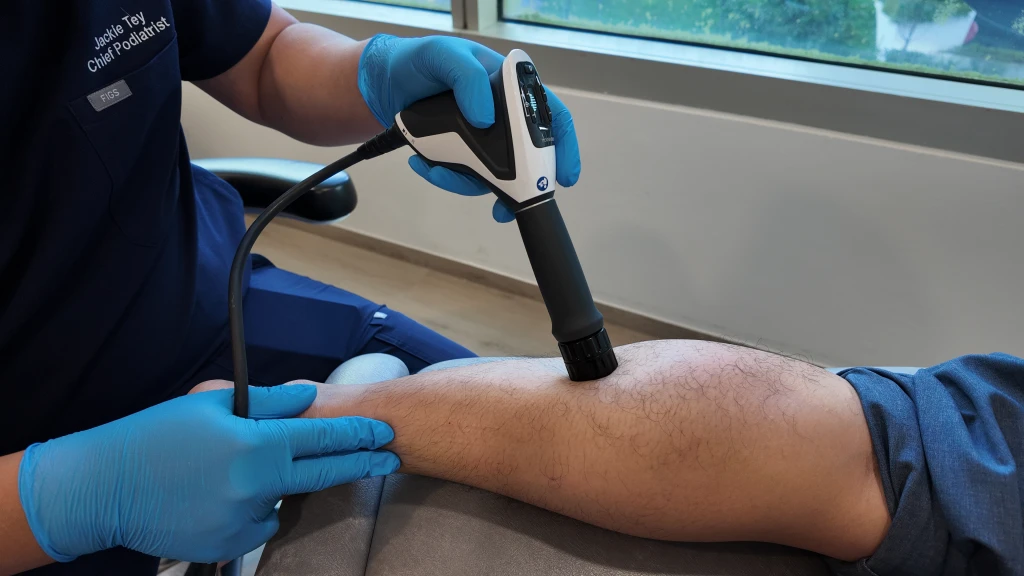
If your calves are constantly tight from marathon training, you have a stubborn trigger point in your hamstring that no amount of foam-rolling resolves, or you keep hitting the same myofascial pain pattern in the same place after Hyrox or CrossFit sessions, radial pressure wave therapy is one of the most useful tools we use in clinic for those situations.
This page explains what radial pressure wave therapy is, how it actually differs from focused shockwave therapy (a distinction many Singapore clinics blur), which conditions it is genuinely effective for, and what to expect from a course.
What Is Radial Pressure Wave Therapy?
Radial pressure wave therapy, or RPWT, is a non-invasive treatment that uses pressure waves generated ballistically. Inside the handpiece, a projectile is fired against a transmitter, which delivers a pressure pulse onto the skin. That pulse travels into the underlying tissue and disperses outward in a radial pattern from the point of contact (which is where the name comes from).
Compared with focused shockwave therapy (ESWT), radial pressure wave therapy delivers lower peak energy and reaches a shallower depth, typically up to about 5 cm (about 2 inches into the tissue). Importantly, RPWT is technically not a true shockwave. It is a pressure wave. The clinical use case is different from focused ESWT, even though both modalities are often grouped under the umbrella term “shockwave therapy” in clinic marketing.
The mechanism of effect is similar in principle. Mechanical pressure delivered into the tissue triggers biological changes including increased blood flow, release of pain-modulating substances, and relaxation of tight myofascial tissue. The result is reduced muscle tightness, breakdown of trigger points, and improved tissue mobility in the treated area.
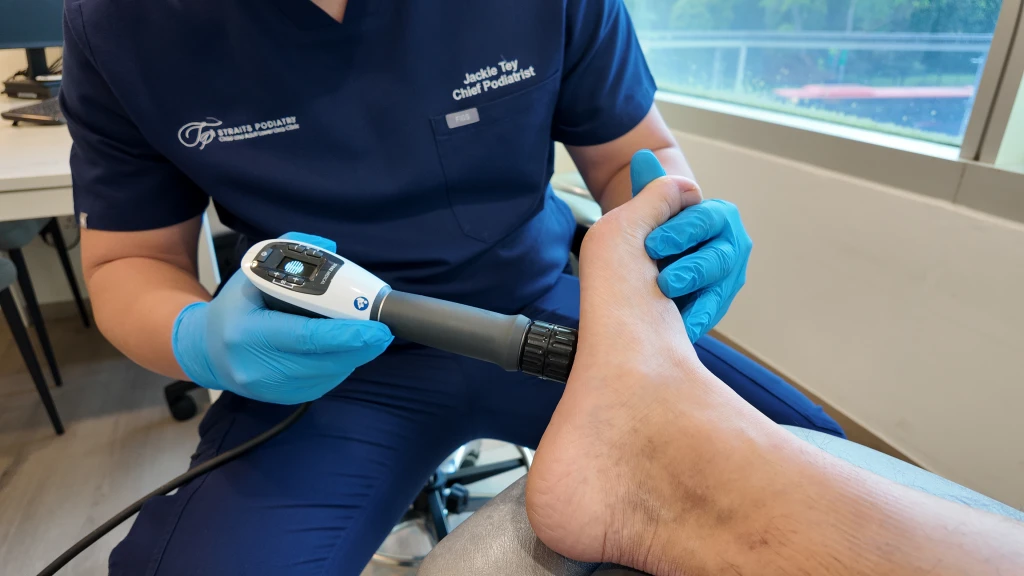
Conditions Managed With Radial Pressure Wave Therapy
RPWT is most effective for the following.
Muscle and myofascial conditions:
- Trigger points in the calf, hamstrings, quadriceps, and glutes
- Myofascial pain syndromes
- Chronic muscle tightness in active adults, including marathon runners, Hyrox competitors, and footballers
- Recovery-focused treatment between training cycles
Superficial soft tissue strains:
- Calf strain in mild or subacute grades
- Hamstring strain in mild grades
- Superficial enthesopathy in early or mild presentations
As an adjunct in selected tendon conditions:
- Achilles tendinopathy (used together with focused ESWT for deeper effect)
- Plantar fasciitis (used together with focused ESWT or for associated calf tightness)
- Shin splints (for the associated soleus and posterior tibial muscle component)
RPWT is not the right modality for deep tendon, joint, or bone conditions. Focused ESWT or magnetotransduction therapy (EMTT) is the appropriate tool there. Choosing the right modality for the condition is the most important decision in any shockwave-based treatment plan, and using RPWT for a deep chronic tendinopathy is one of the more common reasons “shockwave therapy did not work” in our patients’ previous treatment history.
What to Expect During an RPWT Session
A session takes 10 to 20 minutes depending on the area being treated. After we locate the trigger points and tight muscle bands by palpation, we apply ultrasound gel to your skin to transfer the pressure waves efficiently. The applicator is then moved across the treatment area while pulses are delivered.
You will feel a rapid drumming sensation, more concentrated over a trigger point than across broader muscle work. Most patients describe it as uncomfortable but tolerable. We adjust the intensity based on your tolerance and on what the tissue actually needs. Trigger points are typically the most sensitive part of the session.
After the session, your muscles may feel mildly sore for 24 to 48 hours. Some patients feel immediate relief from the trigger point pain. You can walk out of the clinic and continue normal activities. There is no recovery time off training or off work.
How Many Sessions Do I Need?
For chronic muscular tightness and trigger points, 3 to 6 weekly sessions is the typical protocol. Some athletes use a shorter course (2 to 3 sessions) as an in-season recovery tool when a specific area becomes problematic mid-cycle.
Immediate relief is common for muscle tightness and trigger points. Sustained improvement usually develops over 3 to 6 sessions, with the tissue requiring a few days to a week between sessions to respond fully. We do not stack RPWT on the same muscle group across multiple consecutive days.
RPWT for Sports Recovery and Active Adults
RPWT has a specific role for marathon runners, Hyrox and CrossFit athletes, footballers, NS personnel during physical training cycles, and anyone in serious training where chronic muscular tightness, fatigue, and recurring trigger points are part of life. Used between training cycles, RPWT can:
- Reduce muscle tightness and improve range of motion
- Break down trigger points that have been limiting performance
- Shorten recovery time between hard sessions
- Help mild strains resolve faster
It is not a substitute for proper strength work, mobility programming, and load management. It is an adjunct that supports them. The athletes who get the most out of RPWT are the ones using it as one tool in a broader plan, not as the entire plan.
Radial Pressure Wave Therapy vs Focused Shockwave Therapy
These two are often grouped under the same “shockwave therapy” umbrella in clinic marketing, but they are technically and clinically different modalities. Understanding the difference matters because using one when the other is needed is the single most common reason “shockwave therapy did not work” for a patient.
Many Singapore clinics offer only radial pressure wave therapy and use it for everything, including conditions that focused shockwave therapy is specifically designed for. Radial pressure wave devices are simpler to acquire and easier to operate, so most clinics buy one and use it across the full range of conditions that walk through the door. Focused ESWT requires a larger equipment investment and more specialised operator training, which is why fewer clinics offer it.
That approach works for the conditions RPWT actually fits, muscle tightness, trigger points, superficial sports recovery work. It does not work for chronic plantar fasciitis, insertional Achilles tendinopathy, or other deep tendon and bone conditions that need higher-energy focused waves at depth. When RPWT is applied to those conditions, the typical result is marginal improvement after 6 sessions and a patient who concludes that shockwave therapy is not for them.
The practical comparison:
| Feature | Radial Pressure Wave (RPWT) | Focused ESWT |
|---|---|---|
| Type of energy | Ballistic pressure waves at lower energy | Focused acoustic shockwaves at high peak energy |
| Depth of effect | Up to 5 cm (about 2 inches) | Up to 12 cm (about 5 inches) |
| Area of treatment | Dispersed across a broader area | Precise focal point |
| Best for | Muscles, trigger points, superficial myofascial work, sports recovery | Deep tendons, bone-related conditions, chronic tendinopathy, chronic plantar fasciitis, Achilles tendinopathy |
| Common pitfall in Singapore | Often applied to conditions that need focused ESWT instead | Less commonly available, fewer clinics offer it |
Knowing which modality your condition actually needs is the decision that determines whether treatment works. For superficial muscle and trigger point work, RPWT is the appropriate choice. For chronic heel and tendon conditions, focused ESWT is. Both modalities are available at Straits Podiatry, and the assessment before any treatment includes deciding which one fits your case.
When Is RPWT Not Suitable?
RPWT should be avoided in:
- Pregnancy
- Bleeding disorders such as haemophilia or severe thalassaemia, and while on strong blood thinners
- Active cancer at the treatment area
- Acute open wounds or untreated infection at the treatment site
It is also not the right modality if your underlying condition is a deep tendon, joint, or bone injury. In those cases, focused ESWT or magnetotransduction therapy is the appropriate tool. We go through a full screening before starting any course of RPWT to confirm it is appropriate for your case.
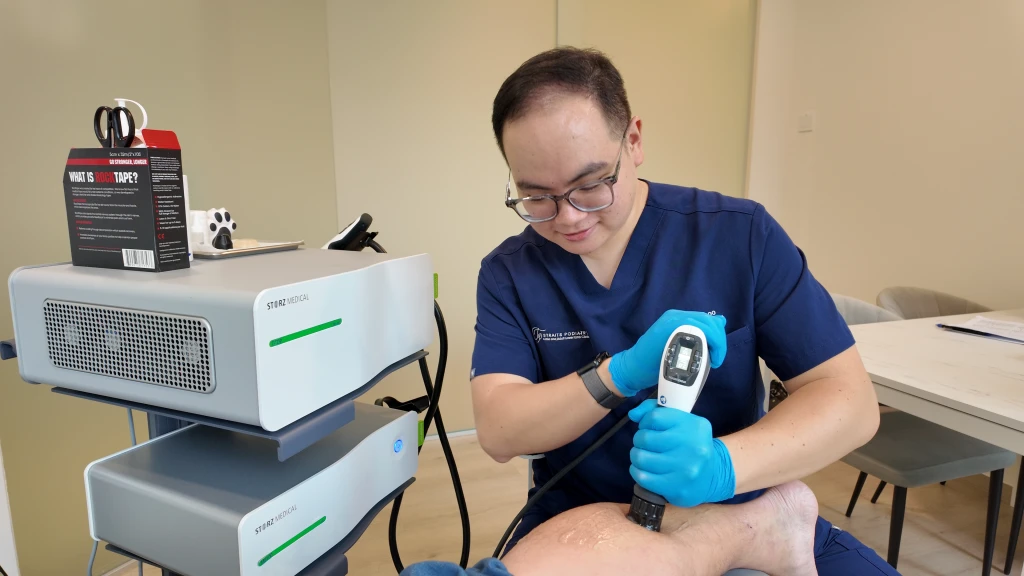
Radial Pressure Wave Therapy at Straits Podiatry
At Straits Podiatry, RPWT is one part of a broader shockwave and regenerative therapy offering that also includes focused ESWT and magnetotransduction therapy (EMTT). The assessment before treatment includes confirming the diagnosis, identifying the specific tissue target, and deciding whether RPWT alone fits your case or whether it should be combined with focused ESWT or EMTT for a more complete effect.
Our podiatrists are certified by the International Society for Medical Shockwave Treatment (ISMST), the global standard for shockwave practice. Our clinical approach is built around matching the modality to the condition rather than applying a single tool to every case.
Treatment is available at all 3 of our Singapore locations: Buona Vista (serving West Singapore), Orchard (serving Central Singapore), and Paya Lebar Square (serving East Singapore). For session pricing, please refer to our prices page.
If you have chronic muscle tightness, trigger points, or a mild soft tissue strain that has not responded to massage, stretching, or rest, book a consultation to discuss whether RPWT is right for you.
Frequently Asked Questions About Radial Pressure Wave Therapy
How is radial pressure wave therapy different from focused shockwave therapy?
Radial pressure wave therapy uses ballistically generated pressure waves at lower peak energy and shallower depth (up to 5 cm). Focused shockwave therapy uses higher-energy acoustic shockwaves at a precise focal point up to 12 cm deep. RPWT is the right tool for muscle, trigger point, and superficial work. Focused ESWT is the right tool for deep tendon, bone, and chronic tendinopathy work. They are not substitutes for each other, and a clinic that only offers RPWT will not be able to treat the conditions focused ESWT is designed for.
Is RPWT painful?
You will feel a rapid drumming sensation over the treatment area. Trigger points and tight bands are typically the most sensitive. The intensity is adjustable, and mild soreness in the treated muscle for 24 to 48 hours after a session is normal.
How many sessions of RPWT do I need?
The standard protocol is 3 to 6 weekly sessions for chronic muscular tightness and trigger points. Athletes sometimes use shorter courses of 2 to 3 sessions as in-season maintenance when a specific muscle group becomes problematic mid-training cycle.
Can I exercise after a session?
Yes. Many patients return to training within 24 hours. Some mild soreness in the treated muscle for the first day or two is normal. For sustained tightness or trigger point work, we generally recommend reducing high-intensity load for 24 to 48 hours after each session.
Is RPWT the right treatment for my plantar fasciitis or Achilles tendinopathy?
Usually not on its own. Pure RPWT is not enough for chronic plantar fasciitis or Achilles tendinopathy because those conditions need deeper energy delivery to the affected tendon attachment. Focused ESWT (sometimes combined with EMTT) is the more appropriate primary treatment for those conditions. RPWT can play a supporting role for the associated muscle tightness in the calf or arch, alongside the focused course.
How long do the results last?
For muscle tightness and trigger points, results vary based on the underlying cause. If the trigger point or tightness is driven by an ongoing training pattern or biomechanical issue, the symptom will return without addressing the root cause. We build RPWT into a broader plan that addresses the contributing factors, so the relief from the sessions is sustained rather than temporary.