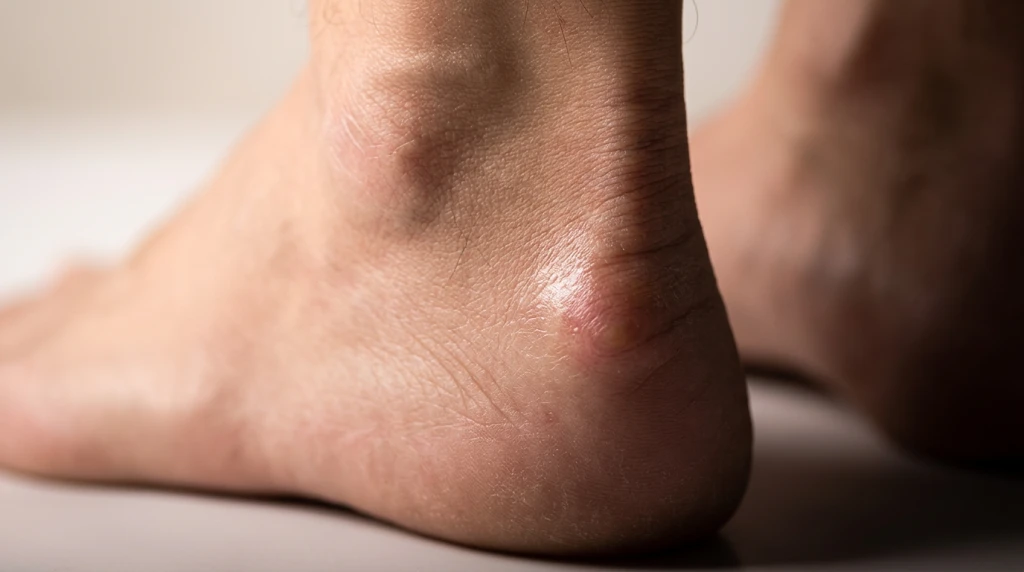
It started as a small bump at the back of your heel that you only noticed when slipping into your work shoes. Over months and years, the bump became more visible. The skin over it has started to redden and sometimes blister where the shoe rubs. The area is tender to the touch. Wearing your usual dress shoes or pumps for a full day is now a daily negotiation between style and tolerable pain. You have tried different pairs, gel pads, and even cutting open the back of older shoes. Some help a little. None of them resolves it. The bump is still there, and the inflammation around it keeps returning.
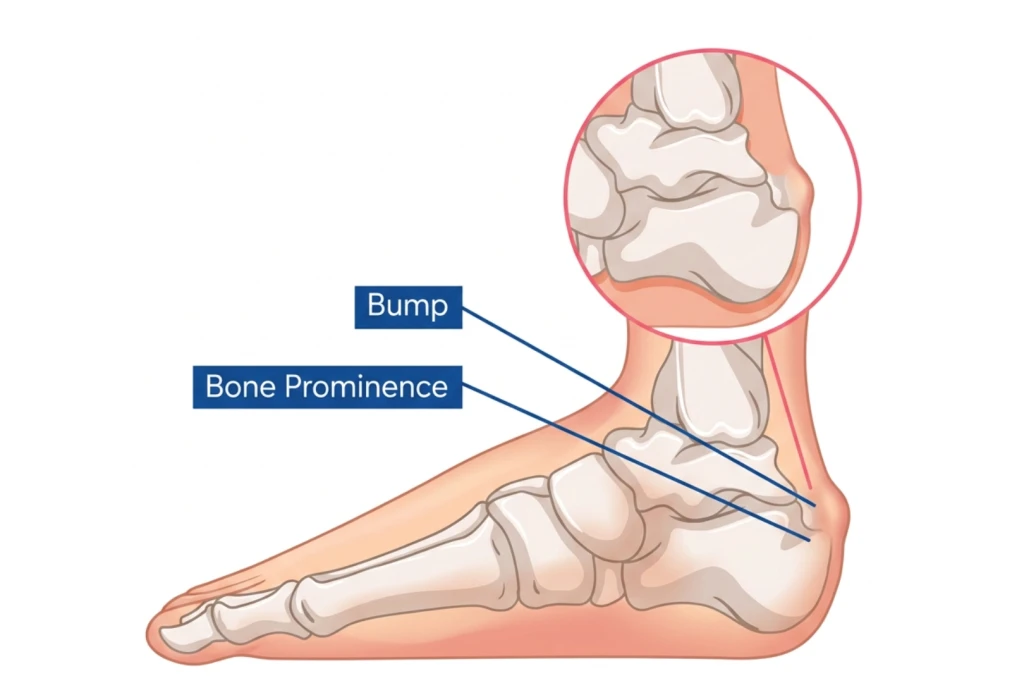
This is what patients usually tell us when they are dealing with Haglund’s deformity, sometimes called pump bump because it commonly worsens with rigid-backed shoes including dress shoes and high heels. The condition involves a bony enlargement at the back of the heel bone, the calcaneus, where the Achilles tendon attaches. When the bony prominence is repeatedly pressed against the rigid back of a shoe, the soft tissue between the bone and the shoe, including the retrocalcaneal bursa, becomes inflamed. Over time the Achilles tendon insertion itself can also become irritated, producing what is sometimes called Haglund’s syndrome — the triad of the bony deformity, retrocalcaneal bursitis, and insertional Achilles tendonitis.
Haglund’s deformity is a structural condition. The underlying bony prominence does not reduce in size with conservative treatment. The pain, inflammation, and soft tissue irritation around it can be managed effectively in most cases. The aim of management is to settle the inflammation, redistribute pressure away from the area, and prevent the cycle of irritation that turns a manageable bump into chronic heel pain.
Symptoms of Haglund’s Deformity
Unlike what the internet says, Haglund’s deformity itself is painless. However, the presence of the bump creates irritation on the surrounding tissues, which leads to pain and discomfort. Symptoms develop gradually over months in most cases, often becoming progressively more noticeable as the bump enlarges or as repeated shoe pressure inflames the surrounding tissue. A smaller proportion of patients describe a more sudden onset, typically triggered by a recent change in footwear or a sudden increase in activity.
- Visible bony bump at the back of the heel – a firm, fixed prominence at the upper outer aspect of the heel, just above where the Achilles tendon meets the bone. The bump itself is bone, not soft tissue, so it does not move or compress under pressure.
- Pain at the back of the heel, especially with shoes – sharp or aching discomfort that worsens when wearing shoes with rigid heel counters such as dress shoes, pumps, hiking boots, or some athletic shoes. Pain tends to ease when barefoot or in open-backed footwear.
- Redness and swelling over the bump – the skin and soft tissue overlying the bony prominence often becomes inflamed, with visible redness, warmth, and sometimes swelling that can be felt.
- Blistering or callus formation at the bump site – repeated friction between the shoe and the prominence often produces blisters or a thickened callus, particularly at the upper outer edge.
- Tenderness on direct pressure – pressing the bump from behind reproduces the pain, often more on the outer aspect than the centre.
- Achilles area stiffness or pain – because the deformity sits close to the Achilles tendon insertion, many patients also notice stiffness in the back of the heel, particularly on the first few steps after rest, similar to insertional Achilles tendonitis.
- Both heels affected, often asymmetrically – many patients have the deformity on both sides, though typically one side is more symptomatic than the other.
Causes of Haglund’s Deformity
Haglund’s deformity has both anatomical and external contributors. In most cases, a combination of factors produces the bony enlargement and the surrounding tissue irritation.
What Causes Haglund’s Deformity?
- Inherited heel bone shape – the most consistent factor is the underlying shape of the calcaneus. A naturally high posterosuperior prominence (the upper back portion of the heel bone) creates the bony bump and predisposes the area to irritation when in contact with shoe backs
- High-arched feet (pes cavus) – patients with high arches sit differently inside the shoe, pushing the back of the heel against the heel counter with each step
- Rigid heel counters in footwear – dress shoes, pumps, hiking boots, and certain athletic shoes have stiff backs that press directly against the bony prominence. Repeated pressure produces inflammation in the surrounding soft tissue
- Tight Achilles tendon and calf muscles – reduced ankle dorsiflexion increases tension at the Achilles insertion, which sits immediately adjacent to the bony bump, contributing to chronic irritation
- Inward-rolling gait pattern (overpronation) – although Haglund’s deformity is more associated with high-arched feet, abnormal gait mechanics can shift load through the back of the heel and accelerate irritation
- Repeated heel impact from running or sport – high-volume running, particularly on hard surfaces in shoes with rigid heel counters, increases mechanical load at the area
Who Carries a Higher Baseline Risk?
- Adults aged 20 to 50, when the condition is most often first noticed clinically, though the bony anatomy is usually present at skeletal maturity
- Women who regularly wear pumps, high heels, or dress shoes with rigid heel counters for work
- Men in professional roles who wear stiff-backed dress shoes daily
- Runners with high training volume, particularly on hard surfaces and in racing shoes with firm heel counters
- People with high-arched feet or naturally prominent posterior heel bones, often present bilaterally
- Patients with tight Achilles tendons or limited ankle dorsiflexion
- Those with a family history of similar heel prominences, since the bony shape tends to be inherited
Conditions Commonly Mistaken for Haglund’s Deformity
Two conditions are often mistaken for Haglund’s deformity, and a third often coexists with it. Distinguishing between them matters because their management approaches differ.
- Insertional Achilles tendonitis – both conditions produce pain at the back of the heel, both worsen with activity, and both can produce stiffness on the first few steps after rest. The distinction is anatomical. Insertional Achilles tendinopathy involves the tendon itself at the point where it attaches to the heel bone, with tenderness directly at the tendon insertion. Haglund’s deformity involves the bony prominence above the tendon, with tenderness at the upper outer heel. The two conditions frequently coexist as part of Haglund’s syndrome, and clinical examination is needed to identify which is the dominant source of symptoms.
- Posterior heel spur (calcaneal spur) – a heel spur is a bony outgrowth that forms at a point of tendon attachment, typically as a response to chronic traction on the bone. A Haglund’s deformity is a different anatomical feature: a naturally enlarged or prominent upper-back portion of the heel bone that does not result from tendon pulling. The pain mechanisms differ. A posterior heel spur tends to produce sharp pain directly at the Achilles insertion. Haglund’s deformity tends to produce pain over the bony prominence itself, especially with shoe contact.
- Retrocalcaneal bursitis – this is inflammation of the small fluid-filled sac (bursa) that sits between the back of the heel bone and the Achilles tendon. Retrocalcaneal bursitis very often develops as part of Haglund’s syndrome, triggered by the bony prominence pressing against the bursa and irritating it. Pure bursitis without a bony prominence can occur, particularly after a single traumatic event, but in most cases bursitis and Haglund’s deformity travel together. Settling the bursitis is part of managing Haglund’s deformity, not a separate condition.
Managing and Preventing Haglund’s Deformity
The bony prominence at the back of the heel is structural. Conservative treatment does not reduce the bump in size. What conservative treatment does, and does effectively in most cases, is settle the inflammation in the surrounding tissue, redistribute pressure away from the area, and prevent the cycle of irritation that produces the pain.
At the earliest signs of symptoms or during an acute flare, the focus is on calming the inflamed tissue:
- Switching to open-backed footwear (mules, slides, certain sandals) during flares to remove all pressure from the bump
- Cold therapy applied to the area for 15 to 20 minutes, two to three times daily for the first 5 to 7 days
- Anti-inflammatory measures as advised by a healthcare provider where appropriate
- Avoiding shoes with rigid heel counters during the acute phase, including dress shoes, pumps, and stiff athletic shoes
- Applying soft heel pads, silicone heel sleeves, or felt padding directly over the bump to cushion contact with whatever footwear is unavoidable
Once the acute inflammation has settled, the longer-term focus shifts to preventing recurrence:
- Choosing footwear with soft, flexible heel counters or open-backed designs for daily wear
- Adding heel lifts inside closed-back shoes to raise the heel slightly, reducing contact between the bump and the shoe back
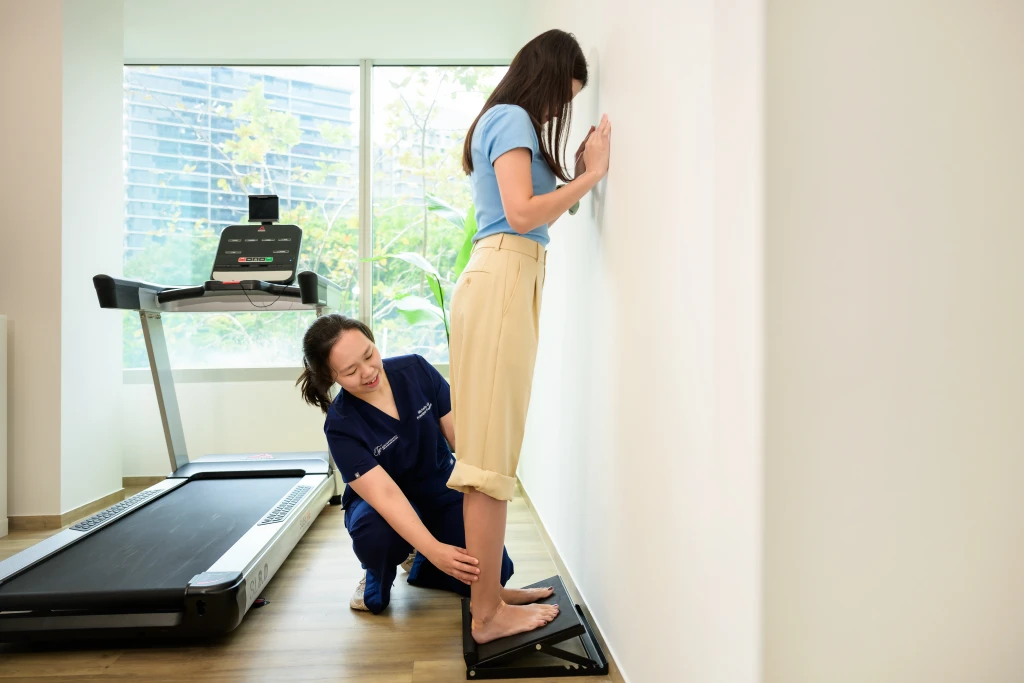
- Stretching the calf and Achilles consistently to reduce tension at the insertion area
- Custom foot orthotics with appropriate heel cushioning and arch support to redistribute load away from the back of the heel, particularly useful for patients with high arches contributing to the load pattern
- Addressing any biomechanical factors such as limited ankle dorsiflexion, gait abnormalities, or imbalance in the lower limb chain that may be perpetuating the irritation
For cases where the surrounding tissue, including the retrocalcaneal bursa or the Achilles insertion, has become chronically inflamed despite consistent conservative management, extracorporeal shockwave therapy and radial pressure wave therapy can support tissue remodelling and reduce chronic inflammation. Extracorporeal magnetotransduction therapy (EMTT) may also be considered for selected cases. These treatments do not change the underlying bony shape but can meaningfully improve the soft tissue picture surrounding it.
Surgery is usually reserved for cases that have not responded to 6 to 12 months of structured conservative management. Surgical options typically involve removal of the bony prominence, debridement of the retrocalcaneal bursa, and where needed, repair and reattaching the Achilles tendon. The decision to proceed with surgery is one that should be made together with an orthopaedic foot and ankle surgeon after conservative management has been genuinely exhausted, not after a few weeks of unsuccessful self-management.
The single most important principle in Haglund’s deformity management is that the footwear must change. No amount of injection, padding, or therapy holds long-term if the patient continues wearing the same shoes that are pressing on the bump for ten hours a day.
Have Your Haglund’s Deformity Managed at Straits Podiatry
Haglund’s deformity is one of the most common presentations seen by our podiatrists in Singapore, particularly among women in client-facing roles who require daily heel wear and men in industries with strict footwear requirements. The frustration is usually the same. The bump itself has been there for years, but the pain and inflammation have become daily, the shoes that fit yesterday is hurting today, and conservative attempts (heel pads, switching brands) are no longer enough.
At Straits Podiatry, the assessment focuses on identifying whether the dominant source of pain is the bony prominence itself, the inflamed bursa, the insertional Achilles tendon, or a combination, since the management plan adjusts based on which structures are most involved. Footwear, gait, and any contributing factors such as Achilles tightness or high-arched foot structure are also assessed.
From that assessment, a management plan is built around the specific presentation. This typically includes a comprehensive lower limb assessment to identify contributing factors, gait and biomechanical analysis to understand load distribution. We regularly use custom foot orthotics or sports orthoses designed with heel lifts and appropriate cushioning to reduce pressure on the area, along with detailed footwear guidance specific to your work and lifestyle demands. Extracorporeal shockwave therapy and EMTT will usually be considered for cases where the surrounding soft tissue has become chronically inflamed. Where surgical opinion becomes necessary, we will coordinate referrals with appropriate orthopaedic foot and ankle specialists.
Speak with our team today or book a consultation for an assessment and a tailored approach to manage your Haglund’s deformity.
Frequently Asked Questions About Heel Fat Pad Syndrome
Can Haglund’s deformity be treated without surgery?
Yes, and in the majority of cases. Conservative treatment does not reduce the bony bump itself, which is structural, but it effectively settles the inflammation and pain surrounding the deformity. The combination of footwear modification (switching to open-backed or soft-counter shoes), heel pads or silicone sleeves to cushion the area, custom foot orthotics to redistribute load, Achilles stretching to reduce tension at the area, and, where indicated, shockwave therapy for chronic soft tissue inflammation, resolves symptoms for most patients without the need for surgical excision. Surgery becomes necessary in a smaller subset of cases where 6 to 12 months of consistent conservative management have not produced meaningful improvement.
How long does Haglund’s deformity take to settle with conservative treatment?
Acute inflammation around the bump typically settles within 4 to 6 weeks with consistent management, including footwear changes and reduced pressure on the area. The longer-term outcome depends on whether the contributing factors stay corrected. Patients who maintain the right choice of footwear, continue consistent Achilles stretching, and use appropriate orthotic support generally remain symptom-free in the long term, even though the bony prominence itself persists. Patients who revert to rigid-backed shoes typically experience recurring flares. Chronic cases with established retrocalcaneal bursitis or insertional Achilles changes may take 3 to 6 months of structured management to fully settle.
What shoes should I wear if I have Haglund’s deformity?
If you are symptomatics, the single most important footwear change is moving away from rigid heel counters during your daily wear. Good options include shoes with soft, flexible backs that flex when the heel moves, open-backed shoes such as sandals, or shoes with a heel counter cut lower so it sits below the bump. However, such shoes are also less supportive and will not protect you in the long term. Once symptoms resolve, you should look for sports shoes with a rigid but straight-sitting heel counter that does not rub against the bony bump, and yet still provide structural support for your heel and foot.
For closed-back formal shoes you must wear for work, choose pairs with a cushioned heel counter and consider adding a heel lift inside to raise your heel slightly above the level where the bump contacts the shoe’s back. For women required to wear heels, lower block heels or wedges with soft heel structures are tolerated better than rigid pumps. A podiatry assessment can provide specific footwear recommendations matched to your work demands and foot structure.
When does Haglund’s deformity need surgery?
Surgical intervention is considered when conservative management for over 6 to 12 months has not produced meaningful improvement, and the pain is significantly affecting daily activity or work. Specific indications include persistent pain despite consistent footwear modifications, orthotics, and physiotherapy, or significant interference with required occupational footwear that cannot be modified. Surgery typically involves removing the bony prominence and addressing the surrounding soft tissue. The decision to proceed with surgery should involve an orthopaedic foot and ankle surgeon and a clear understanding that recovery takes several months.
How is Haglund’s deformity different from a heel spur?
The two often confuse the patients we see, but they are structurally and clinically distinct. A heel spur is a bony outgrowth that develops in response to chronic tension on the bone at a point of tendon attachment, typically the plantar fascia (under the heel) or the Achilles tendon (back of the heel). It is the body’s response to repetitive pulling. A Haglund’s deformity is a naturally enlarged or prominent area of the upper-back portion of the heel bone, often inherited as part of the patient’s anatomy, and not caused by tendon pulling. They produce different symptoms. A plantar heel spur causes pain under the heel, whilst a posterior heel spur causes pain at the back of the heel where the Achilles tendon attaches. A Haglund’s deformity causes pain at the back of the heel, particularly with shoe contact over the bony bump. Both conditions can coexist with Achilles tendinopathy, and a clinical examination by a podiatrist is the most reliable way to confirm which is contributing to your symptoms.
把这个分享给你认识的人