
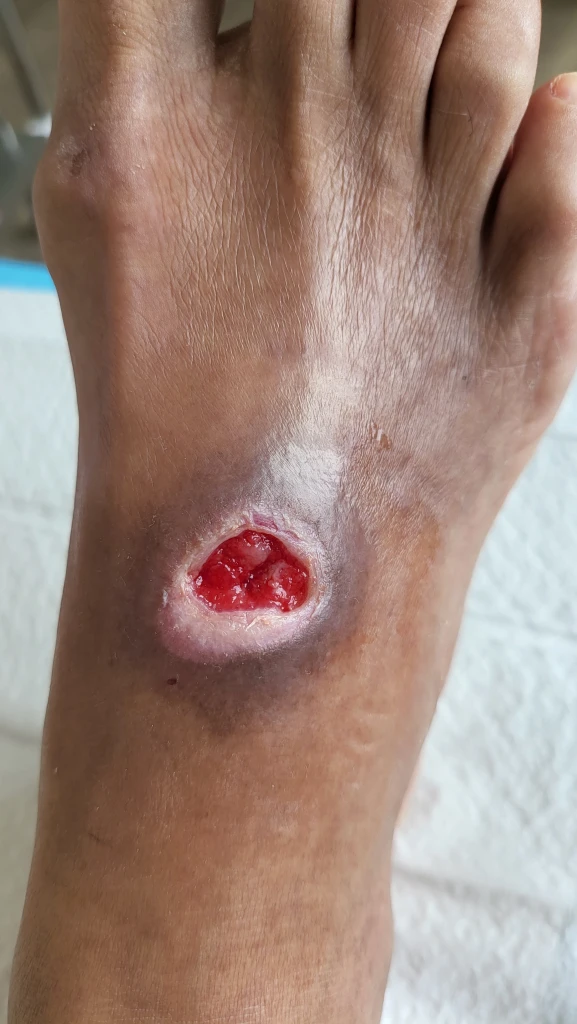
A diabetic foot ulcer is an open wound that develops on the foot in a person with diabetes. It is one of the most serious complications of long-standing diabetes and the leading cause of lower limb amputation in Singapore. Ulcers usually start small: a blister from a new shoe, a callus that has broken down underneath, or a tiny cut from walking barefoot. In a foot that has lost protective sensation from diabetic peripheral neuropathy, these small breaks go unnoticed and then fail to heal at a normal rate because blood flow, immune response, and tissue repair are all affected by diabetes.
Diabetic foot ulcers are not a podiatry-only problem. Healing depends on blood sugar control led by the diabetes team, on adequate blood flow which is the territory of vascular surgery, and on the local wound care, offloading, and pressure management that podiatry provides. Patients seen at Straits Podiatry are usually co-managed with their family doctor or endocrinologist, and with vascular surgery if peripheral arterial disease is present. Setting realistic expectations matters: even with good care, a diabetic foot ulcer can take weeks to months to heal, and recurrence rates are significant without ongoing follow-up.
Symptoms of Diabetic Foot Ulcers
- An open wound on the foot, often on the sole, heel, or under the toes, that may be red, yellow, brown, or black at the base
- Drainage or discharge from the wound, sometimes with a foul odour
- Redness, warmth, or swelling around the wound
- Pain at the wound site, although many ulcers in neuropathic feet are not painful
- A callus that has darkened, softened, or developed a hole in the centre
- Visible deeper structures such as tendon or bone in advanced ulcers
A new wound on the foot of a person with diabetes should be assessed within days, not weeks. Loss of pain sensation is part of the condition, so the absence of pain does not mean the ulcer is minor.
Causes of Diabetic Foot Ulcers
What Causes Diabetic Foot Ulcers
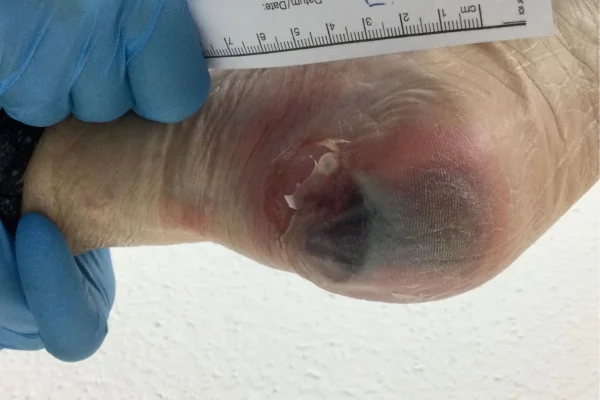
Diabetic foot ulcers develop when several diabetes-related changes combine. Peripheral neuropathy removes the warning system that would normally stop a patient from walking on a blister or a foreign body in the shoe. Reduced blood flow from peripheral arterial disease slows the delivery of oxygen and nutrients needed to repair skin. High blood sugar impairs immune cell function, so small infections take hold more easily. Repeated pressure under bony areas or inside calluses breaks down the underlying tissue from beneath, producing an ulcer that may only become visible once the surface skin gives way.
Who Carries a Higher Baseline Risk?
- People with long-standing diabetes, especially with HbA1c persistently above target
- People with confirmed peripheral neuropathy or peripheral arterial disease
- People with a previous foot ulcer or previous amputation
- People with foot deformities, including bunions, hammertoes, or post-Charcot foot shape
- People who smoke, which worsens circulation
- People with chronic kidney disease related to diabetes
- People who walk barefoot at home or wear ill-fitting footwear
Conditions Commonly Mistaken for Diabetic Foot Ulcers
In a diabetic foot, several everyday skin changes can be assumed to be harmless when they are in fact the early surface of an ulcer forming underneath. Reduced sensation means these changes are often not painful, so they are easy to dismiss. The safer default is to have any persistent skin change in a diabetic foot reviewed rather than treated at home.
Calluses
A callus is a build-up of hard skin over a pressure point, and a small dark spot in its centre is sometimes assumed to be a bruise or just thickened skin. In a diabetic foot, that dark spot can be blood or fluid from an ulcer developing beneath the callus. Unlike a simple callus, an ulcer involves a break in the deeper skin layers that will not resolve with moisturiser or filing and needs proper offloading and wound care.
Dry cracked heels
Dry, cracked heels are common and usually just a sign of hard, dehydrated skin. In a neuropathic foot, though, a deep heel fissure can split through the full thickness of the skin and become an entry point for infection, behaving like an ulcer rather than a cosmetic problem. The differentiator is depth and persistence: cracks that reach raw tissue, weep, or fail to heal need review rather than routine foot cream.
Fungal skin breaks
Fungal skin infection between the toes or across the sole causes flaking, redness, and small skin breaks that are easy to write off as dry skin. In a diabetic foot, those breaks can be the start of ulceration and a route for bacteria to enter. Unlike simple dryness, a fungal infection tends to spread, itch, and recur, and any associated skin break that does not close over needs assessment.
Small puncture wounds
A small puncture, from standing on a pin, staple, or piece of grit, can seem trivial and seal over on the surface. Reduced sensation means it may go unnoticed, and in a diabetic foot the deeper tissue can become infected or ulcerate even when the entry point looks minor. Any puncture in a diabetic foot is worth reviewing, because the visible wound often understates what is happening underneath.
Treating and Preventing Diabetic Foot Ulcers
Treatment of a diabetic foot ulcer rests on four pillars: removing dead tissue, controlling infection, taking pressure off the wound, and addressing the underlying medical drivers.
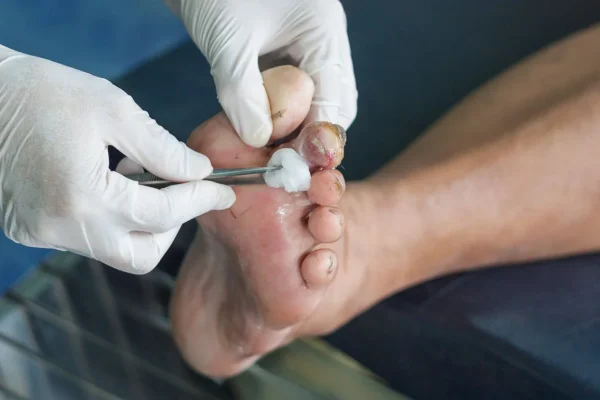
Debridement removes dead or unhealthy tissue from the wound so that healthy tissue can grow in. Dressings are selected to keep the wound clean and moist while managing exudate. Offloading uses custom orthotics, specialised footwear, felt padding, or a CAM walker boot to take pressure off the ulcer site so that healing tissue is not crushed with every step. If infection is suspected, antibiotics are prescribed by the medical team and the wound is monitored closely. Where reduced blood flow is the limiting factor, referral to vascular surgery for revascularisation may be needed before the ulcer can heal.
Prevention is the larger task. Blood sugar control led by the diabetes team slows the underlying nerve and vascular damage that allows ulcers to form. Daily foot self-checks, properly fitted footwear, avoiding walking barefoot, and yearly diabetic foot screening to catch neuropathy and circulation problems early all reduce the lifetime risk. Once a patient has had one ulcer, the recurrence risk is high, so ongoing review at intervals set by clinical risk is standard.

Have Your Diabetic Foot Ulcer Managed at Straits Podiatry
At Straits Podiatry, diabetic foot ulcer care covers wound assessment and debridement, dressing selection and review, offloading with felt padding, CAM boots, or custom orthotics, footwear advice, and coordination with your family doctor, endocrinologist, and vascular surgeon where appropriate. Diabetic foot screening to detect neuropathy and circulation problems before an ulcer develops is also available, alongside ongoing review schedules for patients with a previous ulcer to reduce recurrence risk.
Speak with Straits Podiatry or book a consultation for an assessment and a tailored approach to manage your diabetic foot ulcer.
Frequently Asked Questions About Diabetic Foot Ulcers
How long does a diabetic foot ulcer take to heal?
Healing time varies widely. A small, superficial ulcer with good blood supply and appropriate offloading may close in a few weeks. A deeper ulcer, an infected ulcer, or one in a foot with reduced blood flow can take several months. Some ulcers, particularly in patients with severe peripheral arterial disease or poorly controlled diabetes, do not heal until the underlying medical issues are addressed. Adherence to offloading is one of the strongest predictors of healing time. An ulcer cannot close if it is repeatedly compressed under body weight.
Will my diabetic foot ulcer come back after it heals?
Recurrence is common: about 42% of healed diabetic foot ulcers return within a year, and 65% within five years, particularly at the same site. This is because the underlying drivers (neuropathy, pressure distribution, footwear fit, and blood sugar control) are usually still present after the wound has closed. Ongoing podiatric review, properly fitted footwear, custom offloading where needed, and continued attention to diabetes management all reduce recurrence risk.
Do I need to see a vascular surgeon as well?
Sometimes yes. If clinical examination or non-invasive vascular testing suggests reduced blood flow to the foot, referral to a vascular surgeon is appropriate. Restoring blood flow through angioplasty, stenting, or bypass may be needed before the ulcer can heal. Podiatry can assess and screen, but the decision and procedure for revascularisation sits with vascular surgery. Straits Podiatry coordinates that referral when the clinical picture calls for it.
Can I keep walking and working with a diabetic foot ulcer?
Light walking with an appropriate offloading device is usually possible, but prolonged standing or walking on the wound delays healing. The exact restriction depends on where the ulcer is, how deep it is, and what offloading device has been fitted. A CAM walker boot or custom offloading insole allows most patients to continue working in roles that do not require long hours on their feet. Roles that involve heavy walking, standing, or wet environments may need temporary modification while the ulcer heals.
When should I worry that my ulcer is getting worse?
Signs that the ulcer is deteriorating rather than improving include increasing redness or swelling spreading away from the wound, increasing pain or a new pain in a previously painless ulcer, foul odour, thicker or more discoloured discharge, fever, or feeling generally unwell. Any of these suggests infection that may be spreading into deeper tissue and needs same-day medical assessment. Patients with diabetes and a worsening foot ulcer should be reviewed urgently rather than waiting for the next routine appointment.