
What Is an Ankle-Foot Orthosis (AFO)?
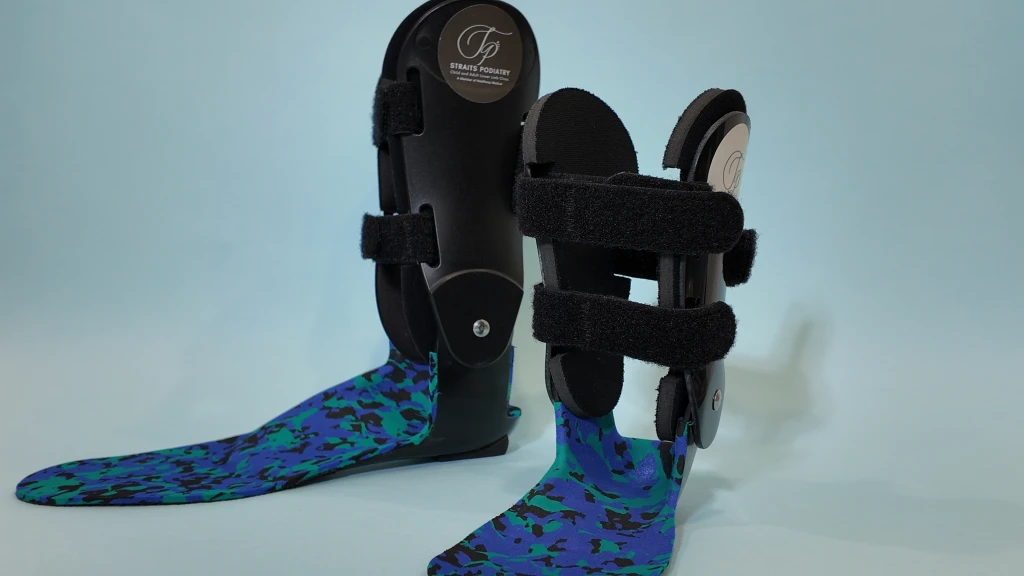
An ankle-foot orthosis, usually shortened to AFO, is a custom-made brace that spans the lower leg, ankle, and foot to control how the ankle moves when you stand and walk. It works as a mechanical stand-in for muscles, tendons, or ligaments that are no longer doing their job, whether that gap comes from a nerve injury, tendon failure, or a progressive deformity. By steadying the ankle through each step, an AFO lowers the effort of walking, reduces the risk of tripping, and takes stress off the rest of the lower limb.
An AFO is a step up in control from a customised foot orthoses, which sits inside the shoe and mainly influences the foot. Where an insole guides foot posture, an AFO governs the ankle joint itself in several directions, which is why we use it for more involved conditions such as foot drop or the later stages of posterior tibial tendon dysfunction. For many people who need an AFO, the aim is the most basic one there is: getting back on their feet and walking again, whether after a stroke, polio, or a nerve injury that has made each step unreliable.
An AFO usually consists of three working parts: an ankle splint that wraps the lower leg, a hinge or joint that decides how freely the ankle moves, and a foot orthosis section under the sole. Adjusting any of these changes what the device does, so the same broad category of brace can be tuned for very different problems. Depending on the design a podiatrist prescribes, an AFO can:
- Stop the foot from dropping during the swing phase of a step
- Restrict the ankle from rolling inward or outward
- Limit downward pointing of the foot (plantarflexion)
- Assist the ankle in lifting the foot (dorsiflexion)
- Add stability to a joint that has become unreliable
- Reduce load on the muscles, tendons, and joints further up the limb

Conditions Managed With an Ankle-Foot Orthosis
An AFO is not a single product but a family of designs, so it helps across a range of conditions where the ankle has lost the ability to control itself. Common reasons we prescribe one include:
- Foot drop from stroke, spina bifida, poliomyelitis, or nerve injury, where the foot cannot lift clear of the ground during the swing phase and catches or slaps down
- Late-stage posterior tibial tendon dysfunction, where the tendon that supports the arch has failed and the ankle collapses inward
- Late-stage foot and ankle arthritis, where a painful, worn joint benefits from having its motion limited and offloaded
- Charcot-Marie-Tooth disease and other neuromuscular conditions that weaken the lower leg
- Cerebral palsy, where an AFO or SMO helps position the foot for standing and walking
- Chronic ankle instability, where the ankle repeatedly gives way
- Fixed ankle or foot deformity, such as club foot or severe cavovarus foot
- Post-surgical foot and ankle deformity, where the limb needs external support during recovery
Because the same underlying weakness and the cause of that weakness can vary widely from person to person, the specific AFO design is matched to the mobility limitation rather than the diagnosis. Two people with foot drop may need very different braces depending on how much control their ankle has left.
How an Ankle-Foot Orthosis Is Made and Fitted
Getting an AFO is a staged process, not an over-the-counter purchase. It begins with an assessment and ends with a device shaped to your own leg and reviewed as your condition changes.
- Clinical assessment. We take a history of how the underlying condition affects your walking, balance, and footwear, then examine your ankle range of motion, calf and lower limb strength, sensation, foot posture, and shoe wear pattern. We also observe your gait to identify exactly which part of your step the brace needs to support.
- Design selection. The type and rigidity of AFO is matched to your case: for example, an assisted spring hinge for a mild foot drop, a free-hinged AFO where the ankle needs controlled motion, or a rigid solid AFO where instability is more pronounced. Activity goals are discussed here so the device suits your lifestyle, not just your diagnosis.
- Casting or scanning. A physical cast or a 3D scan of the lower leg and foot captures the exact shape the device must match. This is what separates a prescription AFO from an over-the-counter brace.
- Fabrication. The AFO is built to the cast or scan, with the shell, hinge, and foot orthosis section made to your prescribed design.
- Fitting and break-in. The device is fitted, and most people follow a short break-in schedule, wearing it for a few hours at a time before building up to full-day use so the skin adapts gradually.
- Review. We will conduct follow-up reviews to check the fit during walking and adjust the trim, padding, and strap tension if necessary. Because a brace shares its work with your muscles, pairing the AFO with physiotherapy often helps you get more out of it.
How an Ankle-Foot Orthosis Differs From a Shop-Bought Ankle Brace
This is the most common point of confusion, and the distinction is worth being clear about before you spend on either. A regular ankle brace from a pharmacy or sports shop is a soft or semi-rigid sleeve made for short-term use, usually after a sprain. It gives general compression and mild support, but it cannot meaningfully change how the ankle joint moves.
An AFO is a prescription medical device made to a physical cast of your leg, with components engineered for specific motion control. Put simply, an off-the-shelf brace supports, while an AFO directs. That difference is why an AFO is appropriate for conditions where the ankle has lost the ability to control itself, such as foot drop, late-stage posterior tibial tendon dysfunction, or fixed deformity, and why a sports sleeve is not. The two are not interchangeable: a sports brace is not a substitute for an AFO, and an AFO is not what you reach for after a routine sprain.
When Is an Ankle-Foot Orthosis Not Suitable?
An AFO is not right for every situation, and part of a proper assessment is recognising when a brace is not the answer or needs to wait. Honest cautions include:
- Broken or ulcerated skin under the brace area. If there is an open wound, a pressure ulcer, or skin breakdown where the shell or straps sit, an AFO can worsen it. The skin needs to settle first, and the design may need adjusting to offload that area.
- Poor skin integrity or reduced sensation. In diabetes or neuropathy, skin that cannot feel pressure is at higher risk of rubbing and blistering unnoticed. An AFO can still be appropriate, but it calls for careful padding, a cautious break-in schedule, and closer review.
- Significant or fluctuating swelling. A brace cast to a limb that is acutely swollen will not fit once the swelling settles, and can restrict circulation while it is present. Swelling is usually managed before casting.
- Deformities that need surgical correction first. Some fixed or unstable deformities need an orthopaedic opinion and possible surgical fixation before a brace can help. An AFO controls motion. It does not realign a fixed joint that needs fixation.
- Circulatory concerns. Reduced blood flow to the foot changes how much pressure the skin can safely tolerate and may need vascular review before bracing.
None of these automatically rules out an AFO. They are reasons to assess carefully, adjust the design, or address the underlying issue first. A podiatrist can help you work out whether an AFO fits your situation now or after a preparatory step.
Get Fitted for Your Ankle-Foot Orthosis at Straits Podiatry
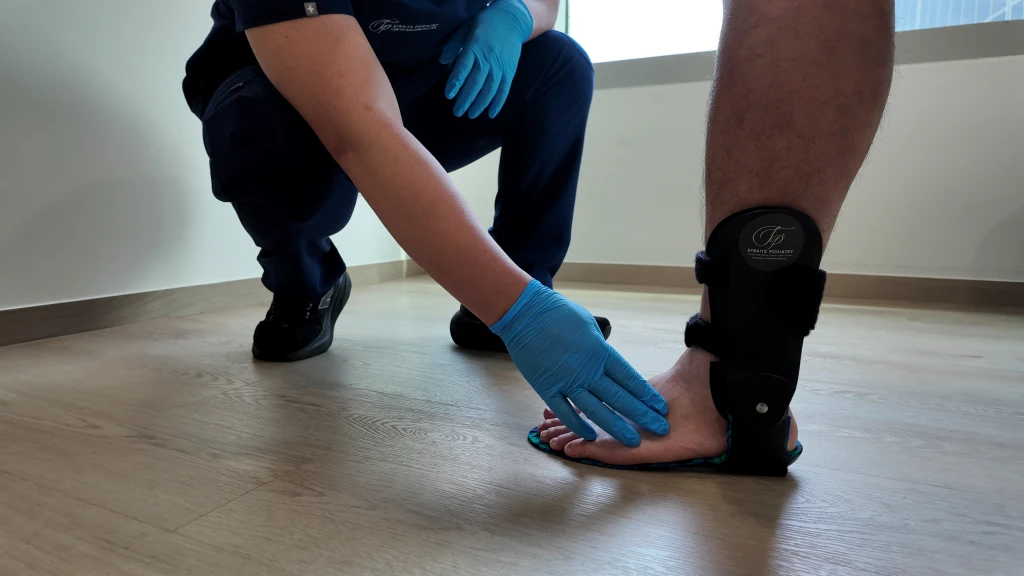
Many AFOs on the market use traditional rigid designs that fit poorly, feel bulky, and limit necessary movement, which is often why people quietly stop wearing them. Every ankle-foot orthosis at Straits Podiatry is designed around your specific diagnosis by our podiatrists and cast to your own leg rather than picked off a shelf, so the device controls the motion that drives your symptoms while preserving the movement you need to walk, climb stairs, and carry out rehabilitation exercises.
Before fabrication, a cast or scan is taken and each patient undergoes a biomechanical assessment, which includes:
- Foot posture analysis using 3D scanning technology
- Musculoskeletal assessment
- Visual gait analysis
- Postural assessment
The design is matched to your case, each AFO is covered under a limited warranty period, and you are reviewed periodically so the fit stays right as your condition changes. Speak with our team or book an assessment to find out whether an ankle-foot orthosis suits your needs.
Frequently Asked Questions About Ankle-Foot Orthoses
Does wearing an ankle-foot orthosis hurt or feel uncomfortable?
A well-fitted AFO should not hurt. It will feel unfamiliar or strange at first, because the brace sits snugly against the calf, ankle, and foot, and most people go through a short break-in period, wearing it for a few hours at a time before building up to full-day wear. Mild pressure marks that fade soon after you take the brace off are normal. Anything that rubs, pinches, blisters, or leaves a lasting red mark is not, and it means the fit needs adjusting. Because each AFO here is cast to your own leg rather than bought off a shelf, the contact points are shaped to your anatomy, which is what keeps it comfortable over a full day. Tell the podiatrist about any sore spot at your review so the trim, padding, or strap tension can be tweaked.
Can I walk and exercise normally with an ankle-foot orthosis?
In most cases yes, and that is one of the design goals. Older and out-dated AFO designs were rigid and limited daily activity, which discouraged consistent use. AFOs designed here aim to preserve the movements needed for walking, climbing stairs, and rehabilitation exercises, while restricting only the motion that contributes to your symptoms. Most people can wear the device throughout the day, including during physiotherapy, which matters because rehabilitation depends on safe, repeated loading of the limb. High-impact running may not suit every AFO design, so discuss your activity goals at the prescription stage and the device can be matched to your lifestyle.
Will an ankle-foot orthosis fit inside my normal shoes?
Most AFOs are worn inside a shoe rather than over it, so footwear does matter. As a rule, a shoe with a removable insole, a slightly wider fit, a deeper toe box, and an adjustable fastening (laces or straps rather than slip-on) gives the brace room and holds the foot securely. Very narrow, shallow, or slip-on shoes usually will not accommodate an AFO comfortably. Bring the shoes you wear most often to your assessment so our podiatrists can factor them into the design, and be prepared that you may need to choose a different everyday shoe. Footwear is part of the fitting conversation, not an afterthought.
How is an ankle-foot orthosis different from a regular ankle brace?
A regular ankle brace from a pharmacy or sports shop is a soft or semi-rigid sleeve made for short-term use, usually after a sprain. It provides general compression and mild support but cannot meaningfully change how the ankle joint moves. An AFO is a prescription medical device made to a physical cast of your leg, with components engineered for specific motion control. Where an off-the-shelf brace supports, an AFO directs. That is why an AFO suits conditions where the ankle has lost the ability to control itself, such as foot drop or late-stage posterior tibial tendon dysfunction, and why a sports sleeve does not replace one.
How long does an ankle-foot orthosis last, and when does it need replacing?
A well-fitted AFO typically lasts several years of regular wear, though this varies with body weight, activity level, and whether the underlying condition is stable or progressive. Plastic shells can soften over time, hinge components can wear, and the foot orthosis section inside the AFO loses its corrective properties as the cushioning layers compress. Children outgrow AFOs and SMOs faster and usually need replacement every 12 to 24 months depending on growth. Adults with stable conditions may go longer between replacements. Each AFO here is covered under a limited warranty period, and you are reviewed periodically so the device can be adjusted, repaired, or replaced before symptoms return.
Is an ankle-foot orthosis safe for someone with diabetes or reduced sensation?
It can be, but it calls for extra care. When sensation is reduced by diabetes or neuropathy, the skin may not signal rubbing or excess pressure, so a fault that would be uncomfortable for someone else can go unnoticed and lead to a blister or ulcer. This does not mean you should avoid an AFO. It means the design uses careful padding, the break-in schedule is more cautious, you check your skin daily, and reviews are more frequent. If there is already broken skin, an open wound, or significant circulation concern, that is addressed first before an AFO is cast.
What happens at an AFO assessment with a podiatrist?
The assessment begins with a history of how foot drop, a neurological condition, or post-injury weakness is affecting your walking, balance, and footwear. Our podiatrist examines ankle range, calf and lower limb strength, sensation, foot posture, and shoe wear pattern, and observes your gait to see which phase of the step the AFO needs to support. From there the type and rigidity of AFO is matched to the case: a flexible posterior leaf for a mild drop, a hinged AFO where controlled ankle motion is needed, or a rigid solid AFO where instability is more pronounced. Casting or scanning of the lower leg follows, and the device is made to fit your foot, calf, and footwear. A follow-up review then checks the fit during walking and adjusts the trim, padding, and strap tension.