

You have been told you have plantar fasciitis. You have done the stretches, changed your shoes, tried orthoses, and the heel pain still has not settled. Worse, it is not the usual deep ache of a tight plantar fascia. There is a burning quality to it, sometimes a tingling sensation that runs through the inner heel and the arch, and standing for long periods makes it worse rather than better.
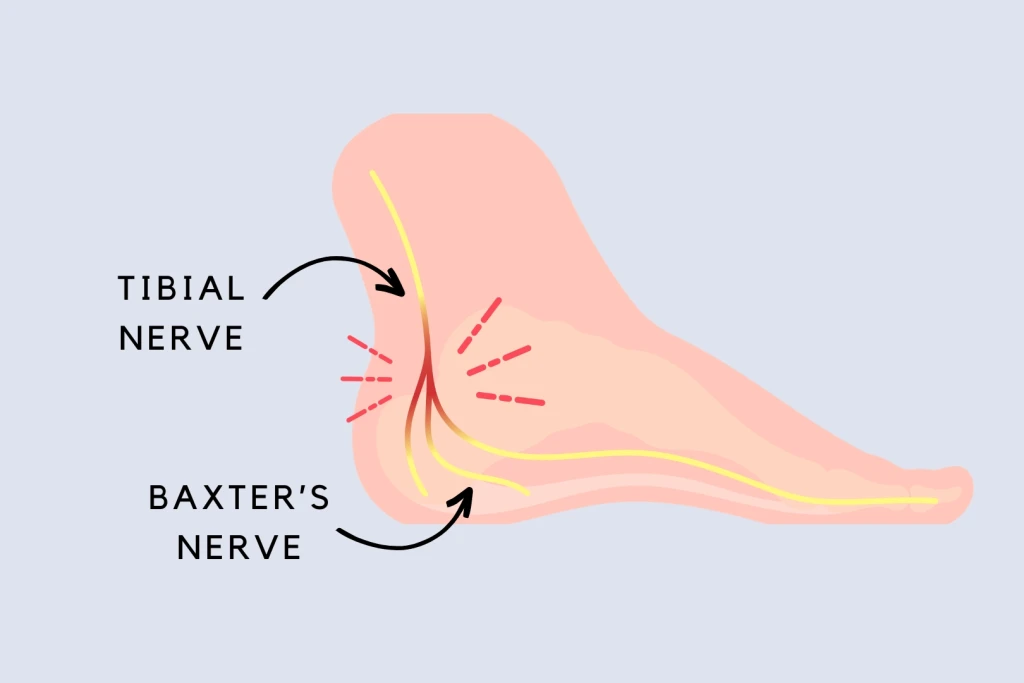
When we hear such patterns, it normally raises suspicion of Baxter’s nerve entrapment, a compression of the first branch of the lateral plantar nerve as it courses through the inner heel. Up to 20% of patients with chronic heel pain have some level of Baxter’s nerve involvement, often alongside a thickened plantar fascia, which is why it is so often mistaken for plantar fasciitis alone. Identifying it changes the treatment plan almost entirely, because nerve irritation responds to different interventions than fascial irritation.
Symptoms of Baxter’s Nerve Entrapment
The nature of the pain is the most useful clue, and is something your clinician should ask during initial assessment. While the location overlaps with plantar fasciitis, the quality of the symptoms is neurological rather than purely mechanical.
- Sharp or burning pain along the inner side of the heel, sometimes radiating to the outer heel.
- Burning sensation that builds with prolonged standing or walking.
- Numbness or tingling under the heel and along the arch.
- Pain that does not follow the classic plantar fasciitis pattern of worst-first-steps in the morning. Often, Baxter’s pain worsens through the day.
- Pain that may persist or even increase after stopping activity, where fascial pain typically eases at rest.
- Tenderness on the inner heel just in front of where the plantar fascia originates. Location of tenderness can extend to the inner arch region.
Causes of Baxter’s Nerve Entrapment
The nerve is compressed because the space it travels through has narrowed. The narrowing is usually caused by an adjacent thickened plantar fascia, the abductor hallucis muscle, or biomechanical changes that crowd the inner heel. Multiple factors often combine.
What Causes Baxter’s Nerve Entrapment?
- Thickened plantar fascia, often as a consequence of chronic plantar fasciitis, occupying space and compressing the nerve.
- Inflammation or swelling around the inner heel from any cause, reducing nerve clearance.
- Excessive pronation, which stretches the plantar fascia and the abductor hallucis muscle, reducing the space available for the nerve to cross.
- Heel fat pad thinning, removing protection from the nerve.
- Direct trauma to the inner heel, including impact and surgery.
- Heel spurs of significant size in rare cases.
Who Carries a Higher Baseline Risk?
- Adults with flat feet or significant overpronation.
- People with longstanding plantar fasciitis that has not fully resolved.
- Runners with high training mileage.
- Athletes who prefer barefoot training or wear minimalistic shoes.
- Patients with previous heel surgery.
- Adults with reduced heel fat pad cushioning.
Conditions Commonly Mistaken for Baxter’s Nerve Entrapment
Inner heel pain has multiple possible causes, and Baxter’s nerve entrapment is so regularly forgotten by many clinicians. Most of our patients are diagnosed with one of the following instead:
Plantar fasciitis
Baxter’s nerve entrapment frequently coexists with plantar fasciitis, and the two can be hard to separate because both produce inner heel pain. The nerve involvement is often overlooked when heel pain is assumed to be fascial alone.
Tarsal tunnel syndrome
Compression higher up at the inner ankle points to tarsal tunnel syndrome, where the tibial nerve itself is trapped rather than its smaller branch near the heel. The distribution of tingling and numbness helps tell the two apart.
Heel fat pad atrophy
Thinning of the protective cushion under the heel produces deep, central pain on weight-bearing that can mimic nerve pain. Heel fat pad syndrome tends to hurt directly beneath the heel rather than towards its inner border.
Heel spur
A heel spur is a bony outgrowth on the underside of the calcaneus, often forming where the plantar fascia attaches. It can cause heel pain that is felt on weight-bearing and first steps, but the pain is mechanical and bony rather than the burning or tingling quality of Baxter’s nerve entrapment. A spur shows up on imaging as a defined bony projection, whereas Baxter’s involves compression of a soft-tissue nerve, so the two are distinguished by both the character of the pain and what the imaging reveals.
Referred pain from the lower back
Nerve root compression in the lumbar spine can refer pain into the heel, so a spinal source is considered when the local heel findings do not fully explain the symptoms.
Treating and Preventing Baxter’s Nerve Entrapment
Care aims to reduce compression on the nerve and calm the surrounding inflammation. Because the entrapment often sits alongside an existing plantar fasciitis or biomechanical foot type, addressing those underlying drivers is central to a lasting result rather than a temporary settle. Conservative care is the starting point in nearly every case, and it is sequenced carefully because orthoses prescribed without considering the nerve can occasionally worsen symptoms.
Conservative treatment
Most cases respond to a well-thought non-surgical plan that decompresses the inner heel, calms the irritated nerve, and corrects the drivers that keep it compressed.
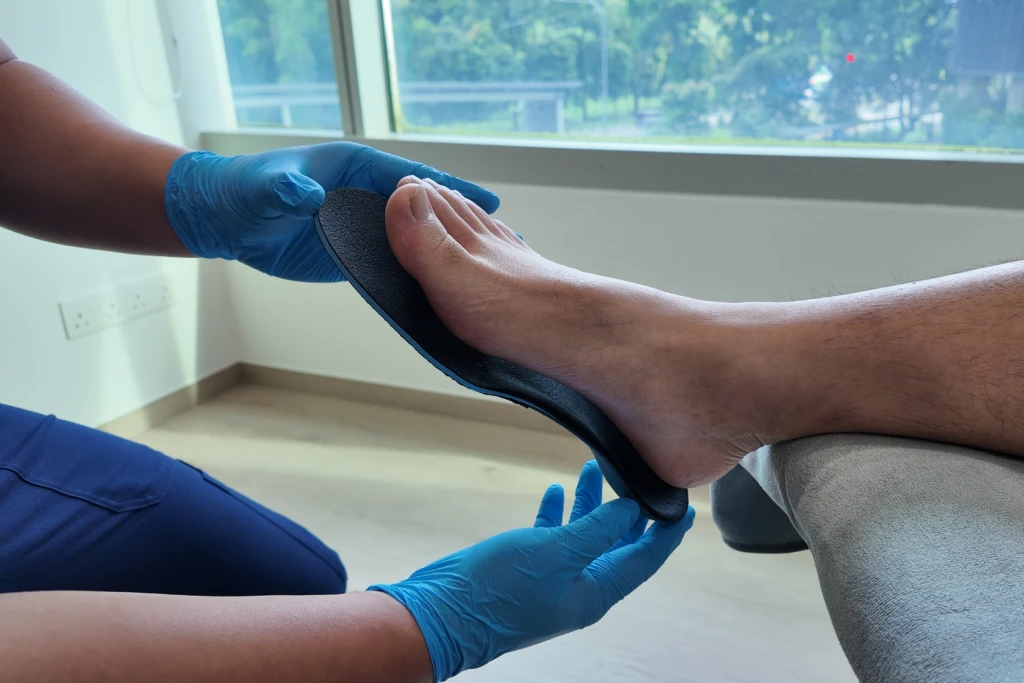
- Customised foot orthoses: Orthoses, when prescribed with the compressed nerve in mind, should control pronation without adding pressure to the inner heel. Long-term use where biomechanical drivers persist helps keep the compression from returning.
- Footwear: Shoes with a wider heel cup, adequate cushioning, and a stable midsole reduce load on the nerve. Avoiding barefoot walking on hard surfaces during a symptomatic period limits the irritation.
- Activity modification: Relative rest from high-impact activity, with low-impact substitutes, gives the nerve time to settle rather than being repeatedly compressed.
- Rehabilitation and physiotherapy: Calf and plantar fascia stretches release tension on the soft tissue compressing the nerve, while strengthening of the arch, intrinsic foot muscles, and gluteal muscles supports the foot and lowers the chance of recurrence.
- Extracorporeal shockwave therapy and magnetotransduction therapy: These reduce pain and inflammation around the nerve where symptoms are slow to settle.
- Medication and nerve block: In selected cases, anti-inflammatory medication or a selective nerve block under medical advice can temporarily calm a persistently irritated nerve. For long-term relief, you should still treat any coexisting plantar fasciitis to completion and address all other underlying drivers.
When conservative care isn’t enough
Surgical decompression of Baxter’s nerve is considered in a small number of cases where symptoms persist despite a thorough trial of conservative care. Most people do not reach this point, and where it is warranted, an orthopaedic surgical opinion is arranged.

Have Your Baxter’s Nerve Entrapment Managed at Straits Podiatry
Straits Podiatry distinguishes Baxter’s nerve entrapment from plantar fasciitis through targeted clinical examination, supported by gait analysis and footwear assessment. Treatment combines carefully prescribed customised foot orthoses, footwear advice, and modalities such as extracorporeal shockwave therapy and magnetotransduction therapy.
Speak with our team or book a consultation for an assessment for a tailored approach to manage your Baxter’s nerve entrapment.
Frequently Asked Questions About Baxter’s Nerve Entrapment
How is Baxter’s nerve entrapment diagnosed?
Diagnosis is primarily clinical. Your podiatrist will examine the inner heel, looking for tenderness slightly in front of the classic plantar fasciitis tender point, and ask about the character of the pain. Burning, tingling, or numbness raises the suspicion of nerve involvement. Tinel’s test, performed by percussing the lower inner arch, is a useful test we use in our clinic to further ascertain the diagnosis. Imaging, particularly MRI, can show changes around the nerve and atrophy of the abductor digiti minimi muscle that the nerve supplies, supporting the diagnosis. Nerve conduction studies are occasionally used, but not always reliable. Because Baxter’s nerve entrapment often coexists with plantar fasciitis, both are assessed together.
Why was my heel pain misdiagnosed as plantar fasciitis?
Because the location overlaps. Both conditions cause inner heel pain. The classic plantar fasciitis pattern of pain with first steps in the morning is so well known that any inner heel pain often gets labelled as such, particularly when the patient has not seen a podiatrist. Baxter’s nerve entrapment has a different quality, burning, tingling, worse with prolonged standing, but this is not always picked up in a brief examination. Patients whose heel pain does not respond fully to plantar fasciitis treatment are good candidates for reassessment.
Will orthoses help nerve pain?
Orthoses can be very helpful when prescribed with the nerve in mind, but they can also make things worse if they apply pressure to an already irritated area. The aim is to reduce overpronation and the stretch on the soft tissues compressing the nerve, without loading the inner heel directly. This is why “off the shelf” arch supports sometimes worsen symptoms in Baxter’s nerve cases. A customised device, prescribed after a proper diagnosis, is more likely to deliver a useful result.
How long does it take to recover?
Nerve-related pain typically takes longer to settle than soft tissue pain. With appropriate treatment, many patients see clear improvement over six to twelve weeks, with continued progress over three to six months. Complete resolution is realistic for many, particularly when the underlying biomechanical drivers are addressed and any coexisting plantar fasciitis is treated to completion. Patients who continue high-impact activity or fail to treat the broader picture often see slower recovery and partial improvement only. Patience matters with nerve symptoms.
Is surgery needed for Baxter’s nerve entrapment?
Surgery is rarely the first choice. Most patients respond well to conservative treatment focused on decompressing the nerve and addressing the surrounding tissue. Surgical decompression is considered when symptoms persist for many months despite a thorough conservative trial, significantly limit walking or sport, and a clear case of nerve entrapment can be confirmed. As with any surgery, there are risks including incomplete relief, nerve injury, and a recovery period of several weeks. Your podiatrist will coordinate with the relevant specialist if surgery becomes a serious option.