
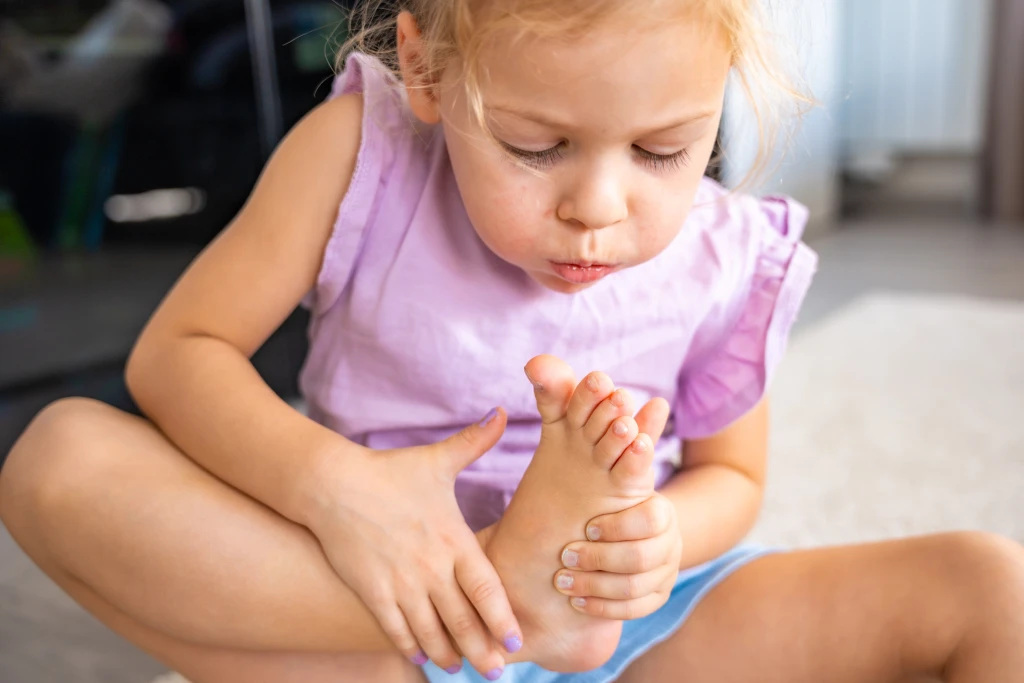
If your child is suddenly hobbling after football, basketball, or ballet practice, and the sore spot sits on the outer edge of the foot near the small toe, Iselin’s disease (apophysitis of the fifth metatarsal base) is worth ruling in or out. It is a type of osteochondrosis that affects the growth plate at the base of the fifth metatarsal, where one of the calf and outer-leg muscles attaches. The condition usually shows up in active children between 8 and 14, while the growth plate is still open.
The good news is that Iselin’s disease is self-limiting. Once the growth plate fuses at skeletal maturity, the condition resolves. The aim of treatment is to keep your child as comfortable and as active as possible during the growing years, not to “cure” the bone.
Symptoms of Iselin’s Disease
- Pain on the outer edge of the foot, just behind the base of the little toe.
- Pain after sport, especially jumping, sprinting, or sudden direction changes.
- A tender, slightly swollen, or warm patch over the bony bump on the outer foot.
- Limping for a few hours to a few days after activity.
- Reluctance to push off the outer foot during running.
- Pain when tight shoes press on the outer foot.
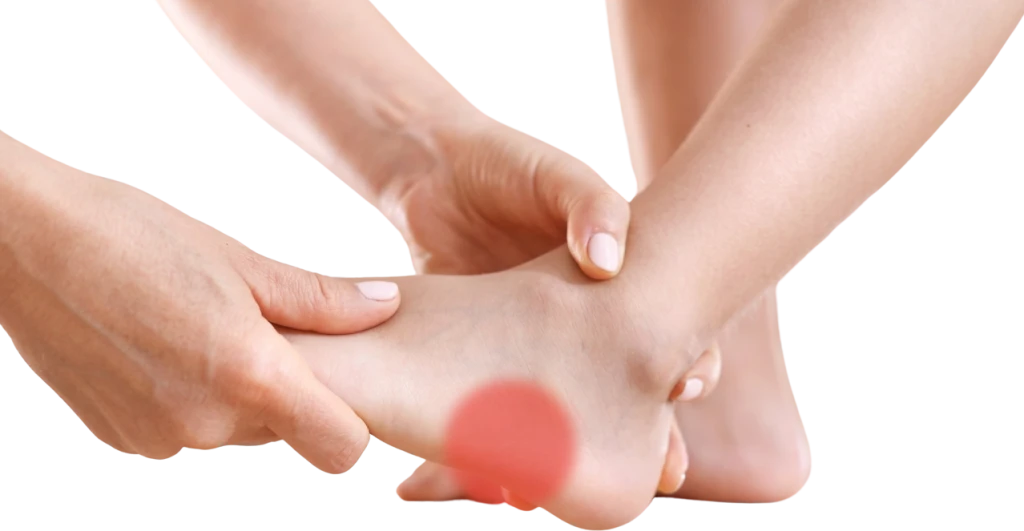
Causes of Iselin’s Disease
What Causes Iselin’s Disease?
- Repetitive traction from the peroneal tendons on the growth plate during running and jumping.
- Sudden spikes in training volume, intensity, or sport frequency.
- Tight calves or weak foot muscles increasing pull on the growth plate.
- Inadequate recovery between sessions during the school sport season.
- Inappropriate or unsupportive footwear, especially for the specific sport.
- A foot shape that loads the outer foot more, such as a high-arched or supinated foot.
Who Carries a Higher Baseline Risk?
- Active children aged 8 to 14 in a growth spurt.
- Children playing pivot- and jump-heavy sports such as football, basketball, netball, ballet, or gymnastics.
- Children with flat feet or high arches, where altered foot mechanics increase peroneal tendon pull.
- Children with tight calves or limited ankle mobility.
- Children using the same single pair of shoes across multiple sports.
Conditions Commonly Mistaken for Iselin’s Disease
Outer foot pain in children has several possible causes that look similar from the outside. A paediatric assessment, sometimes with imaging, helps tell them apart.
Peroneal tendinitis
Peroneal tendinitis is irritation of the tendons that run behind and along the outer ankle towards the foot. Its pain tends to follow the tendon line above and behind the outer foot and worsens when the foot is turned outward against resistance, whereas Iselin’s disease centres on the bony bump at the base of the fifth metatarsal where the growth plate sits.
Fifth metatarsal stress fracture
A stress fracture of the fifth metatarsal produces focal pain over the shaft of the bone rather than at the growth plate, and it usually builds with repetitive loading over time. The point of tenderness sits further along the bone than the growth-plate prominence of Iselin’s disease, and imaging is often used to confirm it.
Fifth metatarsal avulsion fracture
An avulsion fracture happens when a sudden ankle roll pulls a small fragment of bone away at the base of the fifth metatarsal. Unlike the gradual, activity-related soreness of Iselin’s disease, this follows a specific injury and causes immediate pain and swelling, so the history of a distinct twist is the main differentiator.
Soft tissue contusion
A simple bruise from a knock or a kick can cause outer foot pain and tenderness that mimics Iselin’s disease in the short term. The distinction is that a contusion settles steadily over days without recurring, whereas Iselin’s disease is an activity-related growth-plate irritation that tends to return with running and sport.
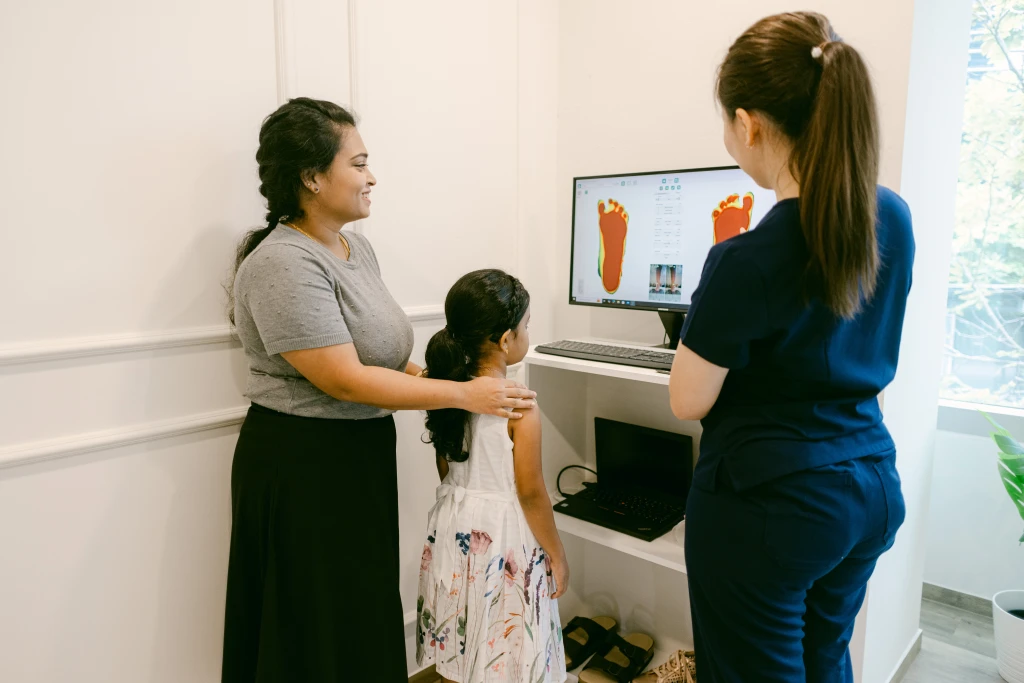
Treating and Preventing Iselin’s Disease
Treatment focuses on calming the inflamed growth plate, removing the mechanical stresses driving the irritation, and letting your child keep doing the activities they enjoy at a tolerable level. Relative rest matters first. That usually means cutting back the sport sessions that flare the pain rather than full bed rest, and using ice and a short course of paracetamol or anti-inflammatory medication where appropriate and on medical advice.
Stretching the calves and strengthening the foot and lower leg muscles addresses the muscular imbalance that fuels the traction. Custom orthotics can reduce peroneal tendon load by redistributing pressure across the foot, especially when foot shape is part of the picture. Sport-appropriate footwear with a good heel counter and a stable midsole takes load off the outer foot during pivots and jumps. For stubborn cases, shockwave therapy is sometimes considered to support healing at the growth plate.
Prevention overlaps with treatment: gradual progression of training, adequate rest between sessions, sport-specific shoes, and warm-up and cool-down routines all reduce flare risk.
Have Your Iselin’s Disease Managed at Straits Podiatry
Paediatric foot conditions are seen at all three Straits Podiatry clinics in Buona Vista, Orchard, and Paya Lebar, where our podiatrists work with children of all ages. Straits Podiatry is part of Healthway Medical Group.
A paediatric assessment for Iselin’s disease includes gait analysis, foot and calf flexibility testing, sport and training review, and where indicated, custom orthotics, footwear advice, a stretching and strengthening programme, and a monitoring plan through the growing years.
Speak with Straits Podiatry or book a consultation for an assessment and a tailored approach to manage your child’s Iselin’s disease.
Frequently Asked Questions About Iselin’s Disease
Will my child grow out of Iselin’s disease?
Yes. Iselin’s disease is self-limiting and resolves once the growth plate at the base of the fifth metatarsal fuses at skeletal maturity, usually in the mid-teens. That does not mean nothing needs to be done in the meantime. The goal of treatment is to control the pain, support healing of the growth plate, and let your child keep playing sport at a tolerable level so growth and development continue normally during the years it takes to resolve.
Does my child need to stop sport completely?
Usually not. Full rest is rarely required and can sometimes do more harm than good for a growing, active child. What is needed is relative rest. That means cutting back the specific movements that flare the pain, easing total volume, and rotating in lower-impact activities while the growth plate settles. Many children continue playing sport at a modified level throughout treatment, with the focus on staying below the pain threshold rather than pushing through it.
Will my child need orthotics?
Not every child does. Orthotics are considered when foot shape, gait mechanics, or recurrent flares are clearly contributing. A high-arched or stiff foot tends to load the outer edge more, which adds pull on the growth plate. A custom orthotic redistributes that load. For mild Iselin’s that settles quickly with rest and stretching, supportive footwear alone may be enough. A paediatric gait assessment guides whether orthotics will add value.
Can adults get Iselin’s disease?
No. Iselin’s disease only occurs while the growth plate at the fifth metatarsal base is still open, which is usually before skeletal maturity in the mid-teens. Adults do not develop osteochondrosis at this site. Outer foot pain in an adult is a different condition, most often peroneal tendinitis, a stress fracture, or an old avulsion fracture, and should be assessed in its own right.
How long does Iselin’s disease take to settle?
It varies. Many children improve within a few weeks of relative rest, stretching, and footwear or orthotic support, though the underlying growth plate sensitivity can persist for months or even a couple of years until it fuses. Flares can recur during growth spurts or when training spikes. Steady management through the growing years usually keeps symptoms low and lets your child stay active until the condition fully resolves.