
Overview
Knee pain is one of the more common musculoskeletal complaints in active Singaporeans, and it shows up across a wide age band. Runners building mileage in MacRitchie, office workers climbing MRT stairs, parents chasing toddlers around the playground, and older patients managing decades of cumulative joint load all sit in the same waiting room. Knee pain rarely happens in isolation. How the foot strikes the ground, how the hip controls the thigh, and how the calf and quadriceps share load through the knee all feed into the same joint. Some knee-pain presentations also overlap with leg pain, particularly where ITB tightness or calf-driven mechanics contribute. That is why an honest assessment matters early, before the pattern settles in and a small irritation becomes a recurring problem.
What Is Knee Pain?
Knee pain is discomfort in or around the knee joint complex, which links the femur, tibia, and patella through a network of ligaments, tendons, cartilage, and bursae. Because so many structures load through the same joint, the source is rarely obvious from the symptom alone. Pain can present as a sharp catch with stairs, a deep ache after a long walk, a burning along the outer thigh, swelling that builds over the day, a sense of the knee giving way, or a click or lock during movement. The location, the timing, and the behaviour of the pain together narrow the likely cause.
Symptoms of Knee Pain
The character and timing of knee pain often point to the underlying cause. Common patterns include:
- Sharp pain at the front of the knee, around or behind the kneecap, worse on stairs, squatting, or after prolonged sitting.
- Pain on the inner or outer side of the knee, often related to ligament, meniscus, or iliotibial band involvement.
- Pain behind the knee, sometimes related to hamstring, calf, or joint structures.
- Swelling, warmth, or stiffness around the joint.
- Locking, clicking, or a sense of the knee giving way during movement.
- Pain that comes on with specific activities such as running, jumping, or cycling, and eases with rest.
- Morning stiffness that loosens within thirty minutes of moving.
- Pain that traces back to a twist, a fall, or a sudden change in training volume.
Conditions That Cause Knee Pain
Knee pain is often shorthand for a more specific underlying condition. The conditions below cover the common patterns seen in clinic:
- Patellar tendonitis: pain at the tendon just below the kneecap, often in jumping sports such as basketball, volleyball, and badminton.
- Runner’s knee (patellofemoral pain syndrome): a diffuse ache around or behind the kneecap, worse on stairs, squatting, or after prolonged sitting.
- Iliotibial band syndrome (ITBS): a sharp pain on the outer knee that comes on at a predictable distance into a run.
- Knee osteoarthritis: age-related thinning of joint cartilage, presenting as stiffness, swelling, and a deep ache that builds over the day.
- Meniscus tear: a tear of the shock-absorbing cartilage inside the joint, often after a twist or as part of degenerative change.
- Hamstring strain: pain behind the thigh that refers into the back of the knee, common in sprinting and acceleration sports.
- Calf strain: pain in the calf that can feed tension into the back of the knee and alter how the knee loads.
- Knock knees (genu valgum): a structural alignment pattern that increases load through the inner knee.
- Leg length discrepancy: a difference in functional or structural leg length that loads one knee harder than the other.
Ligament injuries (ACL, PCL, MCL, LCL), bursitis, and inflammatory joint conditions such as rheumatoid arthritis and gout also cause knee pain. These typically need orthopaedic, rheumatology, or general medical input alongside any conservative care.
Causes of Knee Pain
What Causes Knee Pain?
- A sudden rise in running, jumping, or cycling volume that outpaces what the tissues are conditioned for.
- A twist, fall, or direct blow that loads the joint beyond what the ligaments and meniscus can absorb.
- Worn-out or unsupportive shoes that change how the foot strikes the ground.
- Lower-limb mechanics that send load through the knee inefficiently, such as flat feet, knock knees, or a leg length difference.
- Weak quadriceps, hamstrings, or gluteal muscles, which fail to control the knee during movement.
- Tight calves or limited ankle motion, which force the knee to compensate during squatting and stairs.
- A previous knee injury or surgery that altered the joint’s mechanics.
Who Carries a Higher Baseline Risk?
- Runners, cyclists, and athletes in jumping and pivoting sports such as basketball, volleyball, badminton, and football.
- People returning to sport after time off, where conditioning has dropped.
- Adults aged 50 and above with cumulative joint load and early osteoarthritic change.
- People carrying excess body weight, which multiplies load through the joint.
- People with longstanding flat feet, knock knees, bow legs, or a leg length difference.
- People with a history of previous knee injury or knee surgery.
- NS trainees and people moving from a sedentary baseline into high-volume training quickly.
Diagnosis
Getting the correct diagnosis is the practical first step toward effective treatment. The clinician typically works through the following:
- Patient interview: a structured review of when the pain started, what aggravates it, what relieves it, training and activity history, footwear, and any prior knee, hip, or ankle injury. The pattern often points strongly to the cause before any imaging is needed.
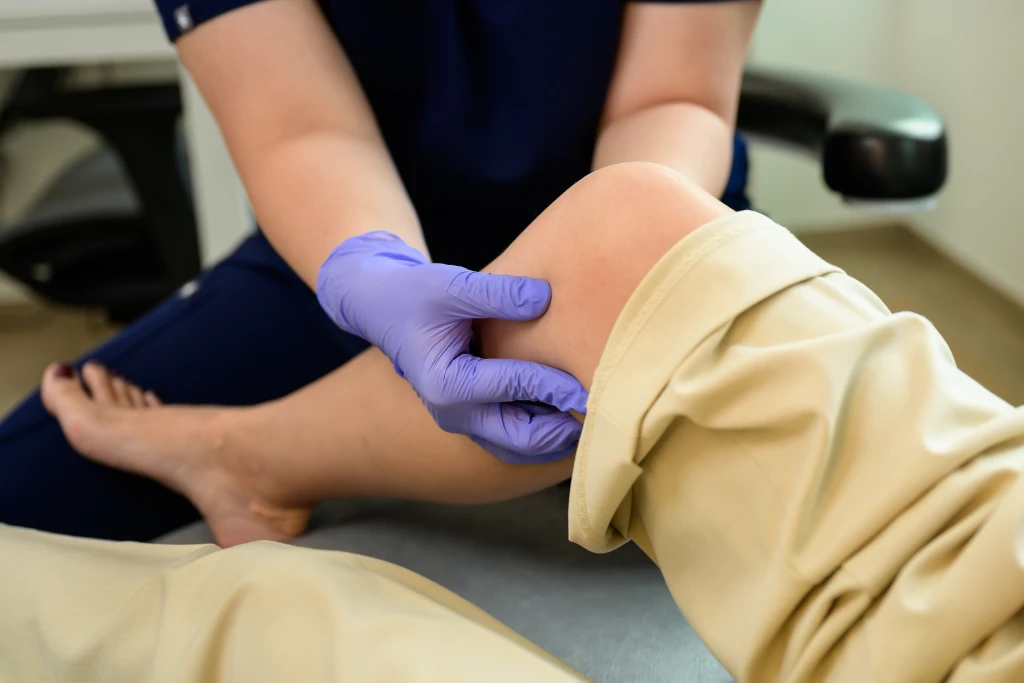
- Physical examination: hands-on assessment to test joint range, ligament integrity, meniscus signs, patellar tracking, swelling, and tender points. Strength and control of the quadriceps, hamstrings, and glutes are checked as part of the same exam.
- Imaging: X-rays for bony causes such as fractures, osteoarthritis, and joint space narrowing. MRI for soft tissue questions such as meniscus tears, ligament injuries, and cartilage damage that persist past a fair trial of conservative care.
- Gait analysis: where lower-limb mechanics are part of the picture, gait analysis identifies how the foot, ankle, knee, and hip move together under load. This is where podiatry adds value to the diagnostic chain for mechanical knee pain.
- Blood tests: when an inflammatory or systemic cause is suspected, such as gout or rheumatoid arthritis, blood tests help confirm or rule it out.
Treatment Options for Knee Pain in Singapore
Treatment depends on what is driving the pain, but most knee pain settles with a paced, structured plan. The first phase calms the irritated tissue, the second restores mechanics so the same flare does not return, and the third escalates only when conservative care has been given a fair trial.
Settle the Pain
- Reduce aggravating high-impact activity for a defined period, rather than pushing through.
- RICE for acute flare-ups: relative rest, ice, compression, and elevation.
- Over-the-counter anti-inflammatories may help in the short term and should be discussed with a clinician.
- Avoid the activities that consistently provoke the knee while the tissue settles. Activity modification is a temporary shift to lower-impact loading, not indefinite avoidance.
Restore Mechanics
- Structured physiotherapy to rebuild strength and control in the quadriceps, hamstrings, and gluteal muscles, and to restore ankle and hip mobility where these are limiting the knee.
- Custom orthotic insoles where foot mechanics are loading the knee inefficiently, particularly in cases with flat feet, knock knees, or a leg length difference.
- Supportive footwear matched to the activity, replaced before the midsole packs out.
- A gradual return to load, with lower-impact training mixed in to share work across the kinetic chain.
- Weight management where excess body weight is multiplying joint load.
Escalate When Needed
For cases that resist conservative care, Extracorporeal Shockwave Therapy (ESWT) can stimulate stubborn tendon tissue to heal in chronic patellar tendonitis and ITBS, and Magnetotransduction Therapy (EMTT) is used alongside ESWT for chronic cases where progress has stalled. Injection therapies, prescribed by a doctor, can offer temporary relief in selected cases.
Surgery becomes a serious consideration in specific situations: a complete cruciate ligament rupture, a large meniscus tear causing mechanical locking, severe end-stage knee osteoarthritis where joint replacement is the next step, or structural knee deformity that conservative care cannot correct. The decision to operate sits with an orthopaedic surgeon. The podiatry role is to assess what the foot, ankle, and lower limb contribute, manage that conservatively, and refer to orthopaedic surgery when the clinical picture calls for it.
Prevention
Build training load gradually rather than in sudden jumps. Keep quadriceps, hamstrings, and gluteal strength up year-round, not just in pre-season blocks. Replace running shoes before the midsole packs out. Address foot mechanics through a gait assessment if knee pain keeps returning, rather than treating each flare in isolation. Warm up before high-impact training and cool down afterwards. Stop pushing through pain that has not settled within a session or two.
Have Your Knee Pain Managed at Straits Podiatry
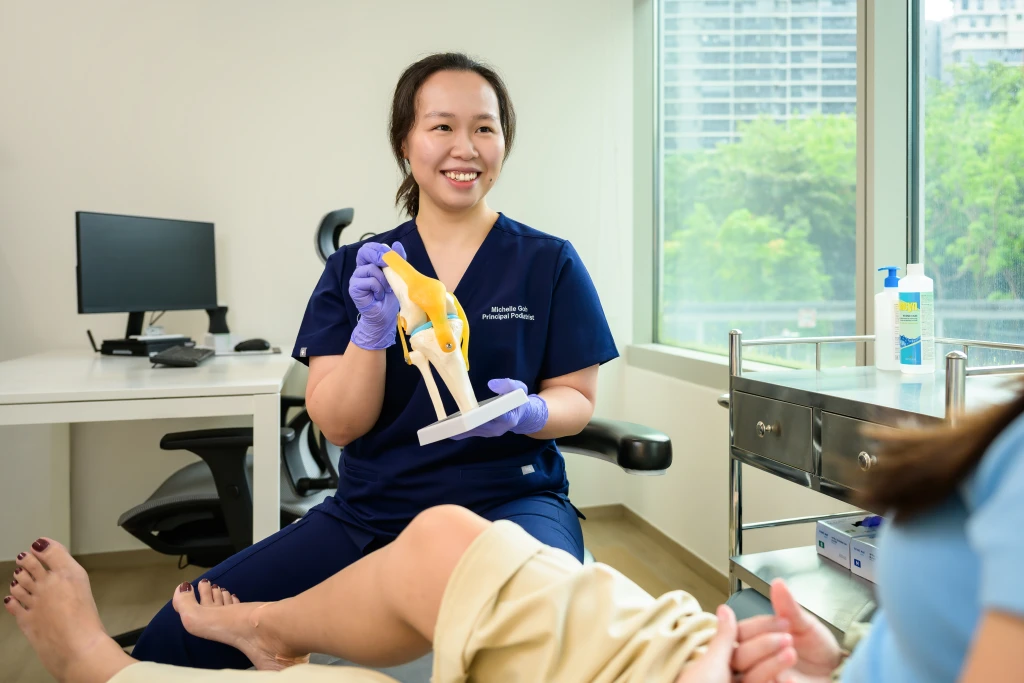
Knee pain straddles podiatry, physiotherapy, and orthopaedic surgery, and the right starting point depends on what is driving the pain. At Straits Podiatry, the assessment focuses on what the foot, ankle, and lower limb contribute to the load through the knee, since that is where mechanical knee pain is often won or lost.
The plan is built around your daily routine. Services that may form part of your care include gait analysis, custom orthotic insoles, footwear guidance, and ESWT or EMTT for tendon-related knee pain that has not settled with conservative measures. Where structured rehabilitation is the right next step, our physiotherapist works alongside the podiatry plan to rebuild strength and control around the knee. Where surgery is the appropriate path, a referral to an orthopaedic surgeon is arranged.
Speak with the team or book a consultation for an assessment and a tailored path back to comfortable movement.
Frequently Asked Questions About Knee Pain
What is the difference between mechanical and inflammatory knee pain?
Mechanical knee pain comes from how the joint is loaded: structural alignment, tendon overload, meniscus or cartilage wear, ligament injury, or lower-limb mechanics that send load through the knee inefficiently. It typically worsens with specific activities and eases with rest. Inflammatory knee pain comes from joint lining inflammation, often with swelling, warmth, prolonged morning stiffness, and pain that can be present at rest. Inflammatory causes such as rheumatoid arthritis and gout need medical management alongside any conservative care. The two can also coexist, which is why an early assessment helps separate them.
How do I know if my knee pain is serious?
Seek help promptly if you have significant swelling or bruising after an injury, the knee gives way when you put weight on it, you cannot fully bend or straighten the knee, the knee locks during movement, you cannot bear weight without sharp pain, or the pain has not improved within a week of rest and self-care. Knee pain in people with diabetes, on blood thinners, or with a prior knee surgery always warrants earlier review.
Can I keep running with knee pain?
Sometimes, but not in the same way. The honest answer depends on the cause, the irritation level, and how the knee responds to lower-volume running. Tendon-related knee pain such as patellar tendonitis or ITBS often tolerates a paced reduction in volume better than a full stop, since complete deload can stiffen the tendon. Acute meniscus or ligament injury, swelling that builds during or after running, and any sense of the knee giving way are signals to stop and get assessed before returning to load. The fastest way back to running is usually a paced plan, not pushing through.
Should I see a podiatrist, physiotherapist, or orthopaedic surgeon for knee pain?
It depends on the picture. A podiatrist is a strong starting point when foot, ankle, or lower-limb mechanics look like part of the cause, when the pain has a tendon-overload pattern such as patellar tendonitis or ITBS, or when footwear and orthotic input is likely to help. A physiotherapist leads on structured rehabilitation to rebuild strength and movement around the knee, and often works alongside the podiatry plan. An orthopaedic surgeon is the right call when imaging shows structural damage that needs surgery, when conservative care has been given a fair trial without improvement, or after a significant injury such as a suspected cruciate ligament rupture or a large meniscus tear. Many cases benefit from input across more than one of these.
How long does knee pain take to settle?
Most acute knee pain settles within a few weeks once the load is reduced and the right supportive measures are in place. Chronic tendon-related knee pain such as patellar tendonitis or ITBS often takes three to six months of paced rehabilitation, particularly when mechanics need addressing. Knee osteoarthritis is a longer-term management picture rather than a single recovery window. The earlier the assessment, the shorter the recovery tends to be, since paced care almost always resolves faster than a stop-start cycle of self-managed flare-ups.