

Overview
Arthritis of the foot and ankle is increasingly common in Singapore, partly because the population is ageing and partly because more adults are staying active into later decades. The foot carries 33 joints between the toes, midfoot, hindfoot, and ankle, and any of them can become arthritic. The drivers fall into four broad lanes: prior injury, years of mechanical loading on a poorly supported foot, autoimmune disease, and crystal disease such as gout. Each lane needs a different treatment plan, which is why a clean diagnosis matters more here than in most foot conditions.
What Is Foot and Ankle Arthritis?
Arthritis is a general term for inflammation, degeneration, or both within a joint. In the foot and ankle it can affect any of the 33 joints, from the toes and midfoot through the hindfoot to the ankle itself. What sets it apart from a purely mechanical foot problem is that the joint surface itself is involved, so the pain tends to be deep, sits at the joint line, and comes with stiffness and reduced movement rather than tracking a single soft-tissue structure.
Several distinct diseases can produce arthritis in the same foot, and each behaves and responds differently. Identifying which type is present is the step that shapes the whole treatment plan, because mistaking one for another sends the patient down the wrong pathway and delays the care that actually helps. The main types seen in the foot and ankle are set out in the next section.
Symptoms of Foot and Ankle Arthritis
The character and pattern of symptoms often point to which type is at play.
- Joint stiffness in the morning that loosens after the first hour of activity, classically associated with rheumatoid and other inflammatory arthritis.
- A deep ache in a single joint that worsens through the day with activity and settles with rest, classically osteoarthritis.
- Sudden severe swelling, warmth, and redness localised to a single joint, often the base of the big toe, classically a gout flare.
- Symmetric small-joint pain across the forefoot of both feet, often with morning stiffness lasting more than 30 minutes, suggestive of rheumatoid arthritis.
- A sausage-like swelling of an entire toe alongside skin or nail changes, suggestive of psoriatic arthritis.
- Reduced range of motion at the big toe, midfoot, or ankle, with grinding or catching during movement.
- A visible bony enlargement around a joint, often at the top of the midfoot or the side of the big toe.
- Pain at the back of the heel or the arch that does not behave like a typical tendinopathy and is paired with skin changes, suggestive of psoriatic involvement.
Types of Foot and Ankle Arthritis
This is the routing section. Each type below has a different mechanism, a different specialty lead, and a different treatment plan.
Osteoarthritis of the Foot and Ankle
Osteoarthritis is wear-pattern arthritis and the most common type seen in the foot and ankle. The cartilage that lines a joint thins out, leaving the bones to load and rub more directly. Drivers include prior fracture or sprain, years of high-load activity, a foot shape (flat foot or high arch) that concentrates stress on one joint, and age-related cartilage change.
The four regions where OA most commonly settles:
- Big toe OA, known clinically as hallux rigidus. The joint at the base of the big toe stiffens and loses upward bend. This is the most common single-joint OA in the foot.
- Midfoot OA, where the tarsometatarsal joints across the top of the midfoot become painful and stiff. Patients describe a deep ache across the top of the foot after walking, often with a visible bony ridge over time.
- Subtalar OA, where the joint below the ankle that controls side-to-side foot motion becomes painful. Often follows a calcaneal fracture or repeated ankle sprains, with pain noticeable on uneven ground.
- Ankle OA, where the joint between the tibia and the talus loses cartilage. True primary ankle OA is uncommon. Most cases follow significant prior trauma or surgery to that joint.
Rheumatoid Arthritis in the Feet
Rheumatoid arthritis is an autoimmune condition. The immune system targets the synovial lining of joints, most often the small joints of the forefoot, and the pattern is usually symmetric across both feet. Morning stiffness lasting more than 30 minutes is a hallmark, and untreated RA can erode joint surfaces and shift toe alignment over time. Systemic management sits with a rheumatologist. The podiatry role is foot-specific support such as pressure offloading, footwear guidance, and protecting at-risk skin. The linked pillar covers the full picture.
Gout
Gout is a crystal arthropathy. Uric acid crystallises inside a joint and triggers an acute, intensely painful flare, classically at the base of the big toe. Flares come on quickly, often overnight, with redness, warmth, and swelling that can mimic infection. Long-term management is medical and dietary, with podiatry supporting flares through offloading and accommodating footwear. The linked pillar covers diagnosis, flare management, and long-term care.
Psoriatic Arthritis
Psoriatic arthritis is autoimmune and linked to psoriasis of the skin or nails. In the foot it shows up as a swollen, sausage-like toe (dactylitis), pain at the Achilles insertion or plantar fascia origin (enthesitis), and nail pitting or thickening. Patients often have skin patches elsewhere, although the foot involvement can sometimes appear before the skin diagnosis is made. Like rheumatoid arthritis, the systemic side belongs with a rheumatologist. The podiatry role is supportive: pressure management, footwear, nail care, and protecting irritated insertions.

Causes of Foot and Ankle Arthritis
The cause depends on which type of arthritis is in play. Treating “arthritis” as a single disease misses this, which is why the pathway differs by type.
What Drives Each Type?
- Osteoarthritis is driven by joint load over time. Prior injury, prior surgery, foot shape that concentrates stress on a single joint, repeated overload from work or sport, and age-related cartilage change all contribute.
- Rheumatoid arthritis is driven by autoimmune attack on the synovial lining. Genetics, smoking, and other immune factors raise the baseline risk, and flares can be triggered by stress or infection.
- Gout is driven by elevated serum uric acid that crystallises inside joints. Diet (red meat, shellfish, alcohol, sugary drinks), kidney function, medication, and genetics all influence uric acid levels.
- Psoriatic arthritis is driven by the same immune pathway that produces psoriasis of the skin. It can flare in parallel with skin disease or independently of it.
Who Carries a Higher Baseline Risk?
- Adults aged 50 and above, where cartilage change is more common.
- People who have had a foot or ankle fracture, dislocation, or surgery to a foot or ankle joint.
- People with a foot shape (flat foot or high arch) that concentrates load on one joint over years.
- Runners, dancers, and people in physically demanding jobs.
- People with a family history of rheumatoid arthritis, psoriasis, psoriatic arthritis, or gout.
Diagnosis
Identifying the type of arthritis is the practical first step, because the treatment lane depends on it. A podiatrist typically works through the following:
- Patient interview: a structured review of when the pain started, whether it came on suddenly or gradually, which joints are involved, morning stiffness duration, skin or nail changes, family history, prior joint injury, and diet and alcohol patterns.
- Physical examination: hands-on assessment of joint range, swelling pattern, warmth, joint line tenderness, gait, and foot shape. The pattern of which joints are affected often points to the type before any imaging is needed.
- Imaging: X-ray for joint space loss, bone spurs, and erosions. MRI for early cartilage change, bone marrow oedema, or soft-tissue involvement that an X-ray will not show.
- Blood tests, ordered through the GP or rheumatologist when an inflammatory or crystal cause is suspected: rheumatoid factor and anti-CCP for rheumatoid arthritis, serum urate for gout, ESR and CRP as general inflammatory markers, and HLA-B27 in suspected psoriatic disease.
Where the picture suggests an autoimmune or crystal cause, a podiatrist will coordinate with the GP or refer onward to a rheumatologist, since systemic management sits with that specialty.
Treatment Options for Foot and Ankle Arthritis in Singapore
Treatment depends entirely on which type of arthritis is in play. The general structure is a paced three-phase plan, but the specifics differ by lane.
Osteoarthritis: Lane-Specific Care
Treatment focuses on reducing load on the affected joint, restoring movement where possible, and escalating to surgery only when conservative care has been given a fair trial.
- Activity modification, swapping out the movements that consistently spike the joint and keeping the lower-impact options the joint tolerates.
- Stiff-soled or rocker-soled footwear for big-toe and midfoot OA, reducing bend demand on the painful joint at push-off.
- Custom orthotic insoles to redistribute pressure, and in selected cases an ankle-foot orthosis for ankle or subtalar OA.
- Gait analysis to identify the movement pattern that overloads the joint, then targeted retraining.
- Joint injections in selected cases, coordinated with the GP or orthopaedic team.
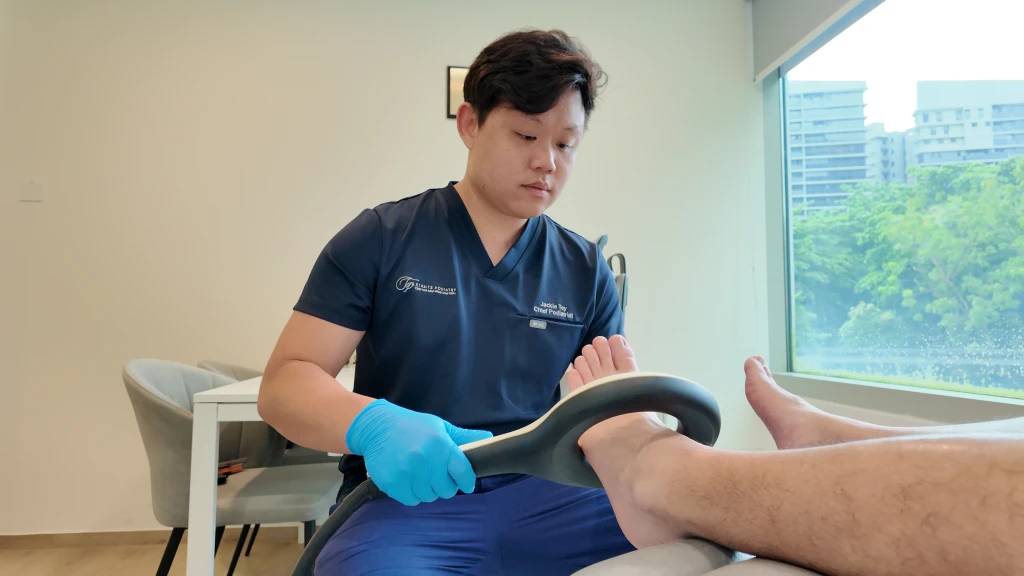
- For periarticular tendinopathy that sits alongside the OA, focused ESWT and EMTT can be used as pain-relieving and anti-inflammatory adjuncts to help calm the surrounding soft tissue.
- Surgery is the last lane. Options include joint fusion, joint replacement, or cheilectomy depending on the joint and severity.
Rheumatoid and Psoriatic Arthritis: Systemic Plus Foot-Specific Support
These are autoimmune diseases, so the lead is a rheumatologist who manages the systemic side with disease-modifying medication. The podiatry role sits alongside that and addresses the foot-specific consequences:
- Pressure offloading for forefoot joints that are inflamed or have shifted alignment.
- Footwear guidance that accommodates joint changes without irritating the skin over bony prominences.
- Custom orthotic insoles to redistribute load away from the most inflamed joints.
- Nail and skin care, especially in psoriatic arthritis where nail changes and at-risk skin matter.
- Coordinated care with the rheumatology team where systemic flares change what the foot can tolerate.
Gout: Acute Plus Long-Term
Gout management has two parts that often get confused:
- Acute flare management: settling the painful joint with anti-inflammatory measures guided by a doctor, offloading the joint, and avoiding footwear that compresses it.
- Long-term management: urate-lowering therapy prescribed by the GP or rheumatologist, alongside dietary attention to alcohol, red meat, shellfish, and sugary drinks, and review of any medications that raise urate.
Podiatry contributes during flares with offloading and footwear, and between flares with pressure management for joints that have been affected repeatedly.

Have Your Foot and Ankle Arthritis Managed at Straits Podiatry
When arthritis starts to affect how you walk, the priority is to identify the type accurately, then build the care plan around what that type actually responds to. At Straits Podiatry, the assessment connects the joints involved, the pattern of symptoms, your foot shape and gait, your activity and footwear, and any relevant medical history, so the type is clear before any treatment begins.
From there, the plan is built around your daily routine and the specific lane the arthritis sits in. For osteoarthritis, services that may form part of your care include gait analysis, custom orthotic insoles, footwear guidance, and ESWT or EMTT for periarticular tendinopathy that is not settling. For rheumatoid and psoriatic arthritis, the systemic lead sits with a rheumatologist, and our role is foot-specific pressure management, footwear, and coordinated care. As part of Healthway Medical Group, internal referral to the right specialty is straightforward when it is needed. Speak with the team or book a consultation for a thorough assessment and a tailored path forward.
Frequently Asked Questions About Foot and Ankle Arthritis
What is the difference between osteoarthritis and rheumatoid arthritis in the foot?
Osteoarthritis is wear-pattern. The cartilage in a joint thins over time, usually after prior injury, mechanical overload, or a foot shape that concentrates stress on one joint. It tends to affect a single joint or a small group of related joints, comes on gradually, and worsens with activity through the day. Rheumatoid arthritis is autoimmune. The immune system attacks the synovial lining of multiple joints in a symmetric pattern across both feet, often the small joints of the forefoot, and morning stiffness lasting more than 30 minutes is a hallmark. The treatment lanes are completely different: OA is largely mechanical and conservative, while RA needs systemic disease-modifying medication led by a rheumatologist.
Can you have more than one type of arthritis in the same foot?
Yes, and it is not unusual. Someone with longstanding rheumatoid arthritis can also develop osteoarthritis in joints that were damaged by earlier RA flares. Someone with gout can develop OA in the big toe joint after repeated flares. Psoriatic arthritis can sit alongside enthesitis at the Achilles or plantar fascia that mimics a mechanical tendinopathy. The practical implication is that each problem still needs its own diagnosis and its own treatment lane, even when they coexist in the same foot.
Do orthotics help with foot arthritis?
Custom orthotic insoles can help in osteoarthritis, rheumatoid arthritis, psoriatic arthritis, and post-flare gout, but the goal is different in each case. In OA, the insole redistributes load away from the worn joint and supports a stiffer push-off pattern. In RA and PsA, the insole offloads inflamed or deformed forefoot joints and protects at-risk skin over bony prominences. In gout, supportive insoles and accommodating footwear help during and after flares. Orthotics do not reverse the underlying disease, but they reduce the day-to-day load that the affected joint has to absorb.
When should I see a rheumatologist instead of a podiatrist?
If symptoms suggest an autoimmune or crystal cause, a rheumatologist is the right lead. Signals include morning stiffness lasting more than 30 minutes, symmetric joint pain across both feet, swollen sausage-shaped toes, skin or nail changes alongside joint pain, sudden severe single-joint flares, family history of rheumatoid arthritis or psoriasis, or blood tests pointing to elevated inflammatory markers or urate. A podiatrist will often be the first port of call for foot pain, will help identify which lane the arthritis sits in, and will refer onward to rheumatology when the picture warrants it. Foot-specific care continues alongside the rheumatology lead.
Can shockwave therapy help with foot and ankle arthritis?
ESWT does not regrow cartilage, so it is not a treatment for the arthritis itself. Where it can help is the periarticular tendinopathy that often sits alongside an arthritic joint. A patient with midfoot OA, for example, may also have an irritated tendon crossing the painful region. ESWT can calm the tendon side while the orthotic and footwear plan manages the joint side. Whether ESWT is appropriate depends on the specific tissue involved and is a decision made after assessment, not as a default.