
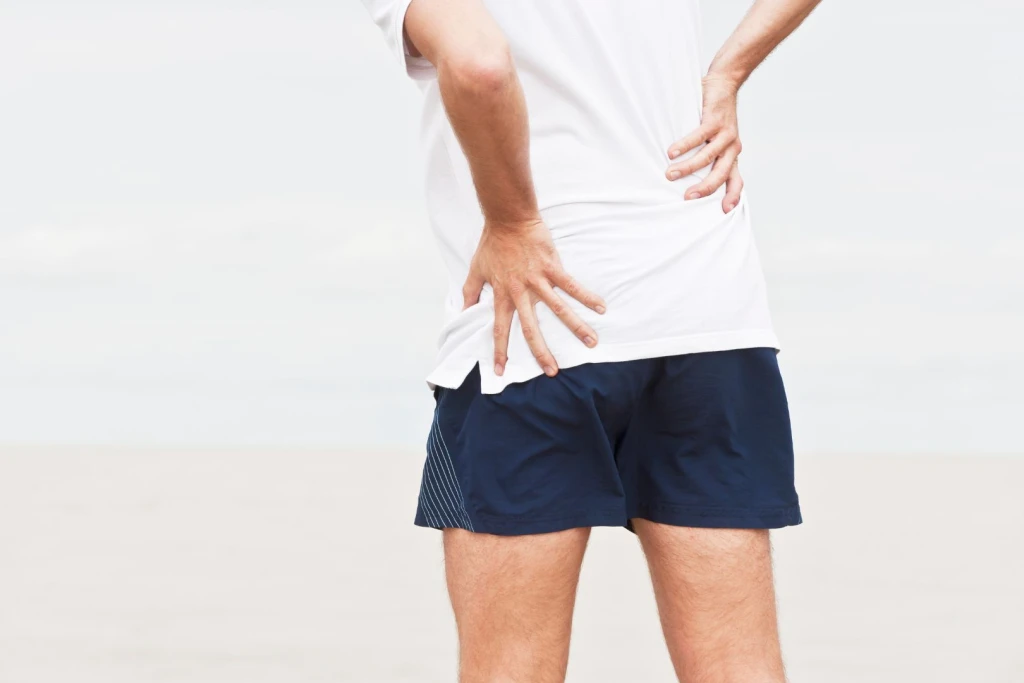
You have been driving for two hours in Singapore traffic, or you have sat through a long day at a desk in the CBD, and a deep ache has settled into one side of your buttock. It is not quite in the hip and not quite in the lower back. Standing up and walking around eases it a little, but the moment you sit back down it returns, and on a bad day it sends a line of discomfort down the back of your thigh. Runners notice it differently: a tightening deep in the buttock that builds over the second half of a long run and lingers afterwards.
The piriformis is a small muscle deep in the buttock that runs from the base of the spine to the top of the thigh bone and helps rotate the hip outward. The sciatic nerve passes directly beneath it, and in some people through it, on its way down the leg. When the piriformis becomes tight, overworked, or irritated, it can compress or aggravate that nerve, producing buttock pain with a sciatic-type radiation. Accurate diagnosis matters here more than in most lower-limb conditions, because the same leg symptoms are far more commonly produced by a disc or nerve-root problem in the lower back, and the two pathways are managed very differently.
Symptoms of Piriformis Syndrome
The pattern is a deep, localised buttock pain with a variable nerve-type component down the leg. The sitting relationship is often the most telling early clue.
- Deep pain in the buttock: the ache sits deep in the muscle of one buttock rather than in the lower back or the outer hip. Pressing into the centre of the buttock often reproduces it.
- Pain that travels down the back of the leg: some people feel the discomfort travels down the back of the leg, following a sciatic-type line into the thigh and occasionally the calf. It is usually less sharp and less far-reaching than the leg pain of a spinal nerve compression.
- Worse with prolonged sitting and driving: long stretches in a car, on a plane, or at a desk tend to build the pain, because sitting places the piriformis under sustained load against the nerve. Getting up and moving typically eases it.
- Aggravated by hip rotation and climbing: movements that rotate the hip, such as getting out of a car, crossing the legs, or climbing stairs, can provoke the pain.
- A tight or cramping sensation deep in the buttock during running: runners often describe a deep tightening that builds over distance rather than a sharp catch.
- Tenderness over the piriformis, not the spine: the most tender point sits deep in the buttock roughly midway between the tailbone and the outer hip, with the lower back itself usually comfortable to press.
- Rarely, pins and needles rather than true weakness: some people notice tingling in the buttock or leg, but a genuine loss of power or a foot that drops points more towards a spinal cause and needs prompt assessment.
From what we see in clinic, the combination of deep buttock tenderness plus a clear “worse the longer I sit” history is the most useful early pointer. It does not confirm the diagnosis on its own, but it tells us where to look and, just as importantly, prompts us to check whether the lower back is the real source.
Causes of Piriformis Syndrome
The piriformis sits at a busy junction between the pelvis, the hip, and the sciatic nerve. It tends to become symptomatic when it is repeatedly overloaded or when the mechanics above and below it change how it works.
What Causes Piriformis Syndrome?
- Prolonged sitting and sustained compression: long hours seated, particularly on a firm seat or with a wallet or phone in a back pocket, keep the muscle under pressure against the nerve. This is one of the most common everyday contributors we hear about.
- Sudden increases in running or hill training: ramping up mileage, adding hill repeats, or returning to sport too quickly loads the hip rotators faster than they adapt, and the piriformis can become tight and irritable.
- Gait patterns that overload the posterior chain: the way the foot and leg load the ground influences how hard the hip rotators work. Patterns such as excessive pronation, a leg-length difference, or weak gluteal control can leave the piriformis compensating on one side, which is where a lower-limb biomechanical assessment becomes relevant.
- Weak or poorly coordinated gluteal muscles: when the larger gluteal muscles do not stabilise the hip well, the smaller piriformis takes on more than its share and fatigues into a tight, tender state.
- Direct trauma or a fall onto the buttock: a heavy landing or a blow to the buttock can bruise and irritate the muscle, after which it tightens protectively around the nerve.
- Prolonged or repetitive hip rotation: activities that repeatedly rotate the hip, from certain racquet sports to occupations that involve twisting while seated, can overwork the muscle.
Who Carries a Higher Baseline Risk?
- Drivers, long-haul travellers, and desk-based office workers who sit for extended periods.
- Distance runners, cyclists, and racquet-sport players.
- People who have recently increased training load or changed running surface or footwear.
- Those with a leg-length difference, marked foot pronation, or weak gluteal control.
- Anyone recovering from a fall or direct injury to the buttock.
- People who habitually sit on a wallet or bulky object in a back pocket.
Conditions Commonly Mistaken for Piriformis Syndrome
Buttock and leg pain has several possible sources, and piriformis syndrome overlaps closely with problems arising in the spine, the hip, and the surrounding muscles. Distinguishing them is the central task of the assessment, because the treatment pathways diverge sharply. The most common patterns of confusion are below.
Sciatica from a lower-back disc or nerve root
This is the single most important condition to separate out. A disc bulge or nerve-root compression in the lower back produces true sciatica, where pain, numbness, or weakness travels from the spine down the leg. It tends to reach further down the limb than piriformis pain, is often provoked by bending, coughing, or straining, and can come with genuine muscle weakness. Piriformis pain centres on the buttock and is provoked more by sitting and hip rotation. Because a spinal cause is both more common and more serious, any leg weakness, a foot that drops, or changes in bladder or bowel control need prompt medical assessment and usually spinal imaging rather than muscle-focused care.
Greater trochanteric pain syndrome
Greater trochanteric pain syndrome causes pain over the bony point on the outer side of the hip, often worse when lying on that side or climbing stairs. Piriformis pain sits deeper and more towards the centre of the buttock. The two can coexist, but the tender point on examination is in a different place.
Proximal hamstring tendinopathy
Irritation where the hamstring tendons attach to the sitting bone produces a deep pain low in the buttock, close to where you sit down. It is typically worse with sitting on a hard surface and with activities that load the hamstring, such as lunging or fast running, and the tenderness sits lower and more central than the piriformis. It does not usually produce the radiating leg symptoms that piriformis irritation of the sciatic nerve can.
Sacroiliac joint dysfunction
The sacroiliac joint, where the spine meets the pelvis, can refer pain into the buttock and occasionally the upper thigh. It is often aggravated by standing on one leg, rolling over in bed, or transitions such as getting in and out of a car. The tender area sits closer to the dimples at the base of the spine rather than deep in the centre of the buttock, and specific joint stress tests help tell the two apart.
Treating and Preventing Piriformis Syndrome
Piriformis syndrome usually responds well to conservative care once a spinal cause has been reasonably excluded. The logic of treatment is to settle the irritated muscle, restore length and strength through the hip rotators and glutes, and correct any loading pattern that keeps overworking the piriformis. Because the condition is muscular, the stretching and strengthening rehabilitation is the core of recovery and is led by physiotherapy, while podiatry contributes on the biomechanical side where the way the foot and leg load the ground is part of the picture. Surgery is rarely needed.
Conservative treatment
These measures are usually combined and adjusted as symptoms settle.
- Activity and posture modification: the first step is reducing the sustained load on the muscle. Breaking up long periods of sitting, taking movement breaks on long drives, adjusting seat height, and removing a wallet from the back pocket often make a noticeable early difference.
- Physiotherapy-led rehabilitation: a structured programme of piriformis and hip-rotator stretching plus gluteal strengthening is the centrepiece of recovery. Our physiotherapy service, the rehabilitation arm of Straits Podiatry, guides the progression so the larger hip muscles take over the stabilising work and the piriformis is no longer left to compensate.
- Gait assessment and custom foot orthotics: where a foot or gait pattern such as marked pronation or a leg-length difference is loading the posterior chain unevenly, a biomechanical assessment identifies it, and orthotic support can help balance how the limb loads so the piriformis is not repeatedly overworked on one side.
- Focused shockwave therapy: where the muscle has become chronically tight and tender and conservative care has plateaued, focused shockwave therapy can be directed at the piriformis to help settle the persistent muscular component. It is used alongside the stretching and strengthening programme, not instead of it.
- Radial pressure wave therapy: applied over the broader gluteal muscle bulk, radial pressure wave therapy can help ease widespread muscle tightness and support the rehabilitation, particularly in runners with deep, diffuse buttock tension.
- Magnetotransduction therapy (EMTT): in more stubborn cases, EMTT may be combined with the pressure-wave approaches to support recovery in the deep muscle tissue.
When conservative care isn’t enough
Most cases improve with activity modification and a well-run rehabilitation programme over several weeks to a few months. Where buttock pain and leg symptoms have not responded to this, or where the leg symptoms are prominent, the priority is to reassess the lower back, because a spinal nerve-root problem can masquerade as piriformis syndrome. Imaging of the lumbar spine, usually MRI, is the usual next step to clarify the source, and this sits with a spinal or musculoskeletal medical specialist rather than with podiatry. For confirmed, stubborn piriformis syndrome, a specialist may consider an image-guided injection into the muscle to calm the irritation and allow rehabilitation to progress. Surgical release of the piriformis is uncommon and reserved for the small number of cases where nerve compression is confirmed and everything else has failed.

Have Your Piriformis Syndrome Managed at Straits Podiatry
Piriformis syndrome rewards a careful assessment that first works out whether the buttock and leg pain is coming from the muscle or from the lower back. At Straits Podiatry, an assessment for suspected piriformis syndrome includes a focused history, palpation of the deep buttock, movement and hip-rotation testing, and a biomechanical evaluation of how your foot and leg load the ground, since gait patterns and hip and buttock pain are often linked.
Where the picture points to the muscle, we can help with the biomechanical side through gait analysis and custom orthoses, and settle the stubborn muscular component with focused shockwave or radial pressure wave therapy, while our physiotherapy service leads the stretching and strengthening that drives recovery. Where the signs point to the spine instead, we say so and guide you to the right pathway. If a deep buttock ache is flaring every time you sit or drive, book a consultation for an assessment at any of our three Singapore clinics.
Frequently Asked Questions About Piriformis Syndrome
How long does piriformis syndrome take to settle?
Most people notice improvement within a few weeks of starting activity modification and a structured stretching and strengthening programme, with fuller recovery over one to three months depending on how long the muscle has been irritated and how much sitting or training load can be adjusted. Cases that have been building for a long time, or that keep being reloaded by unchanged habits, tend to take longer. If there is no improvement at all with good conservative care, that is a signal to reassess whether the lower back is the real source.
Is walking good for piriformis syndrome?
Gentle walking is usually helpful because movement eases the sustained compression that prolonged sitting places on the muscle, and most people find their buttock pain settles a little when they get up and move. Long, hard, or hilly walking can aggravate an already irritated piriformis, so the aim early on is regular, comfortable movement rather than pushing through pain. If walking sends sharp pain or numbness down the leg, that points more towards a nerve-root problem and should be assessed.
How should I sit and drive to avoid aggravating piriformis syndrome?
Break up long periods of sitting with regular movement, take stops on long drives to stand and walk for a minute or two, and avoid sitting on a wallet or bulky object in a back pocket, which presses directly on the muscle and nerve. A supportive seat cushion and a seat position that keeps the hip from being deeply flexed for hours can also reduce the load. These simple changes often make a meaningful early difference alongside rehabilitation.
Can piriformis syndrome be mistaken for sciatica from a slipped disc?
Yes, and this is the most important distinction to get right. Both can send pain down the leg, but true sciatica from a disc or nerve root in the lower back usually reaches further down the limb, is often provoked by bending, coughing, or straining, and can cause genuine muscle weakness. Piriformis pain centres on the deep buttock and is provoked more by sitting and hip rotation. Because a spinal cause is more common and potentially more serious, any leg weakness, a foot that drops, or changes in bladder or bowel control need prompt medical assessment.
What kind of clinician manages piriformis syndrome?
Piriformis syndrome is a musculoskeletal problem, so it is generally managed through physiotherapy-led rehabilitation, with a podiatrist contributing where foot and gait mechanics are loading the posterior chain and adding to the problem. At Straits Podiatry we assess the biomechanical side and can add focused shockwave or radial pressure wave therapy for the muscle, while our physiotherapy service leads the stretching and strengthening. Where the assessment suggests the pain is coming from the lower back rather than the muscle, the appropriate next step is a spinal or musculoskeletal medical specialist.
Does piriformis syndrome show up on an MRI?
Piriformis syndrome is largely a clinical diagnosis, and a standard scan of the muscle is often normal, because the problem is one of tightness and nerve irritation rather than a visible structural change. Imaging is used mainly to rule out other causes, in particular an MRI of the lower back to check for a disc or nerve-root problem that could be producing the leg symptoms. In that sense, imaging helps confirm what the pain is not, as much as what it is.