
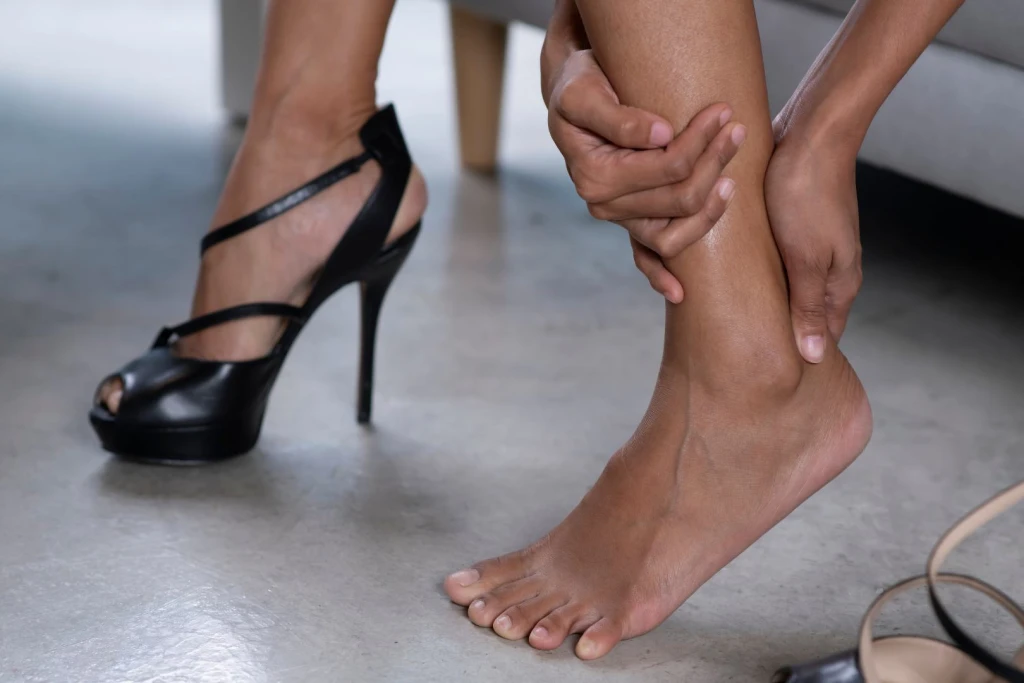
You come down hard out of a jump, push off the blocks, or rise onto the ball of your foot. A sharp pinch bites at the back of the ankle, just behind the bone, deep and a little to the outside. Walking on flat ground is usually fine. The pain shows up specifically when you point your toes down, and it lingers as a dull ache afterward. If you dance, sprint, or play football, this is the pattern of posterior ankle impingement. It behaves quite differently from the front-of-ankle pinch that most people picture when they think of impingement.
At the very back of the ankle, the talus (the bone that sits between the shin and the heel) has a small bony tail. In some people that tail is longer than usual. In others it sits as a separate ossicle called an os trigonum, present from birth in roughly one in ten people. When the foot points down into full plantarflexion, the back of the ankle joint closes like a nutcracker. The bony tail and the soft tissue around it then get squeezed between the shin bone and the heel bone. Repeat that movement thousands of times in pointe work, sprinting, or kicking, and the area becomes inflamed and tender. This is the posterior variant of ankle impingement. Recognising it early matters, because the back of the ankle holds several structures that can produce similar pain and are easily confused with one another.
Symptoms of Posterior Ankle Impingement
Posterior ankle impingement has a movement-specific signature. The pain is tied to one direction, which is pointing the toes down, rather than walking or running. That is what separates it from most other ankle problems.
What posterior ankle impingement feels like
- Deep pain at the back of the ankle on plantarflexion. The hallmark symptom is a sharp pinch behind the ankle when you point your toes down, rise onto demi-pointe or pointe, push off to sprint, or kick a ball. The pain sits deep, slightly toward the outer side, behind the ankle bone.
- Comfortable on flat ground, painful at the extremes. Ordinary walking is usually pain-free, because it does not push the ankle into full plantarflexion. The problem surfaces at the end range of pointing the foot down.
- A lingering ache after activity. Once the area is irritated, a dull background ache often persists for hours after dancing or training, and often eases within 1 to 2 days of rest.
- Tenderness when the back of the ankle is pressed. Pressing into the soft area just behind and slightly outside the ankle bone, between the Achilles tendon and the outer ankle, reproduces the pain. Sometimes it sits so deep that you cannot locate the exact tender spot.
- A pinch when the back of the joint is forced closed. When we passively point your foot down quickly while you sit, the posterior pain reproduces. This loads the bony tail against the back of the joint and is the most useful clinical sign.
- Stiffness or a “blocked” feeling at end range. Patients often describe the ankle feeling like it hits a wall when pointing down to the end range, rather than a soft, springy feeling.
- Swelling behind the ankle in flare-ups. This is less common. The back of the ankle can feel full or puffy after a heavy session.
The most reliable clue is the link between the pain and the specific movement. A dancer who only hurts on pointe is describing this pattern. So is a sprinter who only hurts on push-off, until proven otherwise.
Causes of Posterior Ankle Impingement
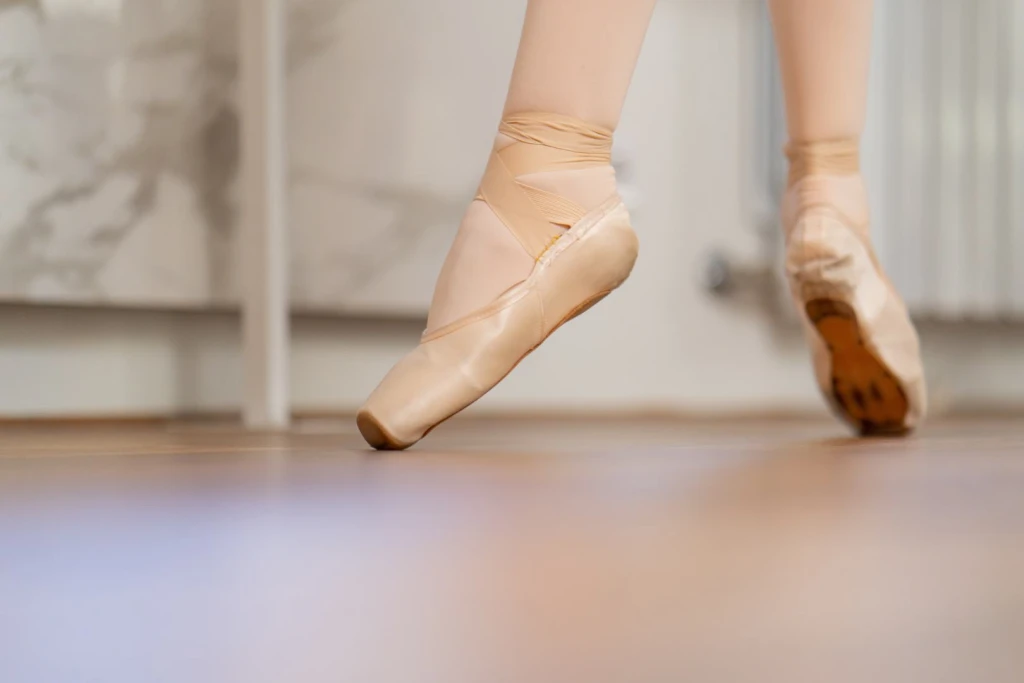
Posterior ankle impingement is fundamentally a problem of repeated end-range plantarflexion. That movement meets a little extra bone at the back of the joint, and repeated impact injures it. Most cases combine a structural factor with an impact trigger.
What Causes Posterior Ankle Impingement?
- An os trigonum. This is a separate ossicle behind the talus, present from birth in around one in ten people. It is the single most common driver of the os trigonum syndrome version of this condition. It often sits silently for years until repeated plantarflexion irritates the soft tissue around it. We usually see this presenting in young ballet dancers.
- A prominent posterior talar process (Stieda process). This is an elongated bony tail on the talus itself, similar to an os trigonum but fused to the bone rather than separate. It produces the same nutcracker effect at end range.
- Repeated forced plantarflexion in sport and dance. Pointe and demi-pointe work in ballet, push-off in sprinting, and kicking in football all drive the ankle into the position that closes the back of the joint.
- A previous ankle sprain that forced the foot downward. A sprain that drove the ankle into plantarflexion can damage the posterior soft tissue or a small bony fragment. That leaves thickened, irritable tissue that then impinges.
- A single impact that forced the foot downward. Missing a step or tripping on a kerb can create the same movement mechanism and trigger the condition.
- Soft-tissue thickening at the back of the joint. Scarring of the posterior capsule or the sheath around the nearby tendon can occupy the space the bony tail needs, tightening the squeeze.
Who Carries a Higher Baseline Risk?
- Ballet dancers, particularly those working en pointe and demi-pointe, where extreme plantarflexion is part of the technique.
- Footballers, where repeated kicking forces the ankle down through a large range.
- Sprinters and jumpers, where explosive push-off loads the back of the ankle.
- Anyone born with an os trigonum or an elongated posterior talar process, often without ever knowing until symptoms begin.
- People with a history of an ankle sprain that forced the foot into plantarflexion.
- Gymnasts and competitive swimmers (especially in events with a strong kick), whose training repeatedly points the foot down.
Conditions Commonly Mistaken for Posterior Ankle Impingement
The back of the ankle is a crowded space. Several structures there produce pain that can be confused with posterior impingement. The distinction matters, because the management differs for each.
Achilles tendonitis
The most common confusion. Achilles tendonitis produces pain in the Achilles tendon itself, a few fingers above the heel. It worsens when you load the calf, such as on a heel raise or going up stairs. Posterior impingement pain sits deeper and more to the outside, behind the ankle bone rather than in the tendon line. It is provoked by pointing the foot down rather than by calf loading.
Flexor hallucis longus tendinopathy
The tendon that bends the big toe runs right behind the ankle, through the same tight space the bony tail occupies. It often coexists with posterior impingement, particularly in dancers. The differentiator is the trigger. Flexor hallucis longus pain reproduces when you actively curl the big toe down against resistance. Pure impingement pain reproduces on passive plantarflexion of the ankle.
Retrocalcaneal bursitis
This is inflammation of the small fluid sac between the Achilles tendon and the heel bone. It produces tenderness right at the back of the heel, lower than impingement pain. It is often linked to footwear pressure on the heel rather than to pointing the foot down.
Treating and Preventing Posterior Ankle Impingement
Posterior ankle impingement usually responds well to a conservative pathway. The plan involves calming the irritated tissue, reducing how often the ankle is forced into end-range plantarflexion, and adjusting technique and footwear so the back of the joint is not repeatedly pinched. Surgery is reserved for cases that do not settle. One key point to note is that when a structural driver is present, such as an os trigonum, the condition can easily recur if you return to activities that repeatedly plantarflex the ankle maximally.
Conservative treatment
- Activity modification and load management: The first step is reducing the volume of forced plantarflexion while the inflammation settles. For a dancer, that may mean scaling back pointe and demi-pointe work for a period. For a sprinter or footballer, it may mean easing off explosive push-off and kicking drills. Lower-load conditioning continues so fitness is maintained. The aim is to take the repeated squeeze off the back of the joint without stopping all activity.
- Rocker footwear: Footwear with a rocker sole can provide some relief, as it helps reduce ankle plantarflexion during push-off. It is best used for walking, though, since this type of footwear may not suit the activity you are taking part in.
- Taping and bracing: While it is not a long-term fix, taping the ankle to gently limit the last few degrees of plantarflexion can settle symptoms during a return to activity. It gives the irritated tissue room to calm while training resumes gradually.
- Rehabilitation: Structured lower leg, calf, and ankle strengthening, along with control work, helps manage how the foot points down. Rehab should also focus on adjusting the movement patterns that drive the impingement. For dancers, working with the teacher on safe plantarflexion mechanics is a big part of the picture.
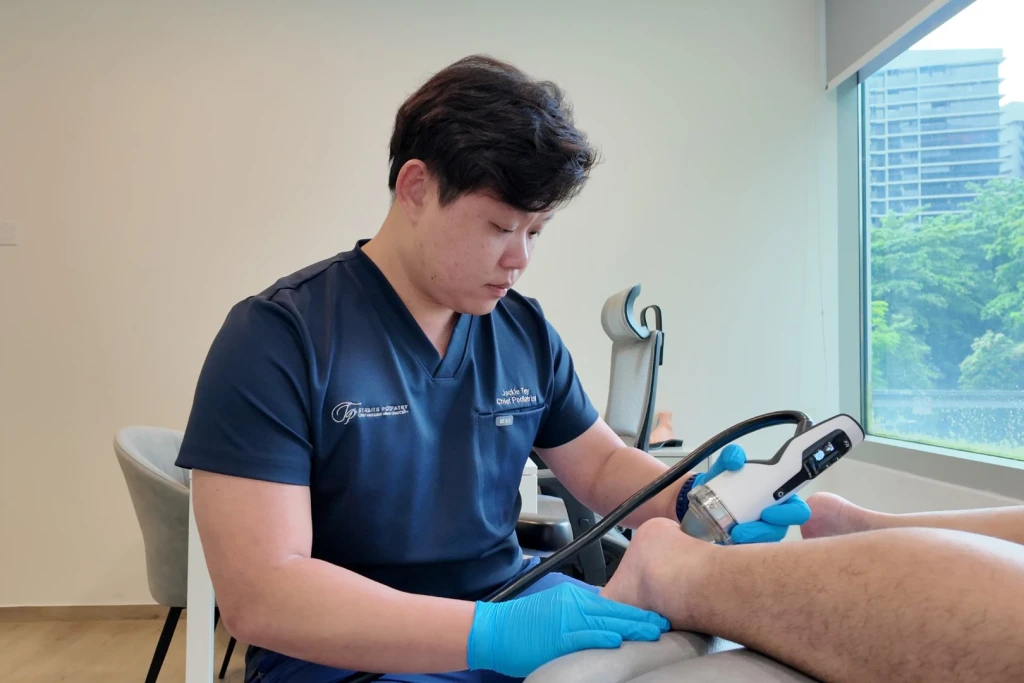
- Focused shockwave therapy: When pain starts limiting your activity, or the soft-tissue thickening at the back of the joint becomes chronic, focused shockwave therapy can be considered. It is used to relieve pain and stimulate a healing response in the irritated posterior soft tissue. It is typically delivered as a short course alongside the rehab programme rather than on its own.
When conservative care isn’t enough
A proportion of cases do not settle with conservative care, and a number of them suffer recurrent flare-ups. These are particularly the ones driven by a sizeable os trigonum or an elongated posterior talar process, clarified through imaging. Where pain persists despite an adequate conservative trial, a corticosteroid injection may settle a stubborn flare. Where a bony fragment is the clear mechanical block, a foot and ankle surgeon may have to remove it through a keyhole (arthroscopic) approach. Straits Podiatry works through the conservative pathway first. We refer onward to an orthopaedic colleague where surgical review is the right next step.

Have Your Posterior Ankle Impingement Managed at Straits Podiatry
A sharp pinch at the back of your ankle can keep interrupting your pointe work, your sprint starts, or your game. An early assessment at Straits Podiatry pins down which structure is actually involved, combining a focused history of the triggering movement with palpation, the passive plantarflexion test, and a check of the nearby tendons.
Once the pattern is clear, the plan is built around your activity goals and how much of the problem is bony versus soft tissue. Depending on the picture, this can draw on gait and biomechanical analysis, footwear and heel-position guidance, taping for a graded return, a structured rehabilitation programme with support through Straits Physiotherapy, and focused shockwave therapy for chronic posterior soft-tissue irritation. Where imaging or a surgical opinion is indicated, we arrange the referral. Speak with our team or book a consultation for an assessment to manage your posterior ankle impingement.
Frequently Asked Questions About Posterior Ankle Impingement
How long does posterior ankle impingement take to settle?
Most cases are driven mainly by soft-tissue irritation. These improve over a few weeks to a few months, once the forced plantarflexion is reduced and the right footwear, taping, and rehab measures are in place. Cases linked to a sizeable os trigonum or a prominent bony tail often take longer and sometimes plateau. That is when imaging and a surgical opinion are considered. How quickly it settles depends heavily on whether the triggering movement can be modified during the settling phase.
Do I need surgery for os trigonum syndrome?
Most people do not. The majority of os trigonum cases settle with activity modification, footwear adjustment, taping, rehab, and sometimes a guided injection. Surgery to remove the os trigonum is considered only when two things are true: an adequate conservative trial has failed, and the bony fragment is clearly the mechanical block. This is usually in a high-demand dancer or athlete who cannot achieve the range their activity needs. When it is done, it is increasingly performed through a keyhole approach by a foot and ankle surgeon.
Can I keep dancing or playing sport with posterior ankle impingement?
Often yes, but usually with adjustments during the settling phase. The aim is to reduce the volume of the specific movement that pinches the back of the ankle (pointe work, explosive push-off, kicking). Lower-load conditioning continues alongside. Pushing through the sharp end-range pain repeatedly tends to prolong the irritation. A graded return guided by symptoms is more reliable than training through it.
Should I get an X-ray or an MRI for back-of-ankle pain?
It depends on what needs to be answered. An X-ray is good for showing a bony os trigonum or an elongated posterior talar process. It is often the first image when a bony cause is suspected. An MRI is only added when the soft tissue needs to be seen. It can confirm inflammation around the bony tail, assess the nearby flexor tendon, or check for a bone reaction that a plain film cannot show. Many cases are diagnosed clinically first, with imaging referred to confirm the cause or guide a decision about injection or surgery.
How is posterior ankle impingement different from regular ankle impingement?
Regular ankle impingement most often refers to the anterior (front-of-ankle) type. Pain appears when the foot is pulled up toward the shin, common in sports with repeated forced dorsiflexion. The posterior type produces pain at the back of the ankle when the foot points down. It is closely associated with an os trigonum or a prominent bony tail on the talus. They share the term impingement (a pinch at the joint margin) but involve different positions, different anatomy, and different at-risk activities.
Should I see a podiatrist for posterior ankle impingement?
Yes, a podiatrist is a sensible first port of call for back-of-ankle pain that is tied to pointing the foot down. The assessment separates impingement from the conditions that mimic it (Achilles tendonitis, flexor tendon irritation, bursitis). It identifies whether the driver is bony or soft tissue, and sets up a conservative plan with footwear, taping, and rehab. Where imaging or a surgical opinion is needed, the podiatrist arranges the onward referral, so you are not left guessing about the next step.