
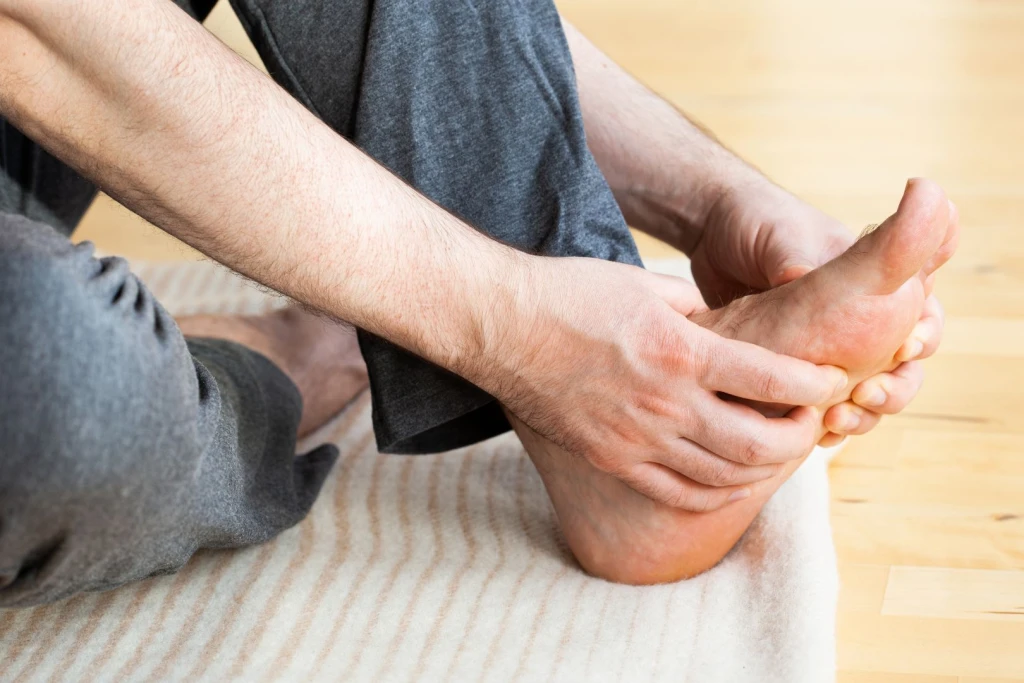
You felt an intense sharp pain under the arch that stopped you from walking further. You ran a check and your thumb caught on something firm in the arch. It felt like a small lump that was not there a year ago. It does not hurt much when you are off your feet. But as you press it, the sharp pain returns. Over time, even when you stand barefoot on hard floor, or when a tight shoe sits right over it, the pain haunts you. You thought you might have plantar fasciitis, but that pain comes and goes with your first steps. This felt different. It is a thing you can actually feel, a discrete bump sitting in the soft tissue of the sole.
That bump is often a plantar fibroma. It is a benign nodule that grows within the plantar fascia, the thick band of tissue running along the bottom of the foot from the heel to the toes. The nodule is made of fibrous tissue that has thickened in one spot along the band, usually toward the middle of the arch rather than at the heel. When several nodules form, or when the fascia thickens more extensively, the pattern is called plantar fibromatosis (also known as Ledderhose disease). It is not cancerous and it does not spread to other parts of the body. But because it sits in a weight-bearing structure, it can become tender and start to influence how you load the foot. That is the point at which most people seek an assessment.
Symptoms of Plantar Fibroma
The hallmark of a plantar fibroma is that you can feel it. The lump usually comes first, and any discomfort follows later as the nodule grows or sits under pressure.
- A firm, fixed lump in the arch. The most recognisable sign is a palpable nodule on the sole. It sits most often in the middle of the arch, and does not move freely under the skin. It is usually pea-sized to grape-sized and feels rubbery rather than hard like bone.
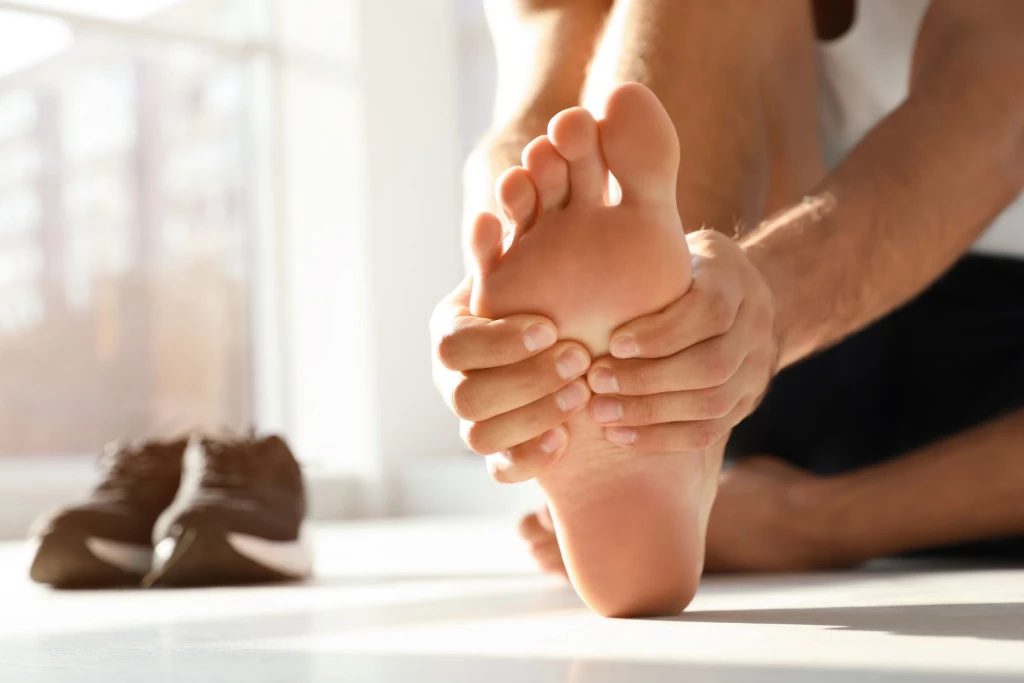
- A lump that is more obvious when the foot is stretched. Pulling the toes upward tightens the plantar fascia, which makes the nodule stand out more clearly. Many patients first notice it this way.
- Sharp discomfort on standing or walking barefoot. The nodule is often painless at rest. Sharp pain tends to appear when it is compressed against a hard surface or the inside of a shoe. Tile, timber, and thin-soled footwear are common triggers.
- A sense of a pebble or fold underfoot. For painless lumps, patients tend to describe walking as if there is a small stone or a bunched-up sock under the arch. The feeling is there even when the shoe is empty.
- Pressure pain rather than first-step pain. The discomfort is tied to direct pressure on the lump, or when the foot is stretched under weight-bearing. It does not follow the morning or after-rest pattern typical of irritation of the plantar fascia band itself.
- Slow change over months. Plantar fibromas usually grow gradually. A nodule that appears suddenly, grows quickly, or changes colour does not fit the typical pattern. It should be assessed promptly to rule out other causes.
The most useful early clue is a feelable, fixed nodule in the arch, paired with discomfort that tracks pressure. That combination distinguishes it from the diffuse heel and arch pain patterns that share the same region.
Causes of Plantar Fibroma
A plantar fibroma forms when fibrous tissue within the plantar fascia thickens and lays down extra collagen in a localised nodule. The exact trigger is not fully understood, and in many people no single cause is found. What is clearer are the factors that raise the baseline likelihood.
What Causes Plantar Fibroma?
- Repetitive microtrauma to the plantar fascia. Repeated small strains along the band are thought to drive the localised tissue response that forms a nodule, though a single injury rarely explains it.
- An abnormal healing response in fascial tissue. The nodule reflects fibrous tissue depositing more collagen than it should during repair. This process is related to the same fibrous tissue family seen in other parts of the body.
- Certain medications. Some long-term medications, including particular anti-seizure and beta-blocker drugs, have been associated with fibrous tissue conditions in case reports. This is a background association, not a guaranteed trigger.
- Genetic predisposition. Plantar fibromatosis runs in some families, and people of Northern European descent are reported more often in the literature.
Who Carries a Higher Baseline Risk?
- People with a family history of plantar fibromatosis. A history of related fibrous tissue conditions at other sites, such as a thickening of the palm tissue in the hands, also counts.
- Adults in their middle decades and beyond, where these nodules are seen more frequently than in younger people.
- People with diabetes, epilepsy, or chronic liver conditions, which carry reported associations in the literature.
- People who place repeated load on the arch through standing occupations, running, or court sports. In these patterns the fascia is worked hard day after day.
- Men, who are reported somewhat more often than women in published series of plantar fibromatosis.
- People with high-arched feet, where the tension through the plantar fascia tends to run high.
Conditions Commonly Mistaken for Plantar Fibroma
Several foot problems can produce arch discomfort or a feeling of fullness underfoot. Most of them do not present as a discrete, fixed lump. Distinguishing them matters because the management is quite different. Some lumps also need to be characterised carefully before any treatment is planned.
Plantar fasciitis
The key differential. Plantar fasciitis is irritation of the plantar fascia where it anchors at the heel. It classically causes sharp first-step pain after rest, and there is no discrete nodule to feel. A plantar fibroma, by contrast, is felt as a firm lump in the mid-arch. Its discomfort tracks direct pressure rather than the morning warm-up pattern. The two involve the same band of tissue, which is why they are confused. But one is a pain pattern and the other is a palpable mass.
Generalised arch pain
More generalised arch pain from foot mechanics or fatigue is spread across the arch. It changes with load and footwear, without a single lump at its centre. A plantar fibroma localises to the nodule itself. Pressing directly on the lump reproduces the discomfort in a way diffuse arch pain does not.
Plantar fascia tear or strain
A partial tear of the plantar fascia can leave a thickened, tender area that feels firm during healing. The history is different. A tear usually follows a sudden painful incident with weight-bearing difficulty. A plantar fibroma, by contrast, grows slowly and painlessly over months without a triggering event.
Ganglion cyst or other soft-tissue swelling
A ganglion or other fluid-filled swelling under the foot can also present as a lump. It tends to feel softer and may change in size, unlike the firm, fixed character of a fibrous nodule. Any lump that is growing quickly, pulsating, or changing appearance needs imaging and assessment first. It should not be assumed to be a fibroma.

Treating and Preventing Plantar Fibroma
Most plantar fibromas are managed conservatively. The first goal is to take pressure off the nodule so that walking and standing become comfortable again. These nodules can be slow to change and can recur after removal. So the usual approach is to offload and monitor rather than rush to surgery. The plan is built around how large and tender the nodule is, how much it interferes with daily life, and whether it is growing.
Conservative treatment
These measures are usually layered, starting with offloading the nodule.
- Custom foot orthotics: For most patients, the centrepiece of management. An orthotic can be built with a recess or accommodation directly under the nodule, so the lump is no longer compressed against a firm insole or the floor with every step. Designed and fitted from a biomechanical assessment, the device also supports the arch and spreads load more evenly across the sole rather than concentrating it on the fibroma. Off-the-shelf insoles rarely include the precise offloading recess that a tender nodule needs.
- Padding and footwear changes: Simple padding placed around the nodule can relieve direct pressure in the short term, often while a custom orthotic is being made. Shoes with a cushioned, supportive sole and enough depth keep the nodule away from hard contact, while thin-soled or tight shoes tend to aggravate it. On hard floors at home, supportive house footwear is kinder to the arch than going barefoot.
- Activity modification and monitoring: Reducing time spent barefoot on hard surfaces and easing back temporarily from activities that pound the arch both help settle a tender nodule. Because a plantar fibroma can change slowly over months, monitoring its size and tenderness over time is part of care. A nodule that stays stable and comfortable with offloading often needs nothing more than ongoing sensible footwear.
- Focused shockwave therapy: In selected cases of plantar fibromatosis, the nodule stays symptomatic and does not settle with offloading. Focused shockwave therapy is then sometimes used as a non-surgical option to address the fibrous tissue and associated discomfort. It is one consideration within a stepped plan rather than a first move, decided case by case.
When conservative care isn’t enough
A minority of plantar fibromas remain painful despite consistent offloading, or grow large enough to interfere significantly with walking. In those situations, an opinion from a foot and ankle surgeon is appropriate. Further options may include corticosteroid injection or surgical excision of the nodule. It is important to be honest about excision. Surgery is reserved for resistant, troublesome nodules, because plantar fibromas can recur after removal, sometimes more extensively than before. Recovery also involves a healing period on a weight-bearing part of the foot. Most patients do not reach this stage when the nodule is offloaded early.
Have Your Plantar Fibroma Assessed at Straits Podiatry
Finding a lump in your foot is unsettling. The most useful first step is a clear assessment of what it is and how it is affecting your walking. At Straits Podiatry, an assessment for a suspected plantar fibroma combines a focused history of how the lump appeared and changed with careful palpation of the nodule and the surrounding fascia. It also includes a biomechanical evaluation of how your foot is loading, so we understand where pressure concentrates on the sole. Where the picture is unclear or the lump has unusual features, imaging or onward referral is arranged. The nodule is characterised properly before any plan is set.
Once the nature of the lump is established, a management plan is built around its size, its tenderness, and how much it interferes with your daily life. For most people this centres on custom foot orthotics with an offloading accommodation under the nodule, alongside footwear and padding adjustments, activity guidance, and monitoring over time. For stubborn fibromatosis, focused shockwave therapy may be discussed. Where a nodule is resistant or growing, we coordinate a surgical opinion. Speak with our team or book a consultation for an assessment and a tailored approach to manage your plantar fibroma.
Frequently Asked Questions About Plantar Fibroma
Is a plantar fibroma dangerous or cancerous?
A plantar fibroma is a benign growth of fibrous tissue and is not cancerous. It does not spread to other parts of the body. That said, not every lump in the foot is a fibroma. A new or changing lump should be assessed to confirm what it is. A nodule that grows quickly, becomes painful out of proportion, changes colour, or appears suddenly does not fit the usual slow-growing pattern. It warrants prompt evaluation, sometimes with imaging.
Will a plantar fibroma go away on its own?
Plantar fibromas rarely disappear by themselves. They tend to stay the same or grow slowly over time rather than resolve. The realistic goal of conservative care is not to make the lump vanish. It is to keep the lump comfortable and stop it interfering with how you walk. Many people live well with a stable nodule once it is offloaded with the right orthotic and footwear, and never need anything more invasive.
Do I need surgery to remove a plantar fibroma?
Surgery is not the first option. It is reserved for nodules that stay painful or grow despite consistent conservative care. The reason for caution is that plantar fibromas can recur after excision, sometimes more extensively. The surgery is also on a weight-bearing part of the foot, so recovery takes time. Most plantar fibromas are managed without an operation. If a nodule is resistant, a foot and ankle surgeon can discuss whether excision is worthwhile in your particular case.
What shoes are best if I have a plantar fibroma?
Look for shoes with a cushioned, supportive sole and enough internal depth. That keeps the nodule from being pressed against a firm footbed. Thin-soled, flat, or tight shoes tend to aggravate the lump, because they let it contact hard surfaces directly. On hard floors at home, supportive slippers or sandals are kinder to the arch than walking barefoot. A custom orthotic with an offloading recess can also be fitted into suitable footwear to take pressure off the nodule.
How is a plantar fibroma different from plantar fasciitis?
They involve the same band of tissue but present differently. Plantar fasciitis is an irritation of the plantar fascia at the heel. It causes sharp pain with the first steps after rest, and there is no lump to feel. A plantar fibroma is a discrete, firm nodule in the mid-arch that you can feel with your fingers. Its discomfort comes from direct pressure on the lump rather than from a morning warm-up pattern. Because they share the same structure, they are easily confused. That is why a hands-on assessment is the reliable way to tell them apart.
Should I see a podiatrist about a lump in my arch?
Yes, a podiatrist is a sensible first point of contact for a lump underfoot. The assessment confirms whether the lump is a plantar fibroma or something else. It evaluates how the lump is affecting your walking, and sets up offloading so it stops being painful. Seeing someone early also means the nodule can be offloaded before it becomes more tender. Any unusual features that need imaging or onward referral are picked up rather than missed.