
Paediatric podiatry
Paediatric Podiatry in Singapore
Children’s feet are still building. Bones are settling into shape, gait is finding its rhythm, and the same finding at age four can mean something very different at age fourteen. Straits Podiatry runs a paediatric podiatry service across three Singapore clinics, with the assessment depth, the equipment range, and the time it takes to read your child’s stage properly. From toddlers pigeon-toeing across the living room to teenagers playing competitive school sport, paediatric foot care lives here.
Why Straits Podiatry for your child
Clinic-wide paediatric capability across three Singapore locations
Every Straits Podiatry podiatrist sees paediatric cases. Every clinic carries the same equipment range, the same assessment depth, and the same paediatric service set. You do not need to chase one named clinician across town. You can book the clinic that fits your week and still get the full paediatric workup. These six points describe what that workup looks like and why parents tell us it changes how they think about their child’s feet.
Every podiatrist sees paediatric cases
Paediatric foot care is part of the full clinical scope at Straits Podiatry, and our podiatrists are all trained in paediatric assessment. Book the clinic closest to your home or your child’s school, and your child will be seen by a podiatrist who has the paediatric workup at hand.
Three clinics across West, Central, and East Singapore
Buona Vista serves the West, Orchard sits in Central at The Centrepoint, and Paya Lebar covers the East at Paya Lebar Square. Each clinic is a short walk from an MRT station, with closed-day differences across the week so you can usually find a slot that fits a school run or a weekend gap.
Assessment matched to your child, not a fixed routine
A child’s walking pattern can tell you more than a static foot exam, so where it genuinely adds to the picture our podiatrists may capture a short video of your child walking and running and talk you through it. It is one tool among several, used only when the case calls for it rather than by default, so the assessment stays matched to what your child actually needs.
Paediatric supramalleolar orthoses and custom orthotics on-site
For selected structural cases where external support is part of the plan, paediatric supramalleolar orthoses and custom foot orthotics are prescribed and fitted in-clinic from a full biomechanical workup. Orthotics are recommended only when the clinical reasoning supports them. Not every child needs one, and we will say so when that is the case.
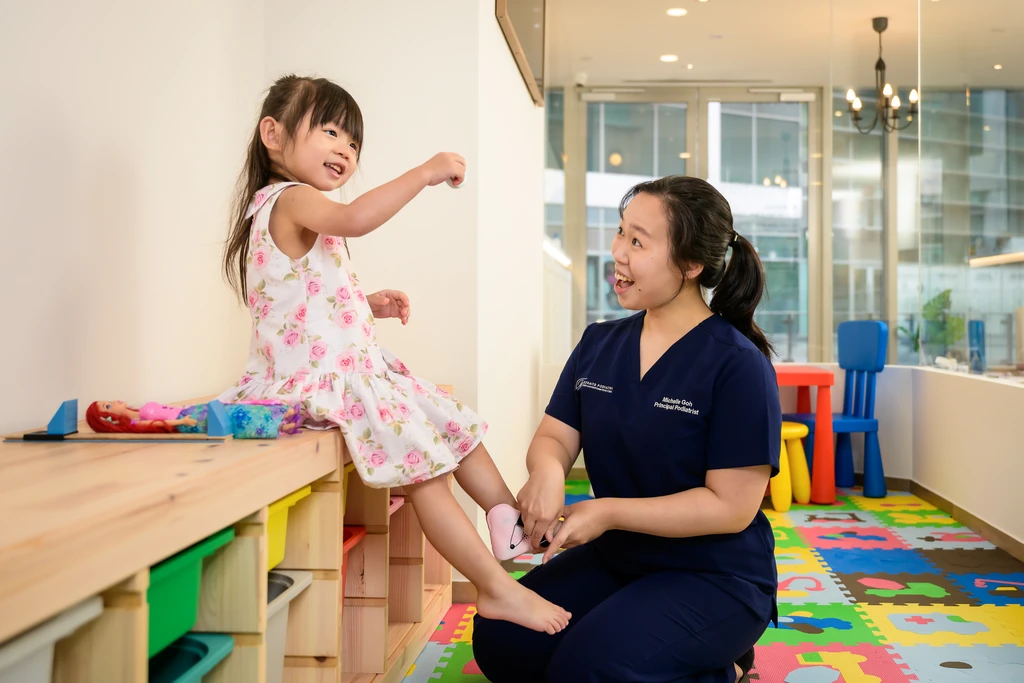
Kid-friendly assessment rooms
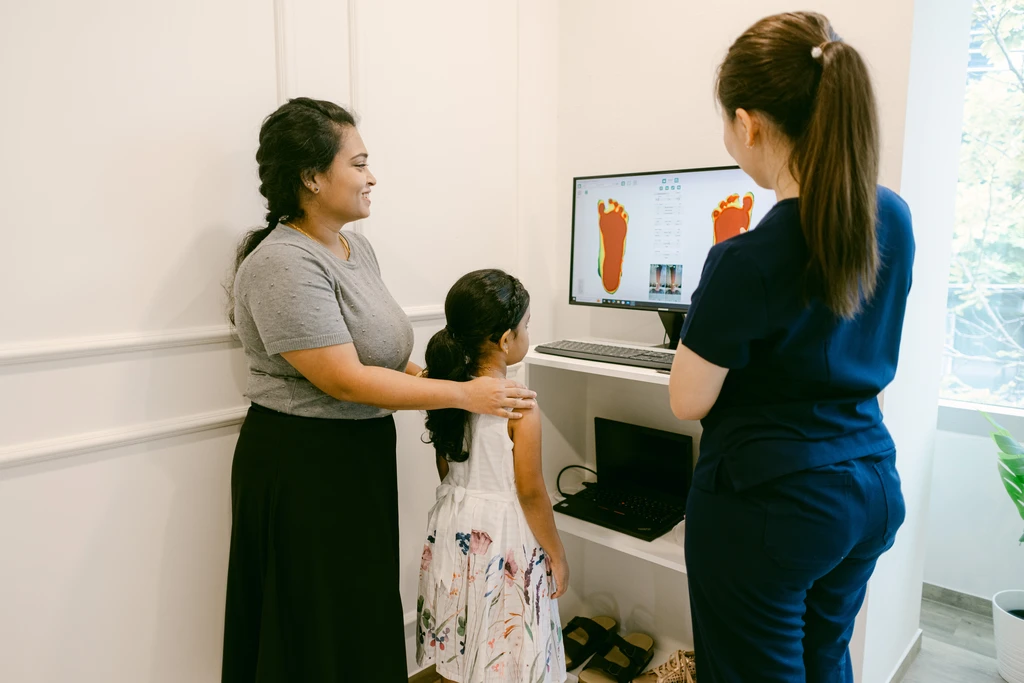
Children read a room within thirty seconds of walking in. Our consult rooms are set up so the assessment can run as a conversation, with toys, picture explanations, and the option to do parts of the gait analysis with the child watching themselves on the screen. The goal is a child who leaves feeling competent, not poked at.
A clear explanation you can act on
You leave the consultation understanding what was found, what it means at this stage of your child’s development, and what the next practical step looks like. Where it helps, we can put the key points in writing so you can share them with a school or another clinician.
Stage-specific paediatric care
What’s typical at each stage, and what’s a flag
A flat foot at age two can be part of normal development. A flat, painful, rigid foot at age seven is a different conversation. The first job of a paediatric podiatry assessment is reading the stage your child is at, then telling apart what is developing normally from what would benefit from a closer look or some support.
Toddler, 0 to 3 years
Walking begins somewhere between 9 and 18 months, and early gait is wide, wobbly, and often turned-in or turned-out as the hips find their resting position. Flat feet are universal at this stage because the arch is still hiding under baby fat and soft tissue. A first paediatric review is worth booking if your child is not walking by 18 months, walks heavily on the outside or inside of the foot, is consistently asymmetric (one side different from the other), or shows persistent in-toeing that worries you. Most of what looks unusual at this age settles on its own. The visit confirms which findings need a follow-up plan and which are simply on the developmental clock.
Early childhood, 3 to 7 years
This is the stage where the arch usually starts to emerge in standing, where running becomes coordinated, and where the first parent-recognisable patterns appear. Toe walking past age three, persistent in-toeing or out-toeing, knock knees that look more pronounced than peers, frequent tripping, or pain after school sport are the common reasons parents book. Footwear advice matters at this stage because school shoes and home slippers are the inputs the foot is loading into every day.
School age, 7 to 12 years
Sport gets serious, school bags get heavier, and the growth plates open in the heel, the shin, and the knee. Sever’s disease (the growth-plate heel pain that flares after football, basketball, or netball), Osgood-Schlatter at the knee, and Iselin’s disease at the outside of the foot all sit in this window. Juvenile bunions can also start to declare themselves here, particularly in children with a family history. The pattern parents notice is a child who limps after training, refuses PE, or drops out of a sport they previously loved.
Adolescent, 12 to 16 years
The skeleton is finishing the long-bone growth phase, the foot is closer to adult shape, and the case mix shifts toward overuse injuries from sport, stress reactions in the bone, and structural concerns that the family has been watching for a while. Adolescents heading into NS in a few years often present with pre-enlistment foot questions, because the PES (Physical Employment Standards) grading takes flat-foot severity, foot pain, and gait into account. Early input at this stage lets the foot enter NS with the structural support and conditioning that prevents trouble downstream.
Common paediatric conditions
Paediatric foot conditions our podiatrists assess and manage
The conditions below cover what brings most parents through the door. Each card links to the dedicated page for that condition, where the symptoms, causes, and treatment options are covered in clinical depth.
Flat Feet & Foot Structure
Walking & Leg Alignment
Children's Sports Injuries
Paediatric tools and treatments
What’s available when your child does need input
Most paediatric cases settle with reassurance, footwear advice, and a structured monitoring plan. Where input is needed, this is the toolkit our podiatrists draw from.
Paediatric supramalleolar orthoses (SMOs)
Above-ankle support to steady rearfoot alignment, recommended only when the clinical reasoning supports it and fitted to your child’s growing foot.
Orthotic therapyCustom paediatric foot orthotics
Prescribed from a full biomechanical assessment and made to your child’s foot, school shoe, and sport shoe, while letting the foot keep developing.
Conservative care and footwear advice
Footwear adjustment, load management, and a follow-up review at the right interval. Often the footwear conversation alone shifts the picture.
Exercise prescription
Targeted stretches and strengthening matched to your child’s stage and sport, with simple routines you can fit into the week at home.
Our paediatric assessment
The four steps inside a paediatric podiatry consultation
Developmental history with the parent
We start with the story. When did your child start walking. What have you noticed at home, at the playground, or after PE. Family history of foot conditions, current sport and CCA load, school shoe situation, any prior injuries. Toddlers and younger children stay involved through this part, but the conversation is mostly with you, because the history shapes everything the hands-on assessment then looks for.
Hands-on examination and gait analysis
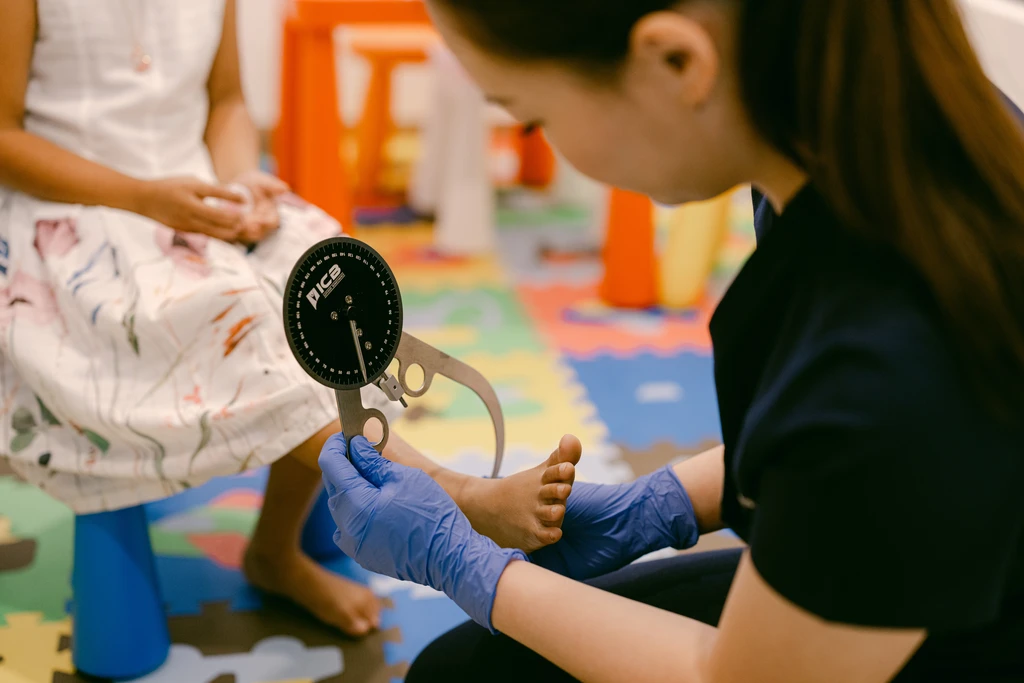
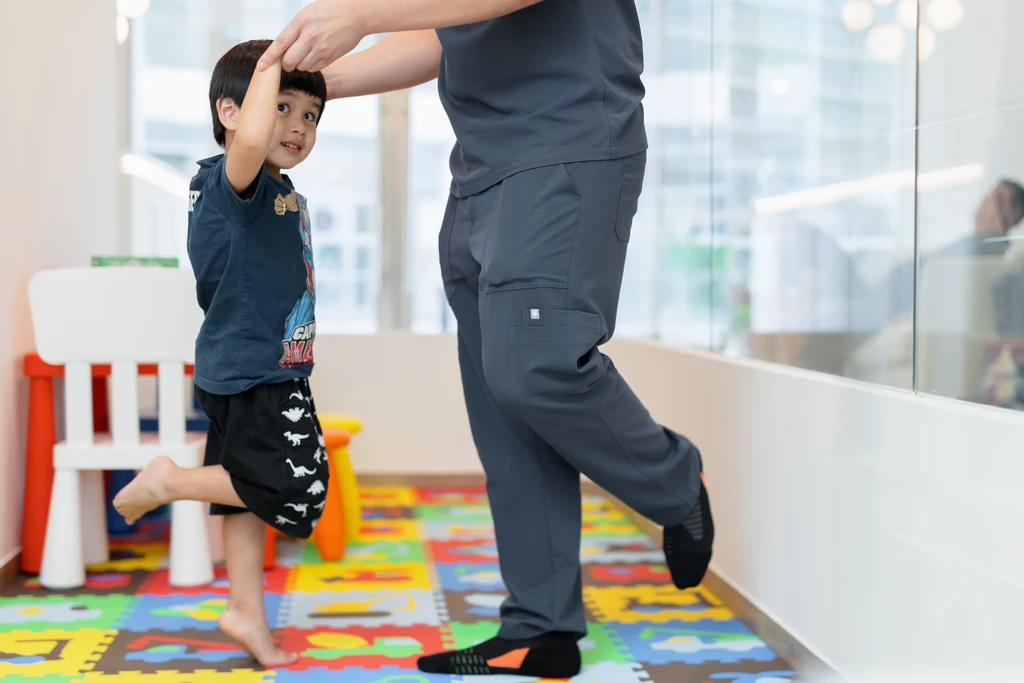
Joint range at the hip, knee, ankle, and foot. Calf tightness, foot shape in standing and in sitting, alignment under load. Then walking and running on the spot or down the corridor, with video capture where the footage will add to the picture. For school-age children we often show them their own gait on screen, which turns the assessment into something they understand rather than something happening to them.
Footwear review and stage-specific advice
We work through what your child is currently wearing. School shoes, sports shoes, home slippers, and any specialist shoes for CCA or dance. We explain what features matter at the stage your child is at and where the gaps are. Often this part of the visit is the highest-yield piece of input, because the foot is loading into footwear every day at school.
Recommendations and follow-up plan
We walk you through what we found, what it means at this stage of your child’s development, and what the practical next step is. If a structural issue benefits from a paediatric SMO, custom orthotics, or a rehabilitation referral, we explain why, what we expect it to do, and when we would review. Where it would help, we can summarise the key points in writing for a school or another clinician.
When to book
Reasons to bring your child in for a paediatric podiatry assessment
Most childhood gait quirks settle on the developmental clock. The list below covers the patterns that earn a paediatric podiatry review rather than continued watch-and-wait. If your child shows one of these, booking an assessment is a reasonable next step.
Paediatric podiatry FAQs
Common questions parents ask
At what age should my child first see a podiatrist?
There is no fixed age. A paediatric podiatry visit is worth booking whenever you notice something that is not settling on its own. Common first-visit ages are around 18 months if walking has not started, the early-childhood stage when toe walking or in-toeing persists past three, the school-age stage when growth-plate heel pain or sport-related foot pain appears, and the adolescent stage as the foot finishes maturing. If you are not sure whether to book, an early review almost always saves time later compared to waiting for a manageable concern to become a chronic one.
Will my child outgrow their flat feet?
Most flexible flat feet in children develop a visible arch as the foot matures, often between ages 6 and 10. The flat shape itself is rarely the problem. What matters is whether the feet are painful, fatiguing, or changing the way your child moves. A paediatric assessment sorts the developmentally normal foot from the foot that would benefit from a structured plan, and gives you a clear answer rather than another year of wondering.
When should I worry about my child's walking pattern?
In-toeing, out-toeing, toe walking, and wide stance all sit inside the range of normal early gait. They earn a paediatric podiatry review when the pattern is asymmetric, has not settled at the age the textbook says it should, is causing tripping or refusal to walk distances, or is paired with reported foot or leg pain. The assessment will tell you which of those drivers is in play and what, if anything, needs to change.
Does my child need orthotics?
Not by default. Most paediatric presentations settle with footwear advice, load management, and a structured follow-up plan. Custom paediatric foot orthotics and paediatric SMOs are recommended when the clinical reasoning supports them, which usually means a structural issue that is driving pain, fatigue, or progressive change. If your child does not need orthotics, we will say so.
What's the difference between growing pains and a clinical condition?
Classic growing pains are bilateral (both legs), usually in the evening or at night, settle with reassurance and a calf rub, and the child is symptom-free in the morning. A clinical condition tends to be localised (one specific spot), reproducible (the same movement triggers it), and present during or after activity rather than only at night. A paediatric podiatry visit can sort one from the other and is worth booking when the pain has stopped fitting the classic growing-pains pattern.
Who at Straits Podiatry will see my child?
Every Straits Podiatry podiatrist sees paediatric cases as part of full clinical scope. You can book any clinician at any of the three clinics and your child will be seen by a podiatrist with the paediatric workup at hand. Each of our four podiatrists has a stated clinical interest profile, which you can read on the our podiatry team page if a particular focus matters to you.
What should I bring to my child's first visit?
Bring your child’s current school shoes, sports shoes, and home slippers, because the footwear review is part of the consultation. Bring any previous reports, scans, or specialist letters if your child has been seen before. A short note of what you have observed at home (when the symptom shows up, what triggers it, what makes it settle) is more useful than you might expect. If your child is comfortable in shorts, that helps for the gait analysis.
How long is a paediatric podiatry appointment?
The first paediatric visit is structured and unhurried. It is built around getting the history, completing the hands-on assessment, capturing video gait analysis where useful, and reviewing footwear, with clear recommendations at the end. Individual procedural steps each take a few minutes; the consultation as a whole takes as long as the assessment needs.
Do I need a referral to bring my child in?
No. You can book your child directly. A referral letter from a paediatrician, GP, school doctor, or orthopaedic specialist is welcome if you have one, and worth bringing along for the visit. Many parents book directly without a referral.
Where are your clinics, and which one should I choose?
We run three clinics. Buona Vista (West Singapore, Rochester Drive), Orchard (Central, The Centrepoint), and Paya Lebar (East, Paya Lebar Square). Each clinic offers the full paediatric service set, so the right choice is the one that fits your week. Closed-day differences across the three locations mean there is usually a slot somewhere when you need it.
From the blog
Paediatric podiatry reading for parents
Practical guidance on children’s foot and lower limb health from our podiatrists.
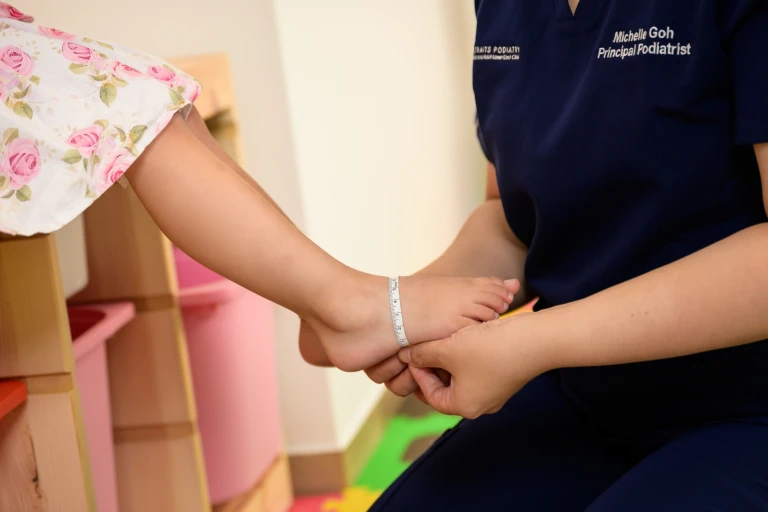 PaediatricWhen Should You Worry About Your Child’s Feet? A Parent’s Guide to Normal Foot Development21 Aug 2026Most of the children’s feet that worry a parent enough to book an appointment turn out to be doing something…
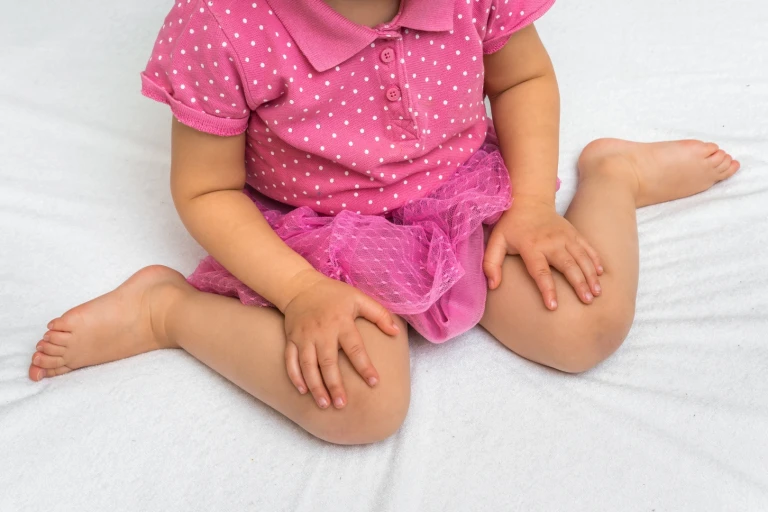 PaediatricW-Sitting in Children: Should You Worry, and When to Correct It12 Aug 2026You glance across the living room, and there it is again: your child sitting on the floor with both legs…
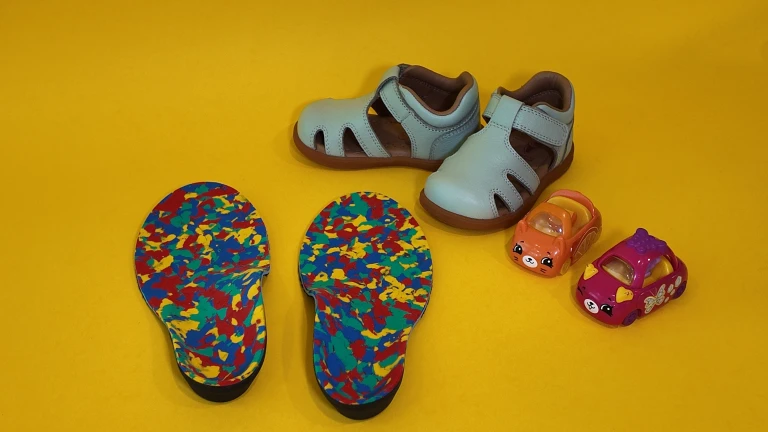 PaediatricThe Complete Guide to Choosing Podiatrist-Recommended Kids Footwear24 Aug 2025Do you know that the shoes you choose for your toddler or child today can impact their foot health for…
Take the next step
Book a paediatric podiatry assessment in Singapore
Three clinics, four podiatrists, paediatric capability at every location. Tell us what you are seeing with your child’s feet, walking, or pain, and the team will get back to you with a clinic and a slot that fits your week.
Ready to start
Book a podiatry consultation in Singapore
Whether you are working through ongoing foot pain, a sports injury, a child's gait concern, or a diabetic foot review, our podiatrists across Buona Vista, Orchard, and Paya Lebar are ready to help you find a clear next step. Bookings are open online, and our team will match you to the clinic and day that fits you.
Prefer to talk? Call +65 6990 4574
Mon to Sat, 9am to 6pm
Prefer to talk? Call +65 6990 4574. Monday to Saturday, 9am to 6pm. Closed-day differences across the three clinics, so the team can route you to the next available slot.