
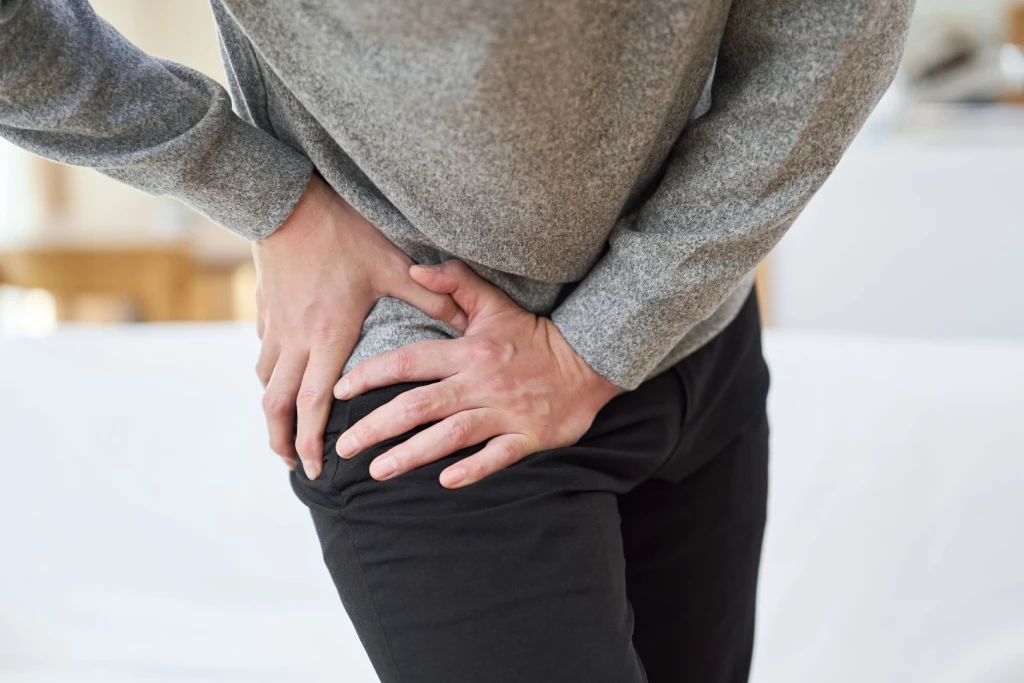
You are a footballer, a Muay Thai regular, or someone who spends long hours at a desk, and there is a deep ache in the front of your hip or your groin that you cannot quite point to with one finger. It clicks or catches when you get out of the car, twist to change direction, or come out of a deep squat. Sitting for a long meeting makes it stiff, and the first few steps afterward feel like the joint wants to give way. This pattern, deep and internal rather than on the surface, is a common way a hip labral tear presents.
The labrum is a ring of cartilage that lines the rim of the hip socket (the acetabulum). It deepens the socket, helps seal the joint, and spreads load across the surface so the ball of the thigh bone glides smoothly. A tear in this ring often traces back to the bone shape of the joint rather than a single injury, which is why the pain can build without an obvious cause. Because the labrum sits deep inside the joint and its symptoms overlap with several other sources of groin and hip pain, an accurate diagnosis relies on imaging and a clinical examination, not on the symptom picture alone. Getting that diagnosis right early matters, because the care pathway and the role each profession plays differ from one hip problem to the next.
Symptoms of a Hip Labral Tear
The symptom pattern of a hip labral tear is not unique on its own, since impingement, early arthritis, and groin injuries can produce a similar picture. The combination of location, the movements that provoke it, and the mechanical sensations is what points toward the labrum.
- Deep groin or anterior hip pain: the pain sits deep and internal, in the front of the hip or the groin crease, rather than on the outer surface of the hip. Patients often struggle to localise it to a single spot.
- Clicking, catching, or locking: a mechanical click, a catch, or a momentary sense that the joint locks during movement. This reflects the torn tissue interfering with the smooth glide of the joint.
- The C-sign: many patients cup a hand into a C shape over the side of the hip, just above and behind the bony prominence, to show where the pain sits. Clinicians recognise this gesture as a classic pointer toward hip joint pathology.
- Pain with deep flexion combined with rotation: bringing the knee up toward the chest and rotating the hip inward reproduces the pain. Deep squats, lunges, and pivoting movements are common triggers.
- Pain after prolonged sitting or driving: sustained hip flexion aggravates the joint, so long meetings, long flights, and long drives are frequently reported flare points.
- A sense of instability or giving way: the hip can feel unstable or as though it may buckle, particularly on push-off, twisting, or changing direction.
- Stiffness and reduced range of movement: the hip may feel stiff and lose some of its rotational range, especially inward rotation, over time.
From what we see in clinic, the most useful early clue is deep groin or anterior hip pain that is provoked by deep flexion and rotation and accompanied by clicking or catching. That combination warrants an assessment and, in most cases, imaging to confirm what is happening inside the joint.

Causes of a Hip Labral Tear
The labrum tears when the forces passing through the rim of the socket exceed what the cartilage can tolerate, and several pathways can lead there. Bone shape is the most common underlying factor, more so than a single traumatic event.
What Causes a Hip Labral Tear?
- Femoroacetabular impingement (FAI) morphology: by far the strongest association we see. Extra bone on the femoral head or neck (cam type) or over the socket rim (pincer type) causes the bones to pinch during hip movement, and that repeated contact grinds against and tears the labrum. This bone shape and a labral tear frequently coexist, which is why femoroacetabular impingement is assessed alongside any suspected tear.
- Hip dysplasia (a shallow socket): where the socket is shallow, the labrum takes on more of the load of stabilising the joint. That chronic overload can tear it over time.
- Repetitive rotational and pivoting load: sports and activities that repeatedly drive the hip into deep flexion and rotation, football, hockey, martial arts, dance, gymnastics, and golf among them, load the rim of the socket cycle after cycle.
- Trauma or a single high-force event: a fall, a dislocation, a sharp twist, or a road-traffic injury can tear the labrum acutely, though this is less common than the gradual pathways.
- Degenerative change: as the joint ages, the labrum can fray and tear as part of the same process that leads to early joint-surface wear, so degenerative tears often travel with early arthritis.
Who Carries a Higher Baseline Risk?
- Athletes in pivoting and cutting sports (football, hockey, rugby, martial arts, and racquet sports).
- Dancers and gymnasts, whose training routinely drives the hip into deep and extreme ranges.
- People with FAI bone morphology or hip dysplasia, whether or not they have been formally diagnosed.
- Golfers and others with repetitive single-side rotational load through the hip.
- Older adults with early hip joint wear.
- People with generalised joint hypermobility, where the joint moves through larger ranges under less control.
Conditions Commonly Mistaken for a Hip Labral Tear
Groin and anterior hip pain has several possible sources, and a labral tear shares that territory with bone-shape, joint-surface, and soft-tissue problems. Several of these can also coexist with a tear, which is part of why imaging is needed to sort them out. The most common patterns of confusion are below.
Femoroacetabular impingement
Femoroacetabular impingement is the bone-shape problem that so often causes the labral tear in the first place, and the two produce overlapping symptoms of deep anterior hip pain with deep flexion and rotation. The distinction is that impingement describes the abnormal bony contact, while the labral tear is the cartilage damage that contact can produce. On imaging they are frequently found together, and the surgical plan usually addresses both at once.
Hip osteoarthritis
Hip osteoarthritis is wear of the joint surface itself, and it can cause deep groin pain and stiffness that mimics a labral tear. The differentiators are age and pattern: arthritis tends to bring progressive morning stiffness and a steadily shrinking range of movement, and it shows joint-space narrowing on X-ray, whereas an isolated labral tear does not. Degenerative labral tears and early arthritis can also occur together in the same hip.
Iliopsoas tendinopathy and snapping hip
The iliopsoas is the deep hip-flexor tendon that runs across the front of the joint. When it is irritated or snaps over the bony rim, it can create a click and front-of-hip pain that feels a lot like a labral catch. The difference is that snapping-hip symptoms usually reproduce with active hip flexion against resistance and can often be felt or seen as the tendon flicks, rather than the deep internal catch of a labral tear.
Adductor-related groin pain
The adductor muscles on the inner thigh attach near the groin, and a strain or chronic tendinopathy there produces groin pain that can be mistaken for a hip joint problem. The differentiator is that adductor pain reproduces with resisted squeezing of the legs together and with direct pressure over the tendon origin, rather than with deep hip flexion and rotation.
Referred pain from the lower back
Irritation of the lower lumbar spine or its nerves can refer pain into the groin, buttock, and front of the thigh, imitating hip pathology. The clue is that back-related pain often changes with spine position and may travel below the knee or bring pins and needles, which a labral tear does not.
Treating and Preventing a Hip Labral Tear
A hip labral tear is led by orthopaedics, because confirming it depends on imaging and because the decision about whether the joint needs surgery is a surgical one. That said, most people start with a conservative phase, and many settle well without an operation. The principle is to calm the joint down, reduce the load and the movements that pinch the labrum, and rebuild the muscular control that stabilises the hip, while correcting any factors further down the leg that increase the rotational load on the joint. Podiatry sits inside that conservative phase as an adjunct on the biomechanical side, and physiotherapy leads the hands-on rehabilitation. The tear itself is not something a podiatrist repositions or repairs.
Conservative treatment
These measures usually run together and are coordinated with the orthopaedic and physiotherapy plan.
- Activity and load modification: stepping back from the deep-flexion, pivoting, and cutting movements that provoke the joint gives the labrum a chance to settle. Prolonged sitting and deep squatting are commonly adjusted first, with a graded return once symptoms ease.
- Physiotherapy-led rehabilitation: the core of conservative care. Our physiotherapy service, the rehabilitation arm of the clinic, works on the deep hip stabilisers, the gluteal and core muscles, and motor control, so the joint is supported through range and the labrum is loaded less. This is where the bulk of the hands-on recovery work happens.
- Gait and biomechanical assessment: a podiatry assessment of how you stand, walk, and load the leg identifies patterns, such as an inward-collapsing foot, that drive extra internal rotation up into the hip. Reducing that rotational demand can lower the strain on the labral rim during daily walking and running.
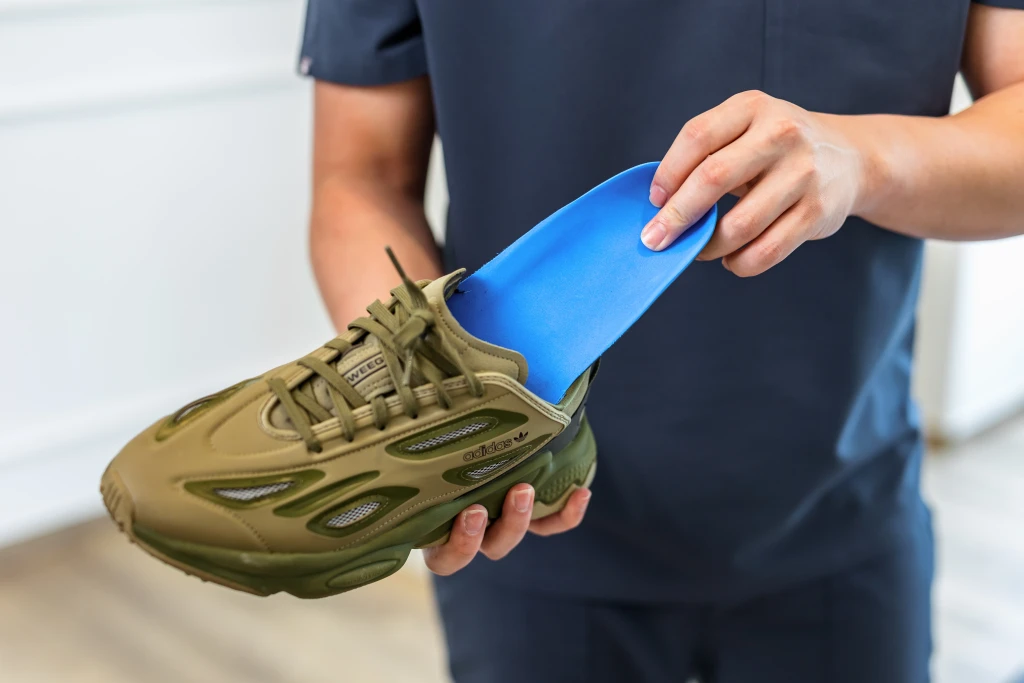
- Custom foot orthoses: where foot posture or a leg-length difference contributes to the way the hip loads, an orthosis can help realign the lower-limb loading pattern and take some of the rotational stress off the joint. This is a supporting measure that addresses the chain below the hip, not a repair of the tear.
- Footwear and daily-load guidance: advice on supportive footwear and on managing sitting posture, driving, and training volume helps keep the joint out of the positions that repeatedly aggravate it.
When conservative care isn’t enough
Because a labral tear is confirmed inside the joint, imaging is central to the pathway. An MRI, and often an MRI arthrogram where contrast is injected into the joint, is the usual way the tear is confirmed, with an X-ray to assess the underlying bone shape for FAI or dysplasia. Where the diagnosis is unclear, an image-guided injection of local anaesthetic into the joint can help confirm that the pain is coming from inside the hip. If a structured conservative phase does not settle the symptoms, or if the tear is large and the hip keeps catching or giving way, an orthopaedic surgeon may consider hip arthroscopy: a keyhole procedure to repair or trim the torn labrum and, importantly, to reshape the underlying bone so the impingement that caused the tear does not keep damaging it. The decision to operate rests with the orthopaedic team, and podiatry and physiotherapy continue to support the lower-limb loading and rehabilitation whether or not surgery is chosen.
Have Your Hip Labral Tear Managed at Straits Podiatry
A hip labral tear is diagnosed and led by orthopaedics, and it is not a condition a podiatrist can fix on its own. Where we help is the part of the picture that sits below the joint. At Straits Podiatry, an assessment for a suspected or confirmed labral tear focuses on gait analysis and a biomechanical evaluation of how your foot, leg, and hip load together, so any pattern that adds avoidable rotational stress to the joint can be addressed with a custom orthosis or footwear change where it is warranted.
Alongside that, our physiotherapy service, the rehabilitation arm of the clinic, can guide the hip-stabiliser and core strengthening that anchors conservative care, and we coordinate with your orthopaedic team where imaging or surgery is on the table. If you have deep groin or anterior hip pain with clicking or catching, book a consultation for an assessment at any of our three Singapore clinics.
Frequently Asked Questions About a Hip Labral Tear
What does a hip labral tear feel like?
Most people describe a deep ache in the front of the hip or the groin that is hard to pinpoint, often with a click, a catch, or a sense of the joint locking during movement. It typically worsens with deep squats, lunges, twisting, pivoting, and long periods of sitting, and some people feel the hip is unstable or wants to give way. A common giveaway is the C-sign, where a patient cups a hand over the side of the hip to show where the pain sits.
Can a hip labral tear heal without surgery?
The labrum has a limited blood supply, so a tear does not usually knit back together on its own the way a muscle strain might. Even so, many people manage their symptoms well without surgery by calming the joint, modifying the loads and movements that aggravate it, and building hip and core strength through physiotherapy. Whether a conservative pathway or surgery is the better route depends on the size of the tear, the underlying bone shape, and how much the hip is limiting you, which is why the decision is made with an orthopaedic team after imaging.
Do I need an MRI to diagnose a hip labral tear?
Imaging is usually needed to confirm a labral tear, because the labrum sits deep inside the joint and cannot be assessed on examination alone. An MRI, and frequently an MRI arthrogram where contrast is placed into the joint, is the standard way the tear is confirmed. An X-ray is often taken alongside it to check the bone shape for impingement or dysplasia. A clinical examination points toward the diagnosis, but imaging is what confirms it.
What is the podiatrist’s role in a hip labral tear?
A podiatrist does not diagnose or repair the labrum itself, as that is orthopaedically led. The podiatry role is on the biomechanical side: assessing how your foot and leg load the hip and identifying patterns, such as an inward-collapsing foot or a leg-length difference, that increase the rotational stress travelling up into the joint. Where relevant, a custom orthosis or footwear change can reduce that avoidable load. It is a supporting measure within a broader plan led by orthopaedics and physiotherapy, not a standalone cure.
What activities should I avoid with a hip labral tear?
The movements to limit are the ones that pinch or twist the joint: deep squats and lunges, pivoting and cutting sports, high kicks and deep stretches, and prolonged sitting in a deeply flexed position. Long drives and long flights often aggravate it, so breaking up sitting time helps. The aim is not indefinite rest but a graded return, guided by symptoms, so the joint is loaded progressively rather than repeatedly provoked. A physiotherapist can help set the pace of that return.
Is a hip labral tear the same as hip impingement?
They are closely related but not the same. Hip impingement, or femoroacetabular impingement, describes an abnormal bone shape where the ball and socket pinch during movement. A labral tear is the cartilage damage that this repeated pinching can cause. The two very often occur together, which is why an assessment for one usually looks for the other, and why surgery for a labral tear commonly reshapes the impinging bone at the same time so the tear is less likely to recur.