

You came down awkwardly from a kerb, a stair, or a tackle. The foot caught underneath you. Now the middle of your foot aches in a way that does not feel like the usual rolled ankle. Standing is uncomfortable, and pushing off to walk is worse. You may also have noticed swelling across the top of the midfoot, or bruising along the sole. Many people assume this is a bad sprain that will settle on its own. That assumption is exactly why this injury is so often missed.
The midfoot is held together by the tarsometatarsal joint complex. This is a row of small joints where the long bones of the forefoot meet the smaller bones of the arch. A short but strong band called the Lisfranc ligament locks the base of the second toe bone to the inner arch. It acts as the keystone of this whole region. When a twisting force or an axial load drives through a foot that is pointed downward, the ligament and the joints around it can sprain, partially tear, or shift out of position. That injury pattern is called a Lisfranc injury. The same fall can also bruise or twist the ankle, so it is frequently treated as a simple sprain when the real problem sits in the middle of the foot.
Symptoms of a Lisfranc Injury
Symptoms range from a subtle midfoot ache that lingers for weeks to a swollen, painful foot that cannot take weight. The clue is the location. The pain sits across the middle of the foot rather than at the ankle or the toes. It is provoked by loading and push-off. The features below are worth recognising early.
- Pain across the top of the midfoot: aching or sharp pain over the arch and the bones just behind the toes. It sits away from the ankle bone and the ball of the foot.
- Difficulty or inability to bear weight: many people can limp on a Lisfranc injury. But standing, walking, and pushing off all reproduce the pain. Being unable to put weight through the foot is a red flag that warrants assessment.
- Bruising on the sole of the midfoot: bruising under the arch (plantar ecchymosis) is one of the more specific signs, and is uncommon in an ordinary sprain. If the sole of your midfoot looks bruised after a twist or fall, it should be checked.
- Swelling across the midfoot: diffuse swelling over the top of the foot in the days after the injury, often more than a minor sprain would explain.
- Pain on twisting or rocking the forefoot: turning the front of the foot in and out, or pressing the midfoot joints, reproduces the pain.
- A widened or flattened look to the foot: in more significant injuries the arch can look flattened, or the forefoot can splay wider. This reflects the midfoot losing its normal locked structure.
- A sense that the midfoot is unstable: a feeling that the middle of the foot is not holding together properly under load.
The combination worth acting on
The combination most worth acting on is the inability to bear weight, midfoot bruising on the sole, and swelling. Together these point away from a routine sprain, toward a midfoot injury that needs imaging.

Types of Lisfranc Injuries
Lisfranc injuries sit on a spectrum, and where an injury falls on that spectrum drives how it is managed. The key distinction is whether the midfoot bones have shifted out of alignment.
Sprain without displacement (stable)
The ligaments are stretched or partially torn, but the joints of the midfoot remain in their normal position and stay stable when loaded. These are the injuries most often mistaken for an ordinary sprain. They still need to be confirmed, because a midfoot that looks aligned at rest can occasionally shift under load. That is why a weightbearing X-ray matters.
Displaced or unstable injury
The Lisfranc ligament and surrounding joint capsules have failed. The bases of the metatarsals shift out of alignment, even if only by a few millimetres. A gap can open between the first and second toe bones. These injuries are unstable and typically require an orthopaedic surgical opinion. Restoring and holding the alignment is what protects the midfoot long term.
Fracture-dislocation
In higher-energy injuries, such as a fall from height or a road traffic accident, the ligament injury is accompanied by fractures of the midfoot bones and clear dislocation. These are the most serious end of the spectrum, and are managed surgically.
Causes of a Lisfranc Injury
A Lisfranc injury usually comes from one of two mechanisms. The first is a twisting or crushing force through a foot that is pointed downward. The second is a heavy direct blow across the midfoot. Sport, falls, missteps, and road accidents account for most of what presents in clinic.
What Causes a Lisfranc Injury?
- A twist or fall onto a foot that is pointed downward (plantarflexed), driving body weight through the midfoot.
- Landing awkwardly from a jump and rolling forward over a fixed forefoot, common in football, basketball, netball, and dance.
- A missed step off a kerb or stair where the forefoot catches and the body keeps moving forward.
- A direct crushing load across the top of the midfoot, such as something heavy dropping onto the foot.
- High-energy trauma such as a road traffic accident or a fall from height, which tends to produce the fracture-dislocation pattern.
- A stumble in firm or stiff footwear that pins the forefoot while the leg rotates over it.
Who Carries a Higher Baseline Risk?
- Athletes in pivoting, jumping, and contact sports, where the foot is regularly loaded in a pointed-down position under force.
- Footballers and rugby players, where another player can land on the back of a planted foot.
- Dancers, who load the forefoot in extreme pointed positions.
- Anyone who has had a fall from height or a road traffic accident affecting the foot.
- People doing manual or industrial work where heavy objects can drop onto the midfoot.
- Active National Servicemen and obstacle-course participants, where awkward landings on uneven ground are common.
Conditions Commonly Mistaken for a Lisfranc Injury
Midfoot pain after a twist or fall has several possible explanations. The most important one to rule out is that a Lisfranc injury is being treated as something less serious. The distinction matters because a missed Lisfranc injury can lead to lasting problems, while the conditions below follow different recovery paths.
Ankle sprain
The most common and most consequential mix-up. A twist that injures the midfoot can also stress the ankle. Because an ankle sprain is so familiar, the midfoot component is overlooked. The differentiator is location. An ankle sprain hurts at and below the ankle bones. A Lisfranc injury hurts across the middle of the foot and is worse on push-off. Midfoot bruising on the sole and an inability to bear weight point toward the midfoot rather than the ankle.
Midfoot stress fracture
A stress fracture of one of the midfoot bones builds up gradually with repetitive loading, rather than arriving with a single twist or fall. The pain is usually pinpoint over the affected bone. A Lisfranc injury has a clear moment of injury. Its tenderness spreads across the joint line rather than over one spot.
Dorsal midfoot interosseous compression syndrome
Dorsal midfoot interosseous compression syndrome produces pain and tenderness along the top of the midfoot, worse with weight-bearing and easing with rest. It develops gradually as the midfoot bones compress against one another on their dorsal surfaces during loading, inflaming the dorsal joint lines and sometimes forming small bone spurs, rather than tracing to a single injury. A Lisfranc injury, by contrast, follows a specific twist or impact and involves instability across the tarsometatarsal joints, which is why a weightbearing X-ray is used to tell the two apart.
Simple bruising of the foot
A direct knock can bruise the soft tissue of the foot without injuring the midfoot joints. Soft-tissue bruising settles steadily over a couple of weeks. Lisfranc pain, by contrast, persists or worsens with loading and push-off. It is often accompanied by swelling that does not match a minor knock.
Treating and Preventing a Lisfranc Injury
How a Lisfranc injury is treated depends almost entirely on whether the midfoot is stable or displaced, which is why the injury is first confirmed with a weightbearing X-ray, sometimes of both feet for comparison, and with a CT or MRI where the picture is unclear. A stable, undisplaced sprain can often be managed without surgery, while a displaced or unstable injury usually needs an orthopaedic surgical opinion to restore and hold the alignment. Being honest about this split is part of caring for the injury properly, because the wrong call early on is what leads to long-term midfoot problems.
Conservative treatment
Where imaging confirms the midfoot is stable and undisplaced, the injury is managed by protecting it while the ligaments heal. A midfoot that looks aligned at rest can still shift under load, so progress is checked with repeat imaging.
- Immobilisation: A walking boot or cast protects the midfoot, with a period of non-weightbearing or protected weightbearing guided by the severity of the injury.
- Graded return to loading: A supervised, staged return to weightbearing follows once repeat imaging confirms the midfoot has stayed aligned.
- Activity modification: Stepping away from running, jumping, and pivoting while the midfoot settles.
- Pain and swelling management: Rest, elevation, and ice in the early phase ease the initial pain and swelling.
- Rehabilitation and physiotherapy: Once the midfoot has healed, structured rehabilitation with our physiotherapist rebuilds the strength, mobility, and confidence to load the foot again, progressing from protected loading back toward normal activity.
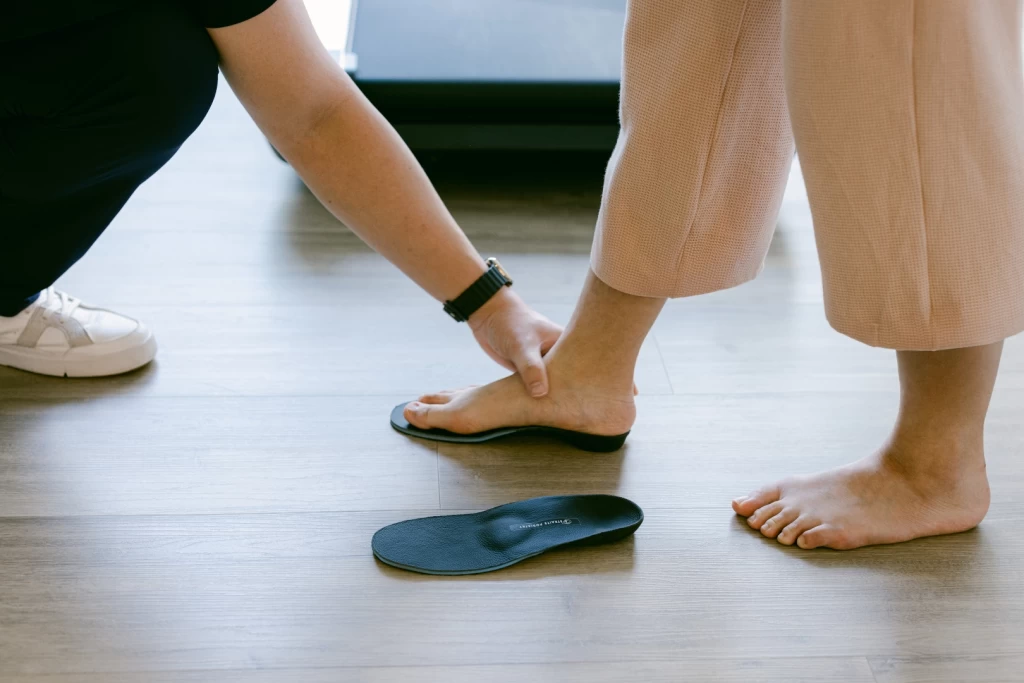
- Custom foot orthotics: As you return to standing and walking, custom foot orthotics can support the arch and redistribute load across the midfoot, which helps where the joints feel stiff or sensitive in the later stages of recovery.
When conservative care isn’t enough
Where the midfoot has shifted, even slightly, restoring and holding the alignment is what protects the joint surfaces over the long term. This is an orthopaedic surgical decision, and a referral to an orthopaedic surgeon with foot and ankle experience is the right pathway. Higher-energy fracture-dislocations are also managed surgically. The aim of surgery is to bring the midfoot bones back into position and stabilise them, so the joints can heal in alignment.
Preventing a Lisfranc Injury
There is no reliable way to prevent a Lisfranc injury, because it comes from a specific traumatic event rather than gradual overload. The most useful protective step is recognition. Treating a midfoot that is painful, swollen, or bruised on the sole after a twist or fall as a possible Lisfranc injury, rather than a simple sprain, is what avoids the long-term consequences of a missed diagnosis.

Have Your Lisfranc Injury Assessed at Straits Podiatry
A Lisfranc injury is one of those problems where being seen early changes the path of recovery. The injuries that cause lasting trouble are usually the ones assumed to be ordinary sprains. They get loaded through for weeks before anyone looks at the midfoot. At Straits Podiatry, an assessment for a suspected Lisfranc injury starts with how the foot was injured, where the pain and swelling sit, and whether you can bear weight. It also includes specific testing of the midfoot joints to gauge stability.
Because confirming the injury matters so much, the assessment is geared toward recognising the pattern and arranging the right imaging. Where a weightbearing X-ray confirms a stable, undisplaced sprain, care focuses on offloading and immobilisation support, structured rehabilitation, and custom foot orthotics during the later return-to-activity stages. Where the imaging shows the midfoot has shifted, the assessment leads to a timely orthopaedic surgical referral rather than continued conservative care. Speak with our team or book a consultation for an assessment and a tailored approach to manage your Lisfranc injury, at any of our three Singapore clinics.
Frequently Asked Questions About Lisfranc Injuries
How do I know if my midfoot pain is a Lisfranc injury or just a sprain?
The clearest signs that point away from an ordinary sprain are pain across the middle of the foot rather than at the ankle, difficulty bearing weight, and bruising along the sole of the midfoot. An ankle sprain hurts at and below the ankle bones, and usually lets you limp reasonably soon. A Lisfranc injury is worse on push-off, and the pain sits over the arch and the base of the toes. The only reliable way to tell them apart is a clinical assessment with a weightbearing X-ray, because some Lisfranc injuries look deceptively mild at first.
Why is a Lisfranc injury so often missed?
Two reasons. First, the foot is usually swollen and painful in the same general region as a twisted ankle, so the midfoot component gets overlooked. Second, a stable Lisfranc injury can look normal on a non-weightbearing X-ray, because the midfoot only shifts when you put load through it. This is why two things matter after a twist or fall: a weightbearing X-ray, and a high index of suspicion when the pain and bruising sit in the midfoot.
Does a Lisfranc injury always need surgery?
No. A stable, undisplaced Lisfranc sprain, where imaging confirms the midfoot bones have not shifted, can often be managed without surgery. It is treated with a period of immobilisation in a boot or cast and a graded return to loading. Surgery becomes necessary when the midfoot has displaced, even by a few millimetres, because restoring and holding the alignment is what protects the joints over the long term. The decision rests on what the weightbearing imaging shows, which is why confirming the injury comes first.
What happens if a Lisfranc injury is left untreated?
A missed or undertreated Lisfranc injury, particularly a displaced one, can lead to the midfoot healing out of alignment. Over time this can cause persistent midfoot pain, a flattened arch, and arthritis of the midfoot joints. That outcome is far harder to manage than the original injury. This is the core reason the injury is taken seriously even when it presents mildly, and why early assessment and the right imaging are worth the effort.
How long does a Lisfranc injury take to heal?
It depends heavily on the severity. A stable sprain managed in a boot may take several weeks of protected loading before a gradual return to activity, with full recovery over a few months. A displaced injury managed with surgery generally involves a longer course of non-weightbearing, followed by staged rehabilitation, and return to sport can take several months. Recovery is paced by repeat imaging and how the midfoot tolerates progressive loading, rather than by the calendar alone. It is worth following the plan rather than rushing back.