
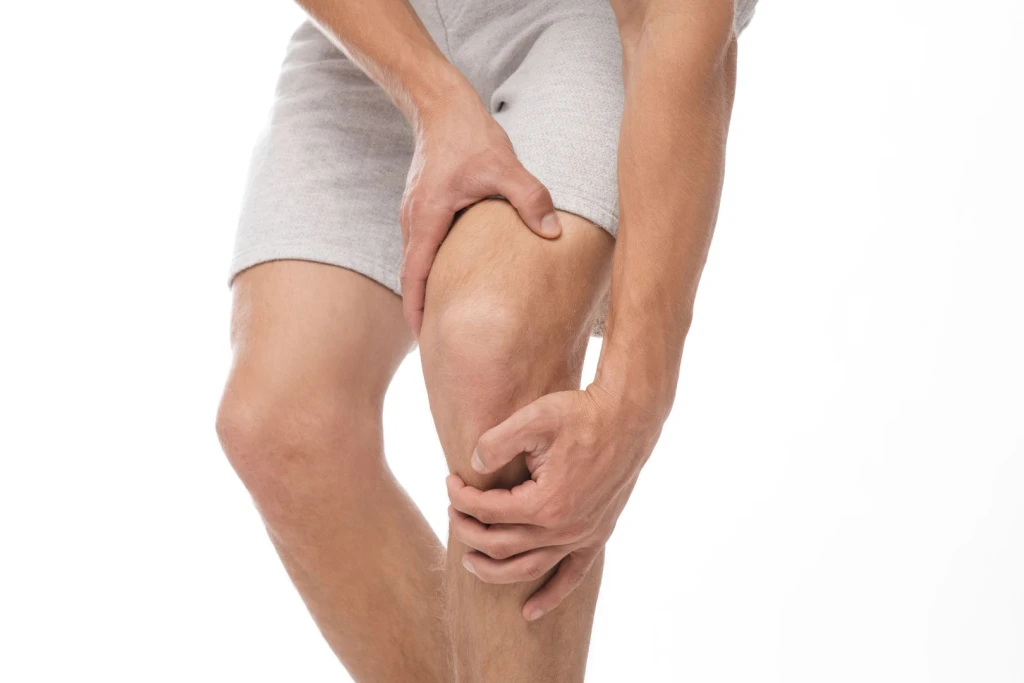
You have started walking down the MRT stairs sideways because facing forward pulls at the inside of your knee. Getting up from the sofa after a long evening does the same thing, a sharp tug on the inner shin just below the kneecap that eases once you are moving. You may have put on a little weight over the past year, or added distance to your evening runs around the neighbourhood, and the inner knee has quietly become the part of your leg you now plan around. The joint itself feels fine when you press the front. The tender spot sits lower and more towards the inside.
That tender spot is usually the pes anserinus, the “goose’s foot”, where three thigh muscles (sartorius, gracilis, and semitendinosus) join into a shared tendon that attaches to the inner shin bone about 5cm below the knee joint line. A small fluid-filled cushion called a bursa sits between that tendon and the bone to reduce friction. When the area is overloaded, the bursa and the surrounding tendon become irritated and painful, which is what we call pes anserine bursitis. Accurate diagnosis matters because this inner-knee pain sits close to, and frequently coexists with, medial knee osteoarthritis and medial meniscus problems, and the pes anserinus source is often overlooked when the assessment stops at the joint.
Symptoms of Pes Anserine Bursitis
The pain of pes anserine bursitis has a fairly specific location and a few reliable triggers, which is what separates it from general inner-knee ache. It is part of a wider pattern of knee pain that active Singaporeans present with, so the details of where and when it hurts carry most of the diagnostic weight.
- Tenderness about 5cm below the inner knee joint line: the most reliable sign. The sore point sits on the inner shin, below the joint itself, not on the kneecap or the joint line. Pressing directly on it reproduces the pain.
- Pain going up and down stairs: loading the knee while it bends under bodyweight tugs on the pes anserinus attachment. Descending stairs is often worse than ascending.
- Pain rising from sitting: getting up from a chair, a low sofa, or a car seat commonly reproduces the pain, particularly after a long period seated.
- Pain that eases once warmed up, then returns after rest: many patients describe a stiff, sore start that loosens during activity and flares again afterwards or at night.
- Aching on the inner knee at night: the area can throb in bed, and lying with the knees pressed together (inner shin against inner shin) is a common aggravator.
- Mild local swelling or a spongy feel: occasionally the bursa is distended enough to feel puffy over the tender spot, though visible swelling is often modest.
From what we see in clinic, the combination of a pinpoint tender spot roughly a hand’s width below the inner knee plus pain on stairs and on standing up is the pattern that points to the pes anserinus rather than the joint. Where the tenderness sits right on the joint line, or the knee locks or gives way, another structure is more likely to be involved.
Causes of Pes Anserine Bursitis
The pes anserinus sits where load from the hip, thigh, and lower leg converges on the inner shin. Anything that increases the pull through those three tendons, or the friction under them, can irritate the bursa.
What Causes Pes Anserine Bursitis?
- Repetitive overload from running and jumping sports: a sudden increase in running distance, hill work, or court and field sports loads the pes anserinus repeatedly. This is the classic overuse pathway in otherwise healthy knees.
- Increased medial knee load from foot and leg alignment: a flat or heavily pronated foot posture, or a knee that drifts inward into valgus during walking and running, shifts load towards the inner knee and increases strain on the pes anserinus tendons. This biomechanical pattern is the part a podiatry assessment is best placed to identify and address.
- Raised bodyweight: carrying more weight increases compressive and shearing load through the medial knee with every step, particularly on stairs and when standing up. Weight is one of the more consistent contributors in the patients we see.
- Tight or weak thigh and hip muscles: tight hamstrings pull harder on the attachment, while weak hip abductors and quadriceps let the knee collapse inward under load. Both raise the strain on the pes anserinus.
- Coexisting medial knee osteoarthritis: where the inner compartment of the knee is already arthritic, the altered mechanics and inflammation commonly irritate the neighbouring pes anserine bursa, so the two frequently occur together.
Who Carries a Higher Baseline Risk?
- Runners and field or court sport players who have recently increased their training load.
- Middle-aged and older adults, especially women, in whom a naturally wider pelvis can increase knee valgus and medial load.
- People carrying extra bodyweight.
- Patients with existing medial knee osteoarthritis.
- People living with diabetes, in whom bursitis and soft-tissue irritation around the knee are more commonly reported.
- Anyone with a heavily pronated foot posture or a knock-knee alignment.
Conditions Commonly Mistaken for Pes Anserine Bursitis
Inner-knee pain has several possible sources sitting close together, and pes anserine bursitis often shares the picture with joint and ligament problems. Because these can coexist, the goal at assessment is to work out how much of the pain comes from the bursa and how much from the joint. The most common patterns of confusion are below.
Medial knee osteoarthritis
Wear affecting the inner compartment of the knee, or medial knee osteoarthritis, produces inner-knee pain that can look very similar to pes anserine bursitis and frequently occurs alongside it. The differentiator is location and behaviour. Osteoarthritic pain tends to sit deeper and on the joint line itself, with morning stiffness and pain that tracks with overall activity, whereas pes anserine tenderness is pinpoint and lower, on the inner shin below the joint. When both are present, treating the bursa can meaningfully reduce pain even though the underlying arthritis remains.
MCL sprain
A sprain of the medial collateral ligament, or MCL sprain, causes pain along the inner knee after a specific incident, usually a force that pushed the knee inward or a twist. The pain follows the ligament higher up towards the joint line and is reproduced by stressing the knee sideways. Pes anserine bursitis has no single injury moment in most cases and reproduces with direct pressure on the tender spot lower down, not with sideways stress.
Medial meniscus tear
A medial meniscus tear causes pain on the inner joint line and can produce catching, locking, or a sense that the knee gives way. These mechanical symptoms are not features of pes anserine bursitis, and the meniscal tender point sits right on the joint line rather than below it. The two can coexist, particularly in older knees, which is why the assessment maps out each tender point separately.
Semimembranosus tendinopathy
The semimembranosus tendon attaches at the back of the inner knee, slightly higher and further back than the pes anserinus. Irritation here produces pain towards the rear inner corner of the knee that worsens with resisted knee bending. The location behind the pes anserinus and the pattern of aggravation help separate it, though careful palpation is needed because the two areas sit close together.
Saphenous nerve irritation
The infrapatellar branch of the saphenous nerve runs across the inner knee, and irritation of it can cause a burning, tingling, or numb quality of pain over the same inner region. Unlike pes anserine bursitis, the discomfort often does not track cleanly with stairs or standing up and may spread as an altered-sensation patch rather than a pinpoint tender spot.
Treating and Preventing Pes Anserine Bursitis
Pes anserine bursitis usually settles with conservative care, and the logic of treatment is straightforward. First, reduce the load irritating the bursa. Then correct the mechanics that concentrated load on the inner knee in the first place. Then rebuild the strength and flexibility that protect the attachment going forward. Because the condition so often sits alongside medial knee osteoarthritis, the plan also accounts for any joint involvement rather than treating the bursa in isolation. Injections and surgery are rarely needed and sit at the far end of the pathway.
Conservative treatment
These measures are usually combined and layered over a few weeks rather than used one at a time.
- Load management and activity modification: the first step. Reducing the aggravating load (cutting running volume, avoiding deep repeated knee bends, taking stairs one at a time or facing forward) gives the irritated bursa a chance to settle. Relative rest, not complete rest, is the aim, so low-impact cardio usually continues while the higher-load activity is dialled back.
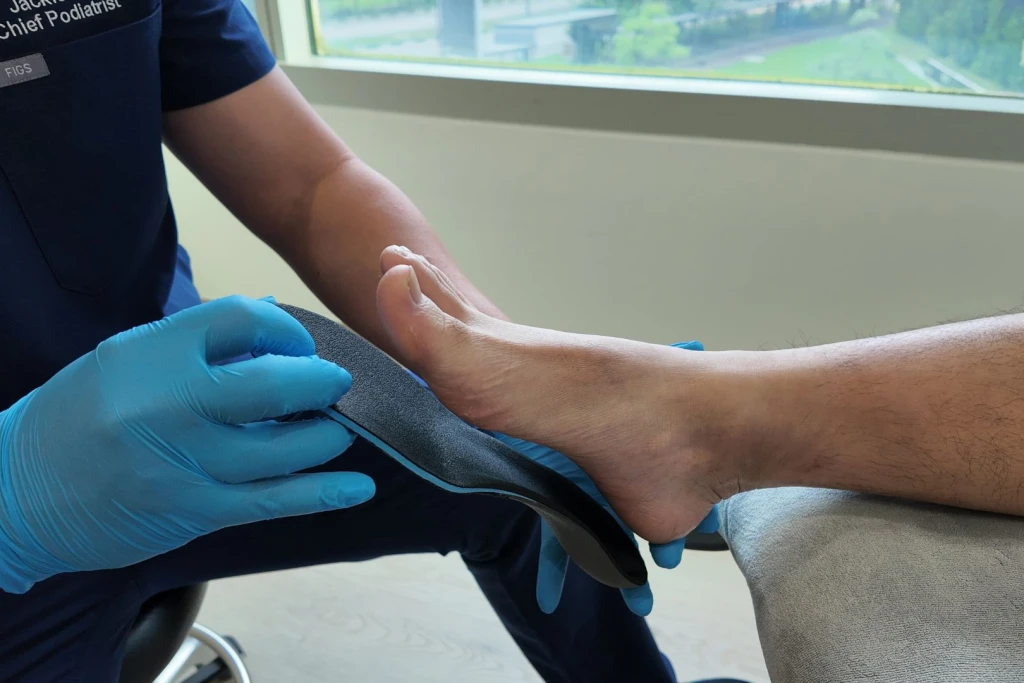
- Footwear and custom foot orthoses: where a pronated foot posture or inward knee drift is loading the medial knee, orthotic correction and appropriate footwear reduce that load with every step. This is the part of the plan where podiatry contributes most directly, and it targets the mechanical driver rather than only the symptom.
- Targeted strengthening and flexibility: strengthening the hip abductors and quadriceps to control inward knee collapse, alongside restoring hamstring flexibility, addresses the muscular pattern that overloads the pes anserinus. This progressive programme is guided by our physiotherapy service, the rehabilitation arm of Straits Podiatry.
- Focused shockwave therapy and radial pressure wave therapy: where the tendon and bursa have been irritated for months and have not settled with load and strengthening work, shockwave and radial pressure wave therapy can help stimulate the local healing response. They are used alongside the load and biomechanical work, not instead of it.
- EMTT for stubborn cases: magnetotransduction therapy is a non-contact option sometimes added for persistent soft-tissue irritation around the knee, again as an adjunct to the core plan rather than a standalone fix.
When conservative care isn’t enough
Most cases respond to load management, mechanical correction, and strengthening over a few weeks to a few months. Where inner-knee pain persists despite that, imaging such as ultrasound or MRI is used to confirm the bursa involvement and, importantly, to clarify how much of the pain comes from coexisting medial knee osteoarthritis or a meniscal tear. For a bursa that stays inflamed despite conservative care, a doctor may consider a corticosteroid injection into the bursa, and in rare, genuinely resistant cases an orthopaedic surgeon may discuss surgical excision of the bursa. These are the exception, and where osteoarthritis is the dominant driver the wider knee is managed alongside a sports physician or orthopaedic specialist.
Have Your Pes Anserine Bursitis Managed at Straits Podiatry
Pes anserine bursitis tends to improve once the load on the inner knee is understood and reduced. At Straits Podiatry, an assessment for inner-knee pain combines a focused history, palpation to map the tender point against the joint line, and a biomechanical evaluation of how the foot, knee, and hip are loading the medial side of the knee during walking and running.
From there, our podiatrists can help with the mechanical side of the problem through footwear and orthotic correction, coordinate strengthening through our physiotherapy service, and add shockwave, radial pressure wave, or EMTT where a stubborn case calls for it. Where the knee joint itself is involved, we work alongside the appropriate medical or orthopaedic care. If inner-knee pain is flaring on stairs and when you stand up, book a consultation for an assessment at any of our three Singapore clinics.
Frequently Asked Questions About Pes Anserine Bursitis
How long does pes anserine bursitis take to heal?
Most cases improve over a few weeks once the aggravating load is reduced and the mechanical cause is addressed, though a case that has been building for months, or one sitting alongside knee osteoarthritis, can take a few months to fully settle. The recovery curve is usually faster when the foot and knee mechanics driving the medial load are corrected early rather than left in place. Persisting with the activity that caused it tends to stretch out the recovery.
Can I keep running with pes anserine bursitis?
Often yes, but at a reduced load. Many patients continue light, flat running while cutting distance, hills, and speed work during the settling phase, provided the pain stays low and does not linger afterwards. Pain that climbs during a run or aches for hours after it is a sign the load is still too high. Switching some sessions to low-impact cardio while the mechanics are corrected usually protects fitness without feeding the irritation.
Does pes anserine bursitis show on a scan?
It can. Ultrasound or MRI can show fluid and irritation in the pes anserine bursa and the neighbouring tendons. That said, the diagnosis is largely clinical, made from the location of the tender point and the pattern of pain. Imaging is most useful for confirming the bursa involvement and for clarifying how much of the pain comes from coexisting osteoarthritis or a meniscal tear, which changes how the knee as a whole is managed.
Why do I have pes anserine bursitis in both knees?
Bilateral pes anserine bursitis is not unusual, because the drivers are often systemic or mechanical rather than a one-off injury. Raised bodyweight, diabetes, a symmetrical foot and knee alignment that loads both medial knees, and osteoarthritis affecting both inner compartments can all irritate the bursa on each side. When both knees are involved, the assessment looks harder at these whole-body and biomechanical contributors rather than at a single local cause.
Is pes anserine bursitis the same as knee osteoarthritis?
No, though they frequently occur together. Pes anserine bursitis is irritation of a soft-tissue bursa and tendon on the inner shin below the knee, while osteoarthritis is wear affecting the joint surfaces inside the knee. They can feel similar because both cause inner-knee pain, but the tender points differ, with the bursa sitting lower and the arthritic pain sitting on the joint line. When both are present, addressing the bursa can reduce pain even though the arthritis itself is managed separately.