
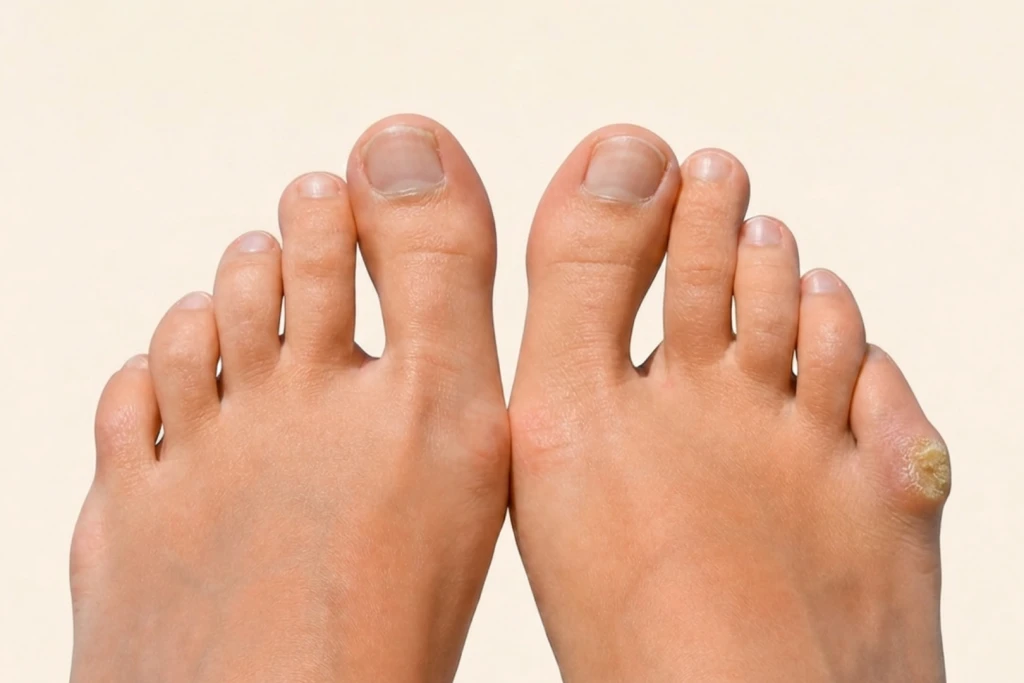
You slip your foot out of a narrow work shoe after a long day. The outer edge of your foot is red and sore where the little toe meets the foot. There is a firm bump there that catches on the side of every closed shoe. A thickened patch of skin has started to build over it, and the toe itself may have begun to lean slightly inward, toward its neighbours.
This is a bunionette, also called a tailor’s bunion. It forms at the fifth metatarsophalangeal joint, the knuckle at the base of the little toe. The long bone behind that toe (the fifth metatarsal) drifts outward while the toe angles in. The result is a bony prominence on the outside border of the foot, the mirror image of a bunion at the big toe. The name comes from tailors who once sat cross-legged for long hours, resting the outer edges of their feet on the floor. The mechanics have changed, but the pressure point has not. In Singapore the more common driver is a narrow shoe rather than a sewing stool.
Symptoms of a Bunionette
A bunionette usually announces itself through pressure and friction rather than deep joint pain, at least early on. Most patients do not pay attention to the deviation of the toe until symptoms set in. Symptoms tend to track closely with footwear and the time spent on your feet.
- A bony bump on the outer edge of the foot. The prominence sits at the base of the little toe, where the fifth metatarsal head pushes against the side of the shoe.
- Redness and swelling over the bump. The skin and soft tissue over the joint become inflamed when the area is rubbed repeatedly through the day.
- A thickened corn or callus over or under the prominence. A corn or callus often builds up as the skin responds to constant friction. This can become more tender than the bump itself, particularly when it is at the sole.
- Pain that worsens in narrow or closed footwear. Tight dress shoes, pointed flats, and stiff covered shoes press directly on the bump. Symptoms flare on long office days and ease in open sandals.
- The little toe drifting inward. Over time the fifth toe may angle in toward the fourth. This can crowd the toes and add a second rubbing point between them.
Types of Bunionette
Not every bunionette forms for the same structural reason. The type matters because it influences how much the bump can be offloaded versus how much is fixed bone. Three patterns are commonly seen in patients:
Enlarged fifth metatarsal head
The bump is mostly a prominent or widened head of the fifth metatarsal. The toe bone itself sits relatively straight out. The prominence is structural but the toe is not markedly deviated.
Lateral bowing of the fifth metatarsal
The shaft of the fifth metatarsal curves outward along its length, pushing the head toward the edge of the foot. This produces a prominence even when the joint angle looks modest on the surface. This is often seen in patients with a history of fifth metatarsal fracture.
Increased angle between the fourth and fifth metatarsals
The fifth metatarsal splays away from the fourth, widening the forefoot and driving the head outward while the little toe leans inward. This pattern often overlaps with a broad forefoot. It tends to be the most footwear-sensitive.
Stages of a Bunionette
Like a bunion, a bunionette tends to progress gradually, so it can feel minor at first and then harder to ignore as the little toe joint shifts further out of line. It generally moves through four stages:
- Stage 1 (Mild): A small bump begins forming at the little toe joint, and symptoms are often minimal or easy to ignore.
- Stage 2 (Moderate): The bump becomes more noticeable, and pain or inflammation flares more often, particularly in snug footwear.
- Stage 3 (Severe): The little toe angles further inward, which increases the misalignment and makes the discomfort more persistent.
- Stage 4 (Advanced): Pain can become constant enough to affect daily footwear choices, and supportive measures are often needed to relieve it.
Causes of a Bunionette
A bunionette develops gradually. The structure of the forefoot and the load placed through the outer border combine to push the fifth metatarsal head outward over months and years. Footwear alone rarely creates the underlying foot shape, but it is often what turns a quiet prominence into a painful one.
What Causes a Bunionette?
- Narrow, pointed, or stiff closed shoes that compress the forefoot and press directly on the outer border of the foot.
- High heels. These tip the body weight forward and raise pressure across the front of the foot, including the fifth toe joint.
- Long hours standing or walking on hard surfaces, which load the forefoot repeatedly through the day.
- Walking patterns that carry more weight along the outer edge of the foot, concentrating force at the fifth metatarsal head.
- Sitting or working positions that rest the outer border of the foot against a hard surface for long periods.
Who Carries a Higher Baseline Risk?
- People with an inherited broad or splayed forefoot, where the fifth metatarsal naturally sits closer to the shoe edge.
- People with a lateral bow in the fifth metatarsal or a prominent metatarsal head.
- People with a history of fifth metatarsal fracture.
- Those with flexible or joint hypermobility, where the bones shift more readily under load.
- People with high arches, which can shift weight toward the outer border of the foot.
- People with flat feet, which cause the fifth toe to claw and curl toward the big toe due to over-recruitment of the flexors for stabilisation.
- Women, who develop bunionettes more often, typically reflect footwear selection.
- Anyone whose work or daily routine keeps them in narrow closed footwear for most of the day.
Conditions Commonly Mistaken for a Bunionette
A sore lump on the outer edge of the foot is not always a bunionette. A few other problems present in the same spot, and the distinction changes how the area is managed.
Corn or callus over the fifth toe joint
A thick corn or callus can build over the joint and feel like a hard lump in its own right. Pressing the skin lesion reproduces a sharp, focused surface pain. A bunionette, by contrast, is a deeper bony prominence rather than just thickening of skin. The two often coexist, which is why the bump and the skin over it are assessed together.
Fifth metatarsal stress reaction or fracture
Pain along the outer border of the foot can sometimes come on after a spike in walking or running. If it hurts on direct pressure over the bone rather than the joint, it can point to a stress reaction in the fifth metatarsal rather than a bunionette. This pain is load-related and present even in roomy shoes.
Joint capsulitis from overload
An onset of redness, heat, and swelling around the little toe joint can reflect an active inflammation of the joint, known as capsulitis. It is categorised under metatarsalgia. This happens when the foot posture or gait pattern tends to overload the fifth metatarsophalangeal joint.
A hammering little toe
When the fifth toe also buckles at a joint, a second prominence forms on top of the toe. This toe deformity can be mistaken for, or sit alongside, the bunionette at the base of the toe. Both rubbing points are mapped during assessment.

Treating and Preventing a Bunionette
A bunionette responds well to conservative care in most cases. The pain comes largely from pressure and friction on the prominence rather than from the bony shape alone, so care is sequenced to take the load off the bump first, settle the inflamed skin and soft tissue, then reduce the daily forces that keep the area irritated. Surgery exists for the minority of cases that stay painful despite this, but it is definitely not first-line.
Conservative treatment
Most bunionettes are managed by podiatrists by first settling the irritated area, then reducing the repeated loading that keeps it symptomatic.
- Footwear: Switching to shoes with a wider, rounder toe box and a soft, flexible upper keeps anything from pressing directly on the outer border of the foot.
- Padding and offloading: A soft donut pad or cushioned sleeve over the bump reduces friction inside closed shoes and gives the inflamed tissue room to settle.
- Icing and short-term pain relief: Icing after a long day, and over-the-counter pain relief where appropriate and guided by your doctor, help settle an inflamed flare.
- Corn and callus care: Removing any overlying corn or callus matters because the skin lesion is often the more painful layer, and it tends to rebuild if the pressure source is not addressed.
- Custom foot orthoses: Where the way your foot loads is driving pressure onto the outer border, custom foot orthoses redistribute force away from the fifth metatarsal head.
- Body weight management: Keeping to a healthy body weight limits the overall load travelling through the forefoot and the pressure reaching the bump.
When conservative care isn’t enough
It helps to be clear about what conservative care can and cannot do. These measures reliably reduce pain and friction and let most people stay comfortable in day-to-day footwear, but they do not reshape the underlying bone. The bony prominence itself can only be corrected with surgery, which realigns or narrows the fifth metatarsal. It is considered when pain limits daily activity despite consistent footwear and offloading changes. For most people that step is never needed, and where it is warranted, it is carried out by an Orthopaedic surgeon.

Have Your Bunionette Managed at Straits Podiatry
When a bump on the outer edge of the foot keeps catching on your shoes and the skin over it stays sore, it is worth having it assessed properly rather than just sizing up your shoes. At Straits Podiatry, the assessment starts by confirming that the pain is coming from a bunionette rather than a corn, a stress reaction, or an inflammatory flare. From there, it looks at what is driving the pressure: your footwear, how your foot loads as you walk, and the position of the fifth metatarsal and little toe.
The plan is then built around your routine. This can include footwear guidance, padding and offloading for the prominence, and care for any overlying corn or callus. Where your foot mechanics are concentrating load on the outer border, custom foot orthoses can redistribute that pressure. Where the bunionette stays painful despite these measures, we can discuss a referral for a surgical opinion. Speak with our team or book a consultation for an assessment and a tailored approach to manage your bunionette.
Frequently Asked Questions About Bunionettes
How is a bunionette treated without surgery?
Most bunionettes are managed by taking the pressure off the bump. That means footwear with a wider toe box and a soft upper. It also means padding or a cushioned sleeve over the prominence, and care for any corn or callus over it. Where the way your foot loads is pushing force onto the outer border, custom foot orthoses can redistribute that pressure. These steps reliably settle the pain and friction for most people. They do not change the shape of the bone.
What shoes are best if I have a bunionette?
Look for a wide, rounded toe box, a soft and flexible upper that does not press on the side of the foot, and a low heel. Stiff, pointed, or narrow closed shoes are the usual aggravators. They are worth avoiding on long days on your feet. Singapore’s climate makes open or orthopaedic-style sandals a practical option for daily wear, even though podiatrists will still advocate enclosed supportive footwear. This keeps direct pressure off the outer border of the foot.
When does a bunionette need surgery?
Surgery is considered only when the bunionette stays painful and limits daily activity. That is despite consistent footwear changes, offloading, and care for the overlying skin. It is not the first step. A procedure realigns or narrows the fifth metatarsal to remove the prominence. It is reserved for the minority of cases that do not settle with conservative measures. An assessment helps clarify whether you are anywhere near that point.
Is a bunionette the same as a bunion?
They are mirror images of each other. A bunion forms at the big toe joint on the inner edge of the foot. A bunionette forms at the little toe joint on the outer edge. Both are bony prominences caused by a metatarsal drifting outward and the toe angling in, and both are aggravated by narrow footwear. They can occur on the same foot, and the conservative principles for managing each are similar.
Can a bunionette be prevented from getting worse?
You cannot change the foot shape once a bunionette has formed. You can, though, reduce the irritation and slow further deviation of the fifth toe. The main lever is footwear: keeping to shoes with enough forefoot width so the prominence is not pressed all day. Addressing how your foot loads, managing any recurring corn or callus, and keeping to a healthy body weight all reduce the forces that keep the area inflamed. Recurrence of pain is closely tied to going back into narrow shoes, so the footwear habit matters most.
Should I see a podiatrist for a bunionette?
It is worth seeing a podiatrist if the bump is painful, if a corn or callus keeps rebuilding over it, or if you are unsure whether the lump is a bunionette at all. An assessment confirms the cause and separates it from look-alikes such as a stress reaction or an inflammatory flare. It also maps the footwear and loading factors driving your symptoms. The offloading and footwear plan is then matched to your foot rather than guessed at.