

Overview
Hip pain shows up across a wide range of Singaporeans, and the cause shifts with age and activity. A runner building mileage around MacRitchie feels it deep in the groin, an office worker feels a nagging ache on the outer hip after sitting through back-to-back meetings, a new parent feels it lifting a toddler, and an older adult feels a stiff, deep ache that has crept in over the years. The hip sits at the top of the lower-limb chain, which means how the foot strikes the ground, how the knee tracks, and how the pelvis and gluteal muscles control each stride all feed load into the same joint. That is also why hip pain sometimes travels with knee pain or broader leg pain, and why an accurate assessment early matters before a small irritation settles into a recurring pattern.
What Is Hip Pain?
Hip pain is discomfort in or around the hip region, which is not only the ball-and-socket joint where the femur meets the pelvis but also the muscles, tendons, bursae, and nerves that surround it. Because so many structures share the same area, the location of the pain is one of the strongest clues to its source. Pain felt deep in the groin usually points to the joint itself. Pain over the bony point on the outer hip usually points to the tendons and bursa there. Pain across the buttock can come from the deep hip muscles or a referral from the lower back. The timing and behaviour of the pain, when it started, what aggravates it, and whether it eases with rest, narrow the likely cause further.
Symptoms of Hip Pain
The character and location of hip pain often point to the underlying cause. Common patterns include:
- Deep pain in the groin or front of the hip, worse on squatting, pivoting, or getting in and out of a car.
- Pain over the bony point on the outer hip, tender to lie on at night and aggravated by climbing stairs.
- Aching across the buttock that can travel down the back of the thigh.
- Stiffness in the morning or after sitting, that loosens once you get moving.
- A catch, click, or sense of the hip locking during certain movements.
- Pain that comes on at a predictable point into a run or a long walk and eases with rest.
- Reduced range when turning the leg in or out, or difficulty with deep hip flexion.
- Pain that traces back to a fall, a sudden increase in training, or a change in footwear or terrain.
Conditions That Cause Hip Pain
Hip pain is usually shorthand for a more specific underlying condition. The conditions below cover the common patterns seen when the lower limb is part of the picture:
- Femoroacetabular impingement (FAI): a bony shape mismatch between the ball and socket that pinches at the front of the hip during deep flexion and pivoting, common in athletes and active adults.
- Greater trochanteric pain syndrome (GTPS): pain and tenderness over the bony point on the outer hip, driven by irritation of the gluteal tendons and bursa, often worse lying on that side at night.
- Hip flexor strain: an overload or tear of the muscles at the front of the hip, felt when lifting the knee, sprinting, or kicking.
- Hip labral tear: a tear of the cartilage rim that seals the socket, presenting as catching, clicking, or a deep pinch, often alongside impingement.
- Hip osteoarthritis: age-related wear of the joint cartilage, presenting as deep groin ache, stiffness, and a gradual loss of range over months to years.
- Piriformis syndrome: deep buttock pain from irritation of the piriformis muscle, which can compress the sciatic nerve and refer pain down the leg.
Hip pain also arises from causes that sit outside the lower-limb-mechanics picture, such as referred pain from the lower back, inflammatory joint conditions like rheumatoid arthritis, stress fractures, and, in children, growth-related hip conditions. These typically need orthopaedic, rheumatology, or general medical input, and it is part of an honest assessment to recognise when the hip is not the true source of the problem.

Causes of Hip Pain
What Causes Hip Pain?
- A sudden rise in running, hiking, or gym volume that outpaces what the hip tissues are conditioned for.
- Prolonged sitting and a sedentary baseline, which lets the gluteal and hip-stabilising muscles weaken and tighten.
- Weak or poorly controlled gluteal muscles, which let the pelvis drop and overload the outer hip tendons.
- Lower-limb mechanics that change how load travels up the chain, such as flat feet, an uneven gait, or a leg length difference.
- Age-related cartilage wear inside the joint, which stiffens the hip and narrows its range.
- A bony shape variation in the ball or socket that limits clearance during deep movement.
- A fall, a direct blow, or a single overloaded effort such as a sprint or a heavy lift.
Who Carries a Higher Baseline Risk?
- Runners, hikers, and athletes in pivoting or kicking sports such as football, hockey, and racket sports.
- People returning to training after a break, where gluteal strength and conditioning have dropped.
- Adults aged 50 and above with cumulative joint load and early osteoarthritic change.
- Women in and after pregnancy, where pelvic loading and ligament laxity shift hip mechanics.
- People with longstanding flat feet, an uneven gait, or a leg length difference.
- People who sit for long stretches through the working day with little hip movement.
- People carrying excess body weight, which multiplies the load through the joint.
How Hip Pain Is Assessed
Getting the source of the pain right is the practical first step, because hip pain from a gluteal tendon behaves very differently from hip pain inside the joint. An assessment typically works through the following:
- History: a structured review of where the pain sits, when it started, what aggravates and relieves it, training and sitting habits, footwear, and any prior hip, knee, or back injury. The location and pattern often point strongly to the cause before any imaging is needed.
- Physical examination: hands-on testing of hip range, the movements that provoke the pain, tenderness over the outer hip and groin, and the strength and control of the gluteal and hip-stabilising muscles.
- Gait and lower-limb assessment: looking at how the foot, ankle, knee, and pelvis move together under load. Where a foot-mechanics issue or a leg length difference is loading the hip inefficiently, this is where podiatry adds value to the wider diagnostic picture.
- Imaging, arranged where needed: X-rays for joint-space narrowing, osteoarthritis, and bony shape variations, and MRI for soft-tissue questions such as a labral tear or a tendon problem that has not settled with a fair trial of conservative care. Imaging is usually arranged through a GP or orthopaedic specialist.
- Onward referral: when the picture points to joint pathology, an inflammatory cause, or a problem referred from the lower back, referral to the right specialist is part of a responsible assessment.
When to See a Podiatrist for Hip Pain
Hip pain straddles several fields, and the right starting point depends on what is driving it. A podiatrist is a reasonable entry point when the hip pain travels with the way you move, for example when foot mechanics, an uneven gait, or a leg length difference look like part of the cause, when the pattern is a tendon-overload one such as greater trochanteric pain syndrome, or when footwear and lower-limb loading are likely feeding the problem. Because the hip sits at the top of the chain, addressing what the foot and leg contribute can take load off an irritated hip even when the hip itself is not where treatment ends.
Some presentations point elsewhere from the outset. Pain after a significant fall, an inability to bear weight, night pain unrelated to position, fever, unexplained weight loss, or hip pain in a child all warrant prompt medical review rather than a mechanical assessment. Deep joint pain from advanced osteoarthritis, a labral tear, or impingement is led by an orthopaedic specialist. A good assessment is honest about which of these applies to you.
Treatment Options for Hip Pain in Singapore
Treatment depends on what is driving the pain, but most mechanical and tendon-related hip pain responds to a paced, structured plan. The first phase settles the irritated tissue, the second rebuilds the strength and mechanics that let the flare happen, and the third escalates only when conservative care has been given a fair trial. Where the problem sits inside the joint, conservative care still has a supporting role while the orthopaedic pathway is worked through.
Settle the Pain
- Reduce the aggravating load for a defined period rather than pushing through, whether that is running volume, deep squatting, or long stretches lying on the sore side.
- Relative rest and activity modification, shifting to lower-irritation movement while the tissue calms rather than stopping altogether.
- Over-the-counter anti-inflammatories may help in the short term and are worth discussing with a clinician.
- Simple changes to sleeping position and sitting setup to take pressure off an irritated outer hip.
Restore Mechanics
- Structured rehabilitation to rebuild gluteal and hip-stabilising strength and control, which is the mainstay for most tendon-related and mechanical hip pain. Where this is the right next step, our physiotherapist works alongside the podiatry plan.
- Custom foot orthotics where foot mechanics or a leg length difference are loading the hip inefficiently, to even out how load travels up the chain.
- Gait retraining and footwear guidance matched to your activity, so the way you load the limb stops feeding the problem.
- A graded return to running or training volume rather than a sudden jump back to full load.
- Weight management where excess body weight is multiplying the load through the joint.
Escalate When Needed
For gluteal and hip tendinopathies such as greater trochanteric pain syndrome that resist a fair trial of loading and rehabilitation, focused shockwave therapy (ESWT) and radial pressure wave therapy can stimulate stubborn tendon tissue, and EMTT is used alongside them for chronic cases where progress has stalled. Injection therapies, prescribed by a doctor, can offer temporary relief in selected cases.
Surgery and specialist-led care become the consideration for problems inside the joint: impingement that limits function despite conservative care, a symptomatic labral tear, and advanced hip osteoarthritis where joint replacement is the next step. Those decisions sit with an orthopaedic surgeon. The podiatry role is to assess what the foot, leg, and gait contribute, manage that conservatively, support rehabilitation, and refer on when the clinical picture calls for it.
Prevention
Build training load gradually rather than in sudden jumps. Keep gluteal and hip strength up year-round, not just in pre-season blocks, since strong hip stabilisers protect the joint and its tendons. Break up long periods of sitting with movement through the working day. Replace running shoes before the midsole packs out, and have your gait assessed if hip pain keeps returning rather than treating each flare in isolation. Warm up before high-intensity training, and stop pushing through pain that has not settled within a session or two.
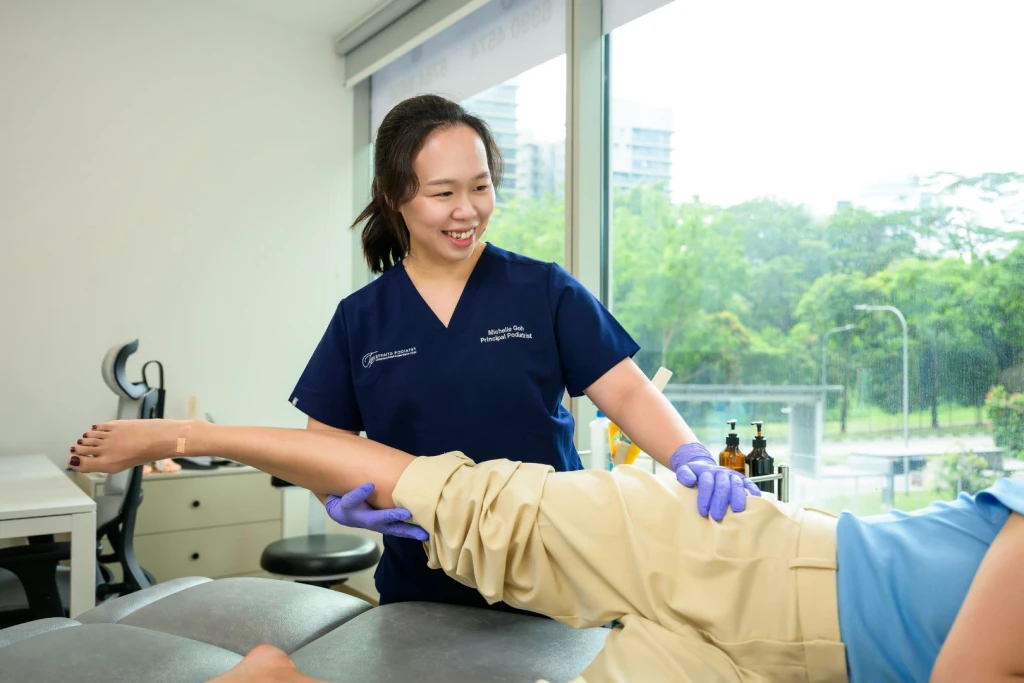
Have Your Hip Pain Managed at Straits Podiatry
Hip pain straddles podiatry, physiotherapy, and orthopaedic surgery, and the right starting point depends on what is driving it. At Straits Podiatry, the assessment focuses on what the foot, leg, and gait contribute to the load travelling up to the hip, since that is where lower-limb care can take pressure off an irritated joint or tendon.
Services that may form part of your care include gait and lower-limb assessment, custom foot orthotics, footwear guidance, and shockwave-family therapy for gluteal and hip tendinopathies that have not settled with conservative measures. Where structured rehabilitation is the right next step, our physiotherapist works alongside the podiatry plan, and where the problem sits inside the joint, a referral to an orthopaedic specialist is arranged. Speak with the team or book a consultation at any of our three Singapore clinics for an assessment and a clear path forward.
Frequently Asked Questions About Hip Pain
Can a podiatrist help with hip pain?
Sometimes, and it depends on the cause. A podiatrist adds value when the way you move is part of the problem, for example when foot mechanics, an uneven gait, or a leg length difference are loading the hip inefficiently, or when the pain has a tendon-overload pattern such as greater trochanteric pain syndrome. Because the hip sits at the top of the lower-limb chain, addressing what the foot and leg contribute can take load off an irritated hip. Where the pain comes from inside the joint, such as advanced osteoarthritis or a labral tear, the podiatry role is to support the wider plan and refer to an orthopaedic specialist. An assessment is the fastest way to know which applies to you.
How do I know if my hip pain is serious?
Seek prompt medical review if you cannot bear weight, the pain followed a significant fall, you have night pain unrelated to your sleeping position, or there is fever, unexplained weight loss, or a hot, swollen joint. Hip pain in a child always warrants review rather than watchful waiting. For mechanical hip pain that builds with activity and eases with rest, an earlier assessment still helps, because a paced plan almost always resolves faster than a stop-start cycle of self-managed flare-ups.
Can knee or foot problems cause hip pain?
Yes. The lower limb works as a chain, so how the foot strikes the ground and how the knee tracks both influence the load that reaches the hip. Flat feet, an uneven gait, or a leg length difference can shift how force travels up the leg and leave one hip working harder than the other. This is why an assessment for stubborn hip pain looks at the whole limb, not just the hip in isolation, and why addressing foot mechanics can be part of settling a recurring hip problem.
Why does the outer side of my hip hurt when I lie on it?
Pain over the bony point on the outer hip that is worse lying on that side at night is a classic pattern for greater trochanteric pain syndrome, an irritation of the gluteal tendons and the bursa that sits over them. It is often driven by weak or poorly controlled hip muscles combined with a compressive load, such as lying directly on the area or sitting with crossed legs. It usually responds to a structured loading and rehabilitation plan, with shockwave-family therapy reserved for cases that have not settled.
Should I keep running with hip pain?
It depends on the cause and how the hip responds to a lower volume. Tendon-related hip pain often tolerates a paced reduction in load better than a full stop, since too much rest can leave the tendon deconditioned. Deep groin pain, a catch or click inside the joint, pain after a fall, or any pain that worsens through a run are signals to stop and get assessed before returning to load. The fastest way back to running is usually a graded plan built around what the assessment finds, not pushing through.
How long does hip pain take to settle?
Most mild, activity-related hip pain settles within a few weeks once the aggravating load is reduced and the right supportive measures are in place. Tendon-related hip pain such as greater trochanteric pain syndrome often takes three to six months of paced rehabilitation, particularly when hip strength and lower-limb mechanics need addressing. Hip osteoarthritis is a longer-term management picture rather than a single recovery window. The earlier the assessment, the shorter the recovery tends to be.