

Your heel pain started a few weeks ago. You assumed it was plantar fasciitis because it was common in runners, just like most runners we managed. You stretched, you switched shoes, you tried a softer insole. The pain unfortunately does not ease. If anything, it has worsened with a “swollen feeling”. Walking is now uncomfortable. Standing for long periods produces a deep, dull ache across the entire heel rather than a sharp localised pain at the inside edge. You finally decide to see a doctor, get an X-ray, and the report comes back clear. No fracture visible, and report says, “no abnormalities detected”. The recommendation is to rest and stretch your calf. Two more weeks pass with no improvement, and you start thinking: maybe it is not plantar fasciitis at all.
This is the typical presentation of a calcaneal stress fracture we see in our clinic. The condition is regularly missed in its first 2 to 3 weeks because X-rays are unreliable in that window for most cases. Patients are often then treated for plantar fasciitis, heel fat pad syndrome, or general overuse heel pain, while the underlying microscopic crack in the heel bone is left unattended for too long and the recovery clock has not yet started. Recognising the pattern early changes the trajectory significantly.
A calcaneal stress fracture is a microscopic crack in the calcaneus, the heel bone, that develops from repetitive impact loading. It is different from a traumatic fracture, which results from a single high-energy event, usually a fall from height. The stress version develops gradually as the bone’s normal remodelling capacity is outpaced by the load being placed through it. The condition is most common in runners with sudden mileage increases, in military recruits during early training, in dancers and jumping athletes, and in older adults with reduced bone density. We often see this following Standard Chartered Marathon or Hyrox season. Since calcaneal stress fracture often gets misdiagnosed as other heel pain conditions, to recognise it earlier, it helps to know what its symptoms are like.
Symptoms of Calcaneal Stress Fracture
Stress fractures of the heel bone develop gradually. Therefore, symptoms often starts from having a mild heel discomfort, then becomes progressively more noticeable. The mild symptoms usually start after a higher-impact activity like a long-distance run.
- Deep, dull, aching pain across the whole heel the discomfort is felt across the entire weight-bearing surface of the heel rather than at one specific tender point. Patients often struggle to localise it precisely.
- Pain that worsens with activity and persists with rest unlike plantar fasciitis (which classically worsens on the first step after rest, then eases as you walk), stress fracture pain often gets worse with any weight-bearing activity and lingers as a deep ache even after stopping.
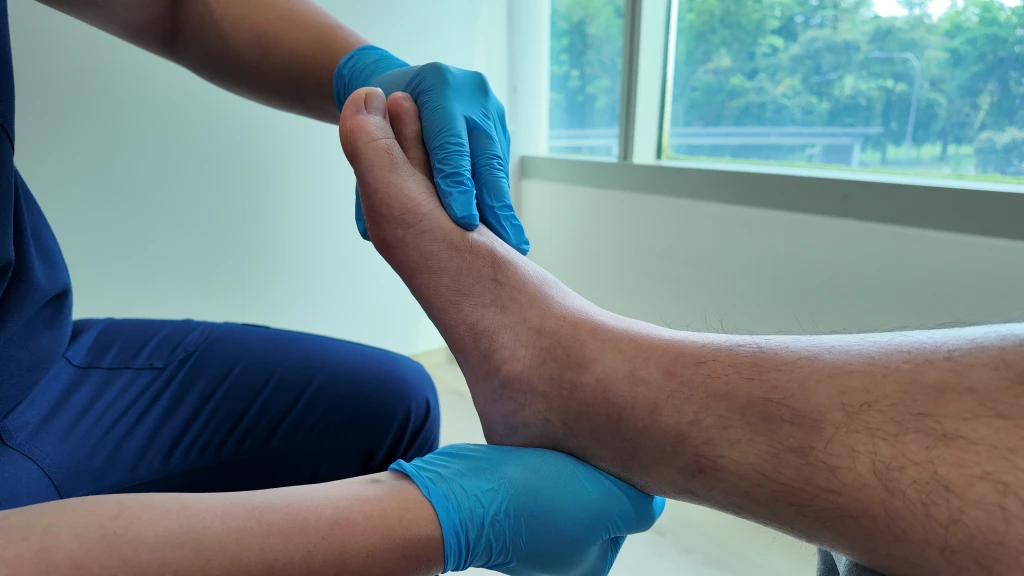
- Tenderness when squeezing the heel from both sides one of the clinical tests we use, compressing the calcaneus between thumb and forefinger from the inner and outer sides of the heel reproduces the pain. This is the classic positive “squeeze test”.
- Mild swelling or “swollen feeling” at the heel subtle puffiness around the heel can be present, but is not always obvious because it is mild.
- Pain that does not match the typical plantar fasciitis pattern no clear morning first-step worsening, no specific tender point at the inside edge of the heel.
- Progressive worsening over weeks rather than fluctuating or improving with rest, the pain tends to escalate steadily until the patient stops all activity entirely.
- In some cases, pain at night or with non-weight-bearing positions typically indicates a more significant crack, so immediate medical attention is necessary.
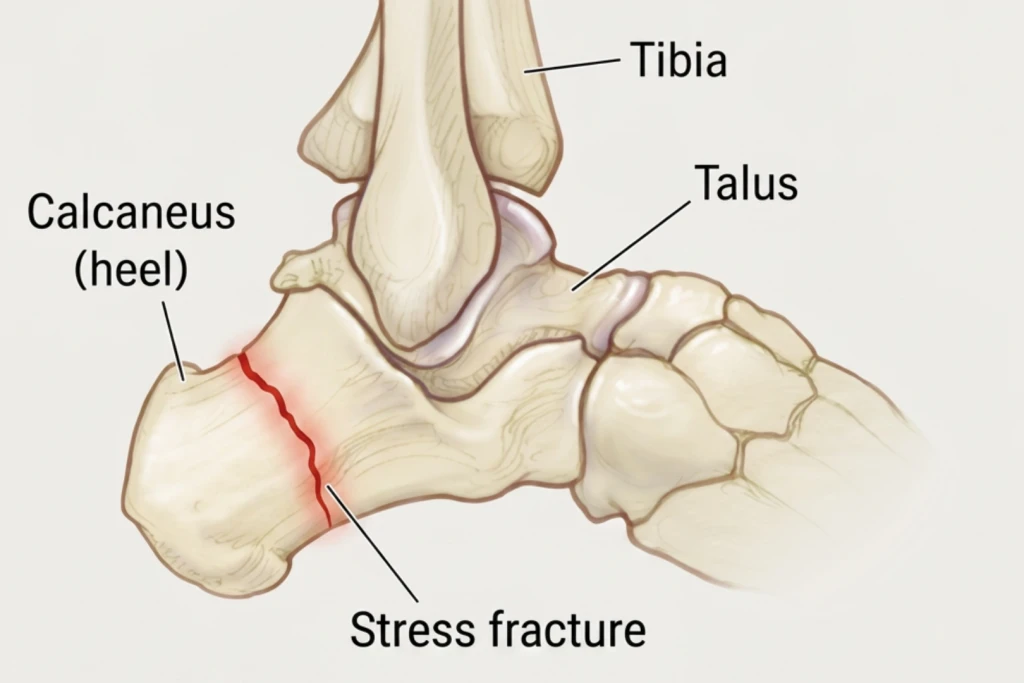
Causes of Calcaneal Stress Fracture
Calcaneal stress fractures develop when the load placed through the heel bone exceeds its capacity to remodel and adapt. Multiple factors contribute, and most clinical cases involve a combination of triggers and pre-existing risk factors.
What Causes Calcaneal Stress Fracture?
- Sudden increase in running or impact training volume the most common single trigger. A jump from 30 km per week to 60 km, a new running program, or rapid marathon training escalation.
- Repetitive jumping or landing activities basketball, volleyball, jump rope training, and dance create repeated heel impact loading.
- Hard training surfaces shifting from grass or turf to concrete or tiled floor increases the impact force the heel must absorb with every step.
- Poor shoe cushioning or barefoot training worn-out running shoes, minimalist footwear, or barefoot training without proper transition, or training shoes used long past their intended mileage.
- Military training the classic National servicemen context. New recruits in early phases of basic military training are at higher risk due to sudden high-volume marching, running on hard surfaces, especially in those hard boots.
- Poor recovery between training sessions inadequate sleep or rest, suboptimal nutrition, and back-to-back hard training days reduce the body’s capacity to remodel bone effectively.
Who Carries a Higher Baseline Risk?
- Long-distance runners and high-performance athletes, particularly during marathon training cycles.
- NS recruits in the early phases of basic military training.
- Low energy availability or Relative Energy Deficiency in Sport (RED-S), which reduces bone density and remodelling capacity. For females, menstrual irregularity is a red flag.
- Adults with osteoporosis or reduced bone mineral density, including postmenopausal women not on hormone or bone-protective therapy.
- People with vitamin D deficiency, which is quite common in Asia due to sun avoidance.
- Older adults who suddenly increase walking or activity (for example, starting a new exercise routine without graduated progression).
- People with structural foot factors, such as high arches.
Conditions Commonly Mistaken for Calcaneal Stress Fracture
Most clinician would not consider a presenting heel pain case as calcaneal stress fracture immediately because they are far less common, and that is why it often get misdiagnosed. Besides, there are a few conditions that present similarly, especially in the beginning. Differentiating them matters because management is fundamentally different, and applying incorrect treatment can lead to much longer recovery.
Plantar fasciitis
Definitely the most common misdiagnosis we see. The distinction lies in the pain pattern. Plantar fasciitis pain is typically sharp, localised to the inside edge of the heel or the arch. It is usually worst on the first few steps after rest and improves with walking. Calcaneal stress fracture pain is deeper and duller, spread across the whole heel, gets worse with continued activity, and lingers or throbs after stopping.
Heel fat pad syndrome
Both conditions cause pain across the underside of the heel, and both worsen with hard surfaces and barefoot walking. The key difference is that heel fat pad syndrome often results in bruising pain that is at the fatty cushion layer, which feels less deep compared to calcaneal stress fracture. For heel fat pad syndrome, squeezing the fat pad reproduces the pain as compared to squeezing the sides of the heel bone for calcaneal stress fracture.
Retrocalcaneal bursitis or insertional Achilles tendinitis
Retrocalcaneal bursitis and insertional Achilles tendinitis are less commonly mistaken for a calcaneal stress fracture, but it still happens when clinicians did not perform a thorough check. The distinction is straightforward: pain at the back of the heel rather than underneath the heel, with tenderness directly at the Achilles tendon attachment.
Treating and Preventing Calcaneal Stress Fracture
Once the diagnosis and underlying causes are clear, the care of a calcaneal stress fracture is straightforward in principle: the bone is injured and needs to be unloaded so it can remodel and heal, much like any other bone fracture. No therapy, orthotic, or exercise protocol bypasses this basic requirement, and continuing to load the bone while the crack is active risks it progressing to a larger fracture and a far longer recovery. This is also why a calcaneal stress fracture mistaken for plantar fasciitis or Achilles tendonitis tends to get worse, because those conditions are managed with loading regimes.
Conservative treatment
Treatment of calcaneal stress fracture centres on confirming the diagnosis, offloading the heel bone so it can heal, then rebuilding capacity and returning to activity in stages.
- Accurate diagnosis and imaging: Clinical assessment identifies the pattern using the squeeze test and palpation, and referral for MRI may be needed to confirm the diagnosis, since X-rays are unreliable and unremarkable in up to 85% of cases during the first 2 to 3 weeks of symptoms.
- Offloading with a walking boot: A CAM walking boot protects the heel and redistributes load to the lower leg, worn for the healing period of typically 4 to 6 weeks and removed only for showering or sleeping. Running, jumping, and high-impact loading stop completely during this time, and crutches may be needed if weight-bearing stays painful even in the boot.
- Extracorporeal shockwave therapy and magnetotransduction therapy: These can be considered to support the healing response and reduce pain and inflammation while the bone recovers.
- Supportive footwear: As pain settles, a transition out of the boot into supportive, high-cushioning footwear worn both indoors and outdoors protects the heel during the next phase.
- Custom foot orthotics: Where foot structure such as high arches contributed, a custom insole reduces heel impact during activity and is worth using during sustained training afterwards.
- Bone health and nutrition: Vitamin D, calcium, and overall nutrition support bone remodelling, and any underlying issue such as RED-S or osteoporosis is assessed and addressed as part of recovery.
- Rehabilitation and graded return: Non-impact cardio such as swimming or stationary cycling maintains fitness early, then a progressive weight-bearing plan builds from walking to incline walking to slow jogging. Running volume is rebuilt gradually using the 10% rule, and where deconditioning has set in, a physiotherapist guides a structured strengthening programme. Returning to pre-injury mileage can take 3 to 6 months, so patience protects against re-injury.
- Training and footwear habits: Mixing training surfaces rather than sustained running on concrete, rotating between two or more pairs of running shoes, replacing worn-out shoes, and taking sufficient rest days all lower the chance of a recurrence.
When conservative care isn’t enough
Surgery is very rare in calcaneal stress fracture care and is reserved for non-healing fractures that have not responded to conservative measures over many months. Most cases heal completely with appropriate offloading and time, and where surgery is warranted, a referral to an orthopaedic surgeon is arranged.

Have Your Calcaneal Stress Fracture Managed at Straits Podiatry
Calcaneal stress fracture is a condition where early recognition makes a meaningful difference. Patients who arrive with several weeks of escalating heel pain after a recent training change, where usual treatment advice has not helped, where X-ray results is too reassuring, are exactly the patients in whom this condition is often hiding. At Straits Podiatry, an assessment for suspected calcaneal stress fracture focuses on the patient’s activity history, the clinical examination (squeeze test, palpation, weight-bearing reproduction), and a clear discussion of whether MRI confirmation is needed and how to arrange it.
From there, a management plan is built around your specific case. This may include a comprehensive lower-limb assessment to identify any contributing biomechanical and training factors, fitting and guidance on walking-boot use, custom foot orthotics, and structured rehabilitation to address deconditioning and return to sport.
When heel pain starts to get in the way of your training, you should take care of it before it gets worse. Speak with our team or book a consultation for an assessment and our podiatrists will assist you.
Frequently Asked Questions About Calcaneal Stress Fracture
How long does a calcaneal stress fracture take to heal?
A calcaneal stress fracture usually takes between 4 to 6 weeks to heal, but can take months before you can return to sport. However, the duration is dependent on appropriate management. At the start, protected weight-bearing in a walking boot is required for 4 to 6 weeks, sometimes longer in cases with delayed diagnosis or more significant cracks. Full return to sport, especially back to pre-injury training volume, typically takes 3 to 6 months from the start of appropriate treatment.
Can I still walk with a calcaneal stress fracture?
Yes, but only with appropriate protection. The standard treatment is a walking boot (CAM boot) for daily activities, removed only for sleep and bathing. The boot redistributes load away from the heel and allows controlled weight-bearing without aggravating the lesion. Walking without protection during the healing phase risks fracture progression and significantly extends recovery. When pain settles after 4 to 6 weeks in a walking boot, you may transit into a pair of supportive, high-cushioning sports shoes for continued protection.
Why was my X-ray clear if I have a calcaneal stress fracture?
We get the question all the time, and the answer is that sometime the fracture is too small to detect on radiographs. Stress fractures are fine disruption of the soft bone rather than a clear break, so typically do not show on plain X-ray, especially during the first 2 to 3 weeks of symptoms. They only become more detectable when the fracture healing process has started, showing up as a sclerotic or bright line on X-ray. MRI is the gold standard for diagnosis because it can detect the bone marrow oedema and trabecular changes that X-ray could not.
How is a calcaneal stress fracture different from plantar fasciitis?
Plantar fasciitis pain is sharp, usually localised to the inner edge of the heel where the plantar fascia attaches, and worst on the first few steps after rest. Calcaneal stress fracture pain tends to be duller and deeper, and spread across the whole heel. Calcaneal stress fracture also worsens with continued activity, and lingers as a dull ache after stopping.
When can I return to running after a calcaneal stress fracture?
Return to running following a calcaneal stress fracture must be gradual and with a structured plan. Our best advice is to start once you are comfortable walking on a treadmill, especially on a incline, without any symptoms. Following that, you can begin slow jog, keeping the distance short (2 to 3km) to begin with, and increase 10% each week. Patience is very important to avoid setbacks. Returning too early is the single most common reason for re-injury, and the consequences (potential complete fracture) are significant enough that the conservative approach is the right one.