

Overview
Ankle pain is among the most common musculoskeletal complaints seen in Singapore. The ankle has to provide both stability for standing and mobility for walking, running, and pivoting, all while carrying body weight. That balancing act leaves it vulnerable to sprains, tendon problems, joint surface damage, and fractures. Court sports (basketball, badminton, futsal), NS and marathon running volume, and long shifts on hard floors are the local patterns that drive most ankle presentations.
Most ankle pain does not come from a single event. It sits on a spectrum, from a mild ligament strain that settles in a week to a severe sprain that leaves long-term instability. Understanding which structures are involved, how the problem started, and what the recovery should look like is the difference between a clean resolution and a problem that keeps coming back.
Understanding Ankle Pain
Ankle pain can arise from damage to any of the structures around the joint: the bones, ligaments, tendons, cartilage, or joint capsule. These causes are grouped by structure (joint and ligament vs tendon) and by mechanism (acute traumatic vs gradual overuse). The location of the pain, the way it started, and the pattern of swelling and instability together point to which structure is involved and how it should be managed.
Symptoms of Ankle Pain
- Sudden sharp pain at the time of injury, sometimes with an audible pop or snap.
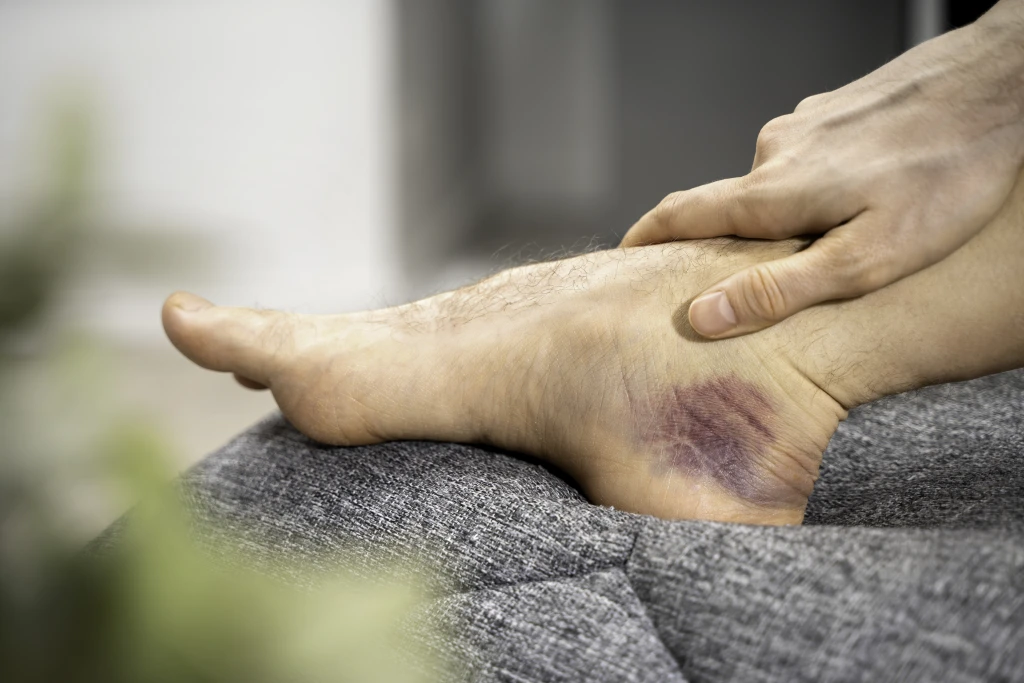
- Swelling and bruising around the ankle, sometimes tracking into the foot.
- Difficulty bearing weight or walking on the affected side.
- Stiffness, restricted range of motion, or a feeling of the ankle locking.
- Instability, with the ankle giving way on uneven surfaces or during a pivot.
- Clicking or catching sensations within the joint during movement.
- Persistent ache that worsens with activity and improves with rest.
Common Causes of Ankle Pain
Ankle pain has several common sources, and each has a different recovery pathway.
Joint and Ligament Injuries
- Acute ankle sprain: the most common cause of ankle pain, where the lateral ligaments are stretched or torn after the ankle rolls outward.
- High ankle sprain: a syndesmotic injury involving the ligaments connecting the tibia and fibula. Slower to settle than a standard lateral sprain and often missed at first review.
- Chronic ankle instability: ongoing pain and instability that follows an under-rehabilitated sprain, with the ankle giving way during everyday activity.
- Ankle impingement: soft tissue or bone pinched at the front or back of the joint, with pain and a blocked feel at end-range.
- Talar dome injuries: damage to the cartilage on top of the talus, often after a significant sprain. Presents as deep ankle ache, catching, or swelling that does not settle.
- Ankle fractures: a break in one or more of the bones forming the ankle joint, usually after direct trauma or a forceful twist.
Tendon Injuries
- Achilles tendonitis: pain at the back of the heel and ankle from overuse, jumping loads, or degenerative tendon change.
- Posterior tibial tendonitis: pain on the inside of the ankle, often in runners with flat feet or after a sudden rise in volume.
- Peroneal tendonitis: pain on the outside of the ankle, common after a sprain or in athletes with high-arched feet.
How Ankle Pain Happens
What Triggers Ankle Pain?
Acute ankle pain usually comes on during sport or on uneven ground, when the ankle rolls outward, twists awkwardly, or absorbs a sudden impact. Landing from a jump, changing direction at speed, or stepping off a kerb at the wrong angle are the common mechanisms. In Singapore, court sports and trail runs along MacRitchie or Bukit Timah are the typical settings.
Overuse-related ankle pain develops more slowly. It is driven by repeated loading without enough recovery, sudden increases in training volume, tight calves, weak hip and ankle stabilisers, and worn footwear. Foot mechanics also matter. Flat feet and rigid high-arched feet both load the ankle asymmetrically, which can predispose to specific tendon and joint problems.
Who Carries a Higher Baseline Risk?
- Athletes in pivoting sports such as football, basketball, badminton, and tennis.
- People with a history of previous ankle sprains or unresolved instability.
- Runners and NS trainees with high weekly volumes.
- Office workers returning to high-impact activity after years of inactivity.
- People with flat feet, high arches, or noticeable leg-length asymmetry.
- Older adults with reduced bone density, balance changes, or early arthritis.
Diagnosis
Getting the correct diagnosis is the practical first step toward effective treatment. A podiatrist typically works through the following:
- Patient interview: a structured review of how the pain started, what aggravates it, daily activity, footwear, and any prior ankle or foot injuries. The mechanism often points strongly to which structure is involved before any imaging is needed.
- Physical examination: hands-on assessment to identify tender points, test joint range and ligament integrity, check foot shape and gait, and look for visible swelling, bruising, or deformity. Specific tests such as the anterior drawer and squeeze test help separate a lateral sprain from a high ankle sprain.
- Imaging: X-rays for bony causes (fractures, joint surface change, alignment), and MRI for ligament tears, cartilage damage, occult stress fractures, or persistent pain that has not settled with standard care.
- Specialist referral: when imaging or examination points to a displaced fracture, full ligament rupture, or significant talar dome lesion, a podiatrist can coordinate timely review with an orthopaedic surgeon for a surgical opinion.

Treatment Options for Ankle Pain in Singapore
Treatment depends on what is injured and how severe it is, but the principles are consistent. The first phase settles the irritated tissue, the second restores mechanics so the same flare does not return, and the third escalates only when conservative care has been given a fair trial.
Conservative Management
To settle the pain:
- The RICE protocol (rest, ice, compression, elevation) in the first 24 to 72 hours for acute injuries.
- A short course of anti-inflammatory measures where appropriate, guided by a clinician.
- Immobilisation in a brace, boot, or walker for moderate to severe sprains and stable fractures, to protect the healing tissue.
To restore movement and share the load:
- Progressive calf, peroneal, and intrinsic foot strengthening.
- Balance and proprioception drills, which are the part of rehab most commonly skipped and the most common reason ankles keep rolling.
- Custom orthotic insoles, or in selected cases an ankle-foot orthosis, to stabilise the joint, offload injured tendons, and correct underlying mechanics that contributed to the problem.
- Supportive footwear matched to the activity (court shoes for court sport, structured trainers for distance running), with worn pairs replaced early.
- A graded return to load, mixing in lower-impact training to share the work across the kinetic chain.
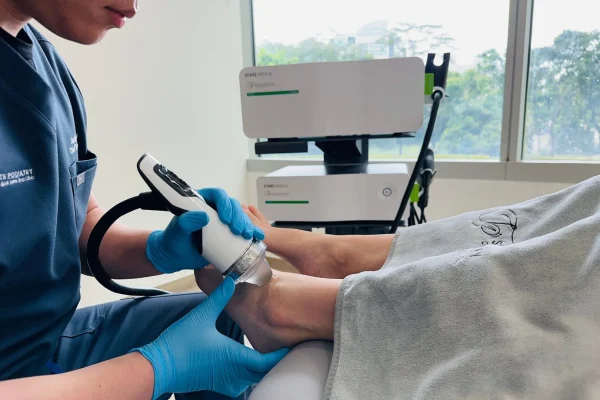
For tendon overuse and stubborn soft-tissue cases that have not settled with the steps above, focused ESWT and EMTT can stimulate the tissue to heal where progress has stalled.
Surgical Intervention
Surgery is typically only necessary when conservative management has been given a fair trial without improvement, or where the structure requires direct repair. Common procedures include lateral ligament reconstruction for chronic instability, talar dome lesion repair, and fracture fixation. A podiatrist can advise when an orthopaedic surgical opinion is appropriate.
Prevention
Warm up before sport. Build training volume gradually rather than in sudden jumps. Choose the right footwear for the activity. Keep calves flexible, hips strong, and ankle proprioception sharp through regular balance work. Address foot mechanics early if you have flat feet, high arches, or a history of giving way. A previous ankle sprain is the single biggest risk factor for the next one, so finishing rehab properly the first time is the best protection.
Have Your Ankle Pain Managed at Straits Podiatry
When ankle pain starts to dictate your training, your work shifts, or your evening walks, guesswork rarely shortens recovery. At Straits Podiatry, the assessment connects how the pain started, where it sits, your footwear, your sport, and your foot mechanics, so the source is clear before any care begins.
From there, the plan is built around your daily routine. Services that may form part of your care include gait analysis, custom orthotic insoles, ankle-foot bracing, ESWT or EMTT for cases that have not settled with conservative measures, and structured rehabilitation with our physiotherapist. Speak with the team or book a consultation for an assessment and a tailored path back to confident, stable movement.
Frequently Asked Questions About Ankle Pain
How do I know if my ankle sprain is serious?
A mild sprain usually allows some limping, with swelling that settles over a few days. A serious sprain or fracture often makes weight-bearing impossible from the outset, with sharp tenderness directly over bone, rapid bruising, and a visible deformity. The Ottawa Ankle Rules are a practical guide: if you cannot take four steps unaided, or there is bony tenderness over the malleolus or the base of the fifth metatarsal, imaging is recommended. Persistent instability or pain that has not settled in two weeks also warrants assessment, even if the initial injury looked minor.
When should I get an X-ray for ankle pain?
X-rays are indicated when a fracture is plausible: inability to bear weight, sharp bony tenderness, significant deformity, or a high-energy mechanism (a fall from height, a sporting collision, a road accident). They are less useful for ligament and tendon problems, which do not show on X-ray. If pain or instability persists after a normal X-ray, an MRI is the more informative next step because it shows ligament tears, cartilage damage, and occult stress fractures that X-rays miss.
Why do my ankles keep rolling?
Recurrent rolling is the hallmark of chronic ankle instability. It usually traces back to an earlier sprain that was rested but never rehabilitated, leaving the ligaments lax and the proprioceptive system unreliable. The ankle no longer “knows” where it is in space, so it gives way on uneven ground or during a pivot. Foot shape (flat or high-arched), worn footwear, and weak hip stabilisers all add to the risk. Targeted strengthening and balance retraining, supportive footwear, and in some cases bracing or custom orthoses can break the cycle. Surgery is reserved for cases where structured rehab has been given a fair trial and the instability remains.
Should I see a podiatrist, the A&E, or an orthopaedic surgeon for ankle pain?
For an acute injury with severe pain, an obvious deformity, or an inability to bear weight at all, the A&E is the right first stop to rule out a fracture and arrange imaging. For most other ankle pain, including ongoing sprains, tendonitis, recurrent rolling, and pain that has not settled, a podiatrist is the appropriate first point of contact. Podiatrists focus on diagnosing and managing foot and ankle conditions and use the same conservative tools (orthoses, gait analysis, footwear advice, shockwave therapy, structured rehab) that orthopaedic surgeons would typically refer for. Orthopaedic input is most useful when surgery is being considered, and a podiatrist can coordinate that referral when the imaging or clinical picture warrants it.
How long does an ankle sprain take to heal?
Mild sprains often settle within one to two weeks. Moderate sprains can take six to eight weeks, and severe ligament tears or fractures may take three to six months including rehabilitation. Recovery time depends as much on the quality of rehab as on the initial grade. Skipping the strength and balance phase is the most common reason an ankle ends up with chronic instability and a higher risk of re-injury, so working through a structured progression all the way back to sport-specific load is what makes the difference between a clean recovery and a recurring problem.