
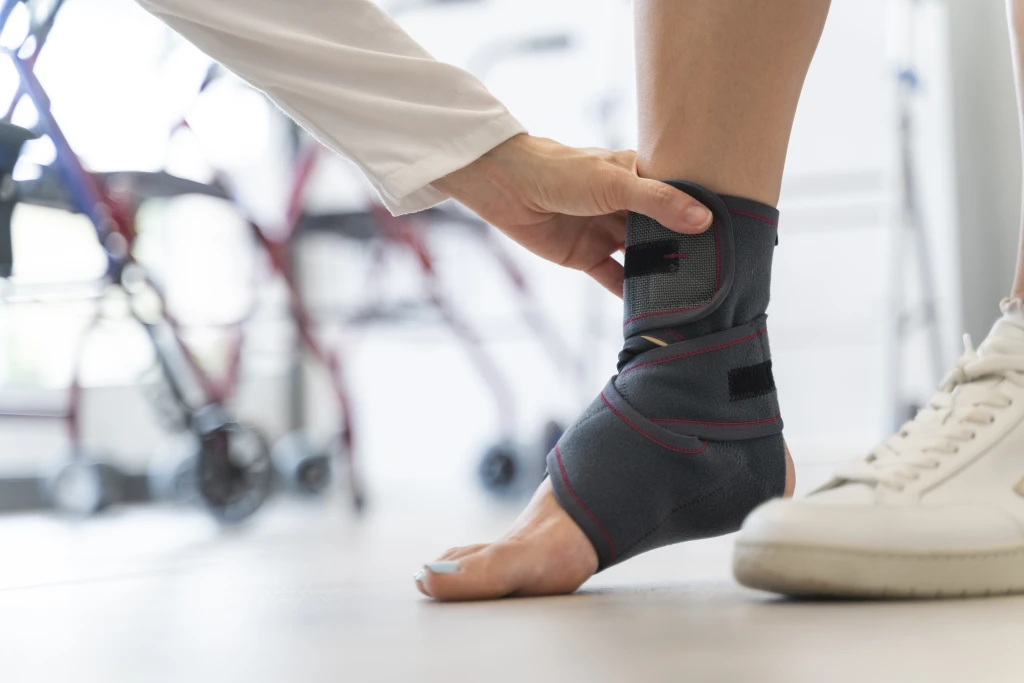
Your ankle rolled badly once, it healed, and you moved on, yet it still catches you out. Stepping off a kerb, turning on grass, or landing awkwardly in sport, it gives way without warning and twists far more easily than the other side. Many people say they never quite trust it again, even years after the original injury. This is chronic ankle instability: what remains when an acute ankle sprain does not fully recover and the ankle is left loose and unreliable rather than stable. It was traditionally described as a chronic or recurrent ankle sprain, but instability is the more accurate label, because the problem is the loss of control rather than a single fresh injury.
This pattern shows up in Singapore among weekend footballers, badminton and basketball players, and anyone who treated a first ankle sprain as a minor knock and skipped the rehabilitation phase. The underlying issue is usually a combination of stretched ligaments and unresolved deficits in balance, strength, and coordination. Left unaddressed, each fresh twist drives further joint damage, including cartilage injury, impingement, and early arthritis.
Symptoms of Chronic Ankle Instability
The giving-way and frequent ankle rolling get the attention, but they rarely travel alone. Sometimes the giving-way is due to something else too, so these are the common signs that usually come with it:
- A persistent feeling that the ankle is loose, weak, or about to give way.
- Recurrent twisting or rolling of the ankle, even when walking on flat or familiar surfaces.
- A dull aching pain over the ankle after prolonged walking or activity.
- Chronic mild swelling at the outer ankle that does not fully settle over time.
- Excessive side-to-side range of motion at the ankle, often far more than the unaffected ankle.
- Loss of confidence on uneven ground, kerbs, or stairs.
- Being unable to confidently take part in sports without an ankle brace or guard.

Types of Chronic Ankle Instability
Mechanical instability
Mechanical instability is structural. The lateral ligaments (anterior talofibular, calcaneofibular, or posterior talofibular) are stretched or torn, causing the structural integrity of the ankle joint to become loose. The ankle joint therefore tends to have excessive range of motion that an examiner can detect on testing.
Functional instability
Functional instability is neuromuscular. The sprained ligaments may have healed, but proprioception (positional and spatial awareness), muscle reaction time, and balance control did not recover, so the ankle feels unstable even though the ankle structure itself is stable.
Most chronic cases involve a combination of both, which is why we always recommend addressing structure and rehabilitation together.
Causes of Chronic Ankle Instability
What Causes Chronic Ankle Instability?
The story is almost always the same. You had a first sprain, the pain and swelling settle, and you go back to sport and daily life without rebuilding the proprioception, strength, and dynamic balance the ankle needs to stay stable. Soon after, you start rolling or twisting the ankle more often. Each subsequent twist stretches the ligaments further and slows the muscle reflex, and the instability becomes entrenched. Other drivers include incomplete rehabilitation after severe first-time tears, repeated sprains on the same ankle in close succession, and structural foot postures such as high-arched feet that load the lateral ligaments more aggressively. People with untreated talar dome injuries, ankle impingement, and peroneal tendonitis also tend to have chronic instability, as these conditions often present together after an injury.
Who Carries a Higher Baseline Risk?
- People with a history of one or more significant ankle sprains, especially if rehab was skipped.
- Athletes in pivoting sports such as football, basketball, badminton, netball, and tennis.
- Dancers, especially those with hypermobile joints.
- People with high-arched feet, which place more stress on the lateral ankle ligaments.
- Those with generalised joint hypermobility or connective tissue conditions.
- Anyone who has had recurrent twisting injuries within a 12-month window.
Conditions Commonly Mistaken for Chronic Ankle Instability
Chronic ankle pain and a giving-way feeling after a previous sprain are not always instability. A careful clinical and imaging workup helps separate true instability from the look-alikes below, several of which can also coexist with it.
Peroneal tendonitis
The peroneal tendons run behind the outer ankle and help stabilise it against rolling. When they are irritated, as in peroneal tendonitis, the outer ankle aches and can feel weak or unreliable, which is easily mistaken for ligament instability. The distinction matters because the rehabilitation focus is different.
Ankle impingement
Where bone or soft tissue is being pinched at the front or back of the joint, as in ankle impingement, the ankle can catch, block, or feel like it is about to give way at end range. This is a mechanical catching rather than true laxity, though the two can occur together after repeated sprains.
Sinus tarsi syndrome
Persistent pain in the small channel on the outside of the ankle, known as sinus tarsi syndrome, is a common sequel to ankle sprains and produces a similar sense of instability on uneven ground. It reflects irritation in the sinus tarsi rather than stretched ligaments.
Talar dome injury
A talar dome injury is damage to the cartilage and bone on the top of the talus, often missed at the time of the original sprain. It causes deep ankle pain, catching, and swelling that can be misread as instability, and it needs imaging to confirm.
Treating and Preventing Chronic Ankle Instability
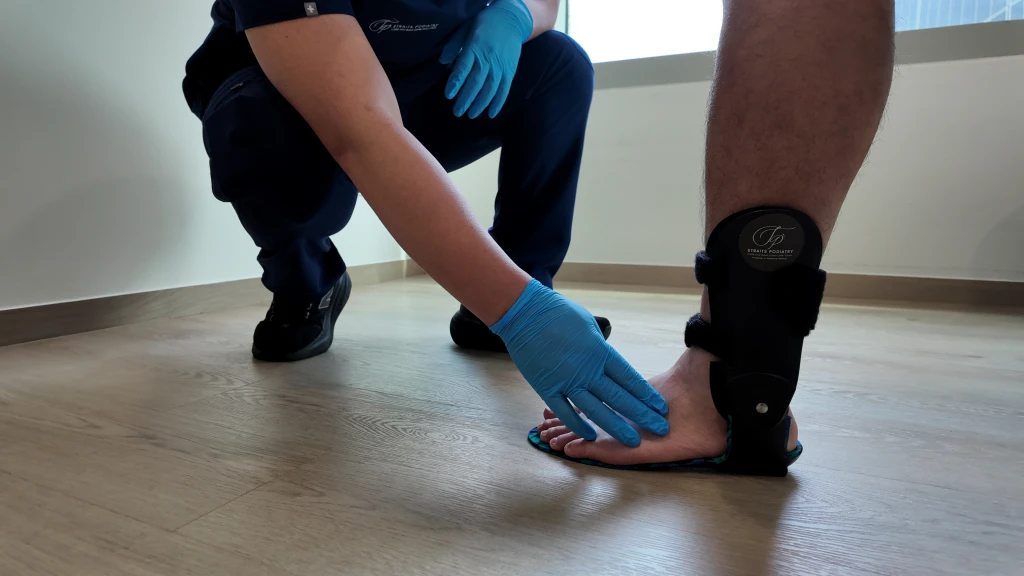
Care has two important halves, and the common mistake we see is doing only one of them. The principle of management is to stabilise the joint from the outside while rebuilding the balance, strength, and control that the first rehab missed. Conservative care typically focuses on external support and biomechanical offloading first so that the ankle can be loaded safely. Progressive rehabilitation that retrains stability then follows.
Conservative treatment
Most chronic ankle instability responds to a structured non-surgical programme that combines external support, biomechanical correction, and progressive rehabilitation.
- Custom foot orthoses: Help correct the foot posture that loads the outside of the ankle, reducing the strain on the lateral ligaments where a high-arched or laterally loading foot type is driving the instability.
- Bracing or ankle-foot orthosis: Provides a higher level of external support during sport and high-risk activities, protecting the ankle while strength and control are being rebuilt. Bracing or taping during high-risk sport is also encouraged while the rehabilitation is still underway.
- Rehabilitation and physiotherapy: Structured rehabilitation aims to rebuild calf and peroneal strength, retrain proprioception with balance work, and progress through sport-specific drills before return to play. This balance and strength work is the part most first-time sprains skip, and it needs to continue for at least three months after the pain has settled to hold the result.
- Focused shockwave therapy: For chronic pain and swelling in irritated soft tissues that does not settle, or any scar tissue build-up, focused shockwave therapy can help stimulate the body’s healing response.
- Activity modification and footwear: Take a graded return to high-risk pivoting movements (sports-related movements) rather than continuing as if nothing has changed, so the ankle is not repeatedly stressed while control is still being restored. Wearing supportive footwear, especially footwear that supports the ankle, can help provide further stability.
When conservative care isn’t enough
Surgical ligament reconstruction is considered when significant mechanical laxity persists despite a full and structured conservative programme, or where there is meaningful coexisting cartilage damage. Most people do not reach this point, and the instability resolves with orthotics, bracing, and a completed rehabilitation programme.

Have Your Chronic Ankle Instability Managed at Straits Podiatry
At Straits Podiatry, chronic ankle instability is assessed with a structured biomechanical exam, imaging referral where indicated, and an honest review of what was and was not done in earlier rehab. Your plan may include gait analysis, custom orthotics, ankle bracing, focused shockwave therapy, and a progressive strength and balance programme. Where significant mechanical laxity persists despite full conservative care, Straits Podiatry refers on to orthopaedic colleagues for a surgical opinion.
Speak with Straits Podiatry or book a consultation for an assessment and a tailored approach to manage your chronic ankle instability.
Frequently Asked Questions About Chronic Ankle Instability
Why does my ankle keep rolling even though it healed?
A healed ligament is not the same as a rehabilitated ankle. The original sprain affects more than the ligament. Balance receptors, calf and peroneal strength, and reaction time all need to be retrained, and most first-time sprains never go through that phase. Without it, the ankle stays neurologically unstable even after the pain settles.
How long does it take to recover from chronic ankle instability?
A structured rehab programme typically takes 12 to 16 weeks to make meaningful change, with continued balance and strength work for several months afterwards to protect the result. Recovery is faster when foot mechanics are addressed alongside the rehab. Stopping at week six because the pain has settled is the most common reason people relapse.
Do I need surgery for chronic ankle instability?
Most people do not. Conservative care with orthotics, rehabilitation, and bracing during high-risk sport resolves the instability in the majority of cases. Surgery is considered when meaningful mechanical laxity persists after a complete and structured non-surgical programme, or when there is significant coexisting cartilage damage.
Can I keep playing sport with chronic ankle instability?
You can, but the risk of further injury rises with each twist, and repeated sprains drive cartilage damage over time. Most people benefit from bracing or taping during sport while rehab is underway, and a graded return to high-risk movements rather than continuing as if nothing has changed.
Will an orthotic help my ankle stop giving way?
A custom orthotic does not directly stop the giving-way feeling, but it can change how the foot loads the ankle, which reduces the strain on the lateral ligaments and supports better balance. Orthoses work best when combined with structured rehab rather than used on their own.
Is chronic ankle instability the same as a chronic ankle sprain?
They describe the same problem. “Chronic ankle sprain” is the older, everyday phrasing, while chronic ankle instability is the more precise clinical term, because the ongoing issue is the loss of ankle control and recurrent giving-way rather than one fresh sprain. You may see either term used for the same condition.