
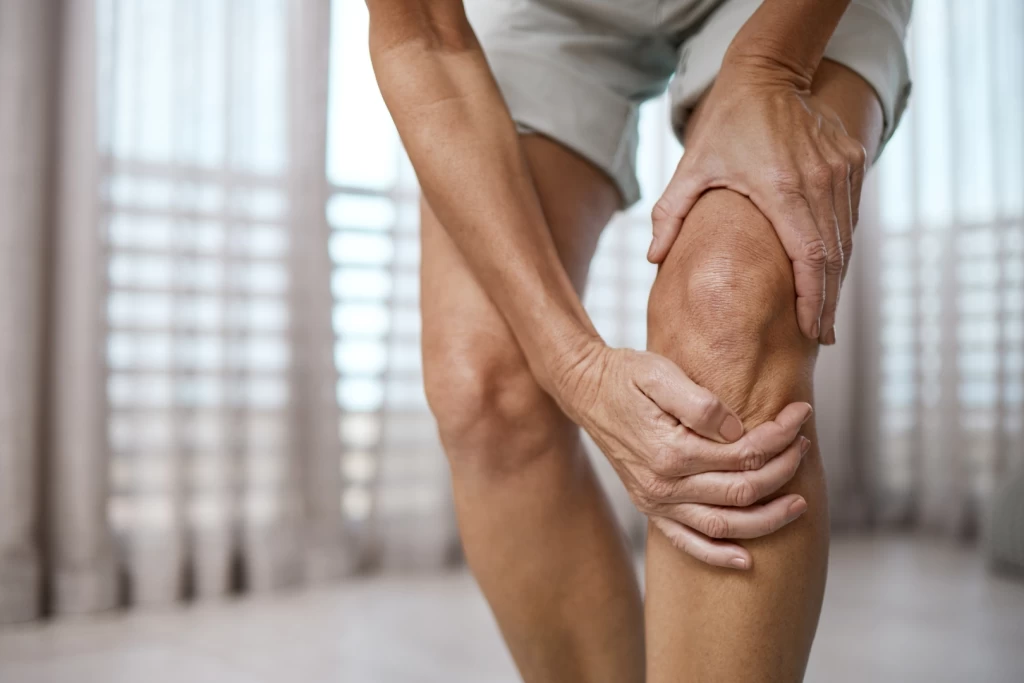
You are coming down the stairs at the MRT station and feel a gritty catch under your kneecap, followed by a dull ache at the front of the knee. Squatting to pick something up produces a similar grinding sensation, and after a long spin class or a hike up Bukit Timah the knee feels puffy and stiff. Sitting through a movie leaves it aching when you finally stand. Unlike a sharp one-off injury, this has crept in over weeks, and the grinding is what makes it feel different from an ordinary sore knee.
Chondromalacia patellae is softening, roughening, or damage of the cartilage on the underside of the kneecap (patella), the smooth layer that lets the kneecap glide over the thighbone as you bend and straighten the knee. When that cartilage loses its smoothness, the surface no longer slides cleanly and the joint becomes irritated. Getting the diagnosis right matters because chondromalacia sits at the structural end of front-of-knee problems: it is an actual change in the cartilage, not simply a pain pattern, and the extent of the damage is often graded on imaging. That distinction shapes how care is paced and what recovery realistically looks like.
Symptoms of Chondromalacia Patellae
The symptom pattern overlaps with other anterior knee problems, but the grinding quality and its link to loaded bending are the more telling features:
- A dull ache around or behind the kneecap: felt at the front of the knee, often hard to pinpoint to a single spot, building with use rather than arriving as a sudden sharp pain.
- Grinding or crepitus under the kneecap: a gritty, crackling, or catching sensation when bending or straightening the knee, sometimes felt with a hand on the kneecap. This reflects the roughened cartilage surface and is often more prominent than in a pure pain syndrome.
- Pain going down stairs, squatting, or kneeling: anything that presses the kneecap into the thighbone through a bent knee loads the damaged cartilage and reproduces the pain. Descending stairs is a classic aggravator.
- The “theatre sign”: aching or stiffness after sitting for a long stretch with the knee bent, easing once you get up and move.
- Puffiness or mild swelling after activity: the irritated joint can produce a small effusion after running, cycling, or a long day on the feet.
- A sense of the knee catching or giving way: the kneecap can feel like it snags or the knee briefly gives on stairs or uneven ground, usually from the surface irregularity and altered tracking rather than true instability.
From what we see in clinic, the combination of grinding under the kneecap plus pain that is worst on stairs and after prolonged sitting is the pattern that raises chondromalacia rather than a purely soft-tissue anterior knee pain.
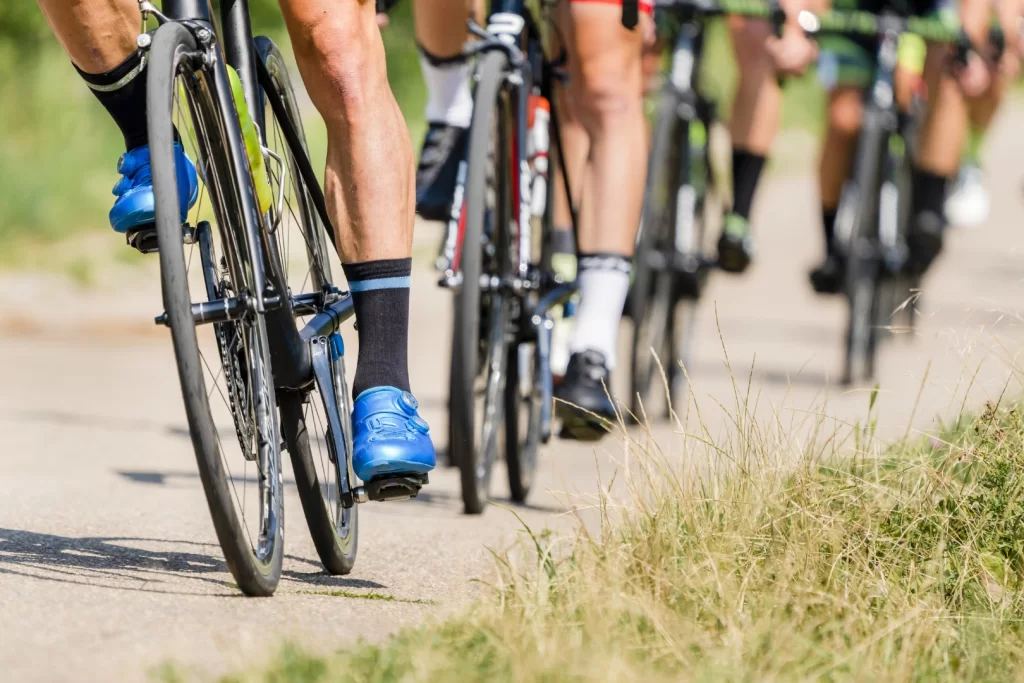
Causes of Chondromalacia Patellae
Kneecap cartilage wears when it is loaded unevenly over time. The common thread is a kneecap that does not track cleanly in its groove, so pressure concentrates on part of the cartilage surface instead of spreading across it.
What Causes Chondromalacia Patellae?
- Patellar maltracking: when the kneecap drifts out of its groove during bending, usually pulled laterally, the cartilage on one facet takes more load than it is built for and gradually softens.
- Muscle imbalance around the knee and hip: weakness in the inner quadriceps (vastus medialis) and the hip abductors and gluteal muscles lets the kneecap track poorly and the thigh rotate inward, both of which increase pressure on the cartilage.
- Repetitive bent-knee overload: high volumes of running, cycling, jumping, or stair and hill work repeatedly compress the patellofemoral joint and can outpace the cartilage’s ability to recover.
- Previous kneecap trauma or dislocation: a direct blow to the kneecap or an episode where the kneecap has partially or fully dislocated can damage the cartilage surface directly and set up chondromalacia afterwards.
- Foot biomechanics that alter knee loading: excessive pronation rolls the lower leg inward, which increases the inward rotation at the knee and shifts how the kneecap sits in its groove, adding load to the cartilage with every step.
- Anatomical factors: a wider Q-angle, a high-riding kneecap (patella alta), or a shallow groove for the kneecap all predispose the joint to uneven cartilage loading.
Who Carries a Higher Baseline Risk?
- Adolescents and young active adults, with a higher frequency reported in women, where hip alignment and Q-angle play a part.
- Runners, cyclists, court-sport players, and dancers whose training loads the bent knee heavily.
- People recovering from a kneecap dislocation or a direct knee injury.
- People with longstanding flat feet or significant pronation.
- Adolescents during rapid growth spurts, when muscle flexibility and strength lag behind bone length.
- Workers whose day involves repeated squatting, kneeling, or stair climbing.
Conditions Commonly Mistaken for Chondromalacia Patellae
Front-of-knee pain has several possible sources, and chondromalacia shares its territory with pain syndromes, tendon problems, and joint wear. Sorting between them matters because the treatment emphasis and the outlook differ. A clinical assessment, sometimes supported by imaging, confirms which structure is actually involved.
Runner’s knee (patellofemoral pain syndrome)
Patellofemoral pain syndrome, commonly called runner’s knee, produces a similar ache around or behind the kneecap, which is why the two are often confused and sometimes used interchangeably. The distinction is structural. Runner’s knee is a broader pain syndrome that can be present with the cartilage still intact, driven by how the joint is loaded and how the kneecap tracks. Chondromalacia is the specific diagnosis where the cartilage itself has softened or been damaged, a change that is often confirmed and graded on imaging or arthroscopy. Many people with runner’s knee never develop cartilage damage, while chondromalacia sits at the structural end of the same spectrum. The everyday care overlaps, but the cartilage change is what separates the two and is why recovery from chondromalacia can be slower and less completely reversible.
Patellar tendinopathy
Patellar tendinopathy causes pain on the tendon just below the kneecap rather than the grinding behind the kneecap that marks chondromalacia. It is tender on a specific point of the tendon and is aggravated by jumping and explosive loading, which helps separate it from the diffuse, cartilage-driven pain of chondromalacia.
Knee osteoarthritis
Knee osteoarthritis is more advanced, widespread cartilage wear across the knee joint, typically in older adults, whereas chondromalacia is cartilage change focused on the underside of the kneecap and often seen in younger, active people. The two lie on a continuum, and untreated patellofemoral cartilage damage can be an early contributor to later joint wear, but the age group, distribution, and imaging findings usually distinguish them.
Recurrent patellar instability
Where the kneecap has dislocated or repeatedly slips out of its groove, the problem is one of instability rather than cartilage softening, though the two frequently coexist because a dislocation can scuff the cartilage. Instability tends to give a distinct sensation of the kneecap shifting or going out of place, rather than the steady grinding ache of chondromalacia on stairs and squatting.
Treating and Preventing Chondromalacia Patellae
Cartilage has a limited blood supply and a limited capacity to repair itself, so the aim of conservative care is not to regrow cartilage but to take load off the damaged surface, correct the tracking and biomechanics driving the wear, and settle the irritation so the joint can calm down and stay comfortable. Care is conservative-first and staged, and most early cases respond well when the contributing factors are addressed rather than just the pain. Where symptoms do not settle, imaging helps grade how much cartilage change is present and guides the next step.
Conservative treatment
These measures are usually combined and adjusted to how irritable the knee is:
- Activity and load modification: stepping back from the movements that consistently provoke the grinding pain, such as deep squats, downhill running, and repeated stairs, and swapping in lower-impact cardio like swimming or cycling within a comfortable range while the joint settles.
- Quadriceps and hip strengthening: structured rehab guided by our physiotherapist builds the inner quadriceps, hip abductors, and glutes so the kneecap tracks more evenly and less pressure concentrates on the damaged cartilage. This is the part of care that carries the longer-term result.
- Custom foot orthoses: where excessive pronation is adding inward rotation and load to the patellofemoral joint, orthoses paired with suitable footwear change how the knee is loaded with each step and support the strengthening work.
- Patellar taping and bracing: taping or a patellar brace can offload the painful facet of the kneecap during the settling phase and while returning to activity, giving the strengthening time to take effect.
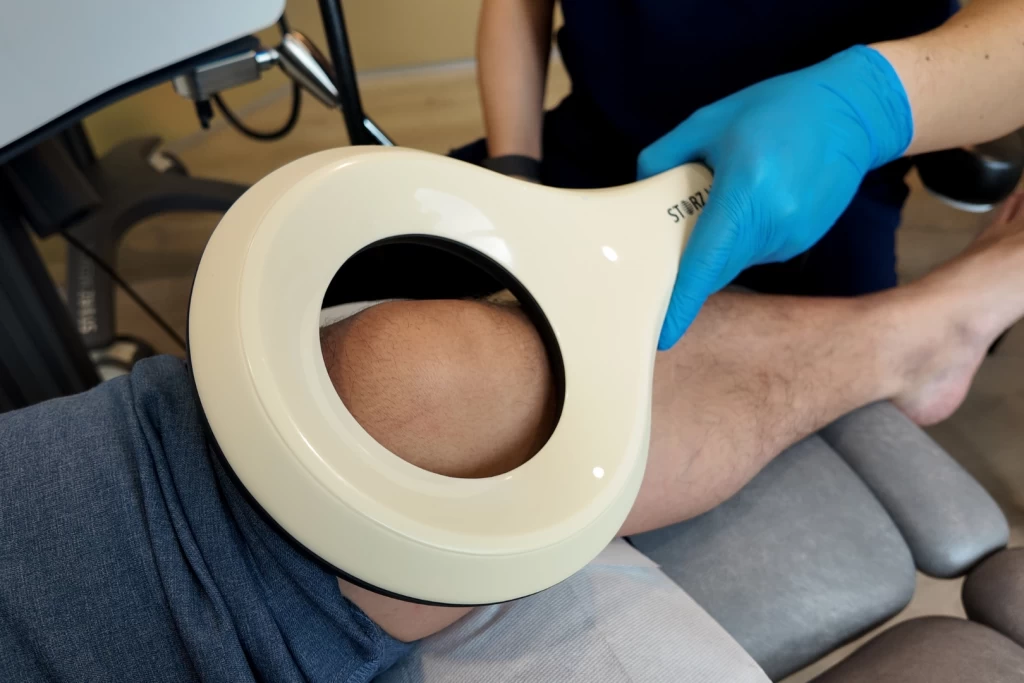
- Focused shockwave therapy and EMTT: where the surrounding tissues stay irritated and pain plateaus despite rehab, these can be used as adjuncts to support the tissue response, alongside radial pressure wave therapy for tight thigh and hip muscles that pull the kneecap laterally.
- Graded return to loading: rebuilding running, jumping, and stair volume by measured increments rather than by feel, so the cartilage is not tipped back into irritation before it has adapted.
When conservative care isn’t enough
Where anterior knee pain has not settled with a sustained programme of load management, strengthening, biomechanical correction, and adjunct therapy, imaging such as an MRI is used to grade the cartilage damage and rule out other joint pathology, and an orthopaedic opinion is appropriate. Higher-grade cartilage lesions that continue to limit activity may be considered for arthroscopic procedures such as smoothing of the damaged surface (chondroplasty) or, in selected cases, cartilage-restoration techniques, with the surgical side led by an orthopaedic surgeon. The podiatry and physiotherapy contribution remains the conservative, biomechanical, and rehabilitation side, both before any procedure and during recovery afterwards.
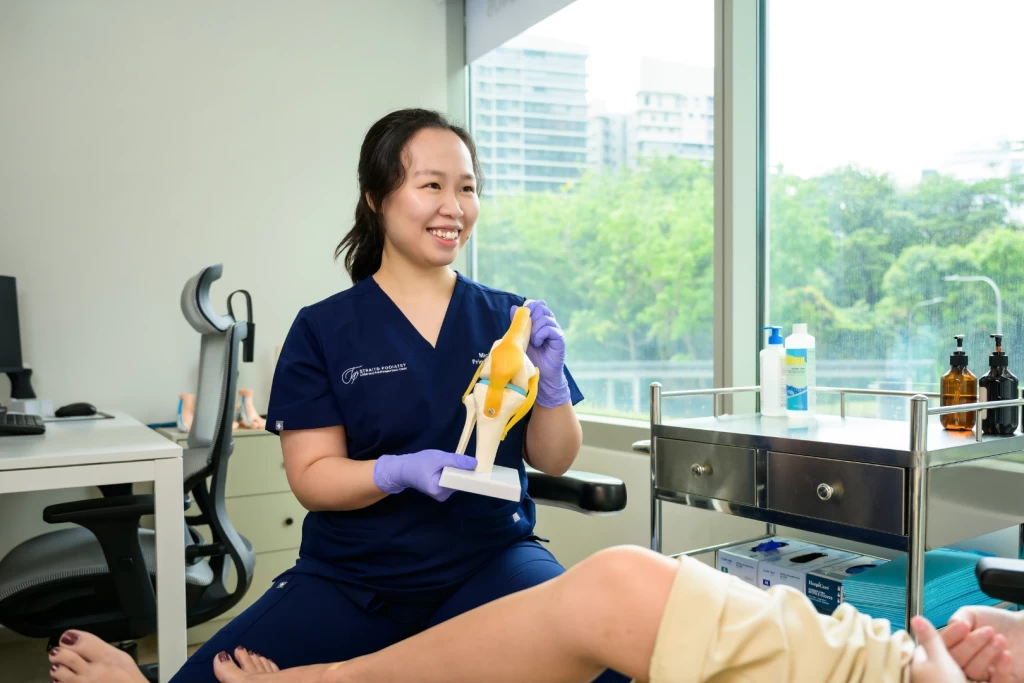
Have Your Chondromalacia Patellae Managed at Straits Podiatry
Chondromalacia patellae responds best when the reason the cartilage is being overloaded is identified early, not just the pain masked. At Straits Podiatry, an assessment for suspected chondromalacia includes a gait analysis and a lower-limb biomechanical review to see how your foot posture, hip control, and kneecap tracking are loading the joint, so care can be aimed at the actual driver.
From there, management may combine custom foot orthoses where pronation is adding load, focused shockwave therapy, radial pressure wave therapy, or EMTT as adjuncts where symptoms plateau, and a strengthening and return-to-activity programme with our physiotherapist. Where the cartilage damage looks significant, we help arrange the right imaging and onward referral. If your knee grinds and aches on stairs and after sitting, book a consultation for an assessment at any of our three Singapore clinics.
Frequently Asked Questions About Chondromalacia Patellae
Can chondromalacia patellae be cured or reversed?
Cartilage does not regenerate the way skin or muscle does, so once the surface has softened or roughened the change is not always fully reversible. That does not mean the knee stays painful. Early and mild chondromalacia often becomes symptom-free once the load and tracking problems are corrected, because a calm, well-supported joint can be comfortable even if the cartilage is not pristine. The realistic goal is a knee that lets you do what you want without pain, achieved by offloading the damaged surface and strengthening around it, rather than by expecting the cartilage to grow back.
Is walking good for chondromalacia patella?
Walking on level ground is usually helpful because it keeps the joint moving and the surrounding muscles active without the heavy compression that stairs, deep squats, and downhill walking place on the kneecap. The knee generally tolerates flat walking far better than loaded bending. If a walk brings on grinding pain, shortening the distance, avoiding slopes and stairs, and building the time back up gradually tends to work better than stopping altogether. Pairing walking with targeted strengthening is what keeps the joint comfortable over the longer term.
How is chondromalacia patellae different from runner’s knee?
Runner’s knee, or patellofemoral pain syndrome, is the broader label for pain around the kneecap and can be present while the cartilage is still intact. Chondromalacia patellae is the more specific diagnosis where the cartilage on the underside of the kneecap has actually softened or been damaged, a structural change often confirmed and graded on imaging or arthroscopy. Grinding under the kneecap tends to be more prominent in chondromalacia, and recovery can be slower because a cartilage change is involved. In everyday practice the two overlap and the conservative care is similar, but the presence of cartilage damage is what sets chondromalacia apart.
What imaging confirms chondromalacia patellae?
The diagnosis usually starts from the clinical picture, the grinding, the pain on stairs, and how the kneecap tracks, which is often enough to begin conservative care. Where confirmation or grading is needed, an MRI is the most useful scan because it shows the cartilage itself and how much of the surface is affected. Plain X-rays do not show cartilage well but can reveal how the kneecap sits and rule out other joint problems. Arthroscopy, a keyhole look inside the joint, gives the most direct view and is where cartilage damage is formally graded, though it is reserved for cases being considered for a procedure rather than for routine diagnosis.
Which is worse, chondromalacia or knee osteoarthritis?
They are related but not the same. Chondromalacia is cartilage change concentrated on the underside of the kneecap, often in younger, active people, and is frequently the milder, earlier problem. Knee osteoarthritis is more advanced, widespread cartilage wear across the joint, usually in older adults, and tends to be the more established condition. Untreated patellofemoral cartilage damage can be one contributor to later joint wear, which is part of why addressing the loading early matters, but chondromalacia is generally the earlier and more manageable point on that spectrum.
Can chondromalacia patellae get worse if I ignore it?
It can. Continuing to load a knee that is already grinding tends to keep the cartilage surface irritated and can let the wear progress, and the surrounding muscles often weaken further while you avoid using the leg normally, which worsens the tracking that caused the problem. Catching it early, while the change is mild, gives the best chance of settling the knee with conservative care. If the grinding, swelling, or stair pain has been building for months, an assessment to work out what is loading the joint is worthwhile before it becomes more entrenched.