
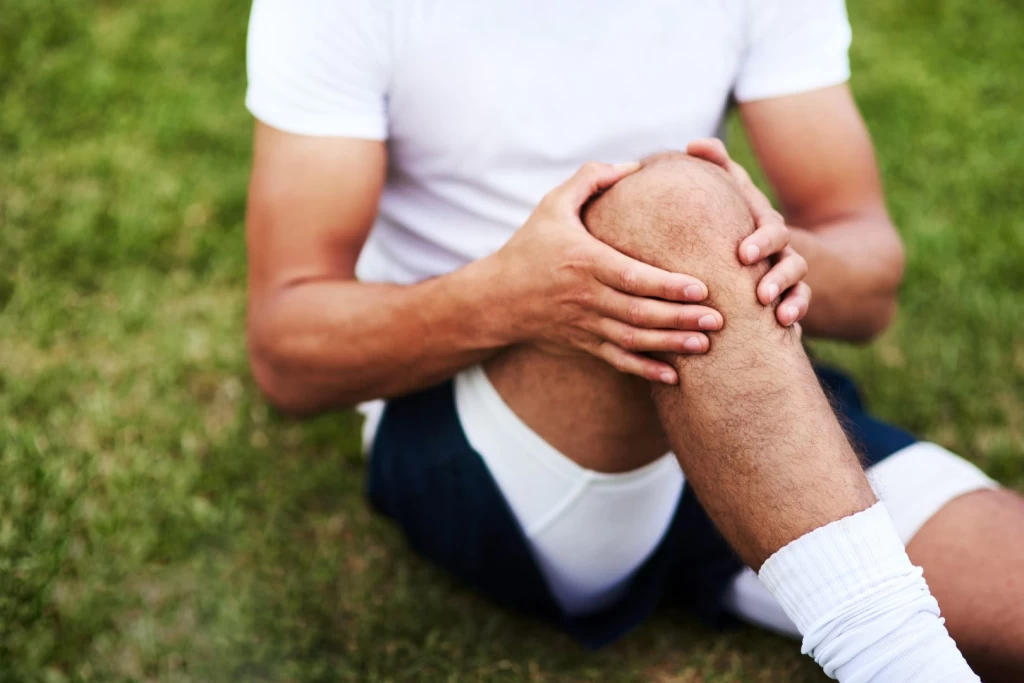
You are planting your foot to change direction in a futsal game, or landing from a jump in netball, when the knee buckles inward and you feel a distinct pop. Within a few hours the knee has ballooned with swelling, and when you try to walk it feels loose, as though it might give way under you. For many patients the game is over in that instant, and the knee never quite feels trustworthy on turns afterwards. This pattern of a twisting or landing injury, a pop, rapid swelling, and a sense of instability is the classic presentation of an injury to the anterior cruciate ligament.
The ACL is one of two ligaments that cross inside the knee, running from the back of the thighbone to the front of the shinbone. Its main job is to stop the shinbone sliding forward and to control rotation, which is why the knee feels unstable on pivots once the ligament is torn. A torn ACL has very limited capacity to heal back together on its own, and it often occurs alongside damage to the meniscus or the medial collateral ligament. Because the injury frequently sits within a cluster of knee damage, and because the management decision (rehabilitation alone versus surgical reconstruction) depends on what exactly is torn, accurate diagnosis through clinical examination and imaging is what shapes everything that follows.
Symptoms of ACL Injury
ACL symptoms tend to appear immediately at the moment of injury and then evolve over the following hours. The combination of the initial pop and the speed of the swelling is often the most telling early clue.
- An audible or felt pop at the moment of injury: many patients describe a distinct pop or snap inside the knee as they pivot or land. It is one of the more specific signs of an ACL tear, though not everyone experiences it.
- Rapid swelling within a few hours: the ACL has a blood supply, so a tear tends to bleed into the joint and produce a tense, swollen knee within the first few hours rather than the next day. Fast swelling after a twisting injury raises the suspicion of an ACL tear.
- A sense of the knee giving way: the hallmark of ACL deficiency is instability. The knee feels like it might buckle or shift, particularly when turning, cutting, or descending stairs.
- Deep pain inside the knee: the pain is often felt deep in the joint rather than pinpointed to one spot, and it is usually worse in the first days after the injury.
- Difficulty fully straightening or bending the knee: swelling and guarding limit the range of movement, and an associated meniscus tear can add a mechanical block.
- Being unable to continue the activity: most patients cannot return to play in the same session and struggle to bear full confident weight on the leg immediately afterwards.
From what we see in clinic, the pattern that most reliably points toward an ACL injury is a non-contact pivot or landing, followed by a pop, followed by a knee that swells quickly and then feels unstable on turns. Any knee that gives way after a twisting injury warrants a proper assessment and, in most cases, imaging.
Causes of ACL Injury
The ACL fails when the knee is loaded and rotated beyond what the ligament can withstand. Most injuries happen without any contact at all, during the athlete’s own movement.
What Causes ACL Injury?
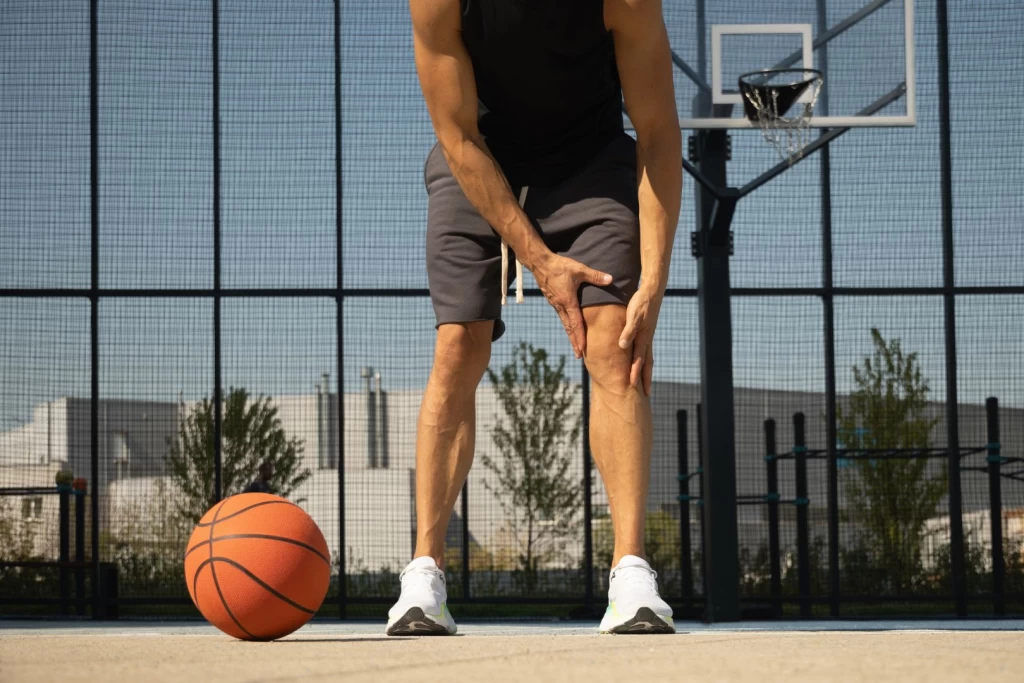
- Non-contact pivoting and cutting: by far the most common mechanism. Planting the foot and rapidly changing direction rotates the shinbone under a loaded knee, and the ligament tears. This is the classic football, netball, and basketball injury.
- Awkward landing from a jump: landing with the knee collapsing inward (dynamic valgus) rather than tracking over the foot places high strain on the ACL. Poor landing mechanics are a major contributor, particularly in jumping sports.
- Sudden deceleration: stopping abruptly from a sprint, as happens when a footballer is dispossessed or a skier catches an edge, can force the shinbone forward on the thighbone and rupture the ligament.
- Direct blow to the knee (contact injury): a tackle or collision that pushes the knee inward or hyperextends it can tear the ACL, often alongside the medial collateral ligament and the meniscus in what is sometimes called the unhappy triad.
- Hyperextension of the knee: forcing the knee back past straight, for example missing a step or overreaching, can load the ACL to failure.
Who Carries a Higher Baseline Risk?
- Athletes in pivoting and jumping sports such as football, netball, basketball, and skiing.
- Female athletes, who experience ACL injuries at a higher rate than male athletes, linked to differences in landing mechanics, muscle balance, and anatomy.
- People with a previous ACL injury on either knee.
- Athletes with poor landing and cutting mechanics, particularly a knee that collapses inward on landing.
- People returning to high-demand sport after a period of deconditioning, where strength and control have dropped.
- National Service personnel and recreational athletes during agility, obstacle, and change-of-direction training.
Conditions Commonly Mistaken for ACL Injury
Several other knee injuries can produce a pop, swelling, or a sense of instability, and they frequently occur alongside an ACL tear rather than instead of it. A clinical examination, supported by MRI where indicated, is what separates them.
Meniscus tear
A meniscus tear can cause swelling, catching, and a knee that feels like it gives way, which overlaps with the picture of an ACL injury. The meniscus is a cartilage cushion rather than a stabilising ligament, so meniscal instability is usually a mechanical catching or locking tied to specific movements, whereas ACL instability is a rotational giving-way on pivots. The two very often coexist after a twisting injury, which is one reason imaging matters.
MCL sprain
An MCL sprain follows a force that pushes the knee inward and produces pain and tenderness along the inner side of the joint. It can look similar to an ACL injury, especially when both are injured together in a contact mechanism, but an isolated MCL sprain tends to produce localised inner-knee pain and tenderness over the ligament rather than the deep instability and rapid joint swelling of an ACL tear.
Kneecap dislocation and patellar instability
A kneecap dislocation can also produce a pop, swelling, and a strong sense that the knee gave way, so it is easily confused with an ACL injury at first. The difference is what actually moved: in patellar instability the kneecap itself slips sideways out of its groove and often visibly relocates, whereas in an ACL injury the instability comes from the shinbone shifting under a torn ligament with the kneecap staying in place.
Posterior cruciate ligament (PCL) injury
The PCL is the other cruciate ligament inside the knee, and a PCL injury can also cause swelling and instability. The mechanism is usually different, typically a blow to the front of the shinbone that drives it backward, such as a dashboard impact or a fall onto a bent knee, rather than the non-contact pivot that tears the ACL. Examination tests that check the direction of shinbone movement, along with imaging, distinguish the two.
Treating and Preventing ACL Injury
The starting point with any suspected ACL injury is accurate diagnosis, because a torn ACL does not knit back together on its own the way many sprains do, and the right pathway depends on exactly what is torn and on the demands the patient places on the knee. Broadly there are two routes. Some patients, particularly those with lower rotational demands and a knee that stabilises well with strengthening, manage well with a structured rehabilitation programme and no surgery. Others, particularly younger patients and those returning to pivoting sport or living with persistent giving-way, are better served by surgical reconstruction followed by rehabilitation. That decision sits with an orthopaedic surgeon after clinical examination and imaging. The podiatry and physiotherapy contribution is the conservative and rehabilitation side: assessing how the whole lower limb loads the knee, building the strength and control the knee needs, and guiding a graded return to activity.
Conservative treatment
Where rehabilitation is the chosen route, whether instead of surgery or as the preparation before and recovery after it, the following are usually combined.
- Structured prehabilitation and rehabilitation: the core of non-surgical management and of preparing for and recovering from reconstruction. A graded programme rebuilds quadriceps and hamstring strength, restores range of movement, and retrains the knee to control rotation and landing. This rehabilitation is led by our physiotherapy service, the rehabilitation arm alongside the podiatry clinic.
- Functional knee bracing: a hinged brace can support the knee during the early recovery phase and, for some patients, during a return to sport, by limiting the movements that provoke instability while strength is being rebuilt.
- Biomechanical and landing-mechanics assessment: a lower-limb assessment looks at how the foot, ankle, hip, and knee work together during walking, squatting, and landing. Correcting a knee that collapses inward on landing is central to both recovery and reducing the risk of re-injury.
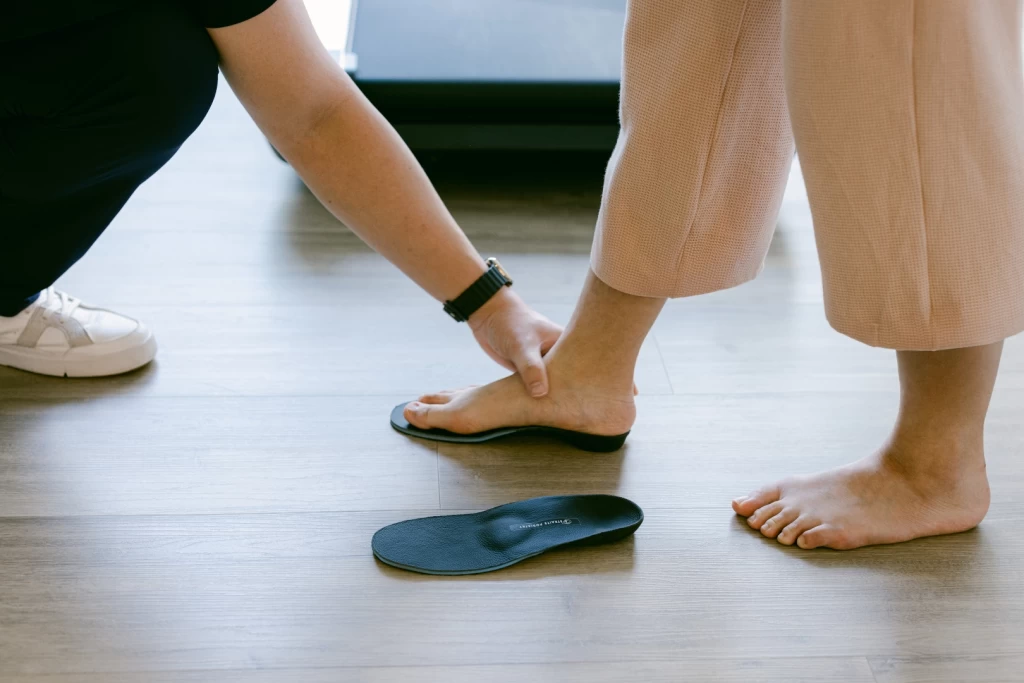
- Custom foot orthoses: where foot posture drives the knee inward during loading, an orthosis can help align how the lower limb loads and support the landing-mechanics work. This addresses a contributing factor rather than the ligament itself.
- Graded return to activity: rather than returning straight to full pivoting sport, load is reintroduced in stages, from straight-line running to controlled change of direction to full sport, once strength and control benchmarks are met.
When conservative care isn’t enough
Where the knee continues to give way despite committed rehabilitation, where imaging shows a full tear in a young or high-demand patient, or where there is associated meniscus or cartilage damage that needs addressing, surgical reconstruction becomes the appropriate consideration. Reconstruction replaces the torn ligament with a graft and is performed by an orthopaedic surgeon, most often arthroscopically. The decision, the surgery, and the imaging that informs it all sit within the orthopaedic pathway. After surgery, a structured rehabilitation programme over several months rebuilds strength and control before a return to sport, and this post-surgical rehabilitation is where the physiotherapy and biomechanical role continues.
Have Your ACL Injury Managed at Straits Podiatry
An ACL injury is a knee injury where an accurate diagnosis and the surgery-versus-rehabilitation decision belong with an orthopaedic surgeon, and we are honest about that. Where Straits Podiatry can help is the biomechanical and rehabilitation side: a gait and lower-limb assessment to understand how the foot, ankle, and knee load together, functional bracing during recovery, and custom foot orthoses where foot posture is driving the knee inward on landing.
For rehabilitation, prehabilitation, and return-to-sport programming, our physiotherapy service works alongside the podiatry clinic. If your knee has given way after a twisting or landing injury and you want the lower-limb loading assessed as part of your recovery, book a consultation for an assessment at any of our three Singapore clinics. Where surgical review is the right next step, a referral to an orthopaedic surgeon is arranged.
Frequently Asked Questions About ACL Injury
Can an ACL injury heal without surgery?
A torn ACL does not physically knit back together on its own, unlike many other sprains, because the ends of the ligament tend to retract and the joint environment does not support that kind of healing. What can happen without surgery is that some patients, particularly those with lower rotational demands, learn to stabilise the knee through a structured strengthening programme and manage well without reconstruction. Whether that is realistic depends on the completeness of the tear, whether other structures like the meniscus are involved, and how much pivoting the person needs to do. An orthopaedic surgeon, informed by imaging, guides that decision.
How do I know if I have torn my ACL?
The strongest early clues are a pop at the moment of a twisting or landing injury, swelling that comes up within a few hours, and a knee that feels unstable or gives way afterwards. None of these confirms the diagnosis on its own, because a meniscus tear or a kneecap dislocation can produce a similar picture. A clinical examination checks the stability of the knee, and an MRI confirms whether the ACL is torn and whether other structures are involved. Any knee that gives way after a twisting injury should be assessed properly rather than assumed to be a minor sprain.
Do I need surgery for a torn ACL?
Not every ACL tear is reconstructed. Surgery is more strongly considered for younger patients, those returning to pivoting sport, those with a knee that keeps giving way, and those with associated meniscus or cartilage damage that needs surgical attention. Patients with lower rotational demands who stabilise well with rehabilitation may do well without surgery. The decision weighs the completeness of the tear, the patient’s activity goals, and how the knee responds to strengthening, and it is made with an orthopaedic surgeon.
How long is recovery after ACL reconstruction?
Recovery after reconstruction is measured in months rather than weeks, because the graft needs time to incorporate and the surrounding muscles need to rebuild strength and control. A structured rehabilitation programme typically runs over roughly nine to twelve months before a confident return to pivoting sport, with earlier milestones for walking, straight-line running, and daily activity along the way. The exact timeline depends on the graft, any additional repairs performed, and how the knee progresses through strength and control benchmarks. Your surgeon and rehabilitation team will set the specific stages for your case.
Can I walk with a torn ACL?
Most people can walk on a knee with a torn ACL once the initial swelling settles, because walking in a straight line does not heavily challenge the ligament’s stabilising role. The difficulty appears with pivoting, cutting, and sudden changes of direction, where the knee is prone to giving way. Repeated giving-way episodes are worth avoiding, as they can cause further damage to the meniscus and cartilage over time. If the knee feels unstable during ordinary activity, that instability should be assessed rather than pushed through.
Can a podiatrist help with an ACL injury?
A podiatrist does not diagnose or repair the torn ligament itself, which sits within the orthopaedic pathway, but there is a genuine role on the biomechanical and rehabilitation side. A lower-limb and gait assessment shows how the foot, ankle, hip, and knee load together and whether a knee that collapses inward on landing is contributing to the strain. From there, landing-mechanics work, functional bracing, and custom foot orthoses where foot posture is a factor all support recovery and help reduce the risk of re-injury. Alongside our physiotherapy service, this covers the strengthening and return-to-sport side of the pathway.