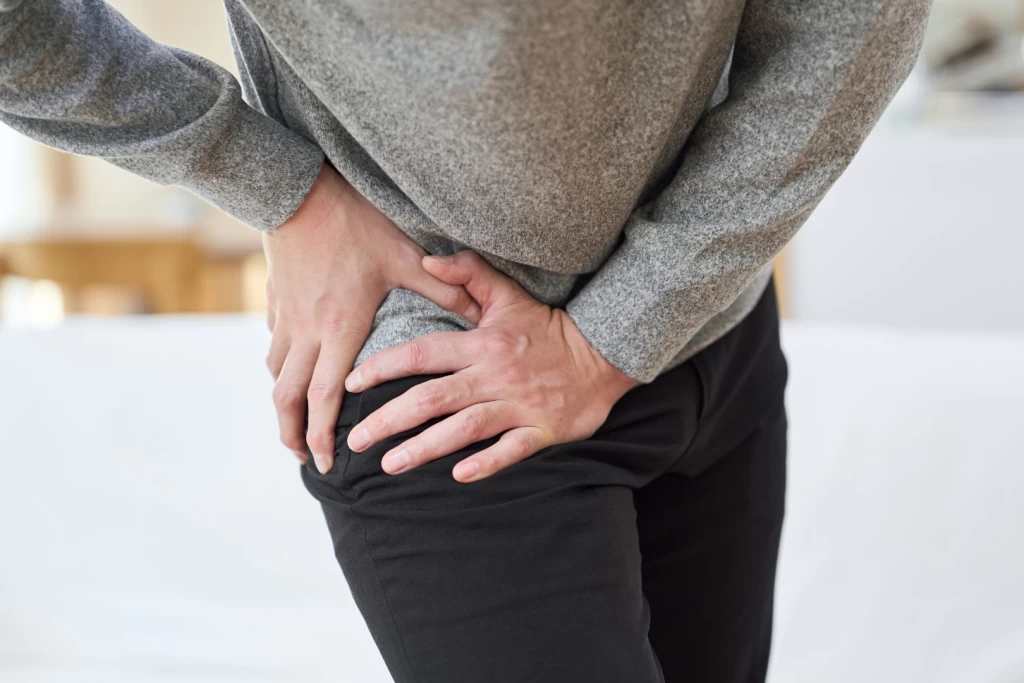
You are 28, you train hard, and lately the front of your hip and the crease of your groin have started to bite. It shows up at the bottom of a squat, when you pull your knee up toward your chest, or after a long drive or a full day at your desk when you stand up and the hip feels pinched and stiff. Some people cup the front of the hip with a thumb and forefinger to show where it hurts, a gesture clinicians call the C-sign. The ache is deep, hard to point to with one finger, and it does not settle the way a simple muscle strain would.
Femoroacetabular impingement, or FAI, describes a shape mismatch between the two halves of the hip joint. The hip is a ball (the top of the thigh bone) sitting in a socket (part of the pelvis), lined by a rim of cartilage called the labrum. When there is extra bone on the ball (a cam shape), on the rim of the socket (a pincer shape), or both, the two surfaces collide during deep bending and rotation instead of gliding cleanly. Over time that repeated contact can fray the labrum and the nearby cartilage. FAI is an orthopaedically led diagnosis, and getting it named accurately matters, because the same groin and hip pain can come from tendons, the lower back, or early joint wear, and the right pathway depends on which one it is.
Symptoms of Femoroacetabular Impingement
FAI pain has a recognisable signature once you know what to look for. The combination of where it sits, what provokes it, and who it happens to is more telling than any single feature.
- Deep groin or front-of-hip pain: the discomfort sits deep in the crease of the groin or the front of the hip rather than on the outer side or the buttock. It is often described as a pinch or a catch rather than a dull ache.
- The C-sign: patients frequently cup the hip between thumb and index finger, wrapping around the front and side, to describe where it hurts. This spread-hand gesture points to the joint itself rather than a single muscle.
- Pain with deep hip flexion and rotation: squatting below parallel, deep lunges, pulling the knee toward the chest, and twisting on a planted leg reproduce or sharpen the pain. Anything that jams the ball deep into the socket loads the impingement.
- Pain after prolonged sitting: long drives, long flights, and long stretches at a desk leave the hip stiff and sore, and the first few steps on standing feel pinched.
- A catching, clicking, or locking sensation: where the labrum is involved, patients report a catch or click deep in the joint during certain movements, sometimes with a brief sense of the hip giving way.
- Reduced hip range, especially internal rotation: turning the thigh inward tends to feel blocked and tight compared with the other side, and forcing it reproduces the deep pain.
- A gradual build in young, active adults: the pain usually creeps in over weeks to months in someone in their twenties or thirties who runs, lifts, plays court or field sport, dances, or does martial arts, rather than arriving after one clear injury.
From what we see when a hip like this is assessed, the most useful early clue is the pairing of deep groin pain with movements that force the hip into deep flexion and rotation. Pain that is worse at the bottom of a squat and after long sitting, in a young active adult, should be assessed rather than trained through.

Causes of Femoroacetabular Impingement
FAI is fundamentally a problem of joint shape combined with the demands placed on it. The bone morphology develops over years, and symptoms tend to appear once activity loads that shape often enough to irritate the labrum and cartilage.
What Causes Femoroacetabular Impingement?
- Cam morphology: extra bone forms where the ball of the hip meets its neck, so the head is not perfectly round. During deep flexion the non-round portion jams into the socket and shears the labrum and rim cartilage. Cam shapes are more common in young athletic men and are thought to develop while the growth plate is still open in the teenage years.
- Pincer morphology: the socket is deeper or more forward-facing than average, so its rim over-covers the ball and the labrum gets pinched between the two bones at the extremes of movement. Pincer patterns are seen more often in active women and in middle age.
- Mixed cam and pincer: many hips carry a combination of both shapes, which is why careful imaging is used to work out the dominant pattern before any decision about surgery.
- Repetitive deep hip loading during growth: high-volume sport in adolescence, when the hip is still forming, is associated with cam morphology developing. The bone adapts to the load, and that adaptation can later become the source of impingement.
- Activities that repeatedly drive the hip to end range: deep squatting, kicking, sprinting, hockey, football, dancing, and martial arts push the hip into deep flexion and rotation again and again, which is what converts a quiet bony shape into a painful one.
Who Carries a Higher Baseline Risk?
- Young active adults, typically in their twenties and thirties, who load the hip hard and often.
- Athletes in sports with repeated deep hip flexion and cutting: football, hockey, martial arts, dance, gymnastics, and heavy barbell training.
- People who played high-volume sport through their teenage years while the hip was still developing.
- Those with a family tendency toward the bony shapes that drive impingement.
- Individuals whose work or lifestyle involves long periods of deep sitting layered on top of demanding training.
Conditions Commonly Mistaken for Femoroacetabular Impingement
Groin and front-of-hip pain has several possible sources, and FAI shares that territory with tendon, joint, and referred pain. Because the pain sits deep and is hard to localise, the wrong label is easy to apply. The most common patterns of confusion are below.
Hip labral tear
A hip labral tear is a split or fraying of the cartilage rim of the socket, and it very often occurs alongside FAI rather than instead of it. The overlap is real: cam and pincer shapes are a common reason the labrum tears in the first place. The catching, clicking, and deep pinch can be near identical, which is why imaging is used to see whether the labrum, the bone shape, or both are driving the pain. In practice, FAI and a labral tear are frequently two parts of the same picture.
Hip osteoarthritis
Hip osteoarthritis is wear of the joint cartilage, usually in older adults, producing groin pain and stiffness that can look like FAI. The differentiators are age and pattern. Osteoarthritis tends to bring morning stiffness, a slow grinding ache with general use, and progressive loss of range, while FAI is more of a sharp positional pinch in a younger hip. The two are linked over the long term, because untreated cam-type impingement is one recognised pathway toward earlier hip osteoarthritis.
Adductor-related groin pain
The adductor muscles and their tendon attachment on the pubic bone are a common source of groin pain in field and court athletes. The differentiator is that adductor pain reproduces when you squeeze the knees together against resistance and is tender directly over the inner-thigh tendon, whereas FAI pain is provoked by deep flexion and rotation of the joint itself and is not usually reproduced by resisted squeezing.
Hip flexor and iliopsoas tendinopathy
Irritation of the hip flexor tendon at the front of the joint causes front-of-hip pain that worsens when lifting the knee against resistance, and it can also produce a snapping sensation. Unlike FAI, the pain follows the tendon line and is reproduced by loading the flexor directly rather than by jamming the joint into deep range, though the two can coexist and blur together.
Lumbar spine referred pain
Problems in the lower back can refer pain into the groin and front of the hip and mimic a hip source. The differentiator is that back-referred pain often changes with spine position and movement, may come with pins and needles or pain running down the leg, and is not reliably reproduced by deep hip-specific movements. A careful examination separates a hip driver from a spine driver.
Treating and Preventing Femoroacetabular Impingement
FAI care starts conservatively and is built around one principle: you cannot reshape bone without surgery, but you can very often reduce the impingement load enough for the joint to settle and stay comfortable. That means calming the irritated labrum and cartilage, restoring control and strength around the hip, and reducing how often the joint is driven into its painful deep range. Because the underlying diagnosis is orthopaedically led, this conservative work runs alongside an orthopaedic assessment where the shape and severity warrant one, and podiatry contributes on the lower-limb loading and gait side rather than on the bone itself.
Conservative treatment
These strands are usually combined and led by physiotherapy for the hip, with podiatry addressing how the foot and lower limb load into the hip.
- Activity and load modification: the first and most productive step is reducing the movements that repeatedly jam the hip, such as deep squats below parallel, aggressive lunging, and prolonged deep sitting, while keeping general activity going. Adjusting squat depth, seat height, and training volume often settles the irritation on its own.
- Physiotherapy-led hip rehabilitation: structured rehab through our physiotherapy service, the rehabilitation arm of Straits Podiatry, focuses on the deep hip stabilisers, the glutes, and the core, plus movement retraining so the hip is controlled through range rather than forced to its painful end point. This is the centrepiece of non-surgical management for most people.
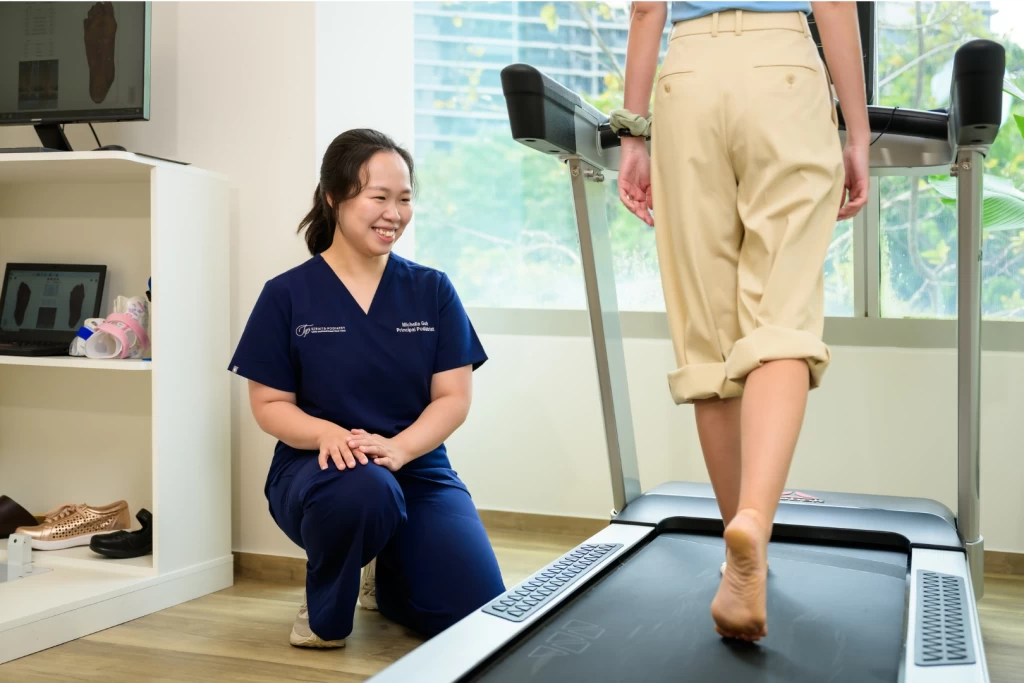
- Gait and lower-limb biomechanical assessment: how you load the foot, knee, and hip in walking and running feeds into how the hip joint is stressed. A biomechanical and gait assessment looks at whether a foot or movement pattern is adding avoidable load to an already irritable hip, so that load can be redistributed.
- Custom foot orthoses: where the foot posture or gait pattern is contributing to how the lower limb loads the hip, orthoses can help modify that loading chain. This is an adjunct that addresses lower-limb mechanics, not a correction of the hip bony shape itself, and it is used only where the assessment shows a foot contribution worth addressing.
- Focused therapies for associated soft-tissue irritation: where the surrounding tendons and soft tissues around the hip have become chronically irritated, focused shockwave therapy, radial pressure wave therapy, and EMTT can help settle that soft-tissue component. These address the irritable tissue around the joint rather than the impingement itself, and are used selectively alongside rehab rather than as a stand-alone answer.
When conservative care isn’t enough
Where deep hip pain persists despite a genuine trial of activity modification and structured rehabilitation over several months, an orthopaedic opinion is the right next step. Imaging, typically an X-ray to define the bony shape and often an MRI or MRI arthrogram to assess the labrum and cartilage, is used at this stage to confirm the pattern and its severity. Some people with clear cam or pincer morphology and a labral tear that keeps them from their sport go on to hip arthroscopy, a keyhole procedure that reshapes the impinging bone and repairs the labrum. That decision belongs with an orthopaedic surgeon, and physiotherapy-led rehabilitation remains central both before and after any surgery. Our role in that pathway is to keep the lower-limb loading and gait side optimised and to coordinate the rehabilitation, not to replace the surgical opinion.
Have Your Femoroacetabular Impingement Managed at Straits Podiatry
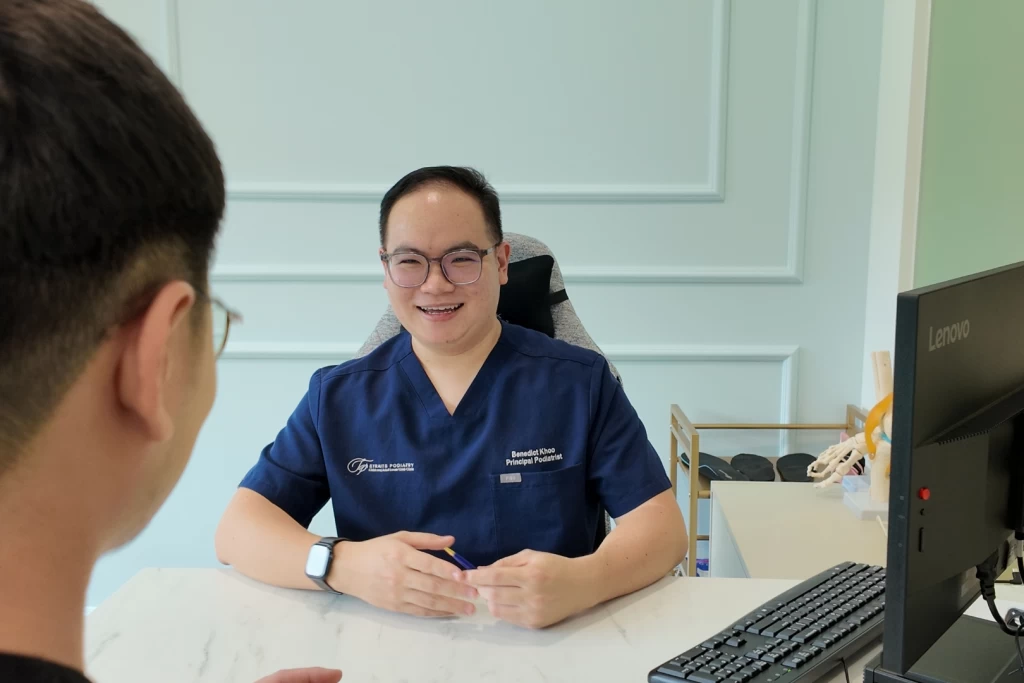
FAI sits at the border of several fields, and honest framing matters: the diagnosis and any surgical decision are orthopaedically led, while much of the day-to-day recovery is rehabilitation and load management. At Straits Podiatry, an assessment for suspected hip impingement looks at how your foot, gait, and lower limb load into the hip, screens for the movement patterns that provoke the pain, and helps place you on the right pathway, including onward referral for imaging or an orthopaedic opinion where that is warranted.
From there, care is coordinated with our physiotherapy service for the hip rehabilitation, with custom orthoses and gait work where the lower-limb mechanics are adding load, and with focused therapies where surrounding soft tissue needs settling. If deep groin or front-of-hip pain is biting at the bottom of a squat and after long sitting, book a consultation for an assessment at any of our three Singapore clinics.
Frequently Asked Questions About Femoroacetabular Impingement
Can FAI be managed without surgery?
For many people, yes. A large share of hips with impingement settle well with activity modification, structured hip rehabilitation, and attention to how the lower limb loads the joint, without ever needing an operation. Surgery is considered when clear cam or pincer morphology, often with a labral tear, keeps causing pain and limiting sport despite a genuine trial of conservative care over several months. The sensible order is to give well-structured non-surgical management a proper run first, guided by an accurate diagnosis, and reserve arthroscopy for the hips that do not respond.
Does FAI always lead to hip arthritis?
No, not always, but cam-type impingement is one recognised pathway toward earlier hip osteoarthritis when it is left unaddressed over many years, because the repeated bony contact wears the labrum and cartilage. Not everyone with the bony shape develops arthritis, and having the shape on an X-ray without symptoms does not mean surgery is needed. The value of an early, accurate assessment is that load can be managed before avoidable joint wear accumulates. This is one of the reasons persistent deep hip pain in a young adult is worth getting looked at rather than training through.
Can podiatry or orthotics help with hip impingement?
Podiatry does not correct the bony shape that drives FAI, and it is not a cure for the impingement. What it can do is address the lower-limb side of the problem: how the foot and gait load the leg and hip, whether a foot posture is adding avoidable stress to an irritable hip, and whether custom orthoses can help redistribute that load. This sits alongside physiotherapy-led hip rehabilitation and, where needed, an orthopaedic opinion. Think of it as one contributing piece of the loading picture rather than the main event.
What activities make FAI worse?
Anything that repeatedly drives the hip into deep flexion and rotation tends to aggravate it: deep squats below parallel, heavy lunging, sprinting and cutting sports, kicking, dancing, gymnastics, and martial arts. Prolonged deep sitting, such as long drives and long flights, also loads the impingement and leaves the hip stiff on standing. Managing FAI usually involves adjusting how deep and how often you take the hip into these ranges rather than stopping activity altogether, which is why individualised load advice is part of the assessment.
How is FAI diagnosed?
Diagnosis combines the history and a clinical examination with imaging. The examination reproduces the pain by taking the hip into deep flexion and rotation and checks how much internal rotation the hip has lost. An X-ray defines the bony shape of the ball and socket, and an MRI or MRI arthrogram is often used to assess the labrum and cartilage in detail. Because FAI is an orthopaedically led diagnosis, the imaging and surgical interpretation belong with an orthopaedic team, while gait, loading, and rehabilitation are where podiatry and physiotherapy contribute.
Is FAI the same as a hip labral tear?
They are closely related but not identical. FAI describes the bony shape mismatch (cam, pincer, or both) that pinches the joint, while a labral tear is damage to the cartilage rim of the socket. The two frequently occur together, because the abnormal bone shape is a common reason the labrum tears. You can have FAI without a torn labrum, and imaging is used to work out how much of the pain comes from the bone shape, the labrum, or both, which then guides whether rehabilitation alone or a surgical opinion is the right path.