
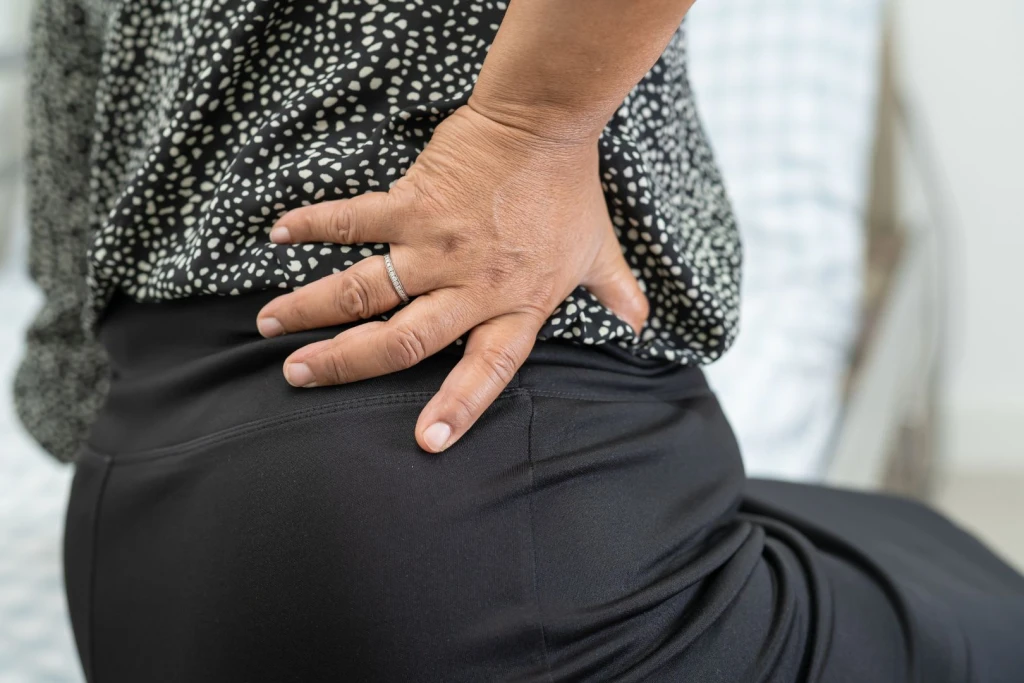
You settle onto your side to sleep and a deep ache spreads over the point of your hip, enough to keep you shifting position half the night. Getting up from a low chair, climbing the stairs at the MRT station, or standing at the bus stop with your weight parked on one leg brings the same soreness on the outer hip. It is not in the groin and not in the back, but squarely over the bony bump on the side. Many people put up with it for months, assuming it is hip arthritis or a back problem, before the pain starts limiting how far they can walk.
That bony bump is the greater trochanter, the top of the thigh bone, and it is the anchor point for the gluteus medius and gluteus minimus tendons that stabilise your pelvis every time you stand on one leg. Greater trochanteric pain syndrome, once labelled trochanteric bursitis, is now understood to be driven mostly by tendinopathy of these gluteal tendons, with the nearby bursa inflamed as a secondary player rather than the main problem. The distinction matters because the two are managed differently, and because lateral hip pain is commonly confused with conditions that arise from the hip joint itself or the lower back. Getting the diagnosis right early prevents months of the wrong exercises and unnecessary imaging.
Symptoms of Greater Trochanteric Pain Syndrome
The pattern is usually recognisable once you know what to look for. The pain is anchored to the side of the hip and provoked by positions and activities that either compress or load the gluteal tendons.
- Pain over the point of the hip: the most tender spot sits directly over the bony prominence on the outer hip, not in the groin and not in the buttock crease.
- Pain lying on the affected side: resting on the sore hip at night compresses the tendons against the trochanter and reproduces the ache. Disturbed sleep is one of the most common complaints we hear.
- Pain with stairs, hills, and single-leg loading: anything that asks one leg to stabilise the pelvis, such as climbing stairs, walking up a slope, or standing on one leg to put on trousers, tends to flare the pain.
- Pain that spreads down the outer thigh: the ache can radiate along the outside of the thigh, though it usually stops above the knee and does not travel into the foot.
- Soreness after prolonged standing with weight shifted to one hip: standing for long periods with the pelvis dropped onto one side (the classic hip-hanging posture) loads the tendon in a compressed position and provokes symptoms.
- Stiffness and pain on the first steps after rest: the first few steps after sitting for a while or after getting out of bed can be the sorest, easing slightly as you warm up.
- Tenderness when the bony point is pressed: firm pressure over the greater trochanter reproduces the pain. This is one of the more reliable clinical signs on examination.
From what we see in clinic, the combination of point tenderness over the trochanter plus pain lying on that side at night is the most telling early clue. Lateral hip pain with those two features is gluteal tendinopathy until proven otherwise.

Causes of Greater Trochanteric Pain Syndrome
The gluteal tendons fail in the same way most tendons do, when the load placed on them outpaces their capacity to adapt. Compression of the tendon against the trochanter, which happens whenever the thigh crosses the midline, adds a second layer of stress on top of tensile load.
What Causes Greater Trochanteric Pain Syndrome?
- Compressive load from hip adduction positions: sitting with legs crossed, standing with the hip hanging to one side, and sleeping curled with the top knee dropped forward all compress the gluteal tendon against the bone. Sustained compression is a key driver of the tendinopathy.
- A sudden increase in activity: a jump in walking distance, a new hill-walking or running routine, or a return to exercise after a break can overload tendons that have not been conditioned for it.
- Weak or poorly controlled hip abductors: when the gluteus medius and minimus cannot control the pelvis during single-leg stance, the pelvis drops on the opposite side and the tendon is loaded in a compressed, disadvantaged position with every step.
- Lower-limb biomechanics that increase hip adduction: foot and gait patterns that raise internal rotation and adduction at the hip, such as a pronated foot posture or a wider pelvis with a larger angle at the knee, can add to the load funnelling into the gluteal tendons.
- Hormonal and age-related changes in tendon resilience: tendon tissue becomes less tolerant of load with age, and the drop in oestrogen around menopause is thought to contribute, which is part of why the condition clusters in women in midlife.
- A direct fall or blow to the hip: landing on the side of the hip can inflame the bursa and irritate the tendons, sometimes tipping a previously silent tendinopathy into a painful one.
Who Carries a Higher Baseline Risk?
- Women aged 40 to 60, particularly around and after menopause.
- Runners, hikers, and people who have recently ramped up their walking volume.
- People with weak gluteal muscles, often after a sedentary spell or a period of reduced activity.
- Those with an altered gait from knee or foot problems, or a leg-length difference.
- People carrying more body weight, which raises the load through the hip stabilisers.
- Anyone who habitually stands or sits in hip-adduction positions for long stretches.
Conditions Commonly Mistaken for Greater Trochanteric Pain Syndrome
Lateral hip pain overlaps with several conditions that arise from the hip joint, the spine, and the surrounding soft tissue. Sorting them out matters because the exercises and management differ. The most common patterns of confusion are below.
Hip osteoarthritis
Osteoarthritis of the hip joint typically causes pain felt in the groin or deep in the front of the hip, along with stiffness and a gradual loss of rotation. Greater trochanteric pain syndrome sits on the outside of the hip over the bony point and does not usually restrict the joint’s range of motion. The two can coexist in older adults, so both are worth checking when the picture is mixed.
Lumbar spine referred pain
Irritation of the lower back or a nerve root can refer pain into the outer hip and thigh, mimicking a gluteal tendon problem. The differentiator is that back-referred pain often changes with spinal movements and may come with pins and needles or numbness travelling further down the leg, whereas gluteal tendinopathy stays local to the trochanter and reproduces with direct pressure on it.
Iliotibial band syndrome
The iliotibial band runs down the outer thigh from the hip to the knee, and iliotibial band syndrome usually produces pain at the outer knee rather than the hip. Where the band is tight or the proximal portion is involved, some outer-thigh discomfort can overlap with GTPS, but the peak tenderness in ITBS sits at the knee, not over the greater trochanter.
Piriformis syndrome
Piriformis syndrome involves the deep gluteal muscles and produces pain centred in the buttock, sometimes with sciatic-type symptoms travelling down the back of the thigh. Greater trochanteric pain syndrome sits further forward and to the side, over the bony point of the hip, and does not usually produce the deep buttock ache or nerve symptoms of a piriformis problem.
Meralgia paraesthetica
Meralgia paraesthetica is caused by compression of a sensory nerve at the front of the pelvis and produces burning, tingling, or numbness over the outer thigh. Unlike gluteal tendinopathy, it is not tender to press over the trochanter and is not made worse by single-leg loading, because it is a nerve-sensation problem rather than a tendon-load problem.

Treating and Preventing Greater Trochanteric Pain Syndrome
Greater trochanteric pain syndrome responds well to conservative care in most cases, and surgery is rarely needed. The guiding principle is to unload and decompress the gluteal tendon first, then progressively rebuild its capacity so it tolerates normal life again. Rushing to strengthen a tendon that is still being compressed all day tends to stall progress, so managing daily postures comes before, and alongside, the loading work. Recovery is measured in weeks to months rather than days, and the honest expectation is a steady curve rather than an overnight fix.
Conservative treatment
These strands are usually combined, starting with reducing the compressive load.
- Load and posture management: the first step is removing the compressive positions that keep provoking the tendon, such as crossing the legs, standing with the hip hanging to one side, and sleeping curled with the top knee dropped across. A pillow between the knees at night and small changes to sitting and standing habits often reduce the night pain within a couple of weeks.
- Progressive gluteal strengthening: the core of long-term recovery is rebuilding the strength and control of the gluteus medius and minimus so the tendon tolerates load again. This is a graded programme led by our physiotherapy service, the rehabilitation arm of the group, progressing from isometric holds to weight-bearing strengthening as symptoms allow.
- Gait and biomechanical correction: where the way you walk or stand feeds extra adduction into the hip, a podiatry gait and biomechanical assessment identifies the pattern so it can be addressed. Adjusting stance width, cueing pelvic control, and reviewing footwear all reduce the load reaching the gluteal tendons during everyday walking.
- Custom foot orthoses: where a pronated foot posture or a lower-limb alignment issue is contributing to the hip load, orthoses can help control the foot and reduce the internal-rotation and adduction forces travelling up the chain. They are an adjunct to the strengthening work, not a standalone fix.
- Focused shockwave therapy: for a gluteal tendinopathy that has become stubborn and has plateaued on loading alone, focused shockwave therapy is used to stimulate the tendon’s repair response. It is applied alongside the strengthening programme rather than in place of it.
- Radial pressure wave therapy and magnetotransduction therapy (EMTT): these are additional options for chronic gluteal tendinopathy, aimed at settling the tendon and supporting its recovery when a case is slow to respond. They are selected case by case and combined with the loading programme.
When conservative care isn’t enough
Most people improve steadily with load management and a well-structured strengthening programme, but a minority remain stubborn. Where lateral hip pain has not responded to several months of appropriate conservative care, imaging (usually ultrasound or MRI) is helpful to confirm the diagnosis, gauge the severity of the tendinopathy, and check whether there is a partial tear of the gluteal tendon. A corticosteroid injection around the bursa can settle a severe flare in the short term, but the evidence favours exercise for lasting recovery, and repeated injections can be counterproductive for tendon health, so it is used selectively. For the small number with a significant gluteal tendon tear or genuinely recalcitrant symptoms, referral to an orthopaedic or sports-medicine specialist is appropriate to discuss options including tendon repair, which is uncommon.
Have Your Greater Trochanteric Pain Syndrome Managed at Straits Podiatry
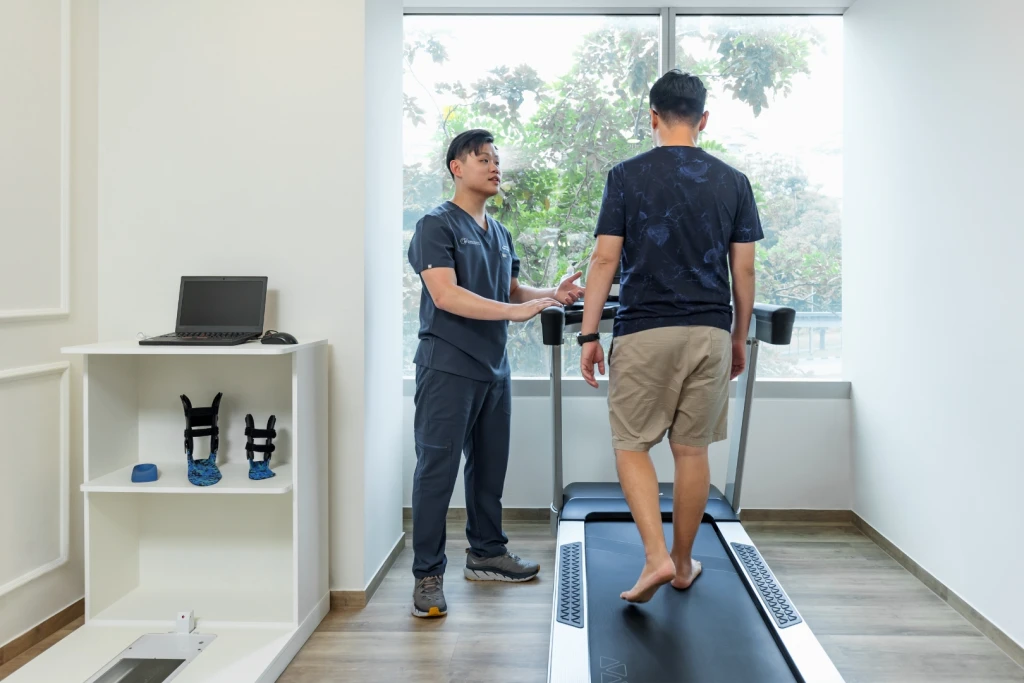
Lateral hip pain rewards an accurate early diagnosis, because the wrong exercises on a compressed tendon can drag the problem out for months. At Straits Podiatry, an assessment for suspected greater trochanteric pain syndrome combines a focused history, palpation over the greater trochanter, single-leg loading tests, and a full gait and lower-limb biomechanical evaluation to see how the foot and pelvis are loading the gluteal tendons.
From there, care is coordinated across the group. Our podiatrists address the load and biomechanical side with gait correction, footwear review, and custom orthoses where the mechanics call for it, plus focused shockwave, radial pressure wave, or EMTT for a stubborn tendon, while our physiotherapy service leads the progressive gluteal strengthening that drives long-term recovery. If your outer hip aches when you lie on it at night and flares on stairs, book a consultation for an assessment at any of our three Singapore clinics.
Frequently Asked Questions About Greater Trochanteric Pain Syndrome
How long does greater trochanteric pain syndrome take to settle?
Most people notice their night pain easing within a few weeks once the compressive positions are removed, but rebuilding the gluteal tendon’s capacity is a longer job, usually several months of progressive strengthening. Cases picked up early, before the tendon has been overloaded for a long time, tend to recover faster. The honest expectation is a steady improvement over weeks to months rather than a quick fix, and staying consistent with the loading programme is what shortens the curve.
Is greater trochanteric pain syndrome the same as trochanteric bursitis?
They describe overlapping problems, but the understanding has shifted. The pain was long attributed to inflammation of the trochanteric bursa, hence the older label bursitis. Current thinking is that the main driver is tendinopathy of the gluteus medius and minimus tendons, with the bursa often inflamed as a secondary feature. Greater trochanteric pain syndrome is the broader, more accurate umbrella term, and it points care towards managing the tendon rather than just the bursa.
Why does it hurt more when I lie on that side at night?
Lying on the affected hip presses the gluteal tendons against the bony trochanter underneath, compressing already-sensitive tissue. Curling up with the top knee dropped forward across the body adds even more compression. Many people find that lying on the other side with a pillow between the knees, to stop the top leg falling across the midline, reduces the night pain noticeably while the tendon settles.
Can I keep running or exercising with greater trochanteric pain syndrome?
Often yes, but usually at a modified level while the tendon settles. The activities that most provoke it are hills, stairs, and high-mileage running, so scaling these back for a period while you build gluteal strength is sensible. Low-compression activity such as level walking, swimming, or cycling with attention to hip position is usually better tolerated. A graded return, guided by how the hip responds over the following day, protects against the flares that come from pushing too hard too soon.
Do I need a scan to diagnose greater trochanteric pain syndrome?
Not in most cases. The diagnosis is usually made clinically from the pattern of symptoms and examination findings, particularly point tenderness over the trochanter and pain on single-leg loading. Imaging such as ultrasound or MRI is reserved for cases that do not respond to a proper course of conservative care, or where a gluteal tendon tear is suspected, because it changes what happens next. Starting management does not have to wait for a scan.