
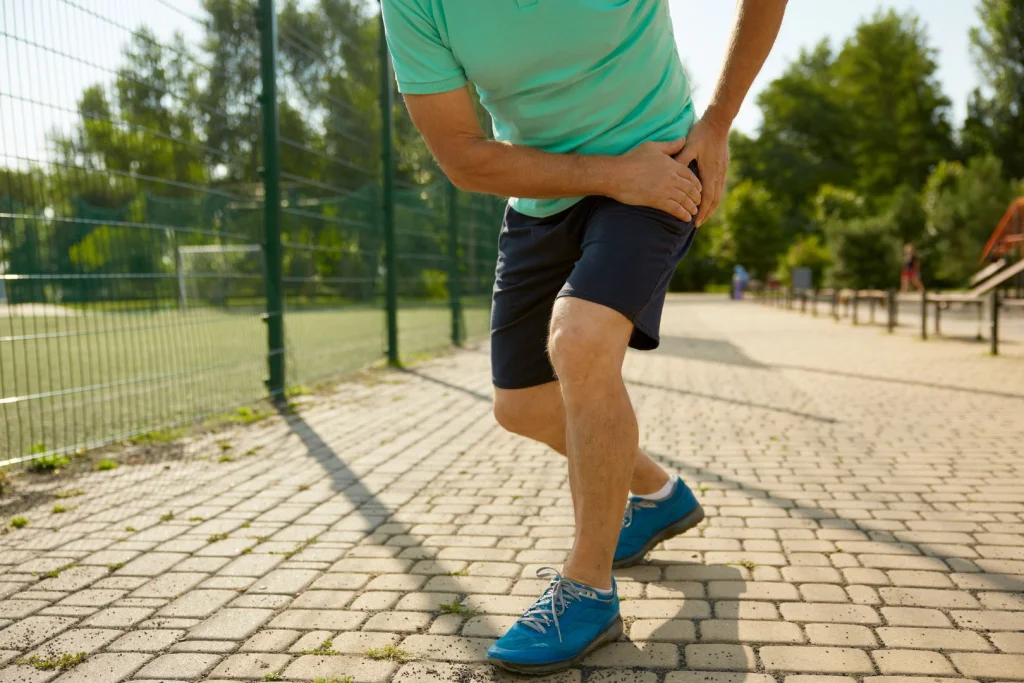
You are into the second half of a weekend football match at an ActiveSG pitch, you stretch for a loose ball, and a sharp catch grabs the front of your hip as you swing your leg through. It eases when you stop running, but the next morning getting out of bed hurts, climbing the stairs at the MRT station hurts, and the first few sit-ups of your NS IPPT prep are suddenly out of the question. Lifting your knee towards your chest reproduces the exact spot. If this sounds like you, the likely culprit is a hip flexor strain.
The hip flexors are the group of muscles at the front of the hip that lift the thigh towards the trunk. The two most commonly injured are the iliopsoas, which runs from the lower spine and pelvis to the top of the thigh bone, and the rectus femoris, one of the quadriceps muscles that crosses both the hip and the knee. A strain is a stretch or tear of these muscle fibres, graded from a mild overstretch (grade 1) through a partial tear (grade 2) to a full tear or avulsion (grade 3). Because the front of the hip and groin is a crowded area, an accurate diagnosis matters. Several other structures produce similar pain at the front of the hip, and the management, timeline, and who leads the care differ for each.
Symptoms of Hip Flexor Strain
The pattern that distinguishes a hip flexor strain is pain at the front of the hip that switches on when the muscle is asked to work, and settles when it is rested.
- Pain at the front of the hip or groin: the tenderness sits over the front of the hip crease, sometimes tracking down into the upper thigh, rather than deep inside the joint or off to the side.
- Pain when lifting the knee against resistance: raising the thigh towards the chest, especially against a hand or a weight, reproduces the pain. This is the most reliable everyday sign.
- Pain with sprinting, kicking, and accelerating: any explosive hip flexion loads the injured fibres. Footballers often feel it on the kicking leg, sprinters on the drive phase.
- Pain climbing stairs and rising from a seat: loading the flexor through range during ordinary movement aggravates it, which is why stairs and getting out of a low chair or car are common complaints.
- Pain during sit-ups and core work: the iliopsoas is heavily recruited in sit-ups and leg raises, so these become uncomfortable early. This is a frequent trigger in the NS and fitness-testing population.
- A pulling or tearing sensation at the moment of injury: higher-grade strains often announce themselves with a sudden catch or pull during a sprint or kick, occasionally followed by swelling or bruising over the following days.
- Stiffness and ache after rest: the front of the hip can feel tight and sore after sitting for a long stretch or first thing in the morning, easing a little with gentle movement before activity provokes it again.
From what we see in clinic, the combination that points most strongly to a hip flexor strain is front-of-hip pain that reproduces on resisted knee lift and worsens with sprinting, stairs, and sit-ups, in someone who can trace it back to a specific explosive movement.
Causes of Hip Flexor Strain
The hip flexors generate and absorb large forces during running and kicking, and they are vulnerable when a strong contraction meets a sudden stretch. Several pathways lead there.
What Causes Hip Flexor Strain?
- A sudden forceful contraction: sprint starts, kicking a ball, or a fast change of direction ask the flexor to fire hard and fast. When the demand outstrips what the muscle can handle, fibres tear.
- A rapid overstretch under load: the leg being forced backwards while the flexor is contracting (a lunge that goes too deep, a slip, an awkward tackle) stretches the muscle while it is trying to shorten, which is when tears most often happen.
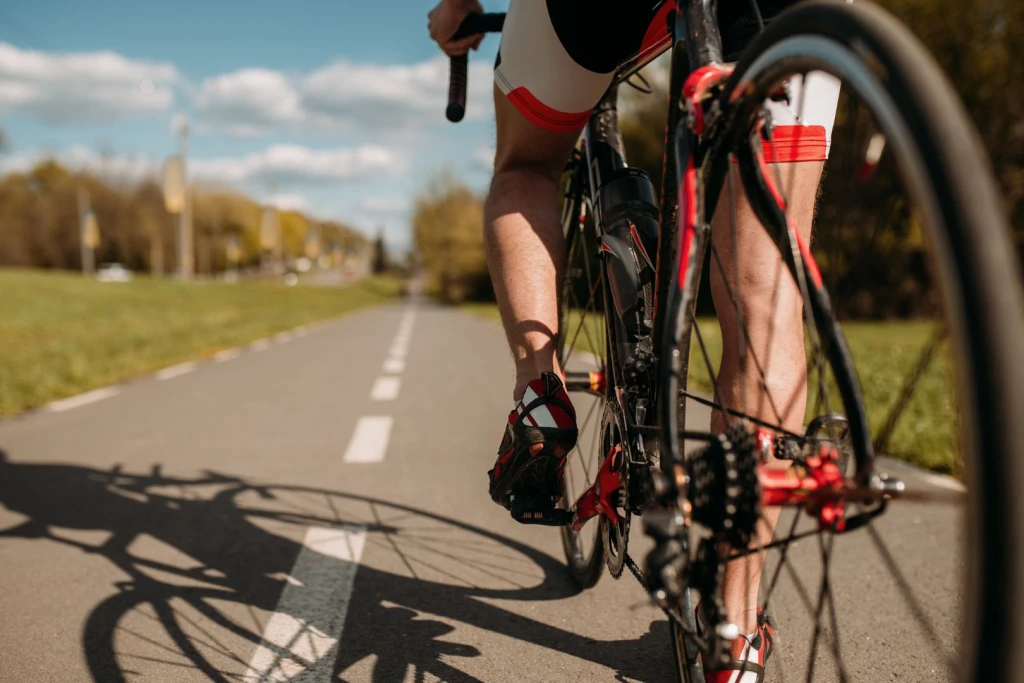
- Repetitive overload: distance running, hill work, repeated kicking, and heavy cycling accumulate demand on the flexors. Without enough recovery, the tissue is left irritated and prone to a frank strain.
- Inadequate warm-up: cold muscle fibres tolerate less stretch. Going straight into sprinting or kicking without preparing the hip flexors raises the risk, particularly in early-morning or air-conditioned training.
- Muscle imbalance and weakness: tight, deconditioned hip flexors from long hours of desk sitting, paired with weak glutes and core, shift more load onto the flexors during sport. A weak muscle asked to do a strong job is a set-up for a strain.
- Returning to sport too soon: going back to full training before a previous strain has fully rehabilitated is one of the most common reasons a strain recurs or lingers.
- Lower-limb biomechanics: foot and gait patterns that alter how the leg swings through, such as marked overpronation or a leg length difference, can raise the demand on the hip flexor over many kilometres of running.
Who Carries a Higher Baseline Risk?
- Footballers, rugby and touch players, sprinters, martial artists, and dancers, where explosive hip flexion and kicking are built into the sport.
- NS personnel and anyone training for fitness tests, given the volume of sit-ups, sprints, and loaded movement.
- Runners increasing mileage or adding hill and speed sessions quickly.
- Cyclists and spin-class regulars, from the repetitive high-cadence flexion.
- Office workers who sit for long hours, then train hard, starting from tight and deconditioned hip flexors.
- Adolescent athletes during growth spurts, who are more prone to a strain at the point where the muscle attaches to the pelvis.
Conditions Commonly Mistaken for Hip Flexor Strain
Front-of-hip and groin pain has several possible sources, and a few of them are important to separate from a simple muscle strain because they are managed very differently. The common patterns of confusion are below.
Hip labral tear
A hip labral tear involves the ring of cartilage that lines the rim of the hip socket. It tends to cause a deeper pain inside the groin, often with catching, clicking, or a sense of the hip locking, and it is provoked by deep bending and rotation rather than by resisted knee lift. A hip flexor strain sits more superficially at the front of the hip and reproduces with active flexion against resistance.
Femoroacetabular impingement
Femoroacetabular impingement is a bony shape mismatch between the ball and socket of the hip that pinches the soft tissues at the front of the joint. It typically causes groin pain with deep squatting, prolonged sitting, and pivoting, and it often coexists with a labral tear. Unlike a flexor strain, it is not brought on by a single explosive movement and does not usually settle with muscle rest alone.
Groin or adductor strain
The adductor muscles on the inner thigh sit close to the hip flexors, and a strain there produces pain lower and more towards the inner groin. It is provoked by squeezing the legs together against resistance rather than by lifting the knee. The two can occur together after the same tackle or sprint, which is why a careful examination of which movement reproduces the pain is worth doing.
Femoral neck stress fracture
A stress fracture in the neck of the thigh bone is uncommon but important, because it needs offloading rather than the loaded rehabilitation a muscle strain tolerates. It tends to cause groin pain that builds with running and weight-bearing, persists at rest as it progresses, and does not switch off when the muscle is relaxed. Deep, load-related groin pain in a runner or recruit that is not settling should be assessed and imaged rather than pushed through.
Snapping hip and iliopsoas bursitis
A snapping or clicking at the front of the hip, sometimes with a painful catch, can come from the iliopsoas tendon flicking over a bony ridge or from irritation of the bursa beneath it. It can feel similar to a strain, but the hallmark is the audible or palpable snap during hip movement rather than a discrete tearing injury.
Treating and Preventing Hip Flexor Strain
Most hip flexor strains recover with conservative care, and the guiding principle is to calm the injured tissue first, then rebuild its capacity gradually before returning to the movements that caused it. The early phase protects the muscle from further tearing, the middle phase restores length and strength through progressive loading, and the final phase reintroduces sprinting, kicking, and cutting in a controlled way. Hands-on rehabilitation is the mainstay here, and our physiotherapy service leads it for muscle and tendon injuries of this kind. Podiatry’s role is adjunctive: managing lower-limb load, correcting the running and gait mechanics that raise hip flexor demand, and structuring the return to running. Surgery is rarely needed, and is reserved for the uncommon complete tear or bony avulsion.
Conservative treatment
These measures are usually combined and progressed in stages rather than used in isolation.
- Relative rest and activity modification: in the first days after an acute strain, the priority is to stop the aggravating movements (sprinting, kicking, deep lunging, loaded sit-ups) while keeping the hip gently moving within a pain-free range. Higher-grade strains with swelling benefit from a short period of protected activity before rehabilitation begins.
- Progressive strengthening and mobility rehabilitation: the core of recovery is a graded programme that gradually restores the flexor’s length, then its strength through range, then its capacity to produce force quickly. Physiotherapy directs this stage, adding glute and core work to correct the imbalances that overloaded the flexor in the first place.
- Running and gait retraining: where running mechanics are part of the picture, a podiatrist can assess how the foot and leg swing through, and adjust cadence, stride, and loading to reduce the pull on the hip flexor. This is where a biomechanical assessment adds to the rehabilitation rather than replacing it.
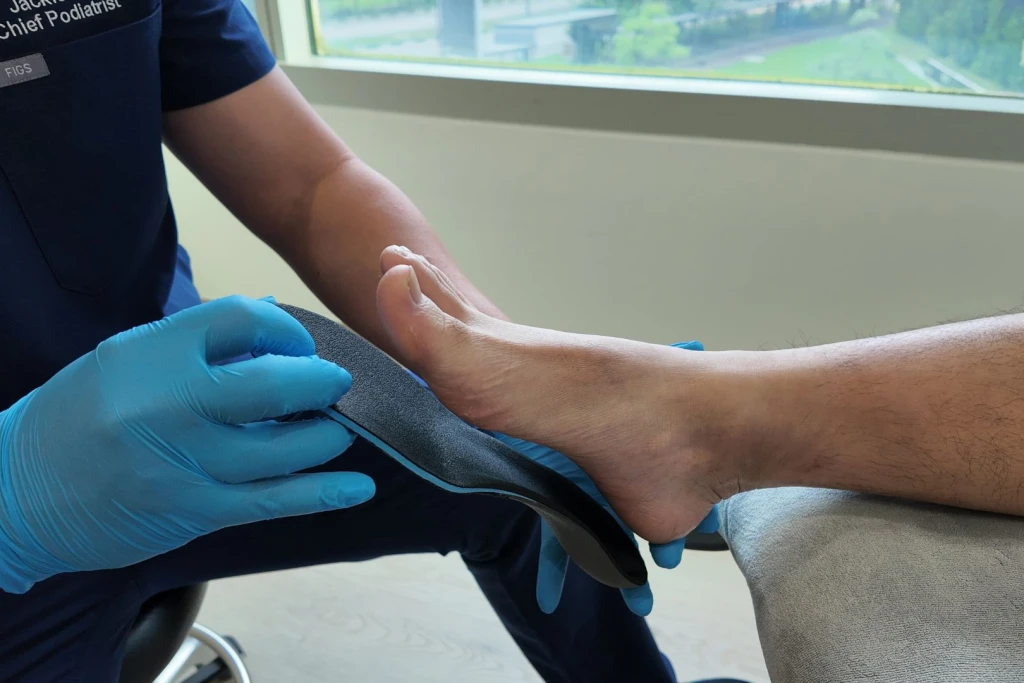
- Custom foot orthoses: for runners whose foot mechanics or a leg length difference contribute to uneven loading, an orthotic can help balance how the limb is loaded over long distances. This is a supporting measure for the minority whose lower-limb biomechanics are feeding the problem, not a routine treatment for every strain.
- Focused shockwave therapy: where a strain has become a lingering hip flexor tendinopathy that has plateaued on rehabilitation alone, focused shockwave therapy can be used alongside the loading programme to stimulate the irritated tendon tissue.
- Magnetotransduction therapy (EMTT): for stubborn chronic tendinopathy at the front of the hip, EMTT is another adjunct that can be combined with shockwave and progressive loading to support the tissue response.
- A structured return to sport: once strength and range are restored, sprinting, kicking, and cutting are reintroduced in graded steps so the flexor is re-exposed to speed and load progressively. Returning to full play before this progression is complete is the most common reason a strain recurs.
When conservative care isn’t enough
Most hip flexor strains respond well to graded rehabilitation. Where front-of-hip pain has not improved after several weeks of appropriate rehabilitation, where the initial injury was severe with significant swelling or bruising, or where there is a suspicion of a bony avulsion (particularly in an adolescent athlete) or a femoral neck stress fracture, a referral to a sports physician or orthopaedic surgeon is appropriate. Imaging such as an MRI is usually arranged at this stage to grade the injury and rule out the more serious causes of groin pain. Complete tears and avulsion injuries are uncommon, and only a small number ever require surgical repair.
Have Your Hip Flexor Strain Managed at Straits Podiatry
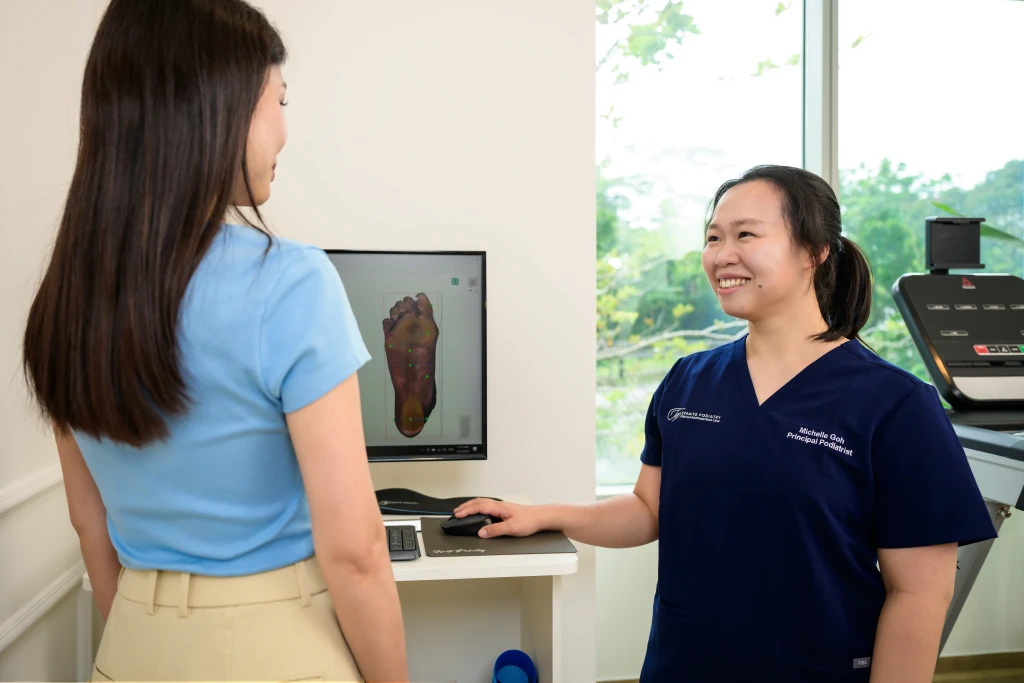
A hip flexor strain is primarily a soft-tissue injury, and the mainstay of recovery is graded rehabilitation. Our physiotherapy service leads the hands-on rehabilitation of the muscle itself, while our podiatrists contribute on the biomechanical side: a gait and running assessment to see how your foot and leg mechanics load the hip, custom orthotic support where a leg length difference or foot pattern is adding to the demand, and a structured return-to-running plan. Where an acute strain has settled into a stubborn tendinopathy at the front of the hip, focused shockwave therapy and magnetotransduction therapy can be added to the loading programme.
If pain at the front of your hip flares with sprinting, stairs, and sit-ups and is not settling, book a consultation for an assessment at any of our three Singapore clinics. We can assess the strain, coordinate the rehabilitation with our physiotherapy team, and guide your return to sport.
Frequently Asked Questions About Hip Flexor Strain
How long does a hip flexor strain take to heal?
A mild grade 1 strain often settles within one to three weeks, while a partial grade 2 tear more typically takes four to eight weeks to return to full sport. High-grade tears and avulsions take longer and sometimes need specialist input. The timeline depends less on rest and more on how the rehabilitation is progressed, because returning to sprinting and kicking before the muscle has rebuilt its capacity is the most common reason recovery drags on or the strain comes back.
Can I keep running or playing sport with a hip flexor strain?
In the first phase it is best to step back from sprinting, kicking, deep lunging, and loaded sit-ups, since these directly load the injured fibres. Low-impact activity that stays pain-free, such as easy cycling or pool work, usually keeps you moving without setting recovery back. Running and sport are reintroduced gradually once resisted knee lift is no longer painful and strength through range has returned, which is a judgement best made during the rehabilitation rather than by pushing through pain.
Should I stretch a strained hip flexor?
Aggressive stretching of a fresh strain can pull on healing fibres and aggravate it, so the early focus is gentle pain-free movement rather than forcing range. As the strain settles, controlled mobility work is reintroduced and combined with strengthening, because a flexor that is both longer and stronger tolerates sport better than one that is only stretched. A physiotherapist can guide when and how far to stretch at each stage.
Does a hip flexor strain need a scan?
Most hip flexor strains are diagnosed from the history and a physical examination, and they recover without any imaging. A scan such as an MRI is reserved for strains that are not improving as expected, high-grade injuries with significant swelling or bruising, or when a more serious cause of groin pain such as a femoral neck stress fracture or a bony avulsion needs to be ruled out. The examination usually guides whether imaging is worthwhile.
Can a podiatrist help with a hip flexor strain?
A podiatrist’s role in a hip flexor strain is adjunctive rather than the lead. The hands-on rehabilitation of the muscle is directed by physiotherapy, while a podiatrist contributes by assessing how your foot and running mechanics load the hip, addressing a leg length difference or foot pattern that is adding to the demand, and structuring the return to running so the flexor is re-loaded progressively. In practice the two work together, which is why coordinating the assessment across podiatry and physiotherapy is useful for runners and field-sport athletes.
What is the difference between a hip flexor strain and a groin strain?
Both cause pain around the front of the hip, but the location and the provoking movement differ. A hip flexor strain sits at the front of the hip crease and reproduces when you lift your knee against resistance. A groin strain involves the adductor muscles of the inner thigh and reproduces when you squeeze your legs together against resistance, with the pain felt lower and more towards the inner groin. The two can happen together after the same sprint or tackle, so a careful examination of which movement recreates the pain helps separate them.