
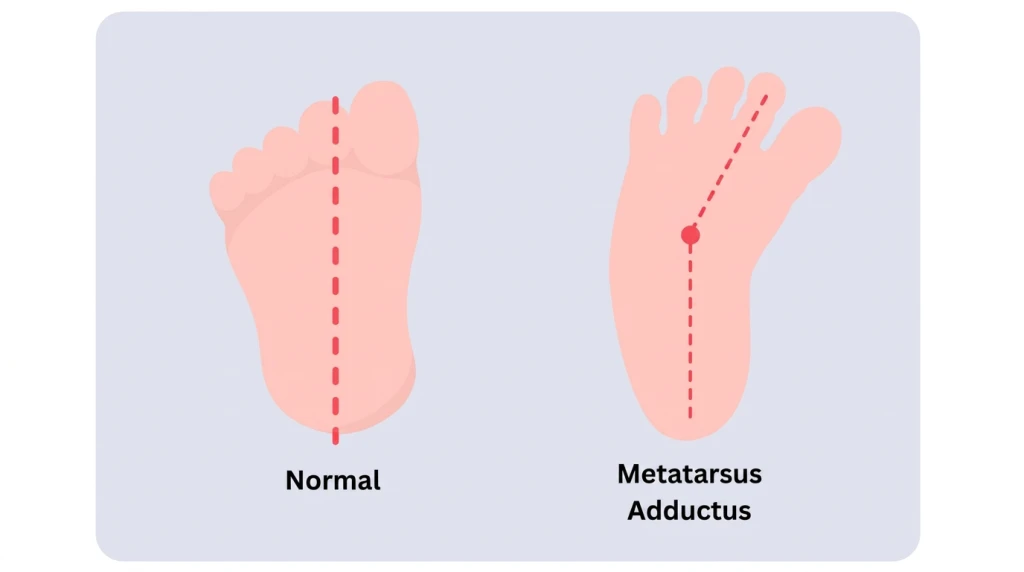
If your toddler’s foot looks curved when you turn the sole up, you may be seeing metatarsus adductus. It is one of the more common paediatric foot findings in Singapore, and parents often spot it themselves while changing nappies or fitting shoes. The forefoot turns inward and the inner border of the foot looks like a “C”. The heel and ankle sit in a normal position.
The reassuring side of metatarsus adductus is that most flexible cases settle on their own in the first one to two years as the child grows and starts walking. The part that warrants a paediatric podiatry assessment is the smaller group of feet that are rigid, or that are tripping the child during early walking, or that sit alongside other findings such as in-toe walking or a family history of hip conditions. A short assessment tells you which side of that line your child sits on, so you can either monitor with confidence or start treatment early enough to make a difference.
Symptoms of Metatarsus Adductus
- The forefoot turns inward while the heel stays in a normal position.
- A visible “C-shape” when you look at the sole of the foot.
- A crease on the inner border of the foot in some children.
- In-toe walking once the child starts walking, since metatarsus adductus is one of the foot-level causes of an in-toed gait.
- Tripping or stumbling during the early walking years.
- Difficulty fitting shoes, with the shoe upper wrinkling on the inner side.
- A flexible foot in most cases, where the forefoot can be guided back to a straight position with gentle pressure. Rigid cases do not straighten with handling.
The heel and ankle position is the key distinguishing feature from clubfoot. In metatarsus adductus, only the forefoot is involved. The hindfoot sits normally.
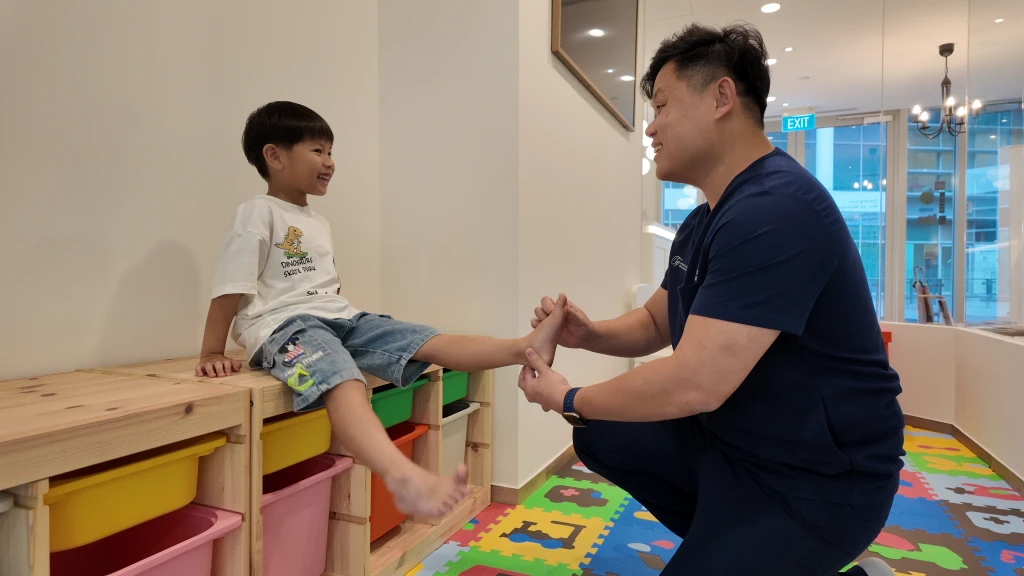
Causes of Metatarsus Adductus
What Causes Metatarsus Adductus?
The exact cause is not fully understood and remains debated. Foetal positioning is the most commonly cited explanation: the forefoot is held in an inward position long enough during late pregnancy that the curve persists after birth. Some evidence points instead to an intrinsic developmental difference in the forefoot, such as an altered shape of the medial cuneiform bone. Contributing factors include:
- Foetal positioning. Tight intrauterine space, particularly in the third trimester, that holds the forefoot in adduction.
- Family history. Metatarsus adductus and other paediatric foot conditions can cluster within families.
- Breech presentation. Babies in a breech position carry a higher rate of metatarsus adductus.
- Oligohydramnios. Low amniotic fluid during pregnancy reduces the room the baby has to move, which can hold the foot in a curved position.
- Firstborn child. More common in firstborns, likely because the uterus has not yet stretched from a prior pregnancy.
- Twin or multiple pregnancy. Metatarsus adductus appears more frequently in twins than in single-born babies.
Who Carries a Higher Baseline Risk?
- Babies who were in a breech position.
- Babies from a multiple pregnancy.
- Firstborn children.
- Children with a family history of metatarsus adductus or clubfoot.
- Children with a history or family history of developmental dysplasia of the hip, since the two conditions can co-present.
- Children with low amniotic fluid documented during pregnancy.
A higher baseline risk does not mean the condition will be severe. It does mean an assessment within the first year is worthwhile so the foot can be classified as flexible or rigid early.
Conditions Commonly Mistaken for Metatarsus Adductus
A curved or in-turned baby foot can look like several other conditions, and some of these need different management.
Clubfoot (talipes equinovarus)
This is the most important differential. In clubfoot the hindfoot is also turned in and pointed down, and the foot is rigid in all directions. Metatarsus adductus only involves the forefoot, and the heel sits normally.
In-toe walking from higher up the leg
In-toe walking can come from the hip (femoral anteversion) or shin (internal tibial torsion) rather than the foot. The feet may look in-turned during walking even when the forefoot itself is straight.
Skewfoot
This is a rarer condition where the forefoot is adducted but the hindfoot is also tilted outward. It usually presents later than metatarsus adductus and is more rigid.
Hallux varus
Only the big toe deviates inward, not the whole forefoot.
A paediatric podiatry assessment uses the Bleck’s test and the position of the heel to differentiate these. Imaging is rarely needed unless the foot is rigid or the diagnosis is unclear.
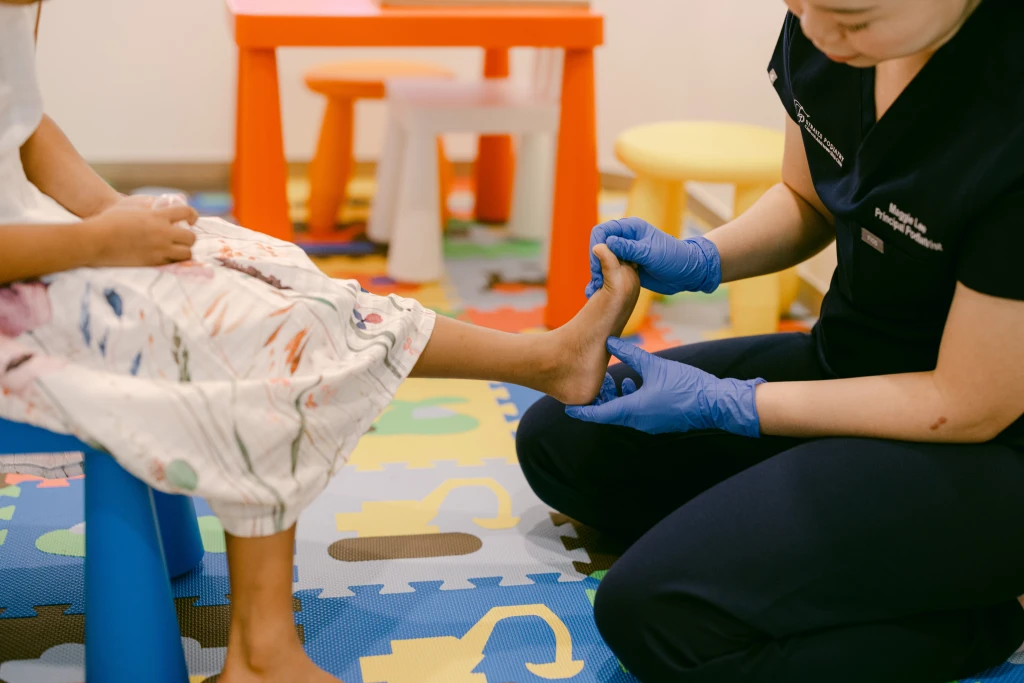
Treating and Preventing Metatarsus Adductus
The first step is classification. A flexible metatarsus adductus, where the forefoot can be guided straight with gentle pressure, behaves very differently from a rigid metatarsus adductus, where the foot will not correct passively. Treatment intensity scales with that finding.
For the flexible majority, the bell curve is reassuring. Most flexible cases resolve on their own by around age 2 as the child grows and starts to walk. Active treatment focuses on simple measures.
- Passive stretching. A parent-delivered stretching routine, taught during the assessment, is the first-line treatment for flexible cases. The forefoot is guided gently into a straighter position several times a day, typically with nappy changes.
- Footwear guidance. Soft, flexible footwear that does not constrain the forefoot. Reverse-last shoes, where the shoe is built on a mirror-image mould to encourage outward positioning, are sometimes used in mild persistent cases.
For rigid cases, or for flexible cases that have not improved by walking age, more active treatment is considered.
- Serial casting. A series of casts changed every one to two weeks gradually moves the forefoot into a corrected position. Most effective when started before age 1.
- Paediatric supramalleolar orthoses or custom foot orthoses. Used in older children when the residual curve is contributing to tripping, in-toe walking, or footwear difficulties.
- Surgical intervention. Reserved for the small number of older children with a fixed rigid deformity that did not respond to conservative care. Most children with metatarsus adductus never need surgery.
The honest framing is that the foot is doing most of the work itself for the flexible majority. The podiatrist’s job is to confirm that judgement, teach the stretches, review footwear, and set a monitoring schedule. For the smaller rigid group, earlier intervention generally has a better window, so an assessment in the first year is more useful than waiting.
Have Your Child’s Metatarsus Adductus Managed at Straits Podiatry
Paediatric foot conditions are seen at all three Straits Podiatry clinics in Buona Vista, Orchard, and Paya Lebar, where our podiatrists work with children of all ages. Straits Podiatry is part of Healthway Medical Group.
A paediatric metatarsus adductus assessment includes a paediatric foot and gait assessment, the Bleck’s test to grade flexibility, hip and lower limb rotation screening to rule out a higher cause of in-toeing, and footwear review. Treatment, where indicated, may include a parent-delivered stretching plan, reverse-last footwear guidance, paediatric supramalleolar orthoses, or custom paediatric orthoses, alongside a monitoring schedule as your child grows. Where serial casting or onward referral is appropriate, that pathway is discussed openly with you.
Speak with Straits Podiatry or book a consultation for an assessment and a tailored approach to manage your child’s metatarsus adductus.
Frequently Asked Questions About Metatarsus Adductus
At what age should I get my child’s metatarsus adductus checked?
The sooner the better, ideally within the first year. Early assessment is not about rushing into treatment, since most flexible cases settle on their own. It is about classification. A paediatric podiatrist can confirm whether the foot is flexible or rigid, rule out clubfoot or hip involvement, and set a sensible monitoring schedule. If active treatment such as serial casting is needed, it works best when started before age 1.
Will my child’s feet straighten on their own?
For flexible metatarsus adductus, often yes. The majority of flexible cases resolve by around age 2 as the child grows and starts walking. Rigid metatarsus adductus is less likely to fully correct without treatment, and is the group where serial casting or orthotic management has the most to offer. An assessment is the only way to tell which type your child has.
What is the difference between metatarsus adductus and clubfoot?
Both involve an inward-turned foot, but they affect different parts of the foot and have very different prognoses. Metatarsus adductus only involves the forefoot. The heel and ankle sit normally and the foot is usually flexible. Clubfoot involves the entire foot. The hindfoot is also turned in, the foot points downward, and the deformity is rigid. Clubfoot needs active early treatment with the Ponseti method. Metatarsus adductus often does not.
Can metatarsus adductus cause in-toe walking?
Yes. Metatarsus adductus is one of the three common causes of an in-toed gait in children, alongside femoral anteversion at the hip and internal tibial torsion at the shin. When the forefoot is curved inward, the foot points inward when the child walks. If you have noticed in-toeing in your child, a paediatric assessment can identify which level the rotation is coming from, since the right plan depends on the cause.
Do orthotics help metatarsus adductus?
Sometimes. Orthotics are not first-line treatment for infants with metatarsus adductus, where passive stretching and footwear guidance do most of the work. In older children with a residual curve that is contributing to in-toe walking, tripping, or footwear difficulty, custom foot orthoses or paediatric supramalleolar orthoses can guide the foot into a straighter loading position. The device is matched to the cause, so the decision sits at the end of the assessment, not the start.