

Your knee has been stiff and achy for a while, and lately you have noticed a soft, tight fullness right behind it. It shows up when you straighten the leg fully, and squatting to reach a low cupboard or walking down the stairs at your HDB block feels like something is filling the space behind the knee. After a long day on your feet it feels larger and more uncomfortable, then it eases overnight. The knee itself has been grumbling for months, so the bulge behind it can feel like a separate new problem when it is usually part of the same story.
A Baker’s cyst, also called a popliteal cyst, is a pocket of joint fluid that has collected in a natural bursa behind the knee. The knee joint and that bursa are connected by a small passage that tends to act like a one-way valve, so when the knee produces more fluid than normal, the fluid is pushed backward and the bursa swells. In adults, that excess fluid almost always comes from a problem inside the joint, most commonly osteoarthritis or a meniscal tear. This is why accurate diagnosis matters on two fronts: the swelling behind the knee needs to be distinguished from more serious causes such as a blood clot, and the real target of care is the knee condition producing the fluid, not the cyst on its own.
Symptoms of a Baker’s Cyst
Many Baker’s cysts are painless and are noticed only as a fullness behind the knee. When symptoms do appear, they tend to track with the underlying knee problem and with how active you have been.
- Soft swelling or fullness behind the knee: a rounded bulge in the hollow at the back of the knee (the popliteal fossa), often more obvious when you stand and straighten the leg.
- Tightness when bending the knee fully: deep squatting, kneeling, or crouching feels restricted, as though something is in the way at the back of the joint.
- Swelling that changes with activity: the cyst often enlarges after a long day of walking or standing and settles with rest, because activity drives more fluid into the bursa.
- A dull ache rather than sharp pain: discomfort behind the knee and into the upper calf is common, but severe pain is not typical of an uncomplicated cyst and points to something else.
- Symptoms of the underlying knee problem alongside it: morning stiffness, joint aching, or catching and locking often sit in the background because the knee condition driving the fluid is usually the bigger issue.
- Sudden calf pain, swelling, warmth, or redness: if the cyst ruptures, fluid tracks down into the calf and produces pain and swelling that closely resembles a deep vein thrombosis. This is the one pattern that needs urgent medical assessment rather than watchful waiting.
From what we see in clinic, the swelling behind the knee is rarely the whole picture. The more useful clinical question is what is happening inside the joint to make it produce that much fluid in the first place.
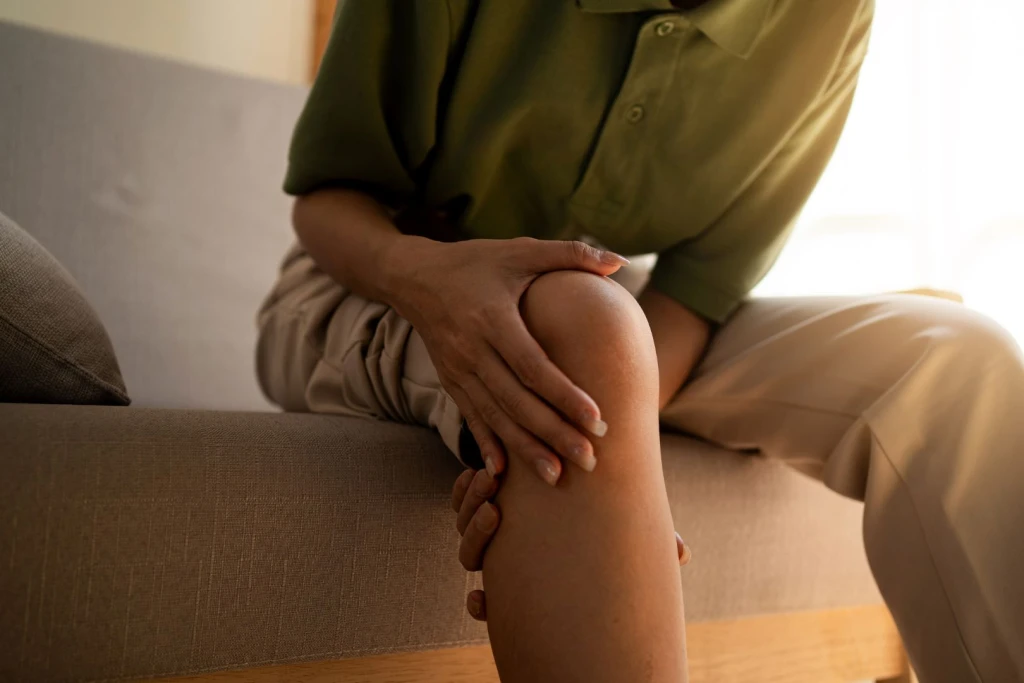
Causes of a Baker’s Cyst
The cyst forms through a simple plumbing problem: the knee is generating excess synovial fluid, and the fluid finds its way into the bursa behind the joint through a valve-like connection. What matters clinically is the source of that excess fluid.
What Causes a Baker’s Cyst?
- Knee osteoarthritis: the most common driver in adults. A worn, inflamed knee osteoarthritis joint produces extra fluid, and a Baker’s cyst is often the first visible sign of that process.
- Meniscal tears: a meniscal tear, particularly a degenerative tear of the inner meniscus, is a frequent cause. The damaged cartilage irritates the joint lining and increases fluid output.
- Inflammatory joint disease: rheumatoid arthritis, gout, and other inflammatory arthritis can inflame the joint lining and produce the same excess-fluid picture.
- Cartilage damage and other intra-articular injury: any process that irritates the inside of the knee, including old ligament or cartilage injuries, can raise fluid production enough to fill the bursa.
- Primary cysts in children: in children, a popliteal cyst is often primary, meaning it is not linked to joint damage. These are usually harmless and frequently resolve on their own over time, which is a different situation from the adult pattern.
Who Carries a Higher Baseline Risk?
- Adults over 40, in whom knee osteoarthritis becomes more common.
- Anyone with a previous meniscal injury, knee trauma, or knee surgery.
- People with an inflammatory arthritis such as rheumatoid arthritis or gout.
- Active people who keep loading a knee that already has early joint wear.
- Children, who can develop primary cysts that are usually benign and self-limiting.
Conditions Commonly Mistaken for a Baker’s Cyst
Swelling or pain behind the knee and calf has several possible causes, and some of them are far more urgent than a cyst. The most important reason to have a lump behind the knee assessed is to sort the harmless from the serious.
Deep vein thrombosis
A ruptured Baker’s cyst produces calf pain, swelling, warmth, and tenderness that can look almost identical to a deep vein thrombosis, which is a blood clot in the deep veins of the leg. This is a medical situation that should not be self-diagnosed as a burst cyst, because a missed clot can be dangerous. Sudden calf swelling and pain, especially with any breathlessness or chest discomfort, warrants urgent medical assessment to exclude a clot before anything is attributed to the cyst.
Popliteal artery aneurysm
A pulsing swelling behind the knee can be a popliteal artery aneurysm rather than a cyst. The distinguishing feature is that an aneurysm typically pulses in time with the heartbeat, whereas a Baker’s cyst does not. This is uncommon but important to rule out, particularly in older adults, because it needs vascular assessment.
Meniscal cyst
Fluid from a meniscal tear can sometimes collect at the joint line to form a meniscal cyst, which presents as a firm lump around the side or back of the knee. It shares the same underlying cartilage problem as many Baker’s cysts, but it sits at the joint line rather than deep in the hollow behind the knee, and imaging usually distinguishes the two.
Soft tissue lump
A benign soft tissue lump such as a lipoma or a ganglion, and rarely a soft tissue tumour, can appear behind the knee and be mistaken for a cyst. A lump that is firm, keeps growing, does not change with activity, or feels fixed to deeper tissue should be imaged rather than assumed to be a Baker’s cyst.
Calf muscle strain
A tear of the calf muscle (a gastrocnemius strain, sometimes called tennis leg) produces sudden calf pain and swelling that can be confused with a ruptured cyst. The difference is usually in the story: a calf strain tends to start with a sharp, well-defined moment during a push-off or sprint, whereas a ruptured cyst follows a period of knee swelling and fullness behind the joint.

Treating and Preventing a Baker’s Cyst
Because a Baker’s cyst in an adult is a symptom of what is happening inside the knee, the sensible approach is to treat the underlying joint condition rather than to chase the bulge. When the fluid production in the knee settles, the cyst commonly shrinks on its own. Care is conservative first and directed at reducing joint irritation, managing load through the leg, and building the muscle support the knee relies on. The exception is the cyst that is very large, persistently painful, or ruptured, where medical assessment leads.
Conservative treatment
These measures work together, and the emphasis shifts depending on which knee condition is driving the fluid.
- Activity and load modification: stepping back from the movements that flare the knee, such as deep squatting, kneeling, and long periods on hard floors, reduces the fluid response and the fullness behind the knee. This is a settling measure during a flare, not a permanent restriction.
- Knee-focused physiotherapy: strengthening the quadriceps, hip, and calf, and restoring knee range, takes load off the irritated joint and supports it more evenly. Rehabilitation of the underlying condition through our physiotherapy service is often the most useful long-term lever for an osteoarthritic or previously injured knee.
- Custom foot orthoses and footwear adjustment: where the way the lower limb loads the ground is adding stress to a worn knee, correcting foot posture and cushioning can reduce the load passing through the joint. This does not act on the cyst directly, but it can help settle the knee pain and irritation that keep the fluid coming.
- Managing the underlying knee condition: the largest gains come from addressing whatever is producing the fluid, whether that is osteoarthritis, a meniscal problem, or inflammatory arthritis. This may mean weight management, medical treatment of an inflammatory condition through your doctor, or a structured knee-loading programme.
When conservative care isn’t enough
Where the cyst stays large and symptomatic despite settling the knee, or where the diagnosis is not clear, further assessment is appropriate. Imaging such as an ultrasound scan or MRI is used to confirm the cyst, measure it, and, importantly, identify the meniscal or arthritic problem behind it. A persistent, painful cyst can be drained (aspirated) and sometimes injected with corticosteroid by a doctor, though it tends to refill if the underlying joint problem is left unaddressed, which is why the joint itself is usually the real target. Where a meniscal tear or advanced arthritis is driving the fluid, an orthopaedic opinion on managing that joint condition is the more durable route, and surgical removal of the cyst itself is uncommon and reserved for cases that do not respond to anything else. A cyst that has ruptured and is producing calf pain and swelling should be assessed medically without delay to exclude a deep vein thrombosis first.

Have Your Baker’s Cyst Managed at Straits Podiatry
A Baker’s cyst is worth taking seriously less for the bulge itself and more for what it says about the knee. At Straits Podiatry, an assessment for swelling behind the knee starts with distinguishing a straightforward cyst from the patterns that need urgent medical attention, then looks at the knee condition and the lower-limb loading behind it. Our podiatrists can assess how your knee is being loaded, help manage the mechanical contributors through footwear and custom foot orthoses, and coordinate knee rehabilitation with our physiotherapy team.
Where the picture points to a significant meniscal or arthritic problem, or where the cyst is large, painful, or ruptured, we will guide you toward the right medical or orthopaedic assessment rather than treating the swelling in isolation. If you have noticed persistent fullness or aching behind the knee, book a consultation for an assessment at any of our three Singapore clinics.
Frequently Asked Questions About a Baker’s Cyst
How do you treat a Baker’s cyst?
In adults, the most reliable approach is to settle the knee condition producing the fluid rather than to target the cyst directly. That usually means load and activity modification during a flare, knee-focused rehabilitation to strengthen and support the joint, and managing the underlying osteoarthritis or meniscal problem. When the joint calms down and produces less fluid, the cyst commonly shrinks on its own. Draining the cyst is an option for a large or painful one, but it tends to refill unless the underlying knee problem is addressed.
How long does a Baker’s cyst last?
It varies with the cause. A cyst driven by a temporary flare of knee inflammation can settle over weeks once the joint calms down, while a cyst tied to ongoing osteoarthritis or an untreated meniscal tear can persist or come and go for months until the underlying condition is managed. Primary cysts in children often resolve on their own over time. The honest answer is that the cyst usually lasts as long as the knee keeps producing excess fluid.
Is a Baker’s cyst dangerous?
An uncomplicated Baker’s cyst is not dangerous in itself, and many cause little more than fullness and tightness behind the knee. The situation that needs prompt attention is a rupture, where fluid tracks into the calf and produces pain and swelling that closely resembles a deep vein thrombosis. Because a blood clot can be serious, sudden calf pain and swelling should be assessed medically to rule out a clot rather than assumed to be a burst cyst.
Will a knee brace or compression help a Baker’s cyst?
Compression or a supportive sleeve can make the knee feel more comfortable and controlled during activity, but it does not act on the cause of the cyst. The support is a symptom-easing measure while the underlying knee condition is being managed, not a treatment for the cyst on its own. If a brace is masking a knee that keeps swelling, the more useful step is to have the joint properly assessed.
Can I keep exercising with a Baker’s cyst?
Usually yes, with some adjustment. Low-impact activity that keeps the knee moving without aggravating it, such as cycling or swimming, is generally well tolerated and helps maintain strength around the joint. The movements to scale back during a flare are the ones that load the knee hard, such as deep squatting, kneeling, and long runs on hard surfaces. If activity is consistently making the swelling and ache worse, that is a signal the underlying knee condition needs attention rather than a reason to stop moving altogether.
Does a Baker’s cyst mean I have arthritis?
Not always, but in an adult it usually means there is something going on inside the knee. Osteoarthritis is the most common driver, followed by meniscal tears and inflammatory joint conditions. A Baker’s cyst is best thought of as a clue that points back to the joint, which is why an assessment focuses on identifying and managing that underlying condition rather than stopping at the cyst.