

The ache in the ball of your foot started as a niggle a few weeks into a heavier training block. At first it only showed up during the run. Then it began turning up during the walk home. Now there is a pinpoint tenderness over the top of the forefoot that you can press on and recreate. Soft insoles, a wider toe box, and a few rest days have not shifted it. The pain reliably builds the longer you are on your feet. This is the classic metatarsal stress fracture picture our patients present. It is one of the conditions most often mistaken for ordinary forefoot pain.
The metatarsals are the five long bones that run from the midfoot to the base of each toe. They carry a large share of the load every time you push off. A metatarsal stress fracture is a hairline overuse crack in one of these bones, most often the second or third. It develops when repetitive impact outpaces the bone’s ability to remodel and repair. It is not the same as a soft-tissue problem at the ball of the foot. It is also not a sudden break from a single heavy blow. Because the crack is microscopic, the key point is this: a bone injury is hiding inside what looks like everyday forefoot pain. Treating it as soft tissue is what lets it drag on or progress.
Symptoms of Metatarsal Stress Fracture
A metatarsal stress fracture builds gradually, so the symptoms escalate over weeks rather than all at once. The pattern is what separates it from the soft-tissue causes of forefoot pain. The location of the tenderness is often the most telling clue.
- Pinpoint pain over the top of the forefoot. The tenderness sits in a small spot over the shaft of one metatarsal bone, on the upper surface of the foot. It does not spread under the ball of the foot.
- Pain that builds with activity and lingers afterwards. The discomfort worsens the longer you walk, run, or stand. It continues as a deep ache after you stop.
- Tenderness when pressing directly on the bone. Pressing on the affected metatarsal shaft from above reproduces the pain. This focal bony tenderness is a useful sign in clinic.
- Pain reproduced by a tuning-fork or load test. A vibrating tuning fork applied to the bone often recreates the symptom over the fracture site. Hopping or pushing off through the forefoot can do the same.
- Localised swelling on the top of the foot. Mild puffiness can appear over the affected bone, sometimes with a vague fullness between the long bones.
- Pain that eases with rest early on, then becomes constant. In the first weeks the pain settles overnight. As the fracture progresses it begins to ache even at rest or wake you at night, which signals the injury has advanced.
- A clear link to a recent change in load. The symptoms usually trace back to a jump in mileage, new shoes, a fresh training block, or a period of unusually heavy walking or marching.
Reading the pattern
The most reliable early clue is a combination: focal bony tenderness over the top of one metatarsal, plus pain that tracks with how much you have been on your feet. Diffuse pain across the whole ball of the foot points elsewhere.

Causes of Metatarsal Stress Fracture
A metatarsal stress fracture develops when the repetitive load through the forefoot exceeds the bone’s capacity to remodel and adapt. Most cases involve a training or load trigger sitting on top of an underlying risk factor.
What Causes Metatarsal Stress Fracture?
- A sudden increase in running or walking volume, the most common single trigger. A jump in weekly mileage, a new running programme, or an unusually long period on hard surfaces gives the forefoot more impact than it has adapted to.
- Route marches and high-volume marching. The original “march fracture” was described in soldiers. The same mechanism applies to National Service recruits and reservists during route marches and field training in heavy boots.
- Repetitive jumping and push-off sports. Basketball, court sports, and dance load the forefoot through repeated push-off and landing. This concentrates force on the second and third metatarsals.
- Hard surfaces, barefoot training or worn footwear. Training on concrete, switching to a stiffer or thinner shoe, or running in shoes long past their cushioning life all raise the impact the forefoot must absorb.
- A long second toe or high arch. A foot shape that loads the second metatarsal more heavily, or a high-arched foot that pushes force toward the forefoot, concentrates stress on specific bones.
- A restricted big toe joint. Hallux rigidus or advanced bunions can shift the pivot point during push-off onto the second or third toe, increasing the load carried at that area.
- Inadequate recovery between sessions. Poor sleep, back-to-back hard days, and limited rest reduce the bone’s ability to remodel between loading bouts.
Who Carries a Higher Baseline Risk?
- Long-distance runners and high-mileage walkers, particularly during a rapid build-up in training.
- NS recruits and reservists during periods of intensive marching and field training.
- Court and jumping athletes whose sport loads the forefoot repeatedly.
- People with low energy availability or Relative Energy Deficiency in Sport (RED-S), which lowers bone density. In women, menstrual irregularity is a red flag.
- Adults with osteoporosis, reduced bone mineral density, or vitamin D deficiency. The last of these is common in Singapore due to sun avoidance and indoor lifestyles.
- People with a long second toe, a high arch, or a previous metatarsal stress fracture.
Conditions Commonly Mistaken for Metatarsal Stress Fracture
Forefoot pain has several possible sources, and the bone injury is easy to miss. The soft-tissue causes are far more common, and the early X-ray is often unremarkable. The distinction matters because a stress fracture needs offloading, while the soft-tissue conditions are managed with loading and support. Getting it wrong is what turns a few weeks of recovery into a few months.
Metatarsalgia
Metatarsalgia is the broad term for soft-tissue pain under the ball of the foot. It is usually felt as a diffuse ache, or a bruised, walking-on-a-pebble sensation across the heads of the metatarsals on the underside. A metatarsal stress fracture sits higher and more focally, with pinpoint tenderness over the shaft of one bone on the top of the foot. It also worsens progressively with load rather than settling with rest. The two can overlap early, which is why a careful look at where the tenderness sits is what separates them.
Morton’s neuroma
Morton’s neuroma is an irritated, thickened nerve between the long bones, classically between the third and fourth toes. It produces burning, tingling, or a sensation of a pebble or a sock bunched under the ball of the foot. The pain often radiates into the toes and can be reproduced by squeezing the forefoot from the sides. A stress fracture produces bony pain, not nerve-type pain, with no burning or radiation. Its tender point sits on the bone itself rather than in the web space between two bones.
Intermetatarsal bursitis
Intermetatarsal bursitis is inflammation of one of the small fluid-filled sacs that sit between the metatarsal heads, often irritated when tight footwear compresses the forefoot. It tends to produce a more diffuse, swollen fullness between two of the long bones, sometimes with a soft or squelchy tenderness, and it can mimic both metatarsalgia and a Morton’s neuroma. A metatarsal stress fracture, by contrast, produces pinpoint tenderness on the top of one bone that sharpens with impact loading rather than a soft, spread-out fullness between the bones. Pressing between the metatarsal heads tends to provoke the bursitis, whereas pressing directly on the bone shaft provokes the fracture.
Treating and Preventing Metatarsal Stress Fracture
Treating a metatarsal stress fracture is straightforward in principle. The bone is injured and needs to be unloaded so it can remodel and heal, and no insole, exercise, or therapy bypasses that basic requirement. Continuing to load the forefoot through an active crack risks it progressing to a full break. Because an early X-ray is often normal in the first 2 to 3 weeks, the diagnosis is frequently made clinically and sometimes requires a repeat film or MRI or bone scan, so the honest pathway is relative rest first, then a graded return once the bone has settled.
Conservative treatment
Treatment centres on offloading the injured bone so it can heal, then rebuilding load gradually.
- Stiff-soled or rigid shoe: For most cases, a stiff-soled or rigid post-operative-style shoe reduces the bend through the forefoot, letting the bone rest while you stay mobile.
- CAM walking boot: Where the pain is more significant or weight-bearing remains sore, a CAM walking boot protects the forefoot and shifts load to the rest of the leg, typically worn for several weeks.
- Relative rest: Rest from running, jumping, and marching for the duration of healing, usually 4 to 6 weeks. The bone healing, not the pain, sets the timeline.
- Low-impact cross-training: Swimming, deep-water running, or stationary cycling maintains fitness without loading the forefoot.
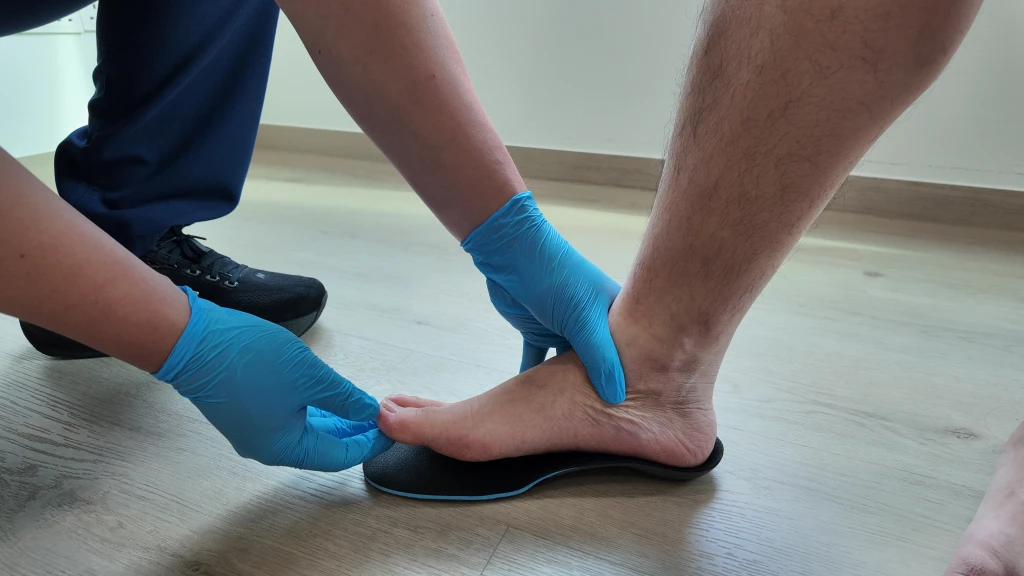
- Custom foot orthoses: Where a foot structure such as a high arch or a long second toe has concentrated load on one bone, custom foot orthoses redistribute forefoot pressure once the acute phase has passed and during the return to sport.
- Focused shockwave therapy and EMTT: Where healing is slow, focused shockwave therapy and magnetotransduction therapy (EMTT) may be used to stimulate bone activity and support the remodelling that heals a stress fracture.
- Nutrition and bone health: Vitamin D, calcium, and broader nutrition are reviewed to support bone remodelling, alongside any underlying issue such as RED-S or low bone density.
When conservative care isn’t enough
Surgery is rarely needed for a metatarsal stress fracture. It is reserved for the uncommon fracture that fails to heal with offloading over many months, and for higher-risk fractures at the base of the fifth metatarsal, which behave differently and warrant closer monitoring. Most cases heal completely with appropriate offloading and patience.
Preventing recurrence
- A graded return to running follows a structured progression, from walking, to incline walking, to slow jogging, building volume by no more than around ten percent a week.
- Long-term prevention rests on sensible load progression, rotating between footwear with adequate cushioning, mixing training surfaces, and replacing worn shoes before the cushioning is gone.

Have Your Metatarsal Stress Fracture Managed at Straits Podiatry
Getting the diagnosis right early is what changes the trajectory of a metatarsal stress fracture. If forefoot pain has built through a training change, has not eased with softer insoles or a wider shoe, and now sits sharply over one bone, it is worth having assessed rather than pushed through. Our podiatrist can localise the tender point, discuss whether imaging is needed to confirm the fracture, and set up the offloading that lets the bone heal.
From there, care is built around your training and daily routine, with a full lower-limb and gait assessment to find what concentrated the load, guidance on a stiff-soled shoe or boot to offload the forefoot, and a graded return once the bone has settled. Speak with a podiatrist in Singapore or book a consultation for an assessment at any of our three clinics.
Frequently Asked Questions About Metatarsal Stress Fracture
How long does a metatarsal stress fracture take to heal?
Most metatarsal stress fractures settle in around 4 to 6 weeks once the bone is properly offloaded, though returning to full running or marching can take longer. The timeline depends on which bone is involved, how early the injury was caught, and how disciplined the offloading is. A crack that is caught early and rested heals faster than one that has been pushed through for weeks. A fracture at the base of the fifth metatarsal is the exception. It heals more slowly and needs closer monitoring.
Can I still walk with a metatarsal stress fracture?
Usually yes, but with protection. Day-to-day walking in a stiff-soled shoe or a walking boot is generally fine, because these reduce the bend and load through the forefoot. What needs to stop is the impact loading: running, jumping, and marching, until the bone has healed. Walking long distances unprotected through an active fracture risks the crack progressing. That is the situation that turns a few weeks of recovery into a few months.
Why was my X-ray clear if I have a metatarsal stress fracture?
A stress fracture is a fine crack in the bone rather than a clean break. So it often does not show on a plain X-ray in the first 2 to 3 weeks, before any healing callus has formed. This is why a normal X-ray does not rule the injury out when the clinical picture fits. The fracture frequently becomes visible on a repeat film a few weeks later as it heals. Where an earlier answer is needed, an MRI or bone scan can detect the bone changes an X-ray cannot.
How is a metatarsal stress fracture different from metatarsalgia?
Metatarsalgia is soft-tissue pain spread across the underside of the ball of the foot. It is often described as a bruised or walking-on-a-pebble feeling, and it tends to ease with rest and cushioning. A metatarsal stress fracture is a bone injury with pinpoint tenderness over the top of one metatarsal that builds with activity and lingers afterwards. The simplest distinction is location and pattern. Focal bony tenderness on top that worsens with load points to a fracture, while diffuse underside pain points to metatarsalgia.
Will I need a walking boot for a metatarsal stress fracture?
Not always. Milder cases often heal well in a stiff-soled or rigid-soled shoe that limits forefoot bending, while still letting you walk normally. A walking boot is used when the pain is more significant, when weight-bearing stays sore, or when extra protection is needed to be confident the bone is resting. The choice is made at the assessment, based on how much the forefoot is loaded and how the bone is behaving. The boot is stepped down as the fracture settles.