
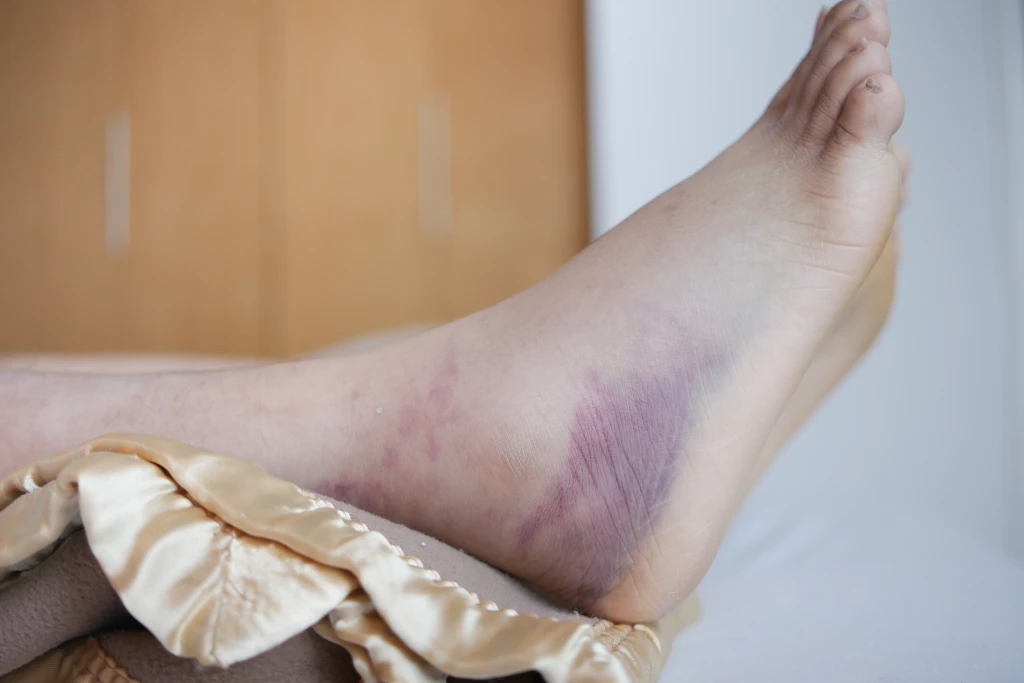
This is a common conversation I have in clinic when it comes to ankle injuries. A patient walks in 3 to 4 weeks after a sprain, frustrated. They did the textbook thing. Rest, ice, compression, elevation. They started moving the ankle again. The swelling settled, the bruising faded. And yet something is not right. The ankle still hurts in a way they do not remember from previous sprains. Walking is okay, but the moment they try to jog, push off, or come down the stairs, the pain is sharp again.
If that sounds like your situation, the question worth asking is whether you are dealing with a regular acute ankle sprain at all. The pattern that I just mentioned above fits a high ankle sprain, also called a syndesmosis injury, which is a different injury that needs a different rehab and takes two to three times longer to heal.
I see this every now and then, and that is because it isn’t that common compared to a regular sprain. Patients arrive after weeks of standard sprain rehab that is not working, and the reason it is not working is that the rehab is correct for the wrong injury. So here is how I help my patients tell the two apart, in the order they usually ask the questions.
First, why would my “regular” sprain not be regular?
A regular ankle sprain damages the lateral ligaments on the outside of the ankle. It happens when the ankle rolls outward, the ligaments stretch beyond their tolerance, and you feel a sharp pain on the outside of the ankle within seconds.
A high ankle sprain damages a different structure entirely. It is the syndesmosis, the band of strong ligaments that holds the two leg bones (tibia and fibula) together just above the ankle joint. When the foot is forced outward while the leg stays planted, those ligaments get stretched or torn. The injury sits higher up the leg, the loading pattern is different, and the healing time is much longer.
The two get confused because in the first 7 to 10 days they can look similar from the outside. Swelling, bruising, tender ankle. By 2 to 3 weeks, when a regular sprain should be turning the corner, a high ankle sprain still feels stuck. That is usually the moment people walk into clinic.
Where should the pain actually be sitting?
This is the single most useful thing you can check at home.
For a regular ankle sprain, the worst tender spot is on the outside of the ankle, in the soft tissue just below and in front of the bony ankle bump (the lateral malleolus). When you press there, the pain is sharp and clearly local. It is right at the level of the ankle joint.
For a high ankle sprain, the worst tender spot is higher up. It sits between the two leg bones, above the level of the ankle joint, roughly 3 to 4 fingers above where a regular sprain hurts. You can usually point to the spot with one finger. The pain feels deeper, almost bony, not the soft-tissue pain of a regular sprain.
If your worst pain is higher than you would expect for a regular sprain, that is the first signal.

What movements should be hurting me?
A regular ankle sprain hurts most with inversion, that same outward ankle-roll motion that caused the original injury. Push-off when walking is usually tolerable from quite early on.
A high ankle sprain hurts most with push-off, with pivoting, and with going up or down stairs. These are rotational and forward-loading motions, not side-to-side. Most patients tell me the same thing: “Walking on flat ground feels fine, but the moment I try to jog or push off the toes, it is sharp again.”
If you are 2 to 3 weeks in and side-to-side feels manageable but push-off, stairs, or pivoting are the problem, that is the second signal.
Does it matter HOW I twisted it?
Yes, more than people realise. In fact, that is the first question I ask my patient: “Tell me, how did you sprain?”
A regular ankle sprain happens through inversion. Stepping off a kerb the wrong way. Landing awkwardly on a basketball game at the community court. Stepping onto an uneven kerb on East Coast Park Connector. The ankle rolls outward, the outside ligaments stretch.
A high ankle sprain happens through external rotation. The foot is twisted outward while the leg is planted. The classic situations I see are touch rugby tackles where one player is fixed and gets hit sideways, a sliding tackle in social futsal, the foot being trapped under another player in a five-a-side game, or a forced dorsiflexion injury where the knee drives forward but the foot stays planted. Skiing trips overseas come up here too.
If your injury involved any of these mechanisms rather than a simple outward ankle roll, that is the third signal.
Why is this taking 6 weeks instead of 2?
This is the question that brings most people into the clinic, because they could not get a proper answer easily.
A regular ankle sprain has a predictable curve. Obvious swelling settles by 2 to 3 weeks. Most people are back to most normal activity by 4 to 6 weeks. Return to running tends to happen around 6 to 8 weeks for the average sprain.
A high ankle sprain runs on a different clock, it sets you back longer. The early swelling and bruising may settle in the first 2 weeks, which is part of why the diagnosis is missed. You assume recovery is on track. Then you try to push off, jog, or go up stairs and the pain is still there. The real recovery timeline is 6 to 12 weeks for low-grade injuries, and 3 to 6 months for higher-grade injuries. Genuinely two to three times longer.
If you are 3 to 4 weeks in and the timeline is not lining up with what you expected for a regular sprain, particularly with push-off and rotational activity, that is the strongest signal that the original diagnosis needs a second look.
Okay, what would you do this week if you were me?
If two or more of the four signals above match your situation, the working diagnosis to rule out is a high ankle sprain rather than a regular one. The next step is a thorough clinical reassessment.
A proper assessment looks at the tender point on palpation, two specific clinical tests (the calf squeeze test and the dorsiflexion-external rotation test), the mechanism of how the injury happened, and where the picture fits, imaging to check for any widening between the two leg bones. From there, you need a management plan built around what is actually injured, not what was initially assumed.
The management is fundamentally different. A regular ankle sprain gets functional rehab with progressive loading. A high ankle sprain needs initial offloading in a walking boot, slower progression through range of motion, and a much longer return-to-sport timeline. Doing regular-sprain rehab on a high ankle sprain prolongs recovery and is one of the more common causes of chronic ankle instability we see months or years after the original injury.
If your ankle sprain is not improving the way it should, book a consultation with any of our podiatrists in Singapore at any of our three locations. The earlier the right diagnosis lands, the shorter the eventual recovery.