
Three months of stretching, three pairs of insoles, and the heel pain has not changed. Your friend suggests a cortisone injection because they heard it’s good. Your GP suggests seeing a podiatrist for shockwave therapy. The internet, predictably, suggests both, along with a dozen other options. The question our patients keep asking in the clinic is the same: which one is right for me?
The honest answer requires looking at what each treatment actually does, the evidence behind them, the risks, and where each one fits in a treatment plan. This is not a head-to-head where one wins. They are different tools with different strengths, and the right choice depends on the case.
We are going to walk you through both options in plain clinical language. By the end, you should know what each does, what each does not do, what the evidence says, and what questions to ask before deciding.
A Quick Reminder of What Plantar Fasciitis Actually Is
Plantar fasciitis is irritation, inflammation, and progressive structural change in the plantar fascia at its attachment to the heel bone. In early cases, the picture is mostly inflammatory. In chronic cases (over 3 months), the picture shifts to structural change in the tissue itself, which is why the term “fasciopathy” is sometimes used to describe long-standing cases.
This distinction matters for treatment selection. An intervention that primarily reduces inflammation may not address structural change. An intervention that supports tissue remodelling may not bring fast symptom relief. The treatment goal in chronic cases is rarely just to switch off pain. It is to actually change the tissue and the load environment around it.
Cortisone Injection: What It Is and What It Does
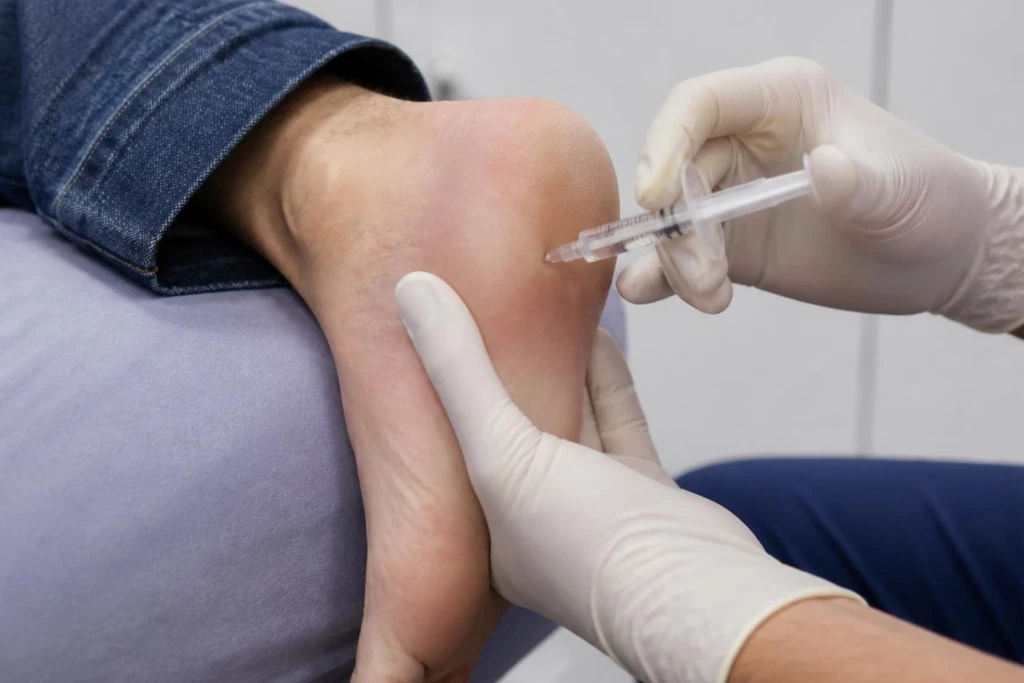
A cortisone injection (also called a corticosteroid injection) places a small amount of anti-inflammatory medication directly into the affected tissue, typically near the plantar fascia attachment on the heel bone. The mechanism is straightforward. Corticosteroids suppress the local inflammatory response, which reduces the pain signal generated by inflamed tissue. This mechanism of action means that your plantar fascia will continue to take on the stress without your body being able to provide feedback to you through pain.
The pros:
- Fast symptom relief, often within days
- Single procedure, no series of sessions required
- Useful only in specific scenarios where you ran out of better options. For example, a patient that does not improve with other proven treatment options (not what your friends recommend you), and also not suitable for surgery.
The cons:
- Relief is typically temporary. Most studies show pain returning within 1 to 3 months, sometimes longer
- Does not address the underlying cause. The load pattern, gait, and biomechanical factors driving the irritation continue uninterrupted
- Risk of plantar fascia rupture, particularly with repeated injections. Repeated cortisone weakens the tissue it is injected into
- Risk of heel fat pad atrophy with multiple injections, which can create a new, separate heel pain problem
- Risk of local skin discoloration and tissue changes at the injection site
- Risk of reducing effectiveness of other treatment options (e.g. shockwave therapy)
The evidence:
The clinical literature is mixed. Short-term studies generally show cortisone reduces pain effectively for 4 to 12 weeks. Longer-term studies show the effect wears off, and outcomes at 6 to 12 months are often no better, and sometimes worse, than non-injection management. Most podiatrist and orthopaedic surgeons tend to avoid recommending cortisone as an option for short-term symptom control, and definitely not something to repeat freely.
Who tends to benefit clinically:
A patient with a specific short-term need for symptom reduction (work demand, important travel, an event), and willingly accepts the risk of complications. A patient who has not addressed underlying factors and is hoping a single injection will resolve a chronic condition is rarely well served by it.
Shockwave Therapy: What It Is and What It Does
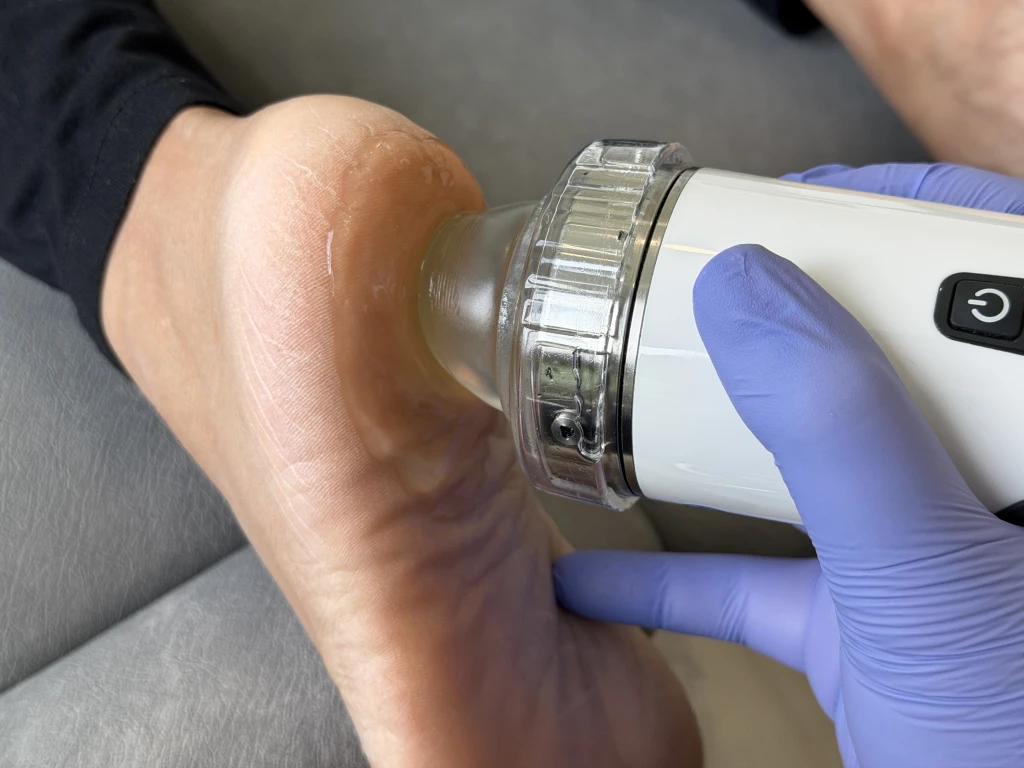
Extracorporeal shockwave therapy, or ESWT, delivers focused acoustic energy pulses through the skin into the affected tissue. The mechanism is different from cortisone. Rather than suppressing inflammation, ESWT delivers controlled mechanical stress to the tissue, which triggers a healing and remodelling response. New blood vessel formation, fibroblast activity, and reorganisation of collagen fibres have all been documented in response to shockwave treatment.
In Singapore, several shockwave modalities are used. Focused ESWT is the most studied for plantar fasciitis. Radial pressure wave therapy is a related but distinct modality that can be appropriate for some presentations. EMTT (magnetotransduction therapy) is another option that can be considered for selected cases.
The pros:
- Non-invasive. No needle, no medication
- Targets the underlying tissue, not just the symptom
- Effects tend to be durable. Improvement continues for weeks or months after the treatment series ends, as the tissue continues to remodel
- No risk of tissue weakening or atrophy, unlike repeated cortisone
- Compatible with simultaneous biomechanical management (orthotics, footwear, rehab exercises)
- No significant side effects except mild bruising and redness post-treatment
The cons:
- Requires a series of sessions, typically 3 to 6 spaced 1 to 2 weeks apart
- Symptoms may take 4 to 8 weeks to improve meaningfully, and the full effect builds over 3 months
- Some pain during the session, particularly at higher intensities
- Some dull ache over the treated site for 24 to 48 hours, which does not affect walking or mobility
The evidence:
Focused ESWT in chronic plantar fasciitis is well studied. Multiple systematic reviews and trials show meaningful pain reduction and functional improvement at 12 weeks and beyond, particularly in cases that have not responded to conservative care.
Who tends to benefit clinically:
A patient with chronic plantar fasciitis (over 3 to 6 months of symptoms), who has had limited improvement with conservative measures (footwear, taping, activity modification, stretching), and whose pain has plateaued, is typically the best candidate. The treatment works alongside the patient’s existing management plan rather than replacing it.
Side-by-Side: Where Each Sits
| Factor | Cortisone Injection | Shockwave Therapy |
|---|---|---|
| Mechanism | Suppresses inflammation and masks pain | Stimulates tissue remodelling |
| Time to relief | Days | 6 to 12 weeks |
| Duration of effect | 1 to 3 months typically | Months to long-term |
| Number of treatments | Usually single, occasionally repeated | Series of 3 to 6 sessions |
| Addresses underlying cause | No | Indirectly, through tissue remodelling |
| Risk of tissue damage | Yes, with repeated use (fascia rupture, fat pad atrophy) | None established |
| Best fit | Cases seeking quick, short-term pain relief despite significant risks | Chronic cases that have plateaued on conservative care |
| Used alongside biomechanical management | Yes (and should be) | Yes (and should be) |

What Most Patients Get Wrong
The most common question we get from patients is whether one of these treatments will “cure” the plantar fasciitis. Neither does it, if only done on its own, in most cases.
Plantar fasciitis is driven by load. The load comes from how your foot moves, the shoes you spend the day in, the surfaces you walk on, your weight or the load you carry, and your activity patterns. Cortisone takes away the pain by completely masking the inflammation produced by that load, but does not change the load. Shockwave helps the tissue rebuild, but does not change the load either. If the load that caused the problem continues unchanged, the problem can return.
This is why the standard of care for plantar fasciitis is not just “pick one treatment.” It is a layered approach. The foundation is identifying and addressing the load pattern, usually through gait and biomechanical assessment, footwear changes, and custom foot orthotics where indicated. Then, in cases that have not improved enough with that foundation, shockwave therapy can support tissue remodelling. Cortisone is a last-resort option, often a desperate move, that should be used very carefully alongside the rest.
Before You Consider Either, Ask Three Questions
If you are weighing up shockwave or cortisone for stubborn plantar fasciitis, three questions are worth asking before deciding.
1. Has the underlying biomechanical cause been assessed and addressed?
If you have been managing plantar fasciitis for 3 to 6 months without a proper gait and biomechanical assessment, the underlying load pattern is probably unaddressed. A course of shockwave therapy along with addressing the underlying load pattern should be considered.
2. What does your treating clinician say about realistic timelines and outcomes?
A clinician only offering a single intervention as a one-and-done solution to chronic plantar fasciitis is over-promising. Ask specifically what they expect, in what timeframe, and what plan they have for the underlying drivers of the problem.
3. What is your specific goal?
A quick pain-reliving solution for a specific upcoming need is a different question from “I want this fixed for good.” A patient with crusing heel pain who has a wedding in 10 days has different priorities from a patient willing to invest 3 months in a structured long-term plan. Both appear valid, but one carries far more risks. The right option depends on your risk acceptance for complications.
How we help you make the right decision
At Straits Podiatry, plantar fasciitis management starts with a comprehensive lower limb assessment to identify what is actually driving the load on the fascia. The plan that comes from that assessment is layered. For most patients, the foundation includes gait and biomechanical analysis, custom foot orthotics or sports orthoses tailored to the specific foot loading pattern, footwear guidance, and where soft tissue retraining is part of the plan, rehabilitative exercises will be prescribed.
For chronic cases, especially when home exercises and conservative measures are not working, focused extracorporeal shockwave therapy is added to the plan, with the session frequency and intensity matched to the specific tissue presentation. EMTT can also be considered for selected cases.
The single biggest decision is not which advanced therapy to pick. It is whether the underlying biomechanical drivers have been identified and addressed. Once that foundation is in place, it helps advanced therapies do their work efficiently. Without it, problem may recur after resolution.
If your plantar fasciitis has not responded to months of self-management, the next useful step is an assessment that clarifies what is driving the problem before deciding what advanced therapy fits. Speak with our team or book a consultation for an assessment and a tailored approach to manage your plantar fasciitis.