
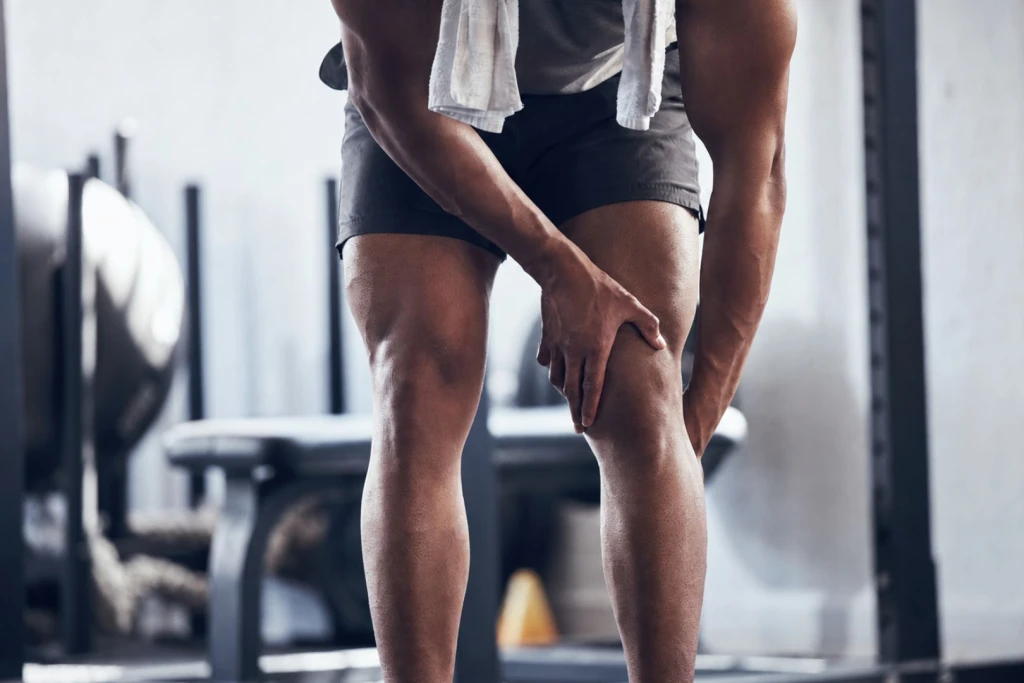
You load up for a heavy back squat at the gym, push out of the bottom of the lift, and feel a nagging soreness settle in at the front of the knee, just above the kneecap rather than below it. Over the following weeks it starts showing up on the stairs, in a deep lunge, and when you stand from a low chair. Weightlifters, CrossFit athletes, volleyball and basketball players, and recreational runners in their thirties and forties tend to notice it first as stiffness before training, then as a sharper catch during the movements that load the knee the hardest.
This pattern often points to quadriceps tendonitis, irritation of the quadriceps tendon where the large thigh muscles converge and attach to the top of the kneecap. This tendon transmits the full force of the quadriceps every time you straighten the knee against load, so it is stressed most during squatting, jumping, and landing. It sits above the kneecap, which is what separates it from patellar tendonitis, where the pain sits below the kneecap on the tendon running to the shinbone. Getting the level right matters, because the loading pattern that aggravates each tendon, and the rehab that settles it, differ in emphasis.
Symptoms of Quadriceps Tendonitis
The way the pain behaves with load, and its position just above the kneecap, is usually the clearest signal:
- Pain just above the kneecap: the most tender spot sits at the top edge of the patella where the quadriceps tendon attaches, higher than the pain of patellar tendonitis.
- Pain that worsens with deep knee bend: squatting, lunging, descending stairs, and rising from a low seat load the tendon and reproduce the ache.
- Pain under heavy or explosive load: jumping, landing, and heavy lifting provoke it more than steady walking on the flat.
- Stiffness at the start of activity: the tendon often feels tight and sore in the first few movements of a session, eases as it warms up, then returns afterwards.
- Tenderness on touch: the area at the top of the kneecap feels sore under light pressure.
- A sensation of weakness straightening the knee: the leg can feel like it lacks its usual push when extending against resistance, without a true loss of power.
A sudden pop, immediate swelling, and an inability to straighten the knee or bear weight is a different and more urgent picture, and points to a quadriceps tendon tear rather than tendonitis. That pattern needs same-day medical assessment.
Causes of Quadriceps Tendonitis
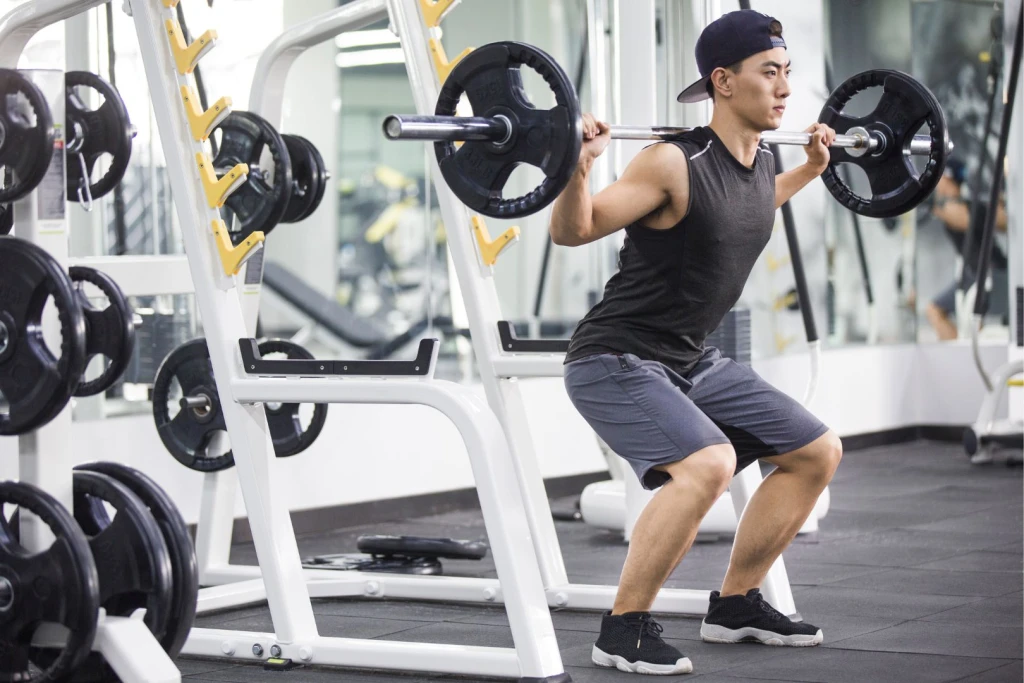
Quadriceps tendonitis develops when the load going through the tendon repeatedly outpaces its capacity to recover. It rarely starts with a single event. More often it builds when training volume climbs faster than the tendon adapts, or when the way the leg loads places extra strain through the front of the knee.
What Causes Quadriceps Tendonitis?
- A rapid increase in training load: adding squat volume, jump work, or running mileage faster than the tendon can adapt is the most common trigger we see.
- Repeated heavy squatting and jumping: sports and gym work built around deep knee bend under load stress the quadriceps tendon with every repetition.
- Inadequate recovery between sessions: training the same heavy pattern without enough rest keeps the tendon irritated and stops it rebuilding.
- Tight or weak quadriceps and hips: limited flexibility and underconditioned thigh and gluteal muscles shift more strain onto the tendon attachment.
- Foot and lower-limb biomechanics: patterns such as significant flat feet, high arches, or excessive pronation change how rotational load reaches the knee and how the extensor mechanism is loaded through each step.
- Age-related tendon change: from the mid-thirties onward the tendon becomes less tolerant of sudden load, which is why quadriceps tendonitis is common in older recreational athletes.
Who Carries a Higher Baseline Risk?
- Weightlifters, powerlifters, and CrossFit athletes whose training centres on heavy squatting.
- Jumping and landing athletes in volleyball, basketball, and netball.
- Runners and hikers increasing volume or hill work quickly.
- Recreational athletes over the age of 35, where tendon tolerance declines.
- People returning to heavy training after a layoff without a graded build-up.
- People with diabetes or other conditions that affect tendon health.
Conditions Commonly Mistaken for Quadriceps Tendonitis
Pain at the front of the knee has several possible sources, and where exactly the pain sits relative to the kneecap is the most useful early differentiator. A clinical assessment confirms which structure is actually involved.
Patellar tendonitis
Patellar tendonitis, also called jumper’s knee, causes pain just below the kneecap on the tendon running down to the shinbone, whereas quadriceps tendonitis sits above the kneecap. Both are aggravated by jumping and loaded knee bend, so the level of the tenderness is the main way to separate them on examination. The two share much of the same rehab logic but differ in where the load is concentrated.
Runner’s knee
Runner’s knee, or patellofemoral pain syndrome, produces a more diffuse ache around or behind the kneecap rather than a specific tender point above it. It is harder to pinpoint with a finger and is often provoked by prolonged sitting with the knee bent, a feature quadriceps tendonitis does not typically produce. The vague, deep quality of the pain helps separate it from the focal tendon tenderness of quadriceps tendonitis.
Quadriceps tendon tear
A quadriceps tendon tear is a partial or complete rupture of the same tendon, usually from a sudden forceful load such as an awkward landing or a heavy lift, and it is a more serious injury than tendonitis. The tell is the onset: a sharp pop, rapid swelling above the kneecap, and difficulty straightening the knee or bearing weight, rather than the gradual soreness of tendonitis. This pattern needs prompt medical assessment and imaging, and often an orthopaedic opinion.
Knee osteoarthritis
Knee osteoarthritis can coexist with tendon pain in older athletes and cause front-of-knee ache, but it tends to bring deep joint stiffness, morning stiffness that eases with movement, and sometimes swelling or grinding within the joint. Quadriceps tendonitis pain is more localised to the tendon attachment and tracks with tendon load rather than with joint stiffness. The two can overlap, which is why an assessment is worthwhile when the picture is mixed.
Treating and Preventing Quadriceps Tendonitis
Quadriceps tendonitis usually responds well to conservative care, and the guiding principle is to settle the irritated tendon first, then rebuild its capacity so it tolerates load again rather than simply resting until the pain fades. Rest alone often eases the pain in the short term, but symptoms tend to return at the same training load if the tendon has not been reconditioned and the contributing factors have not been addressed. Surgery is reserved for tendon tears, not for tendonitis.
Conservative treatment
These approaches are usually combined and sequenced, beginning with settling the load.
- Activity and load modification: the first step is reducing or adjusting the squatting, jumping, and heavy lifting that keep provoking the tendon, while keeping fitness up with lower-load cross-training. Ice after activity and short-term anti-inflammatory medication, where appropriate and advised, can settle the local irritation.
- Progressive eccentric strengthening: rebuilding tendon capacity through graded loading is what carries the longer-term result. A structured programme through Straits physiotherapy focuses on the quadriceps and hip muscles and progresses the load as the tendon adapts, so it tolerates squatting and landing again rather than just settling.
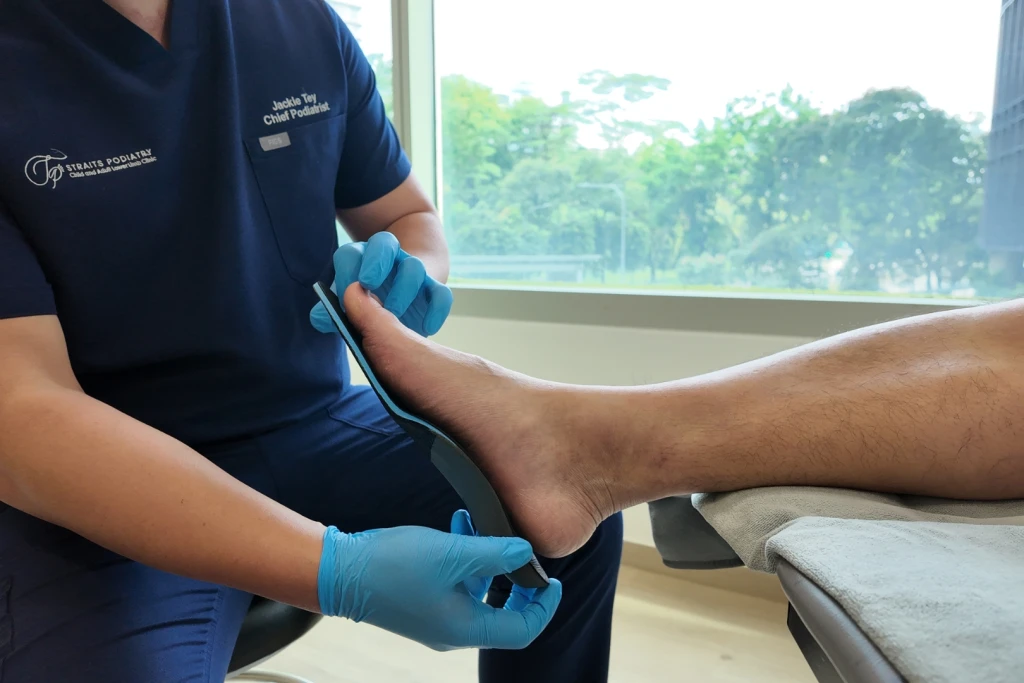
- Custom foot orthoses: where foot mechanics such as significant pronation or a high-arched foot are changing how the knee is loaded, orthoses can reduce the rotational strain reaching the extensor mechanism. A gait analysis and biomechanical review work out whether foot correction is relevant for your specific pattern.
- Focused shockwave therapy: for tendons that have become chronically irritated and have plateaued with rehab, focused shockwave therapy can stimulate the tendon’s repair response. It is used alongside the loading programme rather than instead of it.
- Radial pressure wave therapy: where tightness in the surrounding thigh and hip muscles is adding to the strain on the tendon, radial pressure wave therapy can help release those muscles as part of the wider plan.
- Magnetotransduction therapy: EMTT can be used to support the tendon’s healing response in more stubborn cases, again as one part of a combined loading and biomechanical approach.
When conservative care isn’t enough
Most quadriceps tendonitis settles with load management, progressive strengthening, and biomechanical correction over weeks to a few months. Where front-of-knee pain has not responded to a well-structured programme, or where the history suggests something more than tendon overload, imaging such as an MRI may be arranged to assess the tendon and rule out a partial tear or other intra-articular pathology. An orthopaedic referral is appropriate for a confirmed quadriceps tendon tear, for a suspected complete rupture, or where surgical assessment is warranted. These situations are the exception rather than the rule for tendonitis managed early.
Have Your Quadriceps Tendonitis Managed at Straits Podiatry
At Straits Podiatry, an assessment for quadriceps tendonitis begins with a focused history, palpation of the tendon above the kneecap, and a gait analysis and lower-limb biomechanical review to identify what is loading the extensor mechanism. Where foot mechanics are contributing, care may involve custom foot orthoses. Where the tendon is chronically irritated, focused shockwave therapy, radial pressure wave therapy, or EMTT can support the repair response. The Straits physiotherapy team leads the progressive strengthening and return-to-sport side of recovery.
If the front of your knee aches above the kneecap with squatting, stairs, and heavy lifting, book a consultation for an assessment at any of our three Singapore clinics. Addressing the load and the mechanics early tends to shorten the recovery and reduce the chance of it returning.
Frequently Asked Questions About Quadriceps Tendonitis
What is the difference between quadriceps tendonitis and patellar tendonitis?
The difference is the level of the pain relative to the kneecap. Quadriceps tendonitis affects the tendon above the kneecap, where the thigh muscles attach to the top of the patella. Patellar tendonitis, or jumper’s knee, affects the tendon below the kneecap, running from the bottom of the patella to the shinbone. Both are loaded by jumping, squatting, and landing, so they share much of the same rehab approach, but where the tenderness sits on examination is what separates them clinically. Getting the level right helps target the loading programme correctly.
How long does quadriceps tendonitis take to heal?
Recovery depends on how long the tendon has been irritated and whether the load is adjusted early. Mild cases caught soon after they start can settle over a few weeks of load management and targeted strengthening. Longer-standing cases where someone has trained through the pain for months can take two to four months, because the tendon has undergone structural change and needs progressive reconditioning to tolerate load again. Recovery is generally faster when the cause, not just the symptom, is addressed.
Can I keep training with quadriceps tendonitis?
Complete rest is usually not necessary, but the heavy squatting, jumping, and explosive loading that provoke the pain typically need to be reduced or modified while the tendon settles. Continuing to load it hard through pain tends to entrench the problem and lengthen recovery. Lower-load cross-training keeps fitness up, and a graded return guided by a clinician reintroduces heavier load as the tendon tolerates it. The aim is to load the tendon enough to build its capacity without repeatedly flaring it.
What does quadriceps tendonitis feel like?
It usually feels like a soreness or ache just above the kneecap that is worse with deep knee bend, stairs, jumping, and heavy lifting. Many people notice stiffness in the first few movements of a session that eases as they warm up, then returns afterwards. The tender spot is fairly focal at the top edge of the kneecap, and the leg can feel like it lacks its usual push when straightening against load. A sudden pop with immediate swelling and an inability to straighten the knee is different and suggests a tendon tear rather than tendonitis.
Do foot mechanics really affect quadriceps tendonitis?
They can, because how the foot and lower limb load the ground influences the rotational and loading forces that reach the knee. Patterns such as significant pronation, flat feet, or high arches can change how the extensor mechanism is loaded through each step, adding strain at the tendon attachment. Foot mechanics are rarely the whole story, and strength and training load usually matter more, but where they are contributing, a gait analysis and biomechanical review help work out whether foot correction is a useful lever for your specific case.
Will quadriceps tendonitis heal completely?
Most cases settle well when the load is managed and the tendon is reconditioned through progressive strengthening, and many people return fully to squatting, jumping, and their sport. The key is addressing the contributing factors rather than only resting until the pain fades, because a tendon that is rested but not rebuilt tends to flare again at the same training load. Longer-standing cases can take longer and may not become entirely symptom-free if significant structural change has set in, which is why early, structured management gives the best chance of a complete recovery.