
You notice it first as an itch deep in the skin of your instep or along the sides of your toes, the kind you cannot scratch away because it feels like it is coming from under the surface. A day or two later, a cluster of tiny firm blisters pushes up through the sole, sitting just below the skin like grains of tapioca. They are intensely itchy, sometimes burning, and in Singapore’s heat they tend to flare when your feet have been sweaty inside covered shoes all day. After a week or so the blisters dry, the skin peels in sheets, and the deeper creases can crack and sting. Then, often weeks or months later, the whole cycle returns.
This pattern is dyshidrotic eczema, also called pompholyx. It is a form of eczema affecting the thick skin of the soles, the sides of the feet, and the toes, where small pockets of fluid collect within the skin layers rather than on top of them. It is not an infection and it is not caused by poor hygiene. Because it looks so much like athlete’s foot, it is frequently mistaken for a fungal problem and treated with antifungal creams that do nothing for it. Getting the identification right matters, because dyshidrotic eczema is a dermatological condition: the diagnosis and any prescription medication are led by a GP or dermatologist, while the day-to-day skin, sweat, and footwear side is where a podiatrist can help.
Symptoms of Dyshidrotic Eczema
Dyshidrotic eczema has a fairly distinctive look once you know what to search for, though the early itch can feel like any other irritated foot. The blisters sitting deep within the skin, rather than on the surface, are the most reliable clue.
- Deep-seated, tapioca-like blisters: small firm vesicles that sit within the skin of the soles, the sides of the feet, and along the edges of the toes. They do not pop easily and often look like little clear grains under the surface.
- Intense, deep itch before the blisters appear: many people feel a burning or prickling itch a day or two before anything is visible, coming from within the skin rather than on top of it.
- Symmetry across both feet: the eruption commonly affects both feet in a similar distribution, unlike a fungal infection that may start on one foot or between specific toe webs.
- Peeling and flaking as blisters dry: once the vesicles settle, the skin peels away in sheets, leaving raw or tender patches underneath.
- Cracking and painful fissures: the thick skin of the sole and heel can split along creases as it dries, and these fissures can sting with each step.
- Recurrent crops: the hallmark is that it comes and goes, often returning during hot, humid, or stressful stretches after appearing to clear.
- Sometimes the hands too: dyshidrotic eczema often appears on the palms and sides of the fingers at the same time, which can help point towards the diagnosis.
From what we see in clinic, the combination of deep itchy blisters, symmetry, and a recurring pattern is what separates this from a one-off fungal or contact reaction. A rash that keeps returning to the same skin in crops is eczema until shown otherwise.

Causes of Dyshidrotic Eczema
The exact cause of dyshidrotic eczema is not fully understood, but it is closely tied to a sensitive, reactive skin barrier and a set of triggers that set off flares. Most people have a background tendency towards eczema, and the environment does the rest.
What Causes Dyshidrotic Eczema?
- An atopic tendency: a personal or family history of eczema, asthma, or hay fever makes the skin barrier more reactive and more prone to this kind of blistering response.
- Heat and sweat: warm, humid conditions and sweaty feet trapped in covered shoes are a classic trigger, which is why flares are so common in Singapore’s climate and during the monsoon months.
- Emotional stress: many people notice that flares track with stressful periods, exams, or poor sleep, even when nothing about their footwear has changed.
- Contact irritants and allergens: soaps, detergents, and materials in footwear such as rubber, adhesives, chromate-tanned leather, or nickel components can provoke or worsen the eruption in sensitised skin.
- A reaction to fungal infection elsewhere: in some people, an active fungal infection on the feet can trigger a secondary blistering eczema response known as an id reaction, which is one reason the two conditions get tangled together.
- Sensitivity to certain metals from within: in a smaller group, ingested nickel or cobalt appears to contribute, though this is less common and needs specialist assessment to confirm.
Who Carries a Higher Baseline Risk?
- People with a personal or family history of eczema, asthma, or allergic rhinitis.
- People whose feet sweat heavily or stay damp inside covered footwear for long hours.
- People in warm, humid environments, which describes most of Singapore for most of the year.
- People regularly exposed to irritants, including cleaners, healthcare workers, and those handling detergents or solvents.
- People under sustained stress or with disrupted sleep.
- People with a co-existing fungal foot infection that has not settled.
Conditions Commonly Mistaken for Dyshidrotic Eczema
Blistering, itchy, peeling skin on the feet has several possible causes, and dyshidrotic eczema shares that territory with infections and other rashes. The distinctions below matter because the wrong assumption leads to the wrong treatment, most often an antifungal cream used on eczema.
Athlete’s foot
The most frequent mix-up is with athlete’s foot (tinea pedis), a fungal infection that also causes itching, peeling, and sometimes blisters. The differentiator is the pattern. Fungal foot typically begins between the toes with scaling and maceration, or spreads across the sole in a dry, moccasin-like distribution, and it responds to antifungal treatment. Dyshidrotic eczema produces deep, symmetrical crops of vesicles on the soles and sides of the feet and does not clear with antifungals. The two can also coexist, and a stubborn fungal infection can even set off an eczema-like reaction, which is why an accurate look at the skin is worth it before reaching for a cream.
Contact dermatitis
Contact dermatitis is an irritant or allergic reaction of the skin to something it touches, such as a shoe material, adhesive, or a new sock dye. It can itch, blister, and peel much like dyshidrotic eczema. The clue is distribution: contact dermatitis often maps to where the trigger touches the skin, for example a band across the top of the foot from a sandal strap, whereas dyshidrotic eczema favours the soles, sides, and toe edges in a symmetrical crop. The two overlap, and contact triggers can drive a dyshidrotic flare, so identifying the material involved is part of settling it.
Palmoplantar pustulosis
Palmoplantar pustulosis produces crops of small pus-filled spots on the soles and palms that can resemble the blisters of dyshidrotic eczema. The difference is the content: pustulosis blisters contain pus and often sit on reddened, thickened skin, and the condition is linked to smoking and to psoriasis rather than to atopic eczema. It behaves differently over time and is confirmed by a dermatologist, so a rash of pustules rather than clear vesicles is a reason to seek a medical opinion.
Scabies
Scabies is an itchy rash caused by a mite burrowing into the skin, and its intense itch, especially at night, can be confused with an eczema flare. The distinguishing features are its favoured sites, such as the finger webs, wrists, and around the toes, the thin thread-like burrow tracks, and the fact that close household contacts are often itchy too. Because scabies is contagious and needs a specific treatment, an itchy, spreading rash that others in the home share should be reviewed by a doctor rather than assumed to be eczema.
Treating and Preventing Dyshidrotic Eczema
Dyshidrotic eczema cannot be cured outright, but for most people it can be brought under good control by settling active flares and reducing the triggers that set them off. The important principle is that this is a dermatological condition: confirming the diagnosis and prescribing medication such as topical corticosteroids sit with a GP or dermatologist, while a podiatrist supports the skin, sweat, and footwear side and helps make sure a fungal infection is not being missed or mislabelled. Care is conservative and layered, not a single fix.
Conservative treatment
These measures are usually combined, and the aim is to calm the current flare while making the next one less likely.
- Topical corticosteroids, prescribed by a GP or dermatologist: the mainstay for settling an active flare. A podiatrist does not prescribe these, but recognising when a flare needs prescription-strength anti-inflammatory treatment is part of arranging the right referral quickly.
- Emollients and barrier repair: regular, fragrance-free moisturising rebuilds the skin barrier, reduces itching, and limits the painful cracking that follows the peeling phase. This is the daily foundation between flares.
- Sweat and moisture management: keeping the feet cool and dry with moisture-wicking socks, breathable footwear, and drying carefully between the toes reduces one of the strongest local triggers, which matters in a climate as warm and humid as Singapore’s.
- Footwear and irritant review: identifying and removing contact triggers, for example switching away from a shoe adhesive, rubber, or dye the skin reacts to, can take pressure off skin that keeps flaring.
- Cool compresses during the weeping phase: for tender, oozing blisters, cool compresses can ease discomfort and support the skin while a prescribed treatment takes effect.
- Addressing any co-existing fungal infection: where a genuine fungal foot infection is present alongside the eczema, managing it removes one possible driver and stops it clouding the picture.
When conservative care isn’t enough
When flares are frequent, widespread, or severe despite good skin care and prescribed topical treatment, a referral to a dermatologist is the next step. Specialists can offer options that sit outside podiatry and general practice, such as stronger prescription regimens, phototherapy, or systemic medication for resistant cases, and can arrange patch testing where a contact allergy is suspected of driving the flares. A podiatrist’s role at this stage is to recognise that the skin is not responding as it should and to make sure you reach the right specialist rather than cycling through treatments that were never going to work.
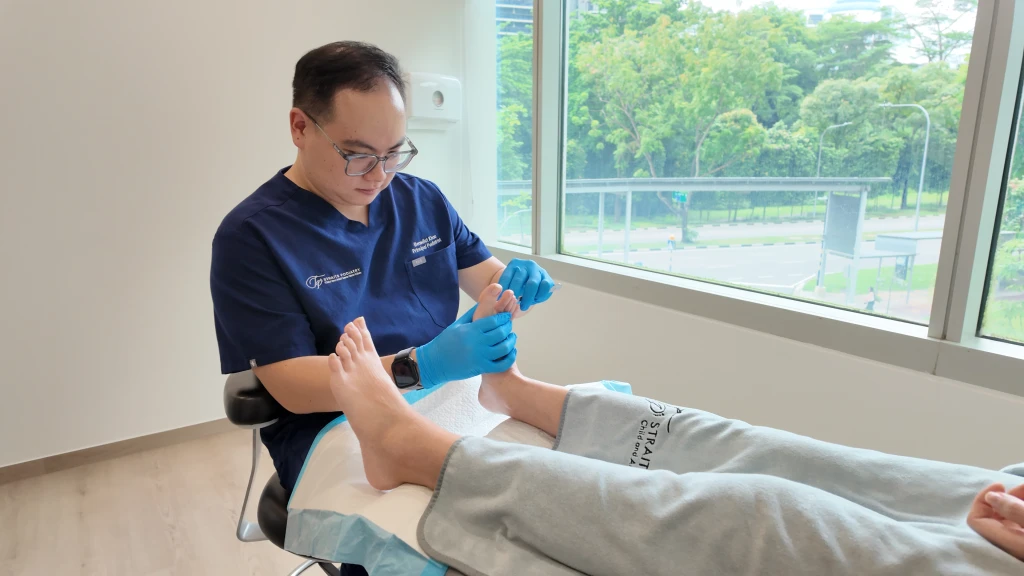
Have Your Dyshidrotic Eczema Managed at Straits Podiatry
Recurrent blistering on the feet is easy to misread, and a lot of people arrive after months of antifungal creams that were never going to help an eczema. At Straits Podiatry, an assessment for suspected dyshidrotic eczema focuses on looking closely at how the rash is presenting, which parts of the foot are involved, and whether the pattern points to eczema, a fungal infection, or a contact reaction, so the picture is clear before any treatment direction is set.
From there we can help with the parts that fall within podiatry: skin and barrier care, sweat and moisture management, footwear and irritant review, and managing any co-existing fungal foot infection. Where the skin needs prescription medication or a specialist opinion, we will point you to a GP or dermatologist rather than leave you guessing. If itchy, recurring blisters on your feet keep coming back, book a consultation for an assessment at any of our three Singapore clinics.
Frequently Asked Questions About Dyshidrotic Eczema
Is dyshidrotic eczema the same as athlete’s foot?
No, though they are easy to confuse. Athlete’s foot is a fungal infection, while dyshidrotic eczema is an inflammatory skin condition with no infection involved. The practical difference is that eczema does not respond to antifungal creams, and it tends to appear as deep, symmetrical crops of itchy blisters on the soles and sides of the feet rather than starting between the toes. The two can also occur together, which is why a proper look at the skin is worth it before deciding what to put on it.
Why do I keep getting itchy blisters on my feet in Singapore’s heat?
Heat and sweat are among the most common triggers for dyshidrotic eczema, so the warm, humid climate here and long hours in covered shoes can keep setting off flares. Feet that stay damp inside enclosed footwear give the reactive skin exactly the conditions it dislikes. Managing sweat and moisture, choosing breathable footwear, and drying carefully between the toes will not cure the tendency, but it often reduces how often the blisters return.
Does dyshidrotic eczema go away on its own?
An individual flare usually settles over a few weeks as the blisters dry and the skin peels and repairs. The tendency itself, however, often stays, and crops can return weeks or months later, particularly when triggers such as heat, sweat, or stress are present. This is why the focus is on controlling flares and reducing triggers rather than expecting a one-time resolution. If flares are frequent or severe, that is a reason to have it assessed rather than wait it out.
Can a podiatrist prescribe cream for dyshidrotic eczema?
Prescription medication such as topical corticosteroids is provided by a GP or dermatologist, not a podiatrist. Where podiatry helps is in recognising the condition, telling it apart from a fungal infection or a contact reaction, supporting your skin and moisture care, reviewing footwear for irritants, and arranging a referral when prescription treatment or a specialist opinion is needed. Think of it as making sure the right diagnosis and the right pathway are in place.
How long does a dyshidrotic eczema flare last?
A typical flare runs for around two to four weeks, moving from the initial itch and blistering through to drying, peeling, and skin repair. Some flares settle faster with early skin care and prescribed treatment, while others linger if the triggers are still active or if the skin keeps cracking. Ongoing moisturising and trigger management between flares tend to shorten and space out future episodes.
Is dyshidrotic eczema contagious?
No, dyshidrotic eczema is not contagious. It is an inflammatory reaction within your own skin, not an infection, so it cannot be passed to other people through contact, shared towels, or footwear. This is one of the ways it differs from athlete’s foot, which is fungal and can spread. If an itchy rash on your feet is being shared by others in your household, that points away from eczema and is worth having reviewed.