
A biomechanical and gait analysis assessment is how our podiatrists find the mechanical cause behind a stubborn foot, ankle, knee, or leg problem, and it is the foundation of every custom orthotic we make. Our principle behind it is straightforward: when a problem keeps coming back, the cause is often not where it hurts, but in the way you move. So rather than start at the sore spot, we start by looking at how your feet and legs are built, and how they behave when you walk and run. We carry out biomechanical and gait assessments at all three of our clinics in Buona Vista, Orchard, and Paya Lebar.
How we read the way you move
Anywhere can scan a foot and make an insole from that alone. We think that skips the part that matters most. Before we suggest any solution, we build a clear picture of how your feet and legs are built and how they load once you start moving, because a plan is only ever as good as the assessment behind it. Here is how the assessment works, step by step.
- Pinpoint what hurts. If there is pain, we start by hand, feeling through the area and running clinical tests, so we know precisely which structures are involved before anything else.
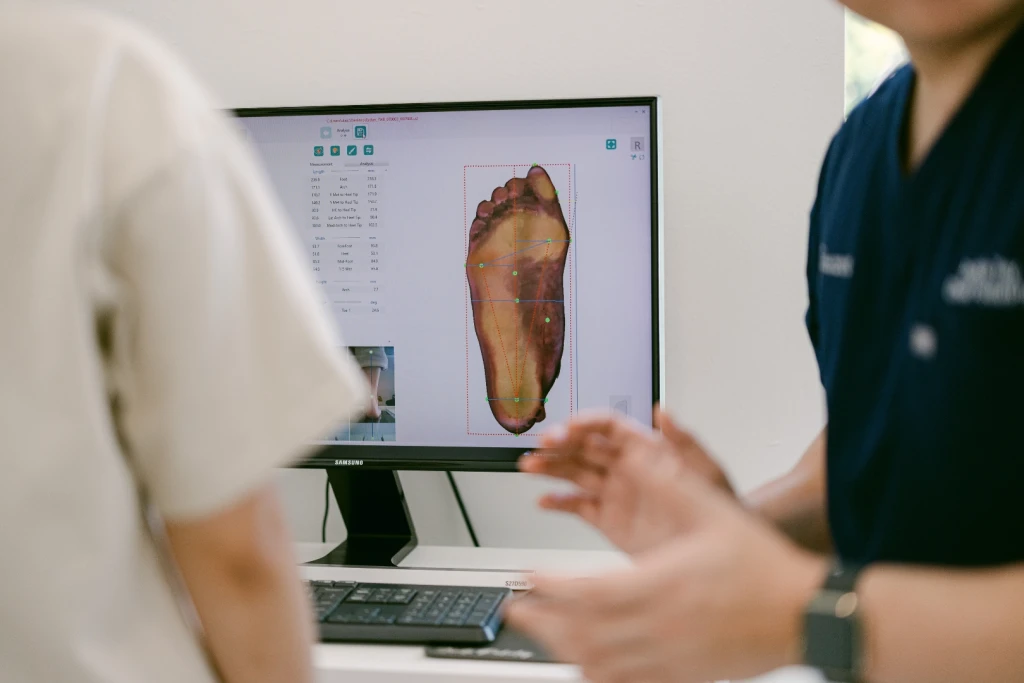
- Read your foot posture. We scan your foot with a USOL 3D foot scanner, then test your arch by hand with Jack’s test and the medial supination resistance test, because how your foot holds up under load tells us far more than how it looks standing still.
- Test how your joints move. We measure movement from your big toe joint through the midfoot to the ankle, and check your hamstrings, since a single stiff joint can quietly change your whole stride.
- Measure your leg length. We measure from the bone at the front of your hip down to your inner ankle, to catch a leg length difference that could be throwing everything else off.
- Look up the chain. We check the level of your hips, knees, and shoulders, and screen your spine, because your feet do not work in isolation from the rest of you.
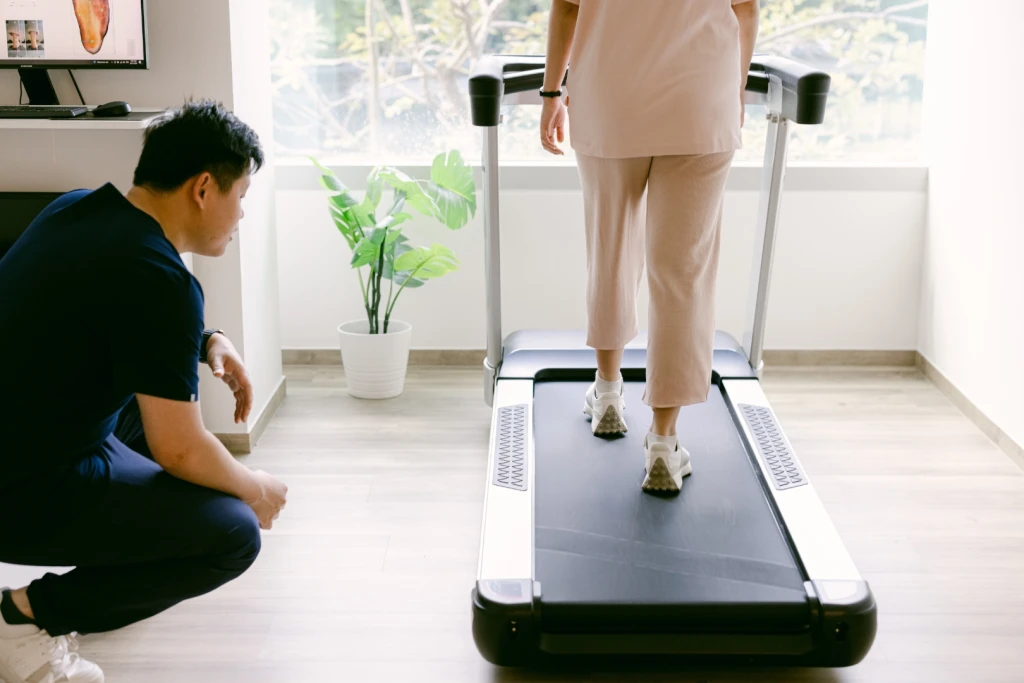
- Film you in motion. We record you walking and running on a treadmill and slow it right down, so we can see what your body has been doing under you all along.
Why this is what makes your orthotics work
This is also why our custom orthotics are different from a pair pressed off a quick mould. Every orthotic we make is designed from this assessment, because an insole is meant to change the way you move or redistribute load more evenly, and it cannot do that job unless it was built from the way you actually move, both standing still and in motion. With the assessment behind it, a custom orthotic has a specific job to do. Without it, an orthotic is just built on a template.
We will tell you if you do not need it
Not everyone needs the full assessment, and we will say so plainly. A good look at your foot posture and a few minutes watching you walk is often enough to know whether going deeper would change anything. We recommend the detailed biomechanical assessment only when there is a clear reason for it: when we find something on examination, when a problem keeps returning, or when you are having custom orthotics made. Matching the assessment to the need, rather than putting every patient through the same routine, is how we keep your care about the problem in front of us.
Who this is for
A biomechanical and gait analysis assessment is worth considering if you are a runner or walker who wants to know what your gait is really doing, or if you have foot, ankle, knee, or leg pain that flares once you get active, or an injury that keeps returning despite rest. It also helps when your feet sit flat or arch high, and you have wondered whether that is behind your aches. If you are not sure whether your symptoms are mechanical at all, an initial consultation is our recommended place to start.
Assessment led by an experienced team
Reading the lower limb as one connected system, rather than a single sore spot, is what our podiatrists are trained to do, and it is the thinking behind every biomechanical assessment we carry out. Across the team, we bring around 40 years of combined clinical experience in podiatry, lower-limb biomechanics, and custom orthotic design. Every assessment is carried out by a qualified podiatrist who explains what they are seeing in plain language as they go, so you always understand what is being found and why.

Have Your Gait and Biomechanics Assessed at Straits Podiatry
You do not have to keep guessing the solution to your pain. Book a consultation with our podiatrists, and we will tell you honestly whether a full biomechanical and gait analysis is your next step, or whether something simpler will do. Our assessment and orthotic fees are set out from the start, with no pressure either way. We see patients at all three clinics, in Buona Vista serving the west, Orchard serving central Singapore, and Paya Lebar serving the east, each a short walk from an MRT station. It is the first step back to moving with comfort, confidence, and freedom.
Frequently Asked Questions About Biomechanics and Gait Analysis
What is gait analysis?
Gait analysis is the study of how you walk and run. At Straits Podiatry we record you on a treadmill and slow the footage down to see how your feet and lower limbs load through every step, which helps us spot the movement patterns that may be feeding your pain or a recurring injury.
Do I need a biomechanical assessment?
Not always, and we will say so if you do not. For many people, a foot posture check and a few minutes of watching them walk is enough. We recommend the full assessment when there is a clear reason, such as an ongoing problem, something we find on examination, or custom orthotics being made, since we build every orthotic from this assessment.
How is your custom orthotic process different?
Every pair of custom orthotics at Straits Podiatry is designed from a full biomechanical and gait assessment, never from a plain scan or mould alone. Reading both your still foot posture and your movement is what lets us build an orthotic around how you actually move, rather than how your foot happens to look on a scanner.
What conditions can biomechanics and gait analysis help with?
It helps wherever foot, ankle, knee, or leg symptoms may be tied to how you move, including recurring or activity-related pain and issues linked to flat feet, high arches, or a leg length difference. The assessment tells us whether a mechanical cause is really involved before any treatment is chosen.
How much does a biomechanical assessment cost?
Our assessment and orthotic fees are listed on our prices page, upfront. Because we only recommend the detailed assessment when there is a genuine clinical reason, the first step is a consultation, where we confirm whether you need one before anything goes ahead.