
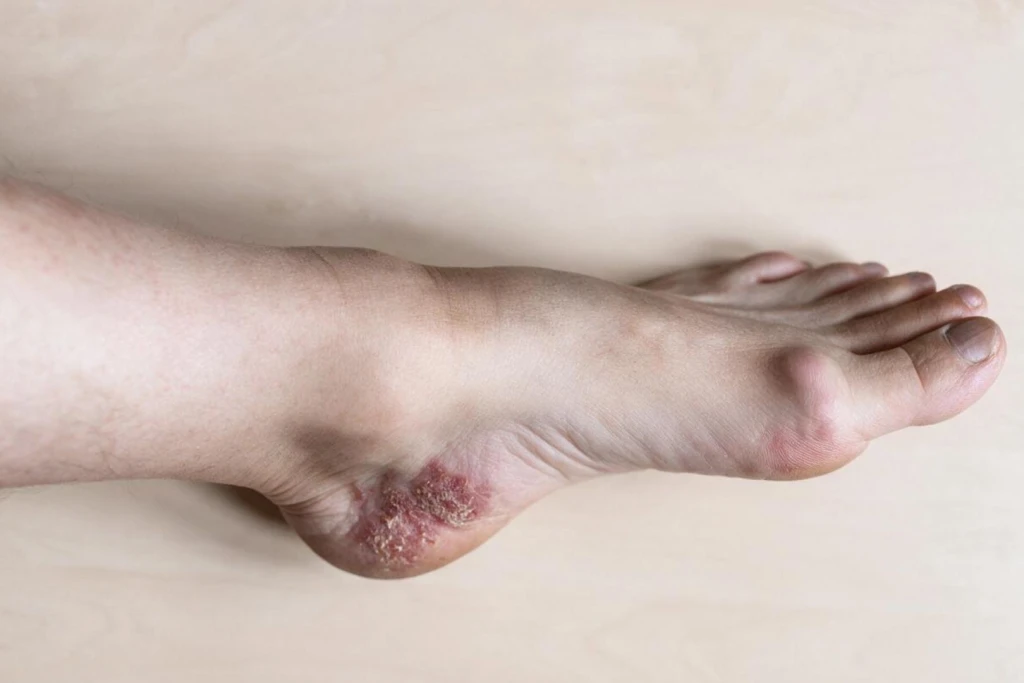
Your dermatologist confirmed psoriasis a while ago, and the patches on your elbows or scalp are under control with the cream you were given. What has not settled is your feet. The skin on your soles has turned thick and scaly, the edges of your heels split and sting when you walk, and one or two toenails have started to pit, lift, or crumble in a way that looks a little like a fungal infection but never quite clears with the antifungal you bought. Some mornings a toe is swollen and stiff, or the back of your heel aches where the Achilles attaches. This is psoriasis showing up below the ankle, and the foot side of it is often the part that gets left behind.
Psoriasis is a systemic immune-mediated condition in which the immune system drives skin cells to turn over far too quickly, and in some people it also targets the joints and the points where tendons anchor to bone. It is diagnosed and led by dermatology, and where the joints are involved (psoriatic arthritis), by rheumatology. What a podiatrist adds is care for the foot complications that these specialists do not always have the tools or the chair-side time to manage: the thick plantar plaques, the painful fissures, the psoriatic nail changes that are easy to mistake for fungus, and the footwear and offloading needs when the foot joints are inflamed. Getting the foot picture read accurately matters, because the wrong label (usually “fungal”) sends people down months of antifungal treatment that was never going to work.
Symptoms of Foot Psoriasis
Psoriasis on the foot does not look the same in everyone. It can sit mainly in the skin, mainly in the nails, mainly in the joints, or in any combination. The pattern below is what tends to bring people in.
- Thick, scaly plaques on the soles: well-defined patches of thickened skin with a silvery or whitish scale, often on the heel and ball of the foot. They can feel tight and tender under load.
- Painful cracks and fissures: thickened, inflamed skin loses its flexibility and splits, most often at the heel margins and across the ball of the foot. Deep fissures can bleed and become an entry point for infection.
- Sterile pustules on the soles (palmoplantar pustulosis): small yellow blisters that are not caused by infection, appearing in crops on the soles (and often the palms), then drying to brown spots as older ones fade and new ones form.
- Nail pitting: small pin-prick dents across the nail surface, as if pressed with the tip of a pen. This is one of the more telling signs that a nail change is psoriatic rather than fungal.
- Onycholysis (the nail lifting): the nail separates from the nail bed, usually starting at the free edge, leaving a whitish or yellowish gap.
- Subungual hyperkeratosis: a build-up of chalky, crumbly debris underneath the nail that lifts it and thickens it.
- Oil-drop or salmon-patch discolouration: a yellow-pink patch under the nail that looks like a drop of oil trapped beneath the plate, a fairly specific sign of nail psoriasis.
- Swollen “sausage” toes (dactylitis): a whole toe becomes uniformly swollen and tender rather than just one joint, a hallmark of the psoriatic arthritis component.
- Heel and Achilles pain (enthesitis): pain and tenderness where the Achilles tendon or the plantar fascia anchors into the heel bone, driven by inflammation at the attachment point rather than a mechanical overload injury.
- Morning stiffness in the toe and midfoot joints: joints that are stiff and sore first thing in the morning and ease with movement, another feature of psoriatic arthritis, a form of inflammatory arthritis that affects the foot and ankle joints.
From what we see in clinic, the two changes that most often get misread are the nail signs (mistaken for fungus) and the enthesitis heel pain (mistaken for ordinary plantar fasciitis). Reading them in the context of a known psoriasis history is what points the assessment in the right direction.
Causes of Foot Psoriasis
Psoriasis is not caused by anything on the foot itself. It is a systemic condition, and the foot is simply one of the places it surfaces. Understanding what drives it explains why foot care has to work alongside the underlying disease rather than in place of it.
What Causes Foot Psoriasis?
- An overactive immune response: the core mechanism is immune-mediated. The immune system signals skin cells to multiply far faster than they shed, which piles up as thick, scaly plaque. This process is systemic, which is why psoriasis can appear on the feet, the scalp, the elbows, and the nails at the same time.
- Genetic predisposition: psoriasis tends to run in families. A close relative with psoriasis or psoriatic arthritis raises the baseline likelihood.
- The Koebner phenomenon (pressure and trauma): psoriasis has a habit of appearing exactly where the skin has been injured or repeatedly rubbed. On the foot that means tight shoes, friction points, and even aggressive callus or plaque removal can trigger a fresh plaque, which is why foot care here has to be gentle.
- Systemic triggers: flares are commonly set off by stress, infection (a streptococcal throat infection is a classic trigger for the guttate pattern), some medications, smoking, and heavy alcohol use. These act on the whole body, not just the foot.
- The Singapore foot environment: humidity and long hours in enclosed footwear keep the skin warm and occluded, which can aggravate plantar plaques and make fissures slower to settle, and it also makes it harder to tell psoriatic skin changes apart from a fungal infection by appearance alone.
Who Carries a Higher Baseline Risk?
- People already diagnosed with psoriasis elsewhere on the body.
- People with a family history of psoriasis or psoriatic arthritis.
- Smokers and people under sustained physical or emotional stress.
- People whose feet take repeated pressure or friction from footwear or occupation, where the Koebner effect can seed new plaques.
- People with psoriatic arthritis, who are more likely to develop the joint, heel, and dactylitis foot changes.
Conditions Commonly Mistaken for Foot Psoriasis
Because psoriasis on the foot can look scaly, blistering, crumbly, or swollen depending on how it presents, it overlaps with several far more common foot problems. The distinction matters because the wrong label often leads to the wrong care. The patterns most often confused with it are below.
Fungal nail infection
A fungal nail infection and nail psoriasis can look almost identical: both thicken the nail, lift it from the bed, and pack debris underneath. The differentiators are the details. Pitting across the nail surface and an oil-drop patch point to psoriasis, whereas a fungal nail more often starts at one corner, spreads gradually, and travels with athlete’s foot skin changes nearby. This distinction is not academic, because starting antifungals on a psoriatic nail treats an infection that is not there, and a nail sample is often the honest way to settle it before any antifungal is begun.
Athlete’s foot (tinea pedis)
Athlete’s foot produces itchy, peeling, scaly skin, often between the toes and along the sole, which can mimic plantar plaque psoriasis. Tinea usually itches more, favours the toe web spaces, and responds to antifungal treatment, while psoriasis forms sharper-edged plaques with a thicker silvery scale and tends not to clear with antifungals. The two can also coexist on the same foot, which is part of why the picture gets muddled.
Dyshidrotic eczema
Dyshidrotic eczema causes small, intensely itchy blisters on the soles and sides of the feet that can resemble the pustules of palmoplantar pustulosis. The eczema blisters are typically clear and very itchy, whereas the pustules of psoriasis are sterile, more yellow, and appear in repeated crops that dry to brown spots. A dermatology review is usually what separates the two with confidence.
Reactive arthritis
Reactive arthritis can produce scaly skin on the soles and swollen, sausage-like toes that closely echo psoriatic arthritis, often following a gut or urinary infection. The overlap in the foot can be striking, and telling reactive arthritis from psoriatic arthritis is a rheumatology assessment rather than something read off the foot alone.
Treating and Preventing Foot Psoriasis
The important principle here is that psoriasis is a systemic disease, so the skin disease is led by your dermatologist and the psoriatic arthritis is led by your rheumatologist. Podiatry does not treat the underlying condition, and no foot care will clear the disease. What a podiatrist does is co-manage the foot complications so the foot stays comfortable and protected while the specialists manage the disease itself: reducing painful plaque and callus safely, caring for fissures, telling psoriatic nails apart from fungal ones before anyone reaches for an antifungal, and offloading joints and entheses when the arthritis component is active. Everything below sits alongside your dermatology and rheumatology care, not instead of it.
Conservative treatment
These measures are usually combined and tailored to how the foot is presenting.
- Safe reduction of thick plaque and callus: thick plantar plaque and overlying callus can be reduced gently to relieve pressure and pain and to let topical treatments penetrate. On a psoriatic foot this is done conservatively, because over-aggressive removal can trigger a fresh plaque through the Koebner effect. Emollients and keratolytic (skin-softening) creams recommended by your dermatologist are usually part of keeping it down between visits.
- Fissure care and skin protection: deep heel and forefoot fissures are cleaned, reduced, and dressed to relieve pain and to close an entry point for infection, with emollient and footwear advice to keep the skin supple. Keeping fissures sealed matters more on a psoriatic foot because the split skin is a ready route for secondary infection.
- Careful nail care and distinguishing psoriatic from fungal nails: psoriatic nails are reduced and tidied to relieve discomfort and pressure, and a podiatrist can help work out whether a nail change is psoriatic, fungal, or both before any antifungal is started. Getting this right avoids months of antifungal treatment aimed at an infection that was never there.
- Custom foot orthoses and footwear guidance: when the psoriatic arthritis component causes joint, heel, or forefoot pain, offloading with orthoses and appropriate footwear takes load off the inflamed joints and tender entheses and makes walking more comfortable. Well-fitting, low-friction footwear also reduces the pressure points that can seed new plaques.
- Pressure and trauma minimisation: because trauma and friction can trigger psoriasis on the foot, care is taken to remove rubbing points, pad vulnerable areas, and advise on shoe fit, so day-to-day walking is not quietly feeding the condition.
- Diabetic-style skin vigilance: the same careful, regular skin and nail checks used in diabetic foot care suit a psoriatic foot, because fissured, plaque-covered skin is more prone to cracking and secondary infection and benefits from being watched rather than left until it flares.
Where the psoriatic arthritis component leaves the foot and ankle stiff and deconditioned, our physiotherapy service can support mobility and strength alongside the rheumatology plan.
When conservative care isn’t enough
Foot care manages the complications, not the disease, so the escalation pathway here is about coordination rather than a bigger foot procedure. When the skin disease is poorly controlled, when the nails are badly affected, or when a fissure shows signs of secondary infection (spreading redness, warmth, or discharge), the right step is prompt referral back to your dermatologist, and to your doctor for any infection. When joints are swelling, a toe becomes sausage-like, or the heel enthesitis is persistent, a rheumatology assessment is warranted, because systemic treatments such as disease-modifying drugs or biologics act on the underlying immune process that foot care cannot reach. A podiatrist’s role at this stage is to keep the foot protected and comfortable and to make sure the foot findings reach the specialist overseeing your care.
Have Your Foot Psoriasis Managed at Straits Podiatry
Foot psoriasis is easier to live with when the skin, nail, and joint complications are looked after by someone who works with feet every day, alongside the dermatologist or rheumatologist directing your care. At Straits Podiatry, an assessment looks at how the psoriasis is presenting on your foot, whether a nail change is psoriatic or fungal, and whether the joints or entheses are involved, so the foot side of your care is read accurately rather than mislabelled.
From there we can care for the foot complications: safe reduction of plaque and callus, fissure and nail care, custom orthoses and footwear advice for psoriatic arthritis foot pain, and regular skin vigilance, coordinated with the specialists managing your disease. If your feet are the part of your psoriasis that keeps being left behind, book a consultation for an assessment at any of our three Singapore clinics.
Frequently Asked Questions About Foot Psoriasis
Is psoriasis on the feet the same as athlete’s foot?
No. Athlete’s foot is a fungal infection, while psoriasis is an immune-mediated condition that the body drives from the inside. They can look similar on the sole, both scaly and flaky, but athlete’s foot usually itches more, favours the toe web spaces, and clears with antifungal treatment, whereas psoriasis forms sharper-edged plaques with a thicker silvery scale and does not respond to antifungals. Because the two can also occur together, an assessment is often what settles which one you are dealing with.
How can I tell if my nail problem is psoriasis or a fungal infection?
They are genuinely hard to tell apart by eye, because both thicken the nail, lift it, and pack debris underneath. A few features lean towards psoriasis: fine pitting across the nail surface, and a yellow-pink oil-drop patch under the plate. A fungal nail more often begins at one corner, spreads slowly, and travels with athlete’s foot nearby. The reason it matters is that antifungals do nothing for a psoriatic nail, so a nail sample is often worth taking before any antifungal course is started.
Can a podiatrist cure my foot psoriasis?
No, and neither can any foot treatment on its own, because psoriasis is a systemic immune-mediated condition. It is led by dermatology, and the psoriatic arthritis component by rheumatology. What a podiatrist does is co-manage the foot complications, reducing painful plaque and callus, caring for fissures and nails, and offloading sore joints, so your feet stay comfortable while the specialists manage the disease itself.
Why do my heels keep cracking when I have psoriasis?
Psoriatic skin on the heel is thickened and less flexible, so under the load of standing and walking it splits rather than stretches, especially in Singapore’s climate where feet spend long hours in enclosed shoes. Deep fissures are painful and can become an entry point for infection. Careful reduction of the thickened skin, regular emollient use, and footwear that lowers the pressure all help keep the fissures closed, and it is worth having recurrent deep cracks looked at rather than left to reopen.
Can psoriasis affect the joints in my feet?
Yes. In some people the same immune process behind the skin disease also targets the joints and the points where tendons anchor to bone, which is called psoriatic arthritis. In the foot this can show up as a whole toe swelling into a “sausage” shape, morning stiffness in the toe and midfoot joints, or persistent pain at the back or underside of the heel. These are worth a rheumatology assessment, and a podiatrist can help offload and protect the affected joints while that care is arranged.
Is it safe to have thick psoriasis plaques or calluses removed from my feet?
It can be, but it needs a careful hand. Reducing thick plaque and callus relieves pressure and pain and helps topical treatments work, but psoriasis has a tendency to flare exactly where the skin is injured, known as the Koebner effect, so over-aggressive removal can trigger a new plaque. This is why it is safer to have it reduced conservatively by a podiatrist who knows the condition rather than cut back hard at home.