
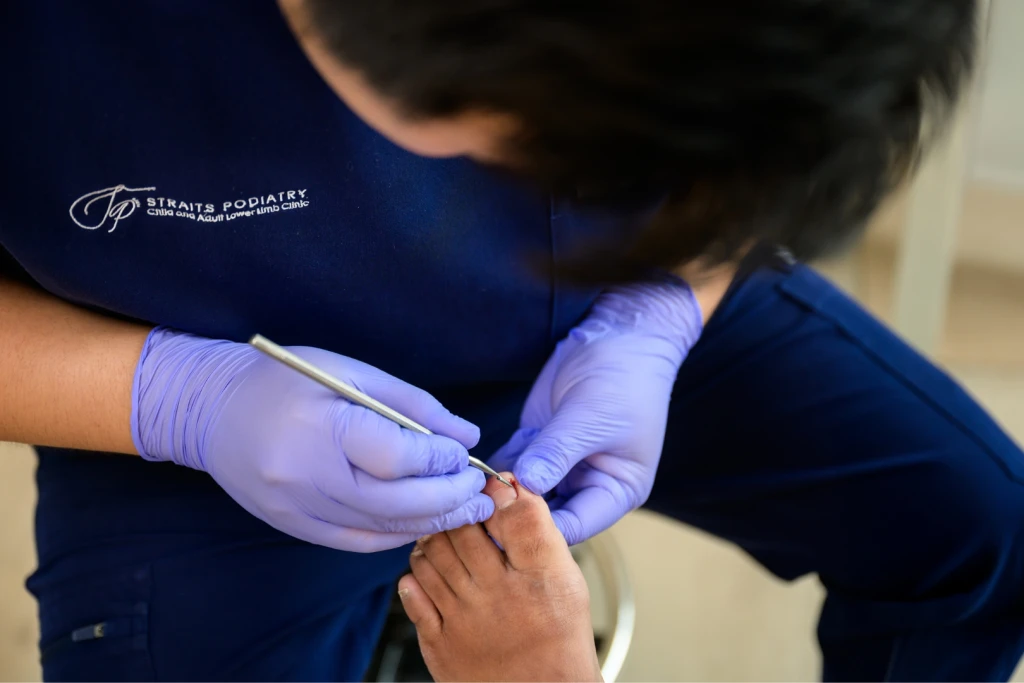
Ingrown toenail removal is the most common procedure we perform at Straits Podiatry, on average at least one a day. An ingrown toenail is when the edge of the toenail grows into the skin beside it, causing pain, redness, and sometimes infection. How we deal with one depends on the nail, and it ranges from conservative care carried out at the visit to a nail brace or a minor procedure, so every case begins with an assessment rather than a fixed treatment. Ingrown toenail care is available at all three of our clinics in Buona Vista, Orchard, and Paya Lebar.
Why see a podiatrist for an ingrown toenail?
The same ingrown toenail can be handled in more than one way, and the right one depends on the stage it has reached. Trimming it yourself, the “bathroom surgery” most people try first, tends to leave a spike of nail behind that grows back into the skin and raises the infection risk. A podiatrist removes the offending edge properly, under clean conditions, and looks at why it happened so it is less likely to return.
Because we see them so often, matching the right step to a particular nail is familiar ground for our podiatrists. In practice, that means:
- your ingrown toenail is handled by a podiatrist, not a general clinic or a nail salon
- every option is in one place, conservative care, nail bracing, and a minor procedure, so you are not sent elsewhere without reason
- many nails are settled at the first visit
- you get accessible care at any of the three clinics across west, central, and east Singapore, each within walking distance of an MRT station
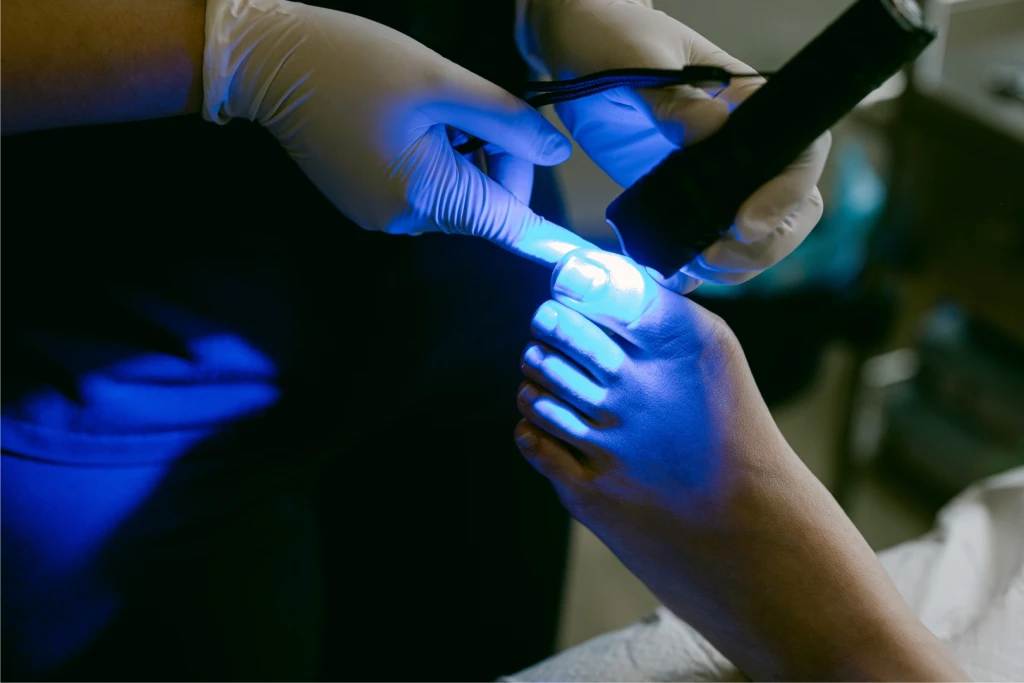
How we find the right treatment for your ingrown toenail
Every plan starts with the assessment, because the care that suits a mild first-time nail is not the care that suits a nail that has been infected three times. Before any treatment is suggested, your podiatrist works through:
- Your history: how long it has hurt, whether this toe has done it before, and what tends to set it off, such as tight shoes, a nail cut too far down the side, sport, or a naturally curved nail.
- The nail edge itself: where it is pressing in, whether a spike of nail (a spicule) has pierced the skin, and how much of the edge is involved.
- Signs of infection: redness, swelling, warmth, discharge, or an overgrowth of tender flesh at the nail fold (granulation tissue), which changes what we do first.
- The nail shape: a flat nail behaves differently from a curved or involuted nail that rolls into the skin, and the shape guides whether bracing is worth considering.
- Your circulation and sensation, particularly if you have diabetes, because that affects healing and how promptly the nail should be dealt with.
That picture is what tells us the stage, and the stage is what determines the options we put in front of you. It also means we are not defaulting every toe to surgery, or leaving every toe to a brace, but matching the step to the nail.
It is worth having your ingrown toenail seen if it:
- keeps coming back
- is red, swollen, or weeping, which points to infection
- has an overgrowth of tender flesh at the nail edge
- is stopping you wearing normal shoes
- and sooner rather than later if you have diabetes or reduced circulation
Clearing a painful ingrown toenail at the first visit
For many ingrown toenails, especially a first episode or a mild one, conservative care in the clinic is enough and no surgery is needed. This is not the same as trimming at home. In the clinic, your podiatrist:
- Gently clears the nail fold and removes the offending edge or spicule of nail that is digging into the skin, using sterile instruments, which usually relieves the sharp pain quickly.
- Clears debris from under and around the nail edge so the pressure point is lifted off the skin.
- Manages any infection with dressings and wound care, and arranges a referral for antibiotics or onward medical review where they are needed.
- Shows you how to trim the nail straight across and reviews footwear and habits, so the same edge is less likely to grow back in.
Conservative care can be repeated and is often all a nail needs. The honest caveat is that if the same toenail keeps growing in despite it, conservative care is settling the flare rather than solving the cause, and that is the point at which we talk about the longer-term options below.
Lasting options for a recurring ingrown toenail: bracing and surgery
When an ingrown toenail keeps returning, or the shape of the nail is the real driver, two options address the cause rather than the flare.
Nail bracing, for which we use the Onyfix system, is the non-surgical route. A thin composite brace is fitted to the nail and gently guides a curved or involuted nail into a flatter shape as it grows, with no cutting. It suits a nail that keeps digging in because of its shape.
Partial nail avulsion is a minor procedure in which only the offending strip of nail is removed, leaving the rest of the nail looking normal. Where the aim is to stop that edge regrowing for good, a chemical is applied to the nail-forming cells at that edge. It is the option most likely to resolve a recurrent or repeatedly infected ingrown toenail.
For a severely deformed or badly damaged nail, a total nail avulsion (removal of the whole nail) is occasionally the right call, but is very rarely needed, and we would talk you through it if it applied to your nail.
What to expect, and how soon you are back to normal
Conservative care has no downtime, since nothing other than the nail is cut, and the sharp pain usually eases at the visit once the offending edge is cleared. For a nail avulsion procedure, the toe is numbed first, so the procedure itself is not painful, and you walk out the same day. You are given aftercare instructions, simple dressing changes, and a review to check healing. The nail fold usually settles over a few weeks, and we tell you what is normal and what is worth calling us about.
Ingrown toenails in children
Children get ingrown toenails too, and we see them often. The triggers are much the same, tight school shoes, nails cut too short at the corners, and busy, active feet, but a child’s toe is approached more gently and at the child’s pace. Many settle with careful in-clinic care and simple changes at home, and where a procedure is the right step, it is carried out gently and with plenty of reassurance for the child and the parent. Every one of our podiatrists sees children, at all three clinics. How a child’s ingrown toenail is managed differs a little from an adult’s, which we cover in our guide to ingrown toenails in children.
How much does ingrown toenail treatment cost in Singapore?
Our fees are published openly on the prices page. The exact cost depends on which care your nail needs, from a conservative visit to a nail procedure, and you will know the recommendation and the cost before anything is done. Our team can help you check what your plan covers.
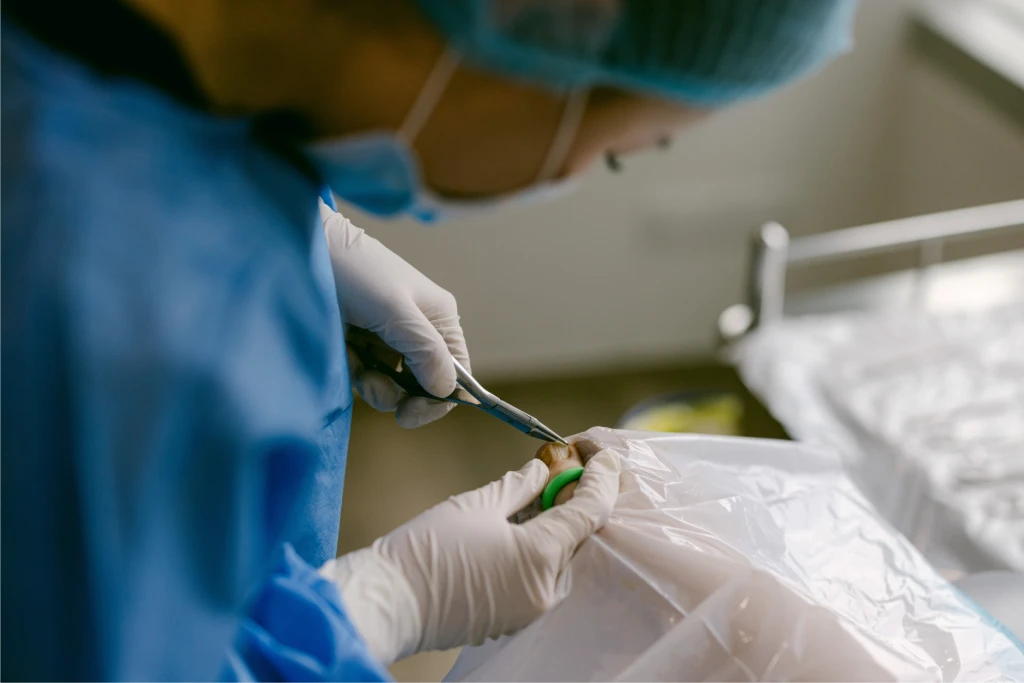
Ingrown Toenail Removal at Straits Podiatry
Our ingrown toenail removal services are available at all three Straits Podiatry clinics in Buona Vista, Orchard, and Paya Lebar. Our podiatrists will assess your nail first and match the suitable treatment options to it, from conservative reshaping and nail bracing to a partial nail avulsion.
If your ingrown toenail keeps coming back, is infected, or is stopping you wearing normal shoes, book an appointment today with any of our podiatrists in Singapore at any of our three clinics. You can book online or call us, and same-day appointments are often available at each clinic, a short walk from the MRT. We are ready to help relieve your pain and get you back to your activities.
Frequently Asked Questions About Ingrown Toenail Treatment
How do I know which ingrown toenail treatment I need?
That is where our podiatrist assessment is important, as it helps to decide the care. A mild or first-time nail often needs only conservative care, a curved nail that keeps digging at the tip may suit a brace, and a recurrent or infected nail is usually best resolved with a partial nail avulsion. Your podiatrist matches the option to your nail rather than to a default.
Can an ingrown toenail heal on its own without treatment?
A mild, first-time ingrown toenail can settle with careful trimming, warm soaks, and roomier footwear. A nail that is infected, recurrent, or growing proud flesh usually will not resolve on its own and is best assessed, because leaving it tends to prolong the pain and the infection risk.
Do I always need surgery for an ingrown toenail?
No. Many ingrown toenails, especially first or mild episodes, settle with in-clinic conservative care and never need a procedure. A procedure is considered when your nail shape is too curved from its roots, when the same nail keeps growing in, when infection is not settling, or when the pain is affecting daily life.
Should I see a GP or a podiatrist for an ingrown toenail?
Either can help a mild flare, but a podiatrist manages the nail itself, clears the offending edge, corrects a nail that keeps digging in, and carries out a minor procedure where it is needed, all in one place. For a recurrent or infected ingrown toenail, that usually means fewer repeat visits.
Can I get my ingrown toenail dealt with on the same day?
Almost always. Conservative care to clear a painful edge is usually done at the first visit, and where a procedure is the right option, it can frequently be carried out the same day once you have been assessed and have decided to proceed.
I have diabetes. Does that change how my ingrown toenail is treated?
It changes how carefully we plan it, not whether we help. Reduced sensation and slower healing in a diabetic foot make a small nail problem riskier, so the assessment checks your circulation and sensation and adjusts the approach. Having an ingrown toenail seen early is safer than leaving it.
Is there a permanent solution for a recurring ingrown toenail?
The nearest thing to a permanent fix is a partial nail avulsion with matrixectomy, where the offending strip of nail is removed, and the nail-forming cells at that edge are destroyed so that part is far less likely to regrow. It resolves most recurrent ingrown toenails, though no procedure can promise a nail will never trouble you again. Where the driver is the nail’s shape, a brace can also give lasting correction.
What happens if I leave an ingrown toenail untreated?
Left alone, an ingrown toenail tends to get worse rather than better. The edge keeps pressing in, which can lead to infection, an overgrowth of tender flesh at the nail fold, and pain that makes shoes and walking difficult. Dealing with it early is usually simpler and less involved than sorting out a nail that has been infected repeatedly, and for anyone with diabetes or reduced circulation it matters more still.
Where can I get an ingrown toenail treated in Singapore?
We see ingrown toenails at all three of our clinics, in Buona Vista serving the west, Orchard serving central Singapore, and Paya Lebar serving the east, so there is usually one within reach. Every option, from conservative care to a minor procedure, is available at each, and you can book at whichever is most convenient.
What patients say
★★★★★
I had an excellent experience with my recent podiatry visit. The staff was welcoming, professional, and made me feel comfortable from start to finish. My ingrown toenail removal was quick, nearly painless, and handled with great care. They explained every step of the procedure and provided clear, helpful aftercare instructions that made healing smooth and stress-free. I'm very grateful for the outstanding service and highly recommend them to anyone needing podiatry care.
★★★★★
Visited Straits Podiatry during to an ingrown toenail, and was greeted by a calming atmosphere in the clinic. Ms Michelle Goh was meticulous in her assessment, treatment was painless, after care was thorough ☺️ shout out also to the friendly staff at the front desk! I had a really pleasant experience with the team~
★★★★★
Mr Jackie has been extremely patient, meticulous, and reassuring throughout my treatment. I was very nervous about the toenail procedure, but he took the time to explain everything clearly and made me feel at ease. The entire process was smooth, and I truly appreciate his professionalism, patience, and care.
★★★★★
Jackie did a great job on my 2 ingrown toe nails.On account of my age n health issues he discussed with me the options. I finally chose the nail brace. I had a most gentle n caring experience for the next couple of months……I m now pain free. Thanks Jackie.
★★★★★
I suffered the pain of ingrown toenails on my 2 toes for approximately 2 years. In March 2024, I made an appointment online to visit Straits Podiatry and got the partial nail avulsion procedure done on the same day. The procedure was done by Benedict Khoo, and he is definitely an expert highly skilled in this procedure. I felt so assured throughout the 1.5-hour procedure as he kept checking on me while he was working on my 2 toes. I can say more or less it was painless, and I even "chitchatted" with Benedict, telling him my upcoming holiday plans while he was working on the procedure. Another thing that I would like to highlight is that all the people, or at least the people I have met in Straits Podiatry, were so nice and welcoming. These small little things created emotional value for me. I definitely recommend Straits Podiatry if you need to look for a podiatrist.
★★★★★
My son had a grown in toe nail and we visited another Podiatry clinic for treatment. Unfortunately the nail issue always came back after a couple of weeks. Then we visited Straits Podiatry, and Mr. Jackie Tey immediately recommended a partial toe nail removal. Now after few weeks and couple of check-ups the toe has fully recovered. I would definitely recommend Straits Podiatry, Mr. Jackie Tey and his team. Service was excellent and appointments spot on. Thank you
★★★★★
I suffered with ingrown toenail for a long time, but Daniel removed the nail easily, and now—just after 2 weeks—it's already growing back normally. Highly recommended!
★★★★★
Very smooth and pleasant experience with Straits Podiatry for my ingrown toenail removal. Mr Benedict Khoo provided a clear explanation before the treatment and was proactively making sure I was ok throughout the procedure which was also quick and pain free. The follow ups after the procedure were very helpful in my recovery. I fully recovered in three weeks, just in time for a vacation where I could walk 20km there per day pain free.
★★★★★
We visited Michelle with our daughter who had an ingrown toenail, my daughter was quite concerned about the procedure, the team were fantastic and very patient with her and talked her through everything, reassuring her. Highly recommend.
★★★★★
My ingrown toenail problem was solved in just a few visits by Mr Daniel.
References
- National Health Service (NHS). Ingrown toenail. https://www.nhs.uk/conditions/ingrown-toenail/
- DermNet. Ingrown toenail. https://dermnetnz.org/topics/ingrown-toenail
- Eekhof JAH, Van Wijk B, Knuistingh Neven A, van der Wouden JC. Interventions for ingrowing toenails. Cochrane Database of Systematic Reviews, 2012. https://pubmed.ncbi.nlm.nih.gov/22513901/