

Four toe deformities look similar at first glance and get used interchangeably online: curly toe, hammer toe, claw toe, and mallet toe. They are clinically distinct, and the distinction matters because the treatment lane is different for each. This article is the visual differential, walking through which joint is bent, in which direction, and what that tells you about how the toe got that way.
A separate piece covers curly toe in paediatric detail, and the adult-onset story sits with clawed and hammer toes.
A quick anatomy primer first. Each lesser toe (the four smaller toes) has three joints: the metatarsophalangeal joint (MTP, at the base where the toe meets the foot), the proximal interphalangeal joint (PIP, the middle knuckle), and the distal interphalangeal joint (DIP, the end knuckle near the nail). Each deformity bends a different combination of these joints.
Curly Toe, Congenital, Paediatric, Usually 3rd to 5th Toe
A curly toe is bent and rotated. Typically the toe twists inward under the next toe, with the tip pointing across the foot rather than forward. The rotation is the giveaway. Hammer, claw, and mallet toes bend up or down. Curly toe twists.
- Joints involved: MTP, PIP, and DIP can all be partly involved, but the dominant feature is rotation rather than pure flexion.
- Usual toes: third, fourth, or fifth toe most commonly. The big toe is rarely affected.
- Cause: congenital, often hereditary. Present from infancy.
- Onset: paediatric. Most curly toes are noted by the parent in the first year of walking.
- Pain pattern: in children, often painless. In adults with a long-standing untreated curly toe, the nail of the affected toe takes pressure abnormally and can thicken, discolour, or get repeatedly bruised.
Hammer Toe, Middle Joint Flexed Downward, Often Adult-Onset
A hammer toe is bent down at the middle joint (PIP) only. The MTP at the base is roughly straight, the PIP is flexed, and the DIP is straight or slightly flexed. The toe looks like an upside-down V from the side, with the PIP knuckle riding higher than the rest of the toe.
- Joints involved: PIP flexed. MTP roughly neutral. DIP straight to mildly flexed.
- Usual toes: second toe most commonly. Often associated with a long second toe or a bunion drift of the big toe.
- Cause: muscle imbalance (intrinsic foot muscle weakness vs long flexor pull), tight or short footwear, sequelae of a bunion crowding the second toe.
- Onset: typically adult, often middle-aged onward.
- Pain pattern: the raised PIP knuckle rubs the top of the shoe and develops a corn. The tip of the toe presses down into the insole.
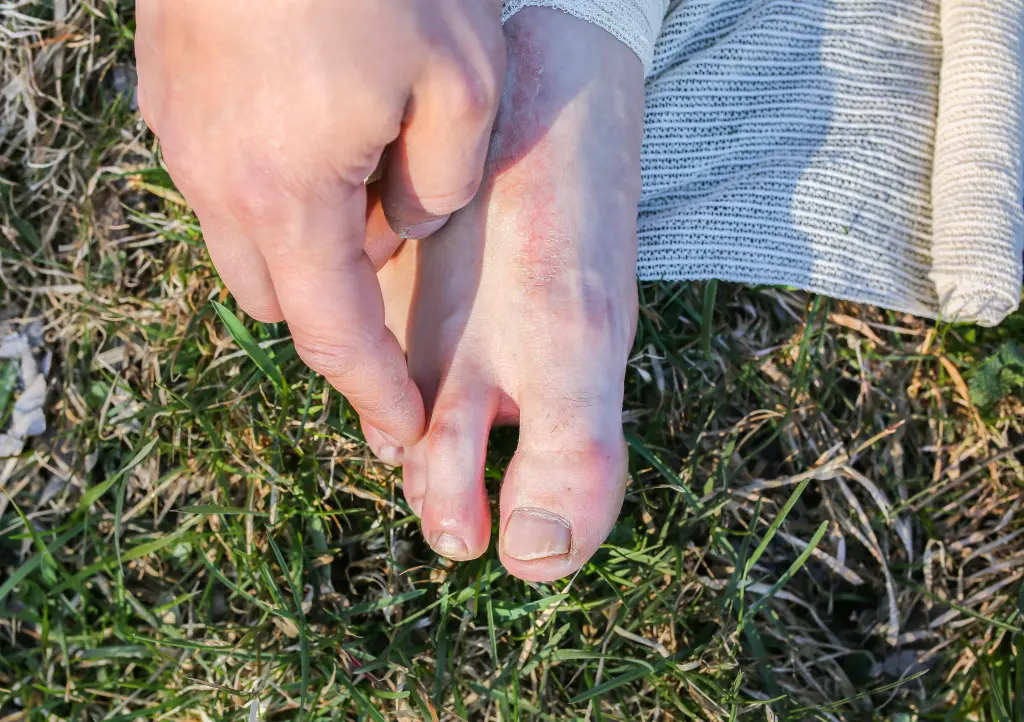
Claw Toe, Middle and End Joints Flexed, Often Systemic Cause
A claw toe is bent down at both the middle (PIP) and end (DIP) joints, while the base (MTP) is bent upward (extended) or dislocated upward. The result is a toe that lifts at the base, then bends sharply down, then bends down again. The whole toe looks like a claw curling under.
- Joints involved: MTP extended (sometimes dislocated upward), PIP flexed, DIP flexed.
- Usual toes: often multiple toes affected simultaneously. Suggestive of a systemic driver.
- Cause: neurological (Charcot Marie Tooth, diabetic neuropathy, stroke, spinal cord injury), inflammatory (rheumatoid arthritis), or biomechanical (long-standing high-arched foot type).
- Onset: adult, often progressive.
- Pain pattern: corn on the top of the PIP, callus at the tip of the toe, and a callus or ulcer under the metatarsal head where the lifted MTP has exposed the bone to load.
Claw toes affecting multiple toes warrant a check for the systemic cause, not just toe-level treatment.
Mallet Toe, End Joint Flexed Only
A mallet toe is bent down at the end joint (DIP) only. The base (MTP) and the middle joint (PIP) are straight, and only the tip of the toe curls under. The toe looks normal until the last segment, which points sharply down.
- Joints involved: DIP flexed only. MTP and PIP straight.
- Usual toes: second toe most commonly. Often the longest toe.
- Cause: repeated micro-trauma from a long toe hitting the end of the shoe, or imbalance of the flexor tendons at the DIP.
- Onset: adult, often gradual.
- Pain pattern: a corn or callus on the tip of the toe where the nail presses into the insole. The nail itself can thicken or discolour from repeated trauma.
Side-by-Side Comparison Table
| Feature | Curly toe | Hammer toe | Claw toe | Mallet toe |
|---|---|---|---|---|
| MTP (base joint) | Variable | Neutral | Extended or dislocated up | Neutral |
| PIP (middle joint) | Variable, with rotation | Flexed down | Flexed down | Neutral |
| DIP (end joint) | Variable, with rotation | Neutral to mildly flexed | Flexed down | Flexed down |
| Direction of deformity | Rotational twist | Down at middle | Curls under | Down at tip only |
| Usual toes | 3rd, 4th, 5th | 2nd | Multiple | 2nd |
| Typical age of onset | Infancy / childhood | Adult | Adult, often progressive | Adult |
| Common cause | Congenital | Muscle imbalance, footwear | Neurological, inflammatory, biomechanical | Long toe, micro-trauma |
| Where the corn forms | Nail or side of toe | Top of PIP | Top of PIP and tip | Tip of toe |
What Each Lane Means for Treatment
The visual diagnosis sets up the treatment lane. The detail of each lane sits with the relevant condition page, but the headlines are these.
Curly toe is congenital and seen primarily in children. Most are flexible at presentation and many improve with growth.
Hammer toe in an adult is usually a footwear and biomechanics problem. Toe spacers, footwear with a deeper toe box, custom orthotics, and targeted toe exercises are the first-line conservative plan. Surgical correction is reserved for rigid, painful deformities that have not responded to conservative care. If a bunion is crowding the second toe and driving the hammer, the bunion is part of the conversation, and in younger patients juvenile bunions follow a different pathway again.
Claw toe affecting multiple toes earns a systemic workup. If diabetes, an inflammatory condition, or a peripheral nerve diagnosis is identified, the foot care plan runs alongside that broader medical plan. Conservative care manages the foot symptoms (offloading, footwear, orthotics, skin care, ulcer prevention). Surgical correction is considered when conservative care no longer controls symptoms.
Mallet toe in an adult is often a long-toe-in-short-shoe problem. Better-fitting footwear and offloading of the tip resolve many cases. Persistent symptoms with corn or nail damage may need surgical correction of the flexor tendon at the DIP.
Closing
Four deformities, four joint patterns, four treatment lanes. Telling them apart in the first thirty seconds of a consultation is what allows the right conversation to happen quickly.
If you are not sure which lane your toe deformity sits in, book a consultation at Straits Podiatry. The first appointment usually settles the differential and sets the plan.