
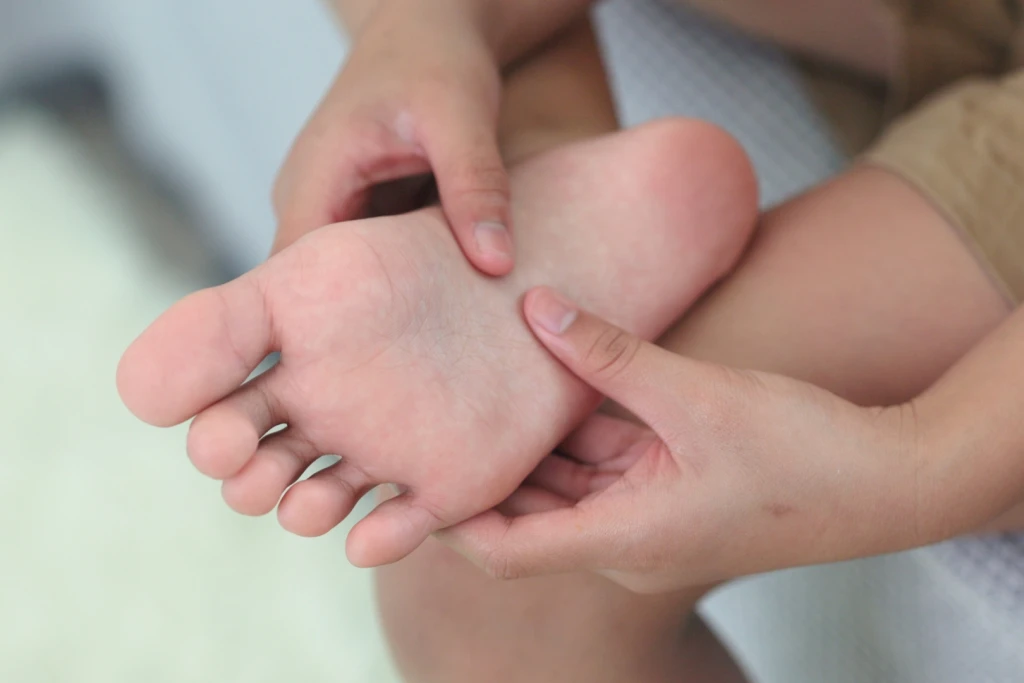
You are rubbing a sore foot one evening and your thumb finds a firm little lump in the arch. You are fairly sure it was not there a few months ago. Now you are wondering whether this is a plantar fibroma or the plantar fasciitis your friend keeps talking about. So you press it again. It is small, it is hard, and it does not really hurt unless you push on it. The more you prod it, the more your mind runs ahead of you. The internet has not helped. It has thrown both of those names at you and they sound like the same thing.
If that is roughly where you are, the useful first thing to know is that these two are not the same problem at all. Both can sit in the arch, and both send people looking for answers late at night. But one of them is a lump you can feel. The other is a pain pattern with nothing to feel. That single difference is where I start. The two are managed in genuinely different ways, and telling them apart early saves you a lot of wasted effort. So let me take you through it the way I would in the chair, working through the questions roughly as patients raise them.
First, can you feel a distinct lump?
This is the question that splits the room, and it is the first thing I check with my hands.
A plantar fibroma is a benign, slow-growing nodule that forms within the plantar fascia itself. That is the thick band of tissue running along the bottom of your foot from the heel to the toes. It is usually small, somewhere between the size of a pea and a marble. It sits in the instep, roughly the middle third of the arch rather than down at the heel. Press on it and you feel a defined, rubbery, firm bump that does not slide around. That is because it is part of the fascia rather than floating on top of it.
Plantar fasciitis is different in a way you can feel under your own fingers. It is irritation of that same plantar fascia, usually right where the fascia anchors into the heel bone. But there is no nodule to find. The tissue is inflamed and tender, not lumpy. So when a patient tells me they can press on one firm bump and feel its edges clearly, that already nudges me toward a fibroma. When they describe real pain but their fingers find nothing but tenderness, that nudges me toward fasciitis.
I will say plainly that a true plantar fibroma is not common. I do not see one every week, and most of the arch problems that walk through my door are not fibromas at all. So if you have found a lump, it is worth taking seriously. That is precisely because it is the less ordinary of the two.
Is it a fibroma or plantar fasciitis?
Once we know whether there is a lump, the next clue is the pattern. The two stories run in opposite directions.
With a plantar fibroma, the lump is the headline and the pain, if there is any, follows it. The nodule lives in the arch, away from the heel. Early on, many people feel nothing at all and only notice the bump by accident, often after a pedicure or while moisturising. Discomfort, when it shows up, tends to be a pressure feeling, like standing on a small stone or a folded sock. It is worse in firm flat shoes, or barefoot on hard floors that push straight up into the nodule.
With plantar fasciitis, the pattern is almost reversed. The pain is the headline and there is nothing to see or feel. The signature is sharp heel and arch pain with the first few steps in the morning or after sitting a while. It eases as you warm up, then often creeps back after a long day on your feet. That start-up pattern is so typical that I treat it as a strong pointer on its own, well before I touch the foot.
The two also come from different places. A fibroma is a tissue-growth process, where the fascia lays down extra fibrous tissue in one localised spot. It is linked to previous trauma to the sole, certain medications, and a tendency that can run in families. Fasciitis is a load story. The fascia is simply being worked harder than it can tolerate, by a jump in running, long days on hard mall and clinic floors, flat unsupportive slippers at home, or a recent weight change.
Is it dangerous, and will it keep growing?
This is usually the worried question, so let me answer it directly. A plantar fibroma is benign. It does not turn into cancer. What it can do is grow slowly over months, and occasionally more than one forms along the same fascia. So it is reasonable to keep an eye on it.
That said, not every lump in the arch is a fibroma. A firm bump can occasionally be a cyst, a swollen tendon, or another soft-tissue change. That is exactly why a lump that is growing, painful, or new deserves a proper look rather than guesswork. You can also have both a fibroma and an irritated fascia in the same foot. The loud first-step heel pain of fasciitis can distract from a quiet little nodule sitting further forward. None of this is cause for alarm. It is just the reason I do not rely on a patient’s self-diagnosis alone before deciding what to do.
What actually helps?
Here is where separating the two pays off, because the plans diverge.
For plantar fasciitis, care is conservative and aimed at the load. Assessment usually starts with gait and biomechanical analysis to understand how your foot loads through each step. That is what tells us why the fascia is being overworked. From there a plan might include calf and fascia loading work, footwear changes, and custom foot orthotics where foot structure is driving the overload. It may add focused shockwave therapy (ESWT) or EMTT for cases that have settled into a stubborn, longer-standing pattern. Rehabilitation support with our physiotherapist fits in where calf strength and movement need rebuilding. Most cases settle once the load is addressed properly.
For a plantar fibroma, the aim is comfort and offloading rather than chasing the nodule. The first step is confirming what the lump is and how it behaves when you stand and walk on it. From there, an offloading insole built with a relief or recess around the nodule can take direct pressure off it. That is often enough to let people walk and stand comfortably, even if the lump itself stays put. Footwear that does not jam into the arch helps too.
Where a fibroma stays genuinely problematic, the conversation may extend to options discussed with a foot and ankle specialist. And I want to be honest upfront that surgical removal of a fibroma carries a real chance of it growing back. So excision is reserved. It is not a first move, and it is not a guaranteed fix. That is exactly why getting the diagnosis right early, and trying offloading first, is worth the effort.
Okay, what would you do if you were me?
If you can press on a firm, fixed lump in your arch, I would treat that as the less ordinary of the two and have it looked at properly. That is both to confirm it is a benign fibroma and to rule out the other things a lump can be. If instead you have first-step heel and arch pain with nothing to feel, that fits plantar fasciitis. The useful work is in offloading the fascia and finding out why it is overworked, not in hunting for a lump that is not there.
Either way, the honest next step is the same: find out which one you are actually dealing with rather than treating both as the same problem. A proper look reads whether there is a true nodule, where it sits, how your foot loads when you walk, and whether anything else is going on. For a fibroma the plan stays comfort-first and patient, with realistic expectations about recurrence. For fasciitis the plan is built around the load. If a lump in your arch or stubborn heel and arch pain is bothering you, book a consultation with any of our podiatrists in Singapore at Straits Podiatry. We see patients at any of our three locations, and we will work out what it is and what actually helps.