
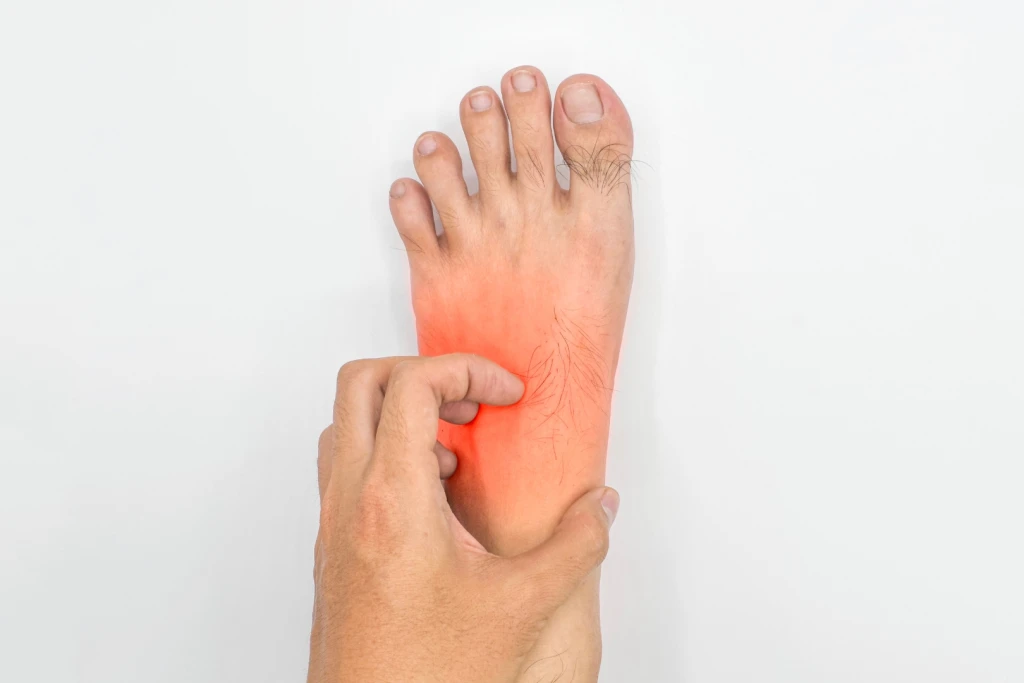
Not every twisted foot is just a sprain, and the midfoot is where that assumption causes the most trouble. Someone comes down awkwardly off a kerb or misjudges the last step on a staircase. Or they get their foot caught underneath them in a tackle during weekend football. The foot feels jarred, so they assume they have rolled their ankle, and they do the sensible thing. Rest, ice, a bit of compression, keep off it for a few days. A week or two on, the ankle is fine, but the middle of the foot still aches. Standing on it is uncomfortable. The moment they try to push off to walk quickly or come down a staircase, the pain sharpens again right across the midfoot.
If that sounds like your situation, the question worth asking is whether you rolled your ankle at all. The pattern can fit a Lisfranc injury, an injury to the middle of the foot rather than the ankle. It does not behave like an ordinary sprain. I want to be upfront that this is not a common injury. It is uncommon, but it is also one of the more frequently missed injuries in the foot. That combination is exactly why it is worth knowing about. So when a foot like this turns up, here are the questions I work through with my patient, roughly in the order they tend to matter.
First, why would a sprain not be a sprain?
The first thing I do is ask exactly how it happened, because the mechanism tells you a lot. A classic ankle sprain happens when the ankle rolls outward and the ligaments on the outside of the ankle get overstretched. You feel it at the ankle bone, and the swelling sits around the ankle. A Lisfranc injury is a different event with a different mechanism. It tends to happen when a twisting force or a sudden load drives through a foot that is pointed downward, heel up and toes planted. The ankle does not roll the way it does in a sprain.
Picture the foot caught underneath you as you come down off a step. Or the front of the foot pinned to the ground while your body weight rotates over it. That force does not stretch the outside ankle ligaments. Instead it loads the small joints and ligaments in the middle of the foot, the area we call the midfoot. So the pain and swelling show up across the arch and the top of the foot, not at the ankle. Same stumble, very different injury.
The injury itself is a sprain or a shift of the row of joints where the long bones of the forefoot meet the bones of the arch. There is a short, strong ligament in there (the Lisfranc ligament) that locks the whole midfoot together. When it gives way, the foot loses some of its built-in stability. That is why it does not just settle and forget itself the way a minor sprain often does.
Where should the pain and bruising be?
This is the part you can usually check yourself, and it is the most useful clue. With a Lisfranc injury the pain sits in the middle of the foot. Not at the bony ankle, and not at the ball of the foot near the toes. It sits across the arch and the top of the midfoot, roughly where the laces of your shoe would lie.
Press gently along that band of bones across the top of the foot. If it is tender there, take it seriously, especially if standing or walking reproduces a deep ache through that same area. The pain is mechanical. It gets worse when you load the foot and eases when you take the weight off. A lot of my patients describe the foot feeling unreliable, like the middle of it cannot be trusted to take a full push-off.
The bruising is the other half of this answer, and it is the detail most people miss. Look at the sole. Bruising that tracks along the underside of the arch, on the bottom of the foot rather than the outside of the ankle, is a recognised warning sign for this injury. It comes from bleeding deep in the joint. It is not what you would expect from a simple rolled ankle. If you turn your foot over and see it there, do not wave it away.
What are the red flags I should not ignore?
There are three signs I would not sit on, because together they point to something more than a routine sprain.
The first is not being able to bear weight properly. A mild sprain is sore, but most people can hobble on it. If you genuinely cannot put your weight through the foot, that counts. So does push-off being sharply painful days after the injury.
The second is the bruising on the sole of the midfoot described above, along the underside of the arch rather than around the ankle.
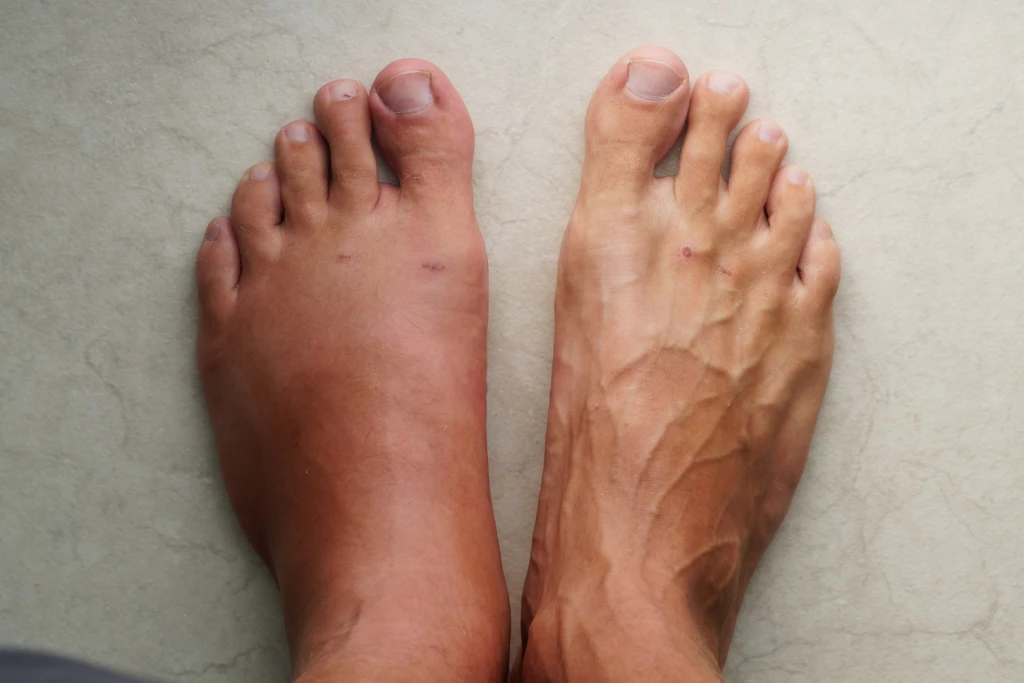
The third is swelling spread across the whole midfoot rather than pooled at the ankle. A puffy band across the top of the foot that does not improve over a few days deserves a proper look.
None of these on its own confirms anything. But put the signs together: a twisting or falling mechanism, midfoot pain, real difficulty bearing weight, and bruising underneath the arch. The picture then moves from “give it time” to “get this checked”.
Why does getting this missed matter so much?
This is the honest reason I bother writing about an uncommon injury at all. A Lisfranc injury is one of the more frequently missed injuries in the foot, and the cost of missing it is real. The midfoot is the foundation of your arch. If the joints there have shifted out of position and that goes unrecognised, the foot can heal in a slightly displaced position. Over time that can lead to ongoing midfoot pain and arthritis in those joints. That is a far harder problem to manage than the original injury was.
The frustrating part is that the early window is exactly when it looks least alarming. A subtle Lisfranc injury can present as a foot that is sore but still vaguely usable. That is why so many get labelled a sprain and sent home. The ones caught early tend to do better. That is the whole argument for treating midfoot pain after a twist or fall more seriously than it first appears.
Why does early imaging matter here?
Because you cannot reliably tell a stable midfoot sprain from a displaced Lisfranc injury by feel alone. Ordinary imaging can under-call it too. A non-weightbearing X-ray, taken while you lie down, can look almost normal even when the joint is unstable. With no load on them, the bones sit back in roughly the right place.
The injury often only shows itself when the foot is loaded. That is why a weightbearing X-ray, taken while you stand on the foot, is the standard way to reveal whether the midfoot bones spread apart under load. Where that X-ray is unclear and suspicion remains, further imaging may be needed to look at the ligament itself. Getting the right image early is what separates “this is a stable sprain we can manage” from “this needs a surgical opinion”. That distinction changes everything about what happens next.
I want to be straightforward about the limits. A confirmed, displaced Lisfranc injury is frequently a surgical problem, not something conservative care alone resolves. The honest answer is that the more displaced it is, the more likely it needs a surgeon. What podiatry does well is recognise the pattern early and protect and offload the foot in the meantime. We also arrange the right weightbearing imaging, and refer onward when that is what the foot needs.
Okay, what would you do if you were me?
If you twisted or fell, the ankle has settled but the middle of your foot has not, and you can see any of those red flags, treat it as more than a sprain until proven otherwise. Keep weight off it as much as you reasonably can. Get it looked at properly rather than waiting another fortnight to see if it fades.
When you come in, the assessment is built around one question. Is this a stable midfoot sprain, or a Lisfranc injury that needs imaging and possibly a surgical opinion? At Straits Podiatry that means working out exactly how the injury happened, examining where the pain and bruising sit, and checking how the midfoot behaves under load. Where the picture points to a Lisfranc injury, the next step is a weightbearing X-ray. In the meantime the foot is supported by offloading and immobilisation, with a referral for an orthopaedic opinion if the imaging shows displacement. For the stable sprains, and during recovery, the plan can include protected weightbearing and a graded return to load. Where the arch needs ongoing support, custom foot orthotics can take pressure off the midfoot while it settles.
The reason I would rather see you early is simple. A midfoot injury caught in the first week or two has the best chance of healing in the right position. The same injury found months later, after the joints have settled wrongly, is a much tougher road. If your midfoot pain after a twist or fall is not improving the way a sprain should, book a consultation with any of our podiatrists in Singapore at any of our three locations. We can tell you which one you are dealing with.