
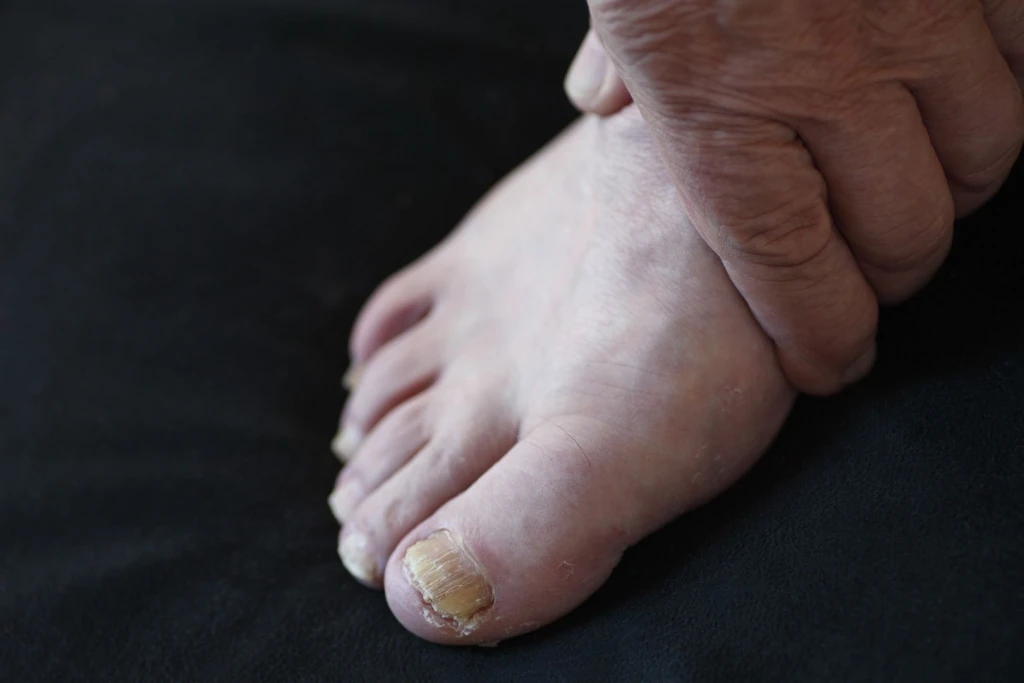
You go to trim your toenails and one of them no longer behaves like the others. It has grown thick and hard. The clippers struggle to bite through it, and it sits raised inside the shoe so the toe feels pressed with every step. The nail may have turned yellowish or brownish, lifted at the edges, or started to curve. Many people assume this is fungal and reach for an antifungal cream. In fact, a large share of thick toenails are not infected at all. They are the nail’s response to pressure, injury, or simply years of wear.
The clinical name for a thickened toenail is onychauxis. When the nail thickens and curves into a long, ridged, claw-like shape, it is called onychogryphosis (the ram’s-horn nail). The thickening happens in the nail matrix, the small zone of growing cells under the skin at the base of the nail. When the matrix is repeatedly disturbed, by a knock, a shoe pressing on the nail, or the slower changes of ageing, it lays down nail tissue faster and less evenly. The result is a nail that is harder to cut, catches more easily, and presses painfully against footwear. That is why recognising what drives the thickening matters more than simply filing the surface down.
Symptoms of Thickened Toenails
The signs develop slowly, often over many months, so the change is easy to overlook until cutting the nail becomes a chore. The pattern of symptoms also gives early clues about the underlying driver.
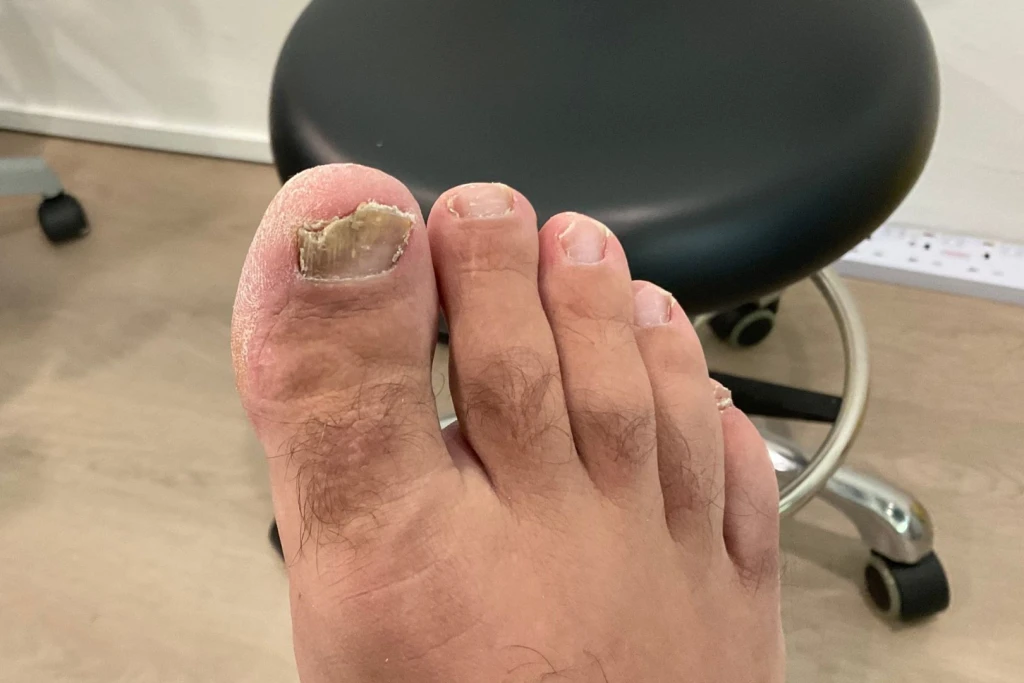
- A nail visibly thicker and harder than its neighbours The nail plate builds up in height, sometimes to several times its normal thickness. Ordinary clippers struggle to cut through it.
- Yellow, brown, or cloudy discolouration The thickened layers trap debris and lose their translucency. Unlike the crumbly white-yellow look of infection, this discolouration sits in dense, compacted layers.
- Ridges, grooves, or a rough, uneven surface The nail loses its smoothness as the disturbed matrix lays down tissue irregularly.
- Curving or claw-like growth In onychogryphosis the nail thickens and curls, most often on the big toe. It grows into a ram’s-horn shape that standard clippers can no longer cut.
- Pain or pressure when wearing shoes The raised nail presses against the toe box. The toe underneath can become tender, especially in closed or narrow footwear.
- A nail that lifts or separates at the free edge Thickened nails often loosen slightly from the nail bed, leaving a gap where debris collects.
- Difficulty trimming the nail safely at home The nail is too hard and too curved for ordinary clippers. Forcing it can split the nail or cut the surrounding skin.
The most useful early clue is the company the thickening keeps. A single thick nail on a toe that has taken knocks, or one under a shoe that has always felt tight, points toward a mechanical cause. Several crumbly, flaky nails spreading between toes point more toward infection. That is a different problem with a different management pathway.
Types of Thickened Toenails
Thickened toenails are described by how the nail has changed. The two main forms differ in severity and in how they are managed.
Onychauxis
Onychauxis is the simple thickening of the nail plate without significant curvature. The nail grows taller and denser than normal but keeps roughly its usual shape and direction. It is the milder and more common form. It usually responds well to regular professional reduction once the source of pressure or irritation is addressed.
Onychogryphosis (ram’s-horn nail)
Onychogryphosis is the advanced form. The nail not only thickens but also curves and twists into a long, ridged, claw-like shape. It most often affects the big toenail. It is more common in older adults, in people who have not been able to care for their feet for some time, and after long-standing nail damage. The curvature makes the nail impossible to cut at home and prone to pressing into the skin or the toe alongside it. It generally needs ongoing professional management.
Causes of Thickened Toenails
Toenails thicken when the nail matrix is disturbed over time. The disturbance can come from a single significant injury, from repeated low-grade pressure, or from the gradual changes of ageing. Often more than one factor is at play in the same nail.
What Causes Thickened Toenails?
- Repeated pressure from footwear Shoes with a tight, narrow, or shallow toe box press on the nail with every step. Over months, this steady micro-trauma prompts the matrix to thicken the nail.
- A past nail injury A single heavy knock, a dropped object, or repeated toenail trauma from sport can damage the matrix. The nail then grows thick and distorted long after the original injury has healed.
- Ageing Nails naturally grow more slowly and unevenly with age, and the nail plate tends to thicken. This is one of the most common reasons for thickened toenails in older adults.
- Pressure from an adjacent toe or deformity A bunion, hammer toe, or crowded toes can load one nail abnormally. This drives thickening on that single nail.
- A fungal nail infection Fungus can also thicken a nail. A fungal nail infection tends to produce crumbly, flaky, discoloured nails that can spread between toes. It is the main condition to distinguish a mechanically thickened nail from, because the treatment is different.
- Reduced circulation or skin conditions Poor blood supply to the feet, or skin conditions such as psoriasis, can change how the nail grows and contribute to thickening.
Who Carries a Higher Baseline Risk?
- Older adults, in whom slower, thicker nail growth is part of normal ageing.
- Runners, footballers, and hikers whose toes take repeated impact inside their shoes.
- People who habitually wear tight, narrow, or pointed footwear.
- Anyone with a previous significant toenail injury, even one from years ago.
- People with bunions, hammer toes, or crowded toes that load a nail unevenly.
- People with diabetes or reduced circulation, in whom thickened nails are both more common and more important to manage carefully.
- Anyone who has found it difficult to reach, see, or care for their own feet for a period of time.
Conditions Commonly Mistaken for Thickened Toenails
A thick, discoloured nail looks alarming, so it is often attributed to the wrong cause. That leads to the wrong treatment. The distinctions below matter. A mechanically thickened nail will not respond to antifungal treatment, and an infected nail will keep progressing if it is only reduced.
Fungal nail infection
The most common point of confusion. A fungal nail infection thickens the nail too, but the texture is the giveaway. Fungal nails tend to look crumbly and flaky. They show white or yellow streaks, debris that pushes the nail up from the bed, and a tendency to spread to neighbouring nails. A mechanically thickened nail is usually denser and more solid, affects the toes that take the most pressure, and does not spread. The two can also coexist, so a sample is sometimes taken to confirm before committing to antifungal management.
Subungual melanoma
Uncommon but important. A dark streak or patch under the nail that appears without an injury, widens over time, or extends onto the surrounding skin is not simple thickening. It needs prompt medical assessment. Thickening from pressure or ageing does not produce a single pigmented band of this kind.
Ingrown toenail
An ingrown toenail causes pain along the side of the nail where it digs into the skin, often with redness or swelling. This is different from the raised, hardened bulk of a thickened nail. The two can occur together when a thick, curved nail presses into the adjacent skin fold.
Treating and Preventing Thickened Toenails
Thickened toenails respond well when the nail is reduced safely and the cause is addressed. The thickened part cannot be made thin again at home. Trying to grind or cut it down with household tools risks splitting the nail or injuring the skin and nail bed. The aim of management is simple: keep the nail comfortable and a manageable thickness, take pressure off it, and confirm what is driving the problem.
Common ways thickened toenails are managed include:
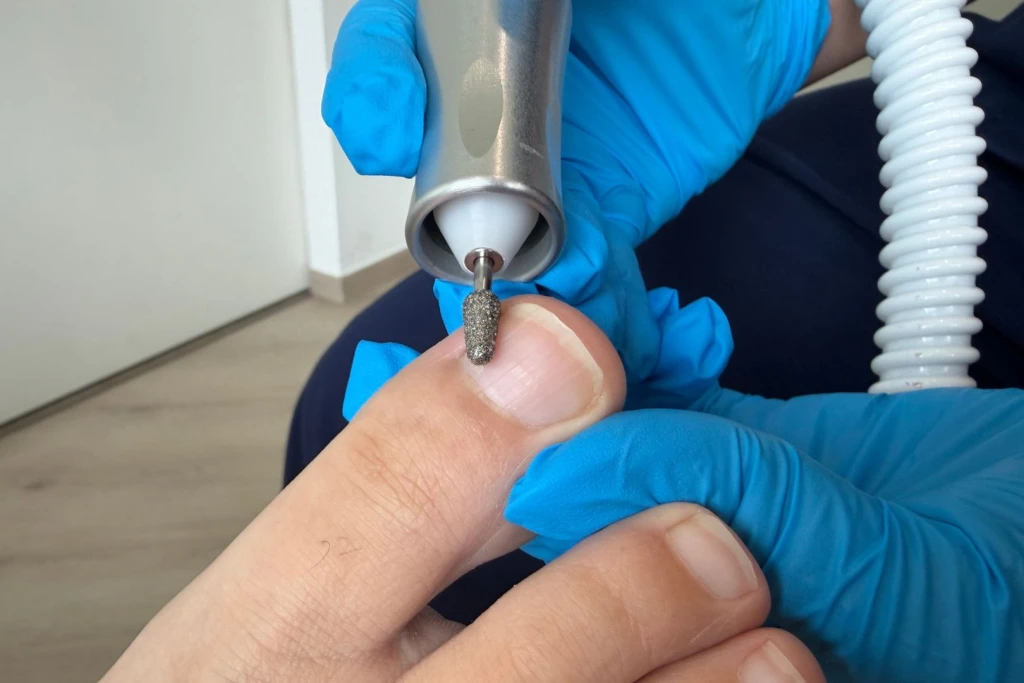
- Careful professional reduction of the nail thickness and length using proper nail instruments and a drill. This thins and smooths the nail so it sits comfortably in the shoe and is easier to maintain.
- Regular maintenance reduction for nails that keep rebuilding, particularly in onychogryphosis, where ongoing care keeps the ram’s-horn shape under control.
- Assessing whether a fungal infection is also present. A nail sample is taken where there is doubt, so antifungal treatment is only used when it is needed.
- Reviewing footwear to remove the pressure that drives many thickened nails, choosing a deeper, wider toe box.
- Addressing the underlying foot mechanics where a bunion, hammer toe, or uneven loading is concentrating pressure on one nail.
Preventing Thickened Toenails
To reduce the chance of a nail thickening or worsening, attention to the daily pressures on the nail unit helps:
- Choosing footwear with enough depth and width so the toes and nails are not compressed during walking, work, or sport.
- Replacing sport shoes that have become too tight or worn, leaving room at the front for the toes.
- Trimming nails straight across and not too short, at a sensible length so they are less likely to catch or take pressure.
- Protecting the toes from knocks during activities where something might strike or land on the foot.
- Having a thick nail looked at early, before it curves or hardens beyond what home care can manage.
For people with diabetes or reduced circulation, a thickened toenail deserves earlier and more careful attention. A hard, raised nail can press on the skin and create a pressure point that is slower to heal. In these cases, regular professional nail care and a diabetic foot screening help keep small problems from becoming bigger ones.
Have Your Thickened Toenails Managed at Straits Podiatry
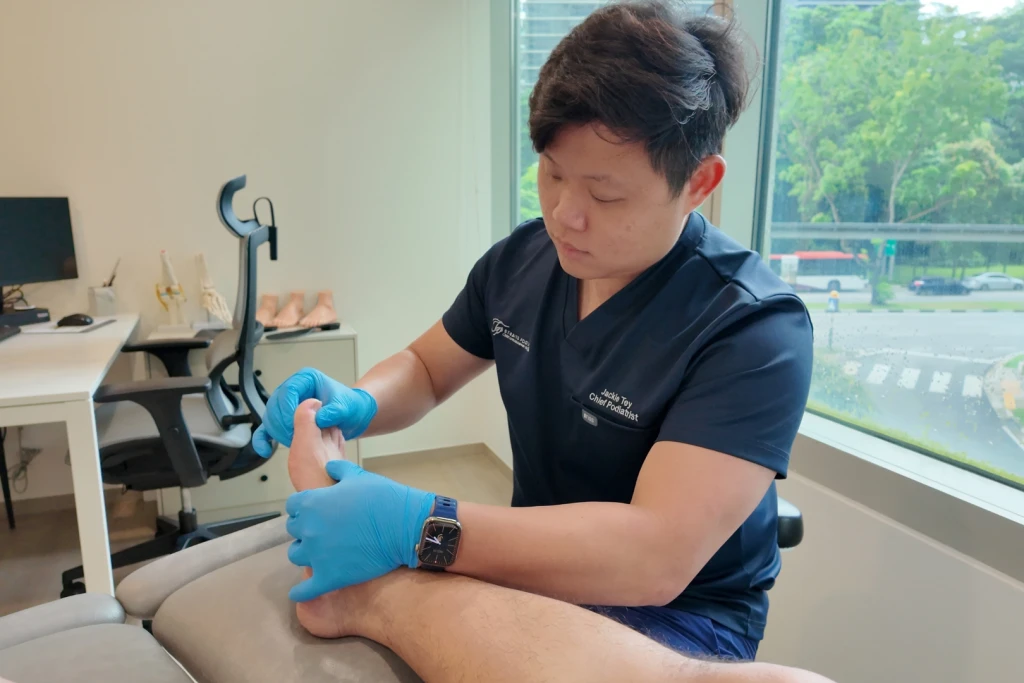
A thick, hard, or curving toenail that has become difficult to cut, or that presses uncomfortably inside your shoes, is worth having looked at properly. At Straits Podiatry, we can assess the nail and work out whether the thickening is coming from pressure, an old injury, ageing, an infection, or a combination. We also look at the footwear and foot mechanics that might be feeding the problem. Distinguishing a mechanically thickened nail from a fungal one early on matters. It decides whether the answer is nail reduction and pressure relief or a course of antifungal care.
Where the nail needs reducing, our podiatrists can carefully thin and reshape it with proper instruments so it sits comfortably again. They can also arrange regular maintenance care for nails that keep rebuilding, as often happens with onychogryphosis. Depending on what is driving the thickening, the plan may also include a fungal nail assessment, a footwear review, custom foot orthotics where uneven loading is concentrating pressure on one toe, and diabetic foot screening where circulation or sensation is a concern. Speak with our team or book a consultation for an assessment and a tailored approach to manage your thickened toenails.
Frequently Asked Questions About Thickened Toenails
Are thickened toenails always caused by fungus?
No. Many thickened toenails are not infected at all. Pressure from footwear, an old toe injury, crowded toes, and the natural changes of ageing all thicken nails without any fungus involved. A fungal nail tends to look crumbly and flaky and can spread between toes. A mechanically thickened nail is usually denser and solid and stays on the toes that take the most pressure. Because the two are managed differently, it is worth confirming the cause rather than reaching for an antifungal cream.
Can a thickened toenail be made thin again?
The thickened part that has already grown cannot be returned to a normal thickness, because the change is in the nail that has formed. What a podiatrist can do is reduce and smooth it with proper instruments. The nail then sits comfortably in the shoe and is far easier to manage. If the cause is removed, for example by changing tight footwear, new growth can come through thinner over time. This varies from person to person and depends on whether the matrix was permanently affected.
Why should I not try to grind or cut down a thick toenail myself?
A thickened nail, especially a curved ram’s-horn nail, is too hard and too uneven to cut safely with household clippers. Forcing it risks splitting the nail or cutting the skin around it. Home grinding tools can also generate heat and remove too much in one spot. A podiatrist uses proper nail instruments and a drill to thin the nail evenly and safely. This matters even more for people with diabetes or poor circulation, where a small self-inflicted nick can be slow to heal.
How often will a thickened toenail need professional reduction?
It depends on how fast the nail rebuilds and on the cause. A mildly thickened nail may only need occasional attention once the pressure on it is relieved. A nail with the ram’s-horn pattern of onychogryphosis usually keeps growing thick and curved. It tends to benefit from regular maintenance reduction to keep it comfortable and under control. Your podiatrist can give you a realistic interval after seeing how your nail behaves.
Should I see a podiatrist for a thickened toenail, or will it sort itself out?
A thickened toenail does not usually resolve on its own. The cause, whether footwear pressure, an old injury, or ageing, tends to persist. It is worth having it assessed when it becomes hard to cut, presses painfully in your shoes, curves or claws over, or changes colour. Early assessment is more important if you have diabetes or reduced circulation, where a hard, raised nail can create a pressure point on the skin. Seeing a podiatrist sorts out the cause and keeps the nail manageable before home care is no longer possible.