
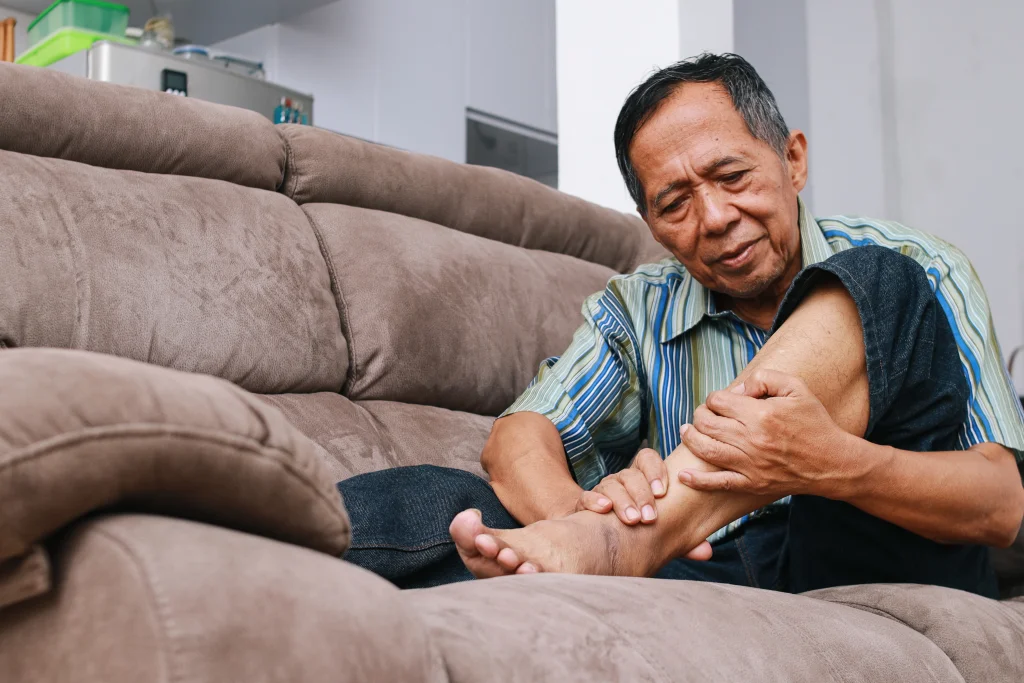
The most preventable diabetic foot complications are the ones caught in the first few months of nerve change. This article covers the seven signs you can check at home in under a minute each, the temperature test, the wear pattern, the colour, the hair, the sensation, the nail, and the moisture pattern. Each is a routine podiatrist check, written for the patient to run between clinic visits.
For the full clinical picture of how diabetes affects the foot, the parent page sits separately. This article is the practical companion. Run the checks weekly. If any of them looks off, you have the early warning before damage becomes structural.
Check 1, Temperature Comparison Between Feet
Sit down, take your shoes and socks off, and let both feet acclimatise to room temperature for two minutes. Place the back of your hand on the top of one foot, then the other. Compare. Both feet should feel similar.
A consistent temperature difference between the two feet is informative. A foot that feels noticeably cooler than the other side can suggest reduced circulation, which is the peripheral arterial disease pattern. A foot that feels noticeably warmer than the other side, in the absence of a recent injury, can be an early sign of inflammation, infection, or developing Charcot foot. Both are reasons to escalate to a podiatrist promptly.
Check 2, Callus or Wear Pattern Changes
Look at the bottom of both feet under a good light. Note where calluses sit. Compare with how they looked a month ago.
A new callus, or a callus that has suddenly become much thicker, points to a new pressure point. In a foot with intact sensation, that pressure would have caused enough discomfort to make you change how you walk. In a diabetic foot with early nerve change, the foot does not register the pressure and the callus builds quietly. Underneath that callus is exactly the tissue where a diabetic foot ulcer typically begins. New callus is the early warning, not just a cosmetic issue.
Check 3, Skin Colour at Rest and After Elevation
Sit on the edge of the bed with both feet on the floor. Note the colour of your feet. Then lift both feet up and rest your heels on the bed at about hip height for one minute. Compare the colour.
A foot with healthy circulation stays a steady pink. A foot with poor circulation goes pale or whitish when elevated, then dusky red or purple when lowered back down. Dark patches, persistent bluish discolouration, or a foot that does not return to a normal colour within thirty seconds of being placed back on the floor are findings worth checking.
Check 4, Hair Pattern on the Foot and Toes
Look at the top of your foot and the top of your toes. Most adults have some fine hair there. Compare your two feet.
Loss of hair on the toes and forefoot, especially when one side has noticeably less than the other, can be an early circulation finding. The hair follicles need a steady blood supply. When circulation drops below the level needed to maintain hair growth, the hair thins. By itself, hair loss is not a diagnosis, but it adds weight when paired with check 1 (temperature) and check 3 (colour).
Check 5, Sensation Test With a Light Touch
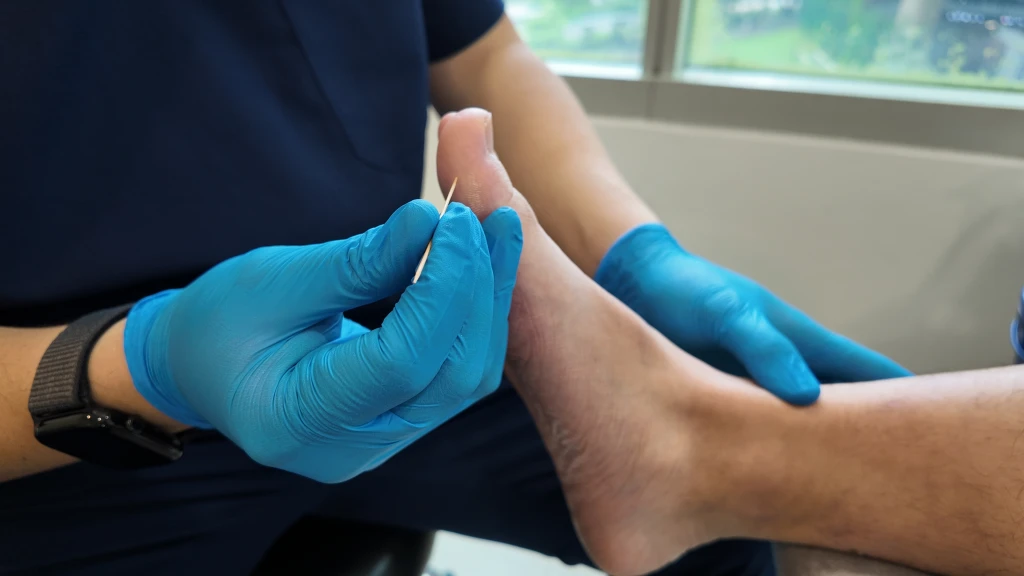
You do not need a clinical monofilament for the home version of this. Take a folded tissue, twist a corner into a soft point, close your eyes, and have a family member touch the point gently to various spots on the sole of your foot, the top of your foot, and the side of each toe. Say "yes" each time you feel it.
A foot with intact sensation registers every touch easily. A foot with early diabetic neuropathy may miss touches on the toes first, then on the ball of the foot, then progressively further back. Any pattern of "I cannot feel that" on areas where the other foot can feel it is a finding. Numbness, tingling, burning, or a sensation of walking on cotton wool are reportable to a podiatrist regardless.
Check 6, Nail Changes
Look at all ten toenails. Compare each nail to itself one month ago and to the equivalent nail on the other foot.
Three nail patterns matter. The first is thickening, where the nail becomes notably harder and harder to cut, which can suggest fungal infection or repeated micro-trauma from footwear that is no longer fitting well. The second is discolouration, ranging from yellow-brown (often fungal) to red-black under the nail (often blood, suggesting trauma the foot did not register). The third is ingrown nail at the corners, where the nail edge is pressing into the skin fold. In a diabetic foot, an ingrown toenail is a higher-stakes problem because of the infection risk.
Check 7, Skin Moisture Pattern
Run your fingers across the skin of the heel, the arch, and the top of the foot. Note whether the skin feels normal, unusually dry, or unusually moist.
Diabetic nerve change can affect the small nerves that control sweat glands. The foot can become unusually dry, with skin that cracks at the heel, or unusually moist between the toes, which softens the skin and increases the risk of fungal infection or skin breakdown. Cracked heels in a diabetic foot are not just a cosmetic concern. A deep fissure in dry skin is a potential entry point for infection.
What to Do If a Check Looks Off
One isolated finding is information, not an emergency. The decisions tree is roughly this. If a check looks off and you have a regular podiatrist, mention it at your next scheduled visit. If two or more checks are off at the same time, bring the appointment forward. If you find an open wound, an ulcer, a black patch of skin, or any sign of infection (redness, swelling, warmth, discharge, fever), call to be seen the same day or attend an emergency department.
For diabetic patients without a regular podiatrist, the entry point is a diabetic foot screening, which establishes your baseline and the cadence of follow-up your specific risk profile needs. That cadence is usually six-monthly for low risk, three-monthly for moderate risk, and monthly or more for high-risk feet.
Closing
Seven checks, under ten minutes total, weekly. That is the home routine that catches diabetic foot damage in the window where it is still reversible. None of these replace the clinical screen by a podiatrist, but together they sit between clinical visits and surface change early.
If you are living with diabetes and have not had a foot screening in the last six months, book a diabetic foot screening at Straits Podiatry. The screening gives you a baseline against which the home checks become useful.