
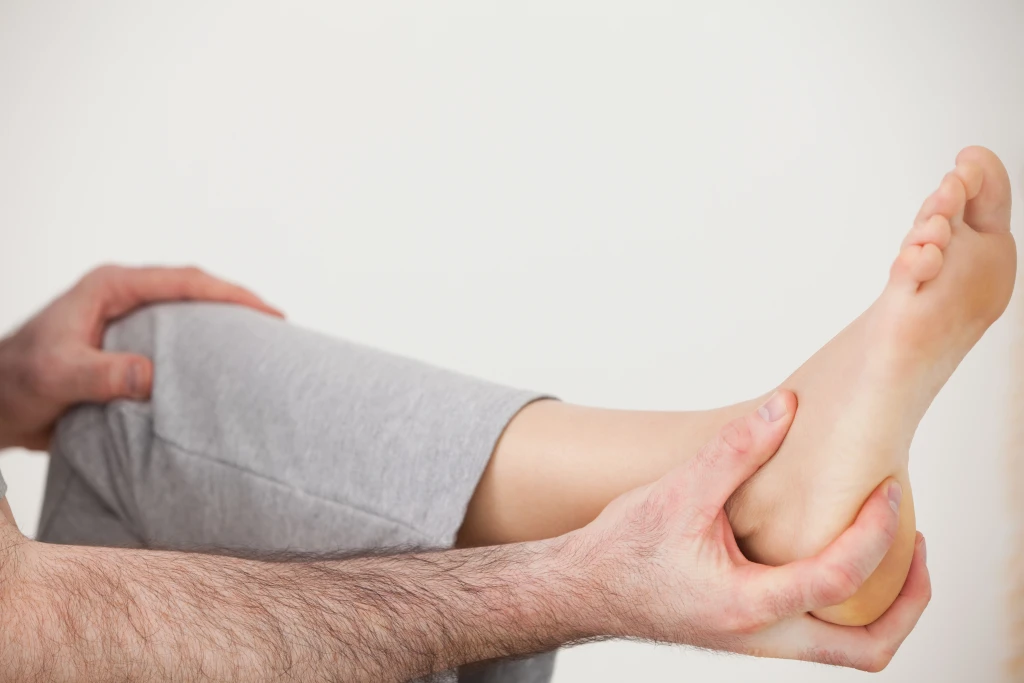
One of the most common questions we hear from patients with retrocalcaneal bursitis is some version of: "It has been a week, why is this not better?" Recovery from a bursa irritated for weeks or months rarely follows a clean upward curve. It moves in steps, with setbacks, and the pattern is more predictable than people expect.
This article walks through what most patients can expect from week one to a return to running. Timing varies with how long the bursa has been irritated, daily load, and whether other structures are involved (coexisting Achilles tendonitis or a Haglund's prominence usually adds time).
Why Retrocalcaneal Bursitis Recovery Is Non-Linear
The retrocalcaneal bursa sits between the Achilles tendon and the back of the heel bone. Once inflamed for a stretch of time, the wall of the bursa thickens, the surrounding soft tissue stays sensitised, and the Achilles often becomes a passenger. None of those changes resolve on the same clock as a bruise.
Three things drive the non-linear pattern:
- First improvement is symptomatic, not structural. Pain often eases within a week of offloading, but the bursa wall and Achilles loading tolerance have not changed. Patients feel better, return to running too early, and flare again.
- The Achilles needs time to rebuild capacity. If the calf-Achilles unit is not coping with the load you are asking of it, the bursa keeps flaring until that capacity catches up. Tendon adaptation takes weeks, not days.
- Daily load matters as much as exercise load. Stairs at home, the walk to the MRT, a stiff dress shoe at work, an incline on the treadmill. The bursa only counts the total.
The framework below assumes you are working through this in a structured way, ideally with a podiatrist or physiotherapist guiding the progression. Timelines reflect typical patterns, not promises.
Week 1: Settling the Acute Irritation
The first week is about turning the temperature down on the bursa.
What most patients feel. Sharp or aching pain at the back of the heel with the first steps in the morning, after sitting, or when pulling on a closed shoe. Running, incline work, and jumping clearly aggravate it.
Where to focus.
- Relative rest. Cut out activities that load the back of the heel: running, hill walking, jumping sport.
- Ice and compression. Ten to fifteen minutes of ice over the back of the heel after activity helps settle local inflammation.
- Footwear swap. Move out of any shoe with a stiff or inwardly sloped heel counter. A softer, slightly higher-heeled trainer or a supportive sandal often feels noticeably better within a day or two.
- Heel lift. A 6 to 10 mm heel lift lifts the back of the heel away from the friction point and shortens the working length of the Achilles. One of the highest-yield interventions in week one.
What to avoid. Pushing through pain on the assumption that "movement is medicine". For an angry bursa, more load now means a longer week-one phase.
Signs to escalate. Rapid swelling with intense redness and warmth, fever, or pain that comes on suddenly without a clear mechanical trigger. These can point to an inflammatory or septic cause and warrant earlier review.
Weeks 2 to 4: Reducing Daily Load
By week two, morning pain has usually eased and walking distance is improving. This is the fragile window: symptomatic relief tempts people back to full activity too soon.
What most patients feel. Lower baseline pain. Occasional flares with longer walks, stairs, or the wrong shoe. Back of the heel still sensitive to direct pressure.
Where to focus.
- Keep the heel lift in. Do not pull it out the moment pain settles. The lift is doing structural work, not just masking pain.
- Calf stretching, gently. Static stretches with knee straight and bent, held 30 to 45 seconds, two to three times daily. Maintain ankle dorsiflexion rather than chase a deeper stretch. Aggressive stretching of an irritated Achilles often backfires.
- Training swap. Cycling, swimming, or pool running preserves fitness without loading the bursa.
- Daily-load audit. Identify hidden load: the dress shoe at work, the stairs at home, the incline on the morning walk. Adjusting these matters as much as adjusting training.
- Custom-orthotic conversation. If you have high arches, flat feet, or a known overpronation pattern, this is the stage where a custom orthotic starts to make sense as a longer-term load redistributor.
What to avoid. Running, incline walking, hill repeats. The bursa is calmer but not yet conditioned for that load.
Signs to escalate. Pain not improving by the end of week three, or pain that returns the moment you try a short walk on an incline. That usually points to a coexisting Achilles tendinopathy or a structural driver such as a Haglund's prominence, and the plan needs to change.
Weeks 4 to 8: Rebuilding Tendon Capacity
By week four, most patients are largely pain-free in daily life and ready to start loading the Achilles. This is the most important phase. Skip it, and the bursa flares the moment running returns.
What most patients feel. Mostly pain-free walking, even on slight inclines. Some end-of-day tightness at the back of the heel.
Where to focus.
- Heel-raise progression. A graded calf-loading programme is the engine of this phase. Start with double-leg heel raises off the floor, progress to double-leg off a step with controlled lowering, then to single-leg, then to weighted single-leg. Three sets of 12 to 15 reps every other day is a common starting dose.
- Eccentric and isometric work. Slow lowering (3 to 4 seconds down) builds tendon tolerance. Brief isometric holds (heel raised, 30 seconds) help with day-to-day pain modulation.
- Walking volume before pace. Build daily walking distance and incline tolerance first.
- Wean the heel lift gradually. Move from 10 mm to 6 mm to 3 mm over two to three weeks as the calf-Achilles unit shows it can handle the load.
What to avoid. Heavy plyometrics, sprint work, or hill repeats. The tendon is rebuilding but not yet ready to absorb impact at speed.
Signs to escalate. Morning stiffness in the Achilles itself (rather than the bursa) lasting more than 15 minutes. That suggests the loading dose needs adjustment.
Return to Running and Incline Work
Most patients are looking at weeks 8 to 12 before structured running returns, depending on how the loading phase has gone. Returning earlier almost always shortens the runs and lengthens the recovery overall.
A typical graded protocol:
- Walk-run intervals on flat ground. One minute easy jog, two minutes walk, repeated four to six times. Run every other day. If the back of the heel is fine the next morning, progress.
- Increase run time, hold the walk. Build up to running 20 to 30 minutes continuously on flat ground without symptoms during or after.
- Add gentle incline. Slight uphill walking first, then short uphill jogs. Avoid steep hills and prolonged incline running until the flat-ground phase is fully tolerated.
- Add pace. Strides, then short tempo segments, then interval work.
- Reintroduce jumping and direction change last. For netball, football, or basketball, this is the final layer.
The rule of thumb: if the heel is uncomfortable during the run, stop for that session. If it is fine during but stiff the next morning for more than 15 minutes, hold the current level until the stiffness clears. Only progress when both during and after are clean.
When to Consider Shockwave or Radial Pressure Wave Therapy
A subset of patients does not follow this timeline. The bursa stays sensitive, the Achilles does not tolerate the loading progression, and the back of the heel is still the limiting factor at week 8 or beyond. This is where targeted soft-tissue therapies enter the conversation.
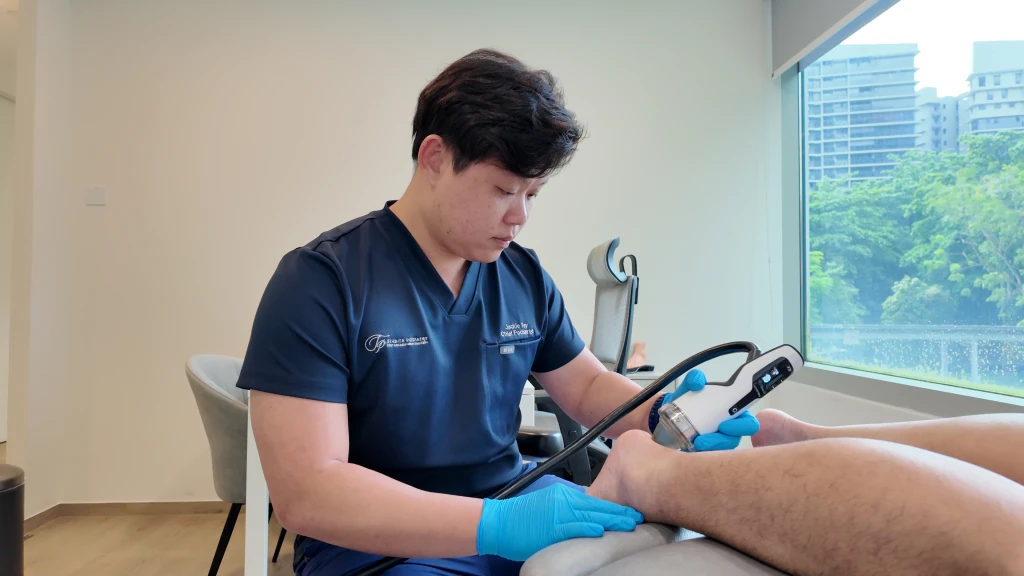
- Extracorporeal Shockwave Therapy (ESWT). ESWT delivers focused acoustic energy into the Achilles insertion and surrounding tissue to stimulate the natural healing process. We typically consider it for cases that have not settled after six to eight weeks of footwear changes, offloading, and structured loading. It runs as a course, not a single session.
- Radial Pressure Wave Therapy. Radial pressure wave works at a more superficial depth and helps release calf muscle tension feeding the irritation at the back of the heel. It often pairs well with ESWT or with the loading programme.
Neither modality is a shortcut around the loading phase. They are accelerators for cases where loading alone is not getting the bursa over the line. The choice belongs to a clinician who has assessed the foot.
If you are still limited by back-of-heel pain at week 8 despite working through the steps above, the next step is an in-person review with one of our podiatrists, who see retrocalcaneal bursitis routinely at all three clinics. Book an appointment at the location that suits you and we will work through where the recovery has stalled and what to adjust.