

Yes, you can rehab an old ankle sprain. One that happened months or even years ago can still respond to rehabilitation. In my experience, the age of the injury matters less than identifying what remains limited and whether rehabilitation has progressed towards the situations in which the ankle feels unreliable.
Chronic ankle instability is commonly described as a recurrent giving way of the ankle after previous sprains. Our condition guide on chronic ankle instability explains the symptoms, diagnosis and broader treatment options. Here, I focus on a narrower question: what should rehabilitation rebuild, and how do we decide whether an old ankle is ready for everyday activity or sport?
Can an old ankle sprain still be rehabilitated?
When I assess an old ankle sprain, I am less interested in whether someone has completed a standard set of ankle exercises than whether rehabilitation has restored the particular capacity that fails. A person may have regained movement, completed calf raises and become pain-free, yet still roll the ankle when landing, changing direction or stepping onto uneven ground.
Clinical guidelines recommend proprioceptive and neuromuscular exercise for chronic ankle instability, and evidence reviews indicate that exercise can improve patient-reported function and dynamic balance. However, research has not identified a single programme that suits everyone. [1,2,3] In practice, I do not simply prescribe more of the same rehabilitation. I match the programme to the remaining deficit and the patient’s goal.
Looking beyond the ligament
When I assess a recurrent ankle sprain, I look beyond the painful ligament. As the acute irritation settles, several parts of recovery may remain incomplete:
- Weight-bearing mobility: restricted movement can change how the body controls walking, squatting, landing and direction changes.
- Strength, endurance and power: the calf and outer-ankle muscles must produce force repeatedly and respond quickly, not simply pass one isolated strength test.
- Sensorimotor control: the nervous system must detect the ankle’s position and organise a timely response when the body moves beyond its base of support.
- Loaded single-limb stability: the ankle and the rest of the lower limb must control the body while reaching, landing or managing an external load.
- Confidence and readiness: pain may settle before trust, movement quality and tolerance of activity have returned.
I do not assume that every recurrent sprain has the same cause. Some ankles become structurally lax, while others feel unstable despite little assessable laxity. I therefore use the pattern found on assessment to decide what rehabilitation needs to address.
Why might basic ankle exercises not be enough?
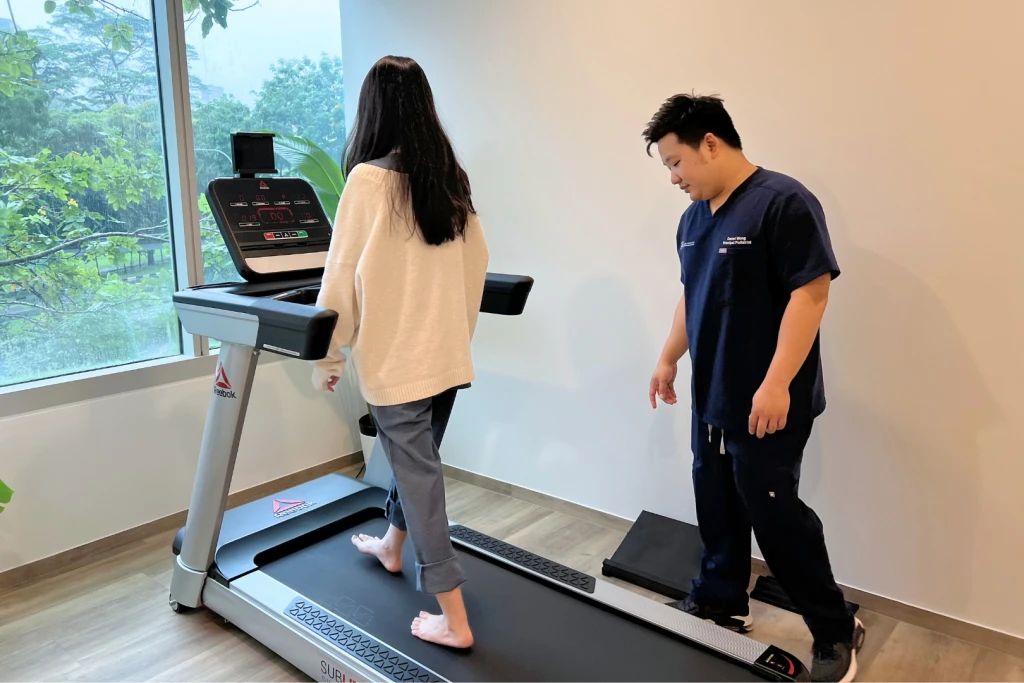
In clinic, I often see ankles that seem strong during seated testing, but remain unreliable during loaded balance, multidirectional reaching, landing or cutting movements.
Simple ankle movements performed while sitting or lying down may improve mobility and isolated strength, but they do not necessarily restore control when the body is moving over the ankle.
I therefore progress rehabilitation until it resembles the task. Walking to the MRT, descending a kerb and playing badminton all require a different speed of response, and each of those demands has to be accounted for.
How do I assess ankle stability under load?
I place particular value on assessing the ankle in weight-bearing, because that is where most patients experience the problem. Assessment may include single-limb balance under an appropriate load and a multidirectional reach task such as the Star Excursion Balance Test. Depending on the person’s goal, hopping, landing, deceleration or change-of-direction tasks may also be relevant.
I use these tests to observe how the ankle, foot and rest of the lower limb behave when the body moves over the supporting leg. They are useful components of assessment, but I do not treat any one test or score as universal clearance.
How should rehabilitation progress?
Rehabilitation should be built around the deficits found and progressed towards the patient’s activity. This stepwise approach is what I aim for in clinic. Depending on the assessment and the goal, it may include:
- restoring relevant weight-bearing ankle mobility,
- building calf strength, endurance and power,
- progressing from controlled single-limb balance to multidirectional stability tasks,
- adding reach, external load, speed, perturbation and decision-making as appropriate, and
- reintroducing running, landing, hopping or change-of-direction tasks where required.
I still routinely monitor pain, but pain reduction is not the only outcome. The more important question for me is whether the ankle can tolerate the load, speed and uncertainty of the activity the person wants to resume.
Where do foot posture and gait fit?
This is where podiatric assessment adds real value: understanding how foot posture, gait and the way the foot interacts with footwear change how load reaches the ankle. I cannot change an adult’s underlying foot posture. A high-arched or cavus foot may bias load towards the outside of the foot in some people, while a flat or highly mobile foot may affect movement timing and control in others.
Foot posture and function are always assessed when I see a case of chronic ankle instability. These assessments matter most when they match the injury history and are accompanied by a meaningful gait or functional problem. For me, posture is one possible contributor, but not the sole explanation for recurrent sprains.
When might custom foot orthoses help rehabilitation?
I consider custom foot orthoses when assessment identifies a foot posture, loading pattern or gait behaviour that is plausibly contributing to the recurrent problem. This is particularly relevant when the ankle continues to be exposed to an unhelpful loading pattern from the foot despite appropriate exercise progression.
My objective is not to “correct” a high arch or flat foot. I may use an orthosis to redistribute load, influence how the foot interacts with the shoe, improve tolerance of weight-bearing activity or provide a more stable platform while loaded function is rebuilt. To me, orthoses work best to complement rehabilitation rather than replace it.
I judge the value of an orthosis against a defined outcome. Patients often report better loaded balance, less pain, or improved walking and sport tolerance.
When persistent pain prevents rehabilitation from progressing
Extracorporeal shockwave therapy (ESWT) can be considered when an old ankle injury remains painful or swollen, but my first step is to identify why. Ongoing swelling is not a diagnosis, and I do not apply shockwave simply because an ankle remains swollen after a sprain.
ESWT is also not used to tighten a lax ligament, restore proprioception or replace progressive balance and strength rehabilitation.
I use ESWT as an adjunctive treatment, when assessment identifies a separate, persistent pain-generating tissue with an appropriate indication. Take, for example, a chronic tendinopathy around the ankle that is preventing rehabilitation from progressing. In that situation, my purpose is to improve focal pain and load tolerance enough for active rehabilitation to continue. Where there is persistent deep joint pain, recurrent joint swelling, catching or locking, investigation for an osteochondral lesion or another associated condition may be warranted before considering ESWT.

Do braces or taping still have a role?
I may recommend a brace or sports taping for external protection, particularly when someone with a previous sprain is returning to a higher-risk activity. This can reduce risk while the support is being worn, but it does not restore mobility, strength, dynamic control or confidence by itself. [1]
When managing chronic ankle instability, my philosophy is not to let braces, taping or foot orthoses become the entire treatment. Each external support should have a defined purpose and sit alongside a rehabilitation programme that progressively rebuilds the ankle’s own capacity.
How do you know whether the ankle is ready?
Readiness is not determined by a universal number of weeks, or by pain alone. I consider symptoms during and after activity, ankle mobility and strength, confidence and perceived stability, dynamic balance, hopping or agility where relevant, activity-specific drills and tolerance of a full training or work exposure.
The exact standard I use depends on what the person is returning to. My threshold for ordinary walking is different from my threshold for badminton, football or trail running. Rehabilitation can be considered finished when the ankle has demonstrated enough capacity for the intended task.
When is rehabilitation not the whole answer?
Persistent deep pain, recurrent swelling, catching, locking, focal tendon pain or an inability to progress despite appropriate care prompts me to reassess. After a new injury, focal tenderness directly over bone, marked bruising, acute sharp pain with substantial swelling or difficulty bearing weight may justify assessment for a fracture or another significant injury. [4,5]
These cases call for a broader assessment of the ankle and any associated injuries rather than simply progressing the exercise programme.
The main question is not how old the sprain is
I have seen ankle injuries dating back many years improve, and newer ankle injuries hit a road block. For some people, the missing element is mobility, strength or confidence. For others, it is multidirectional control, their foot-loading pattern or an associated injury causing chronic pain.
My approach is conservative, but it is not passive. I identify the limiting factor, choose each intervention for a defined purpose, and progressively test whether the ankle is becoming more capable in the situations that matter.
When to seek assessment
I recommend an assessment when the same ankle repeatedly gives way, you no longer trust it on uneven ground or during sport, rehabilitation has not improved loaded stability, or pain and swelling persist between episodes. Deep joint pain, catching, locking, recurrent swelling or new bony tenderness are additional reasons to look beyond a routine exercise progression.
If your ankle keeps giving way or an old sprain has never quite settled, book a consultation with any of our podiatrists at any of our three clinics in Singapore.
References
- Martin RL, Davenport TE, Fraser JJ, et al. Ankle Stability and Movement Coordination Impairments: Lateral Ankle Ligament Sprains Revision 2021. J Orthop Sports Phys Ther. 2021;51(4):CPG1-CPG80. doi:10.2519/jospt.2021.0302.
- Zhang C, Luo Z, Wu D, et al. Effectiveness of exercise therapy on chronic ankle instability: a meta-analysis. Sci Rep. 2025;15:11709. doi:10.1038/s41598-025-95896-w.
- Xu JS, Lin HJ, Li ZK, et al. Exercise Therapy for Chronic Ankle Instability: Which Modality for Which Deficit? A Systematic Review and Meta-Analysis. J Foot Ankle Res. 2026;19(1):e70142. doi:10.1002/jfa2.70142.
- Smith SE, et al. ACR Appropriateness Criteria Acute Trauma to the Ankle. J Am Coll Radiol. 2020;17(11S):S355-S366. doi:10.1016/j.jacr.2020.09.019.
- Schonberger A, et al. ACR Appropriateness Criteria Chronic Ankle Pain. J Am Coll Radiol. 2026. PMID:41817475.