
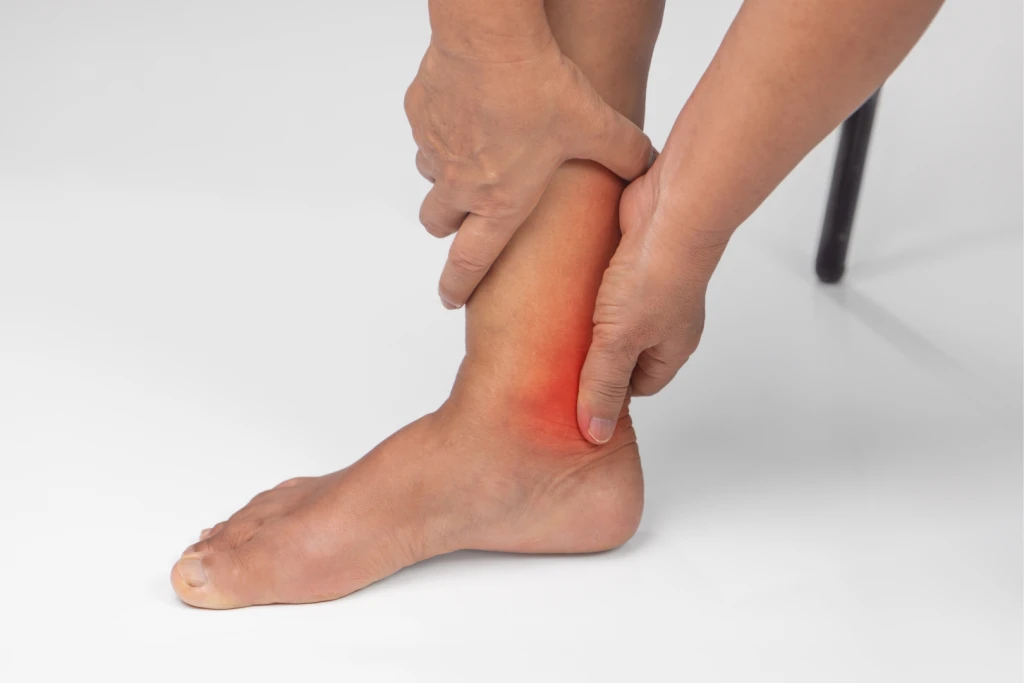
When a patient tells me the inside of their ankle hurts after walking, I do not jump straight to the shape of their foot. The first thing I want to know is what the pain actually feels like. Is it achy, pulling, burning, or tingling? That tells me far more about what is injured than a glance at the arch does. But I will be honest with you about the odds: easily six or seven out of every ten people who come in with this exact complaint turn out to have an injured posterior tibial tendon.
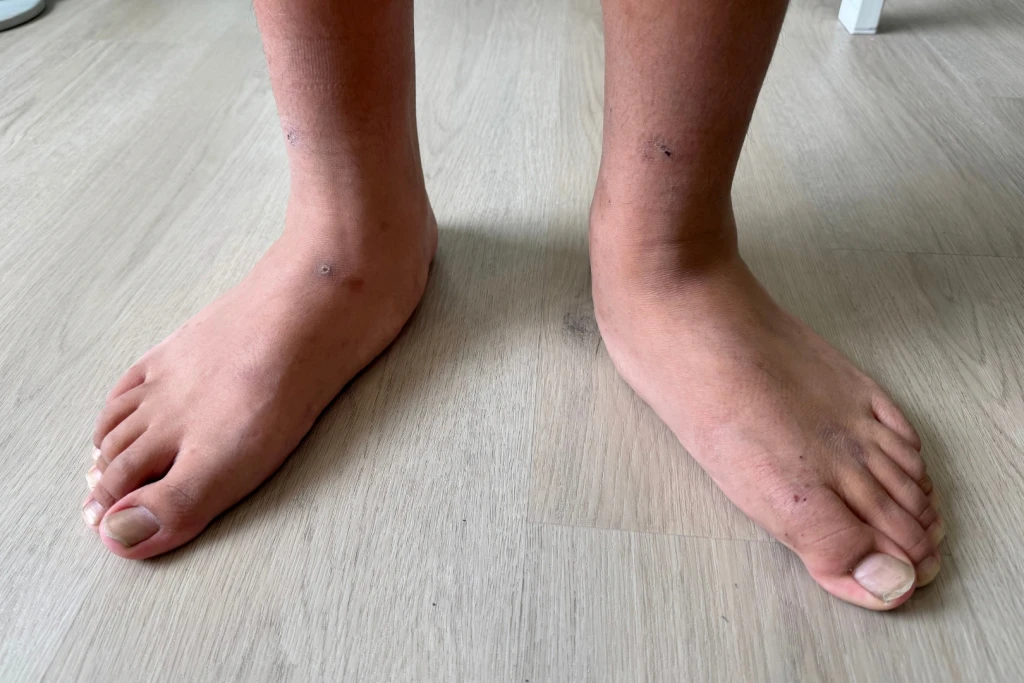
Often there is a second clue. The painful foot looks a little flatter than the other one. When I see that asymmetry sitting alongside inner ankle pain that comes on after walking, it gives a strong impression that the posterior tibial tendon is starting to give way. I have flat feet myself, and mine are symmetrical and have been that way since I was young, which is actually one of the first things I use to separate a lifelong flat foot from a tendon that is quietly failing. Here is how that failure happens, how I work out whether it is really the cause, and why the stage you are at changes everything.
Why the inside of your ankle hurts after walking
Think of the posterior tibial tendon as a sling on the inside of your ankle. Its job is to supinate the foot, or in simpler but less precise terms, to hold your arch up and keep the foot stable as you walk. Every step, it helps turn a loose bag of bones into a firm lever you can push off.
When that tendon takes on too much stress, either built up over time or from a sudden spike in activity, it gets injured and weakens. As it weakens, it can no longer do its job of supporting the arch, so the foot begins to flatten. Left unattended, the arch drops further and further, and eventually the joints themselves start to wear out and stiffen. That whole progression has a name, adult-acquired flatfoot, and clinicians describe it in stages precisely because catching it at stage one is a very different situation from catching it at stage four. [1] [2]
The early signs people brush off
The earliest sign is almost always pain, and it has a fairly typical character. It is a pulling sensation behind the bony bump on the inside of your ankle (the medial malleolus), or a little further forward at the navicular bone in the arch, and it gets worse the longer you are on your feet. Classically it eases with rest, which is exactly why it gets ignored. The moment you go back to sport or a long walk, it returns to haunt you.
Some people get a more sudden version after an intense session of jumping sports such as basketball, and that one tends to show up with redness or swelling around the inner ankle. Either way, the reason catching it early matters is simple. In the early stage, the tendon is irritated but still structurally sound, and settling it down is realistic. Once it has stretched and failed far enough to change your foot shape, you are dealing with a harder, longer problem.
How I find what is really causing your inner ankle pain
Two things come first in my assessment. First, I check whether the flat foot is symmetrical. If both feet are equally flat, it is usually a lifelong flat foot, like mine, rather than something new, so I will ask whether you have always been aware of your foot shape or noticed it since you were young. If one foot is flatter than the other, the second thing I want to know is whether the pain is on that flatter side.
From there, I test the tendon directly. A single-leg balance and a single-leg heel raise are both hard or painful to perform when the posterior tibial tendon is damaged. I also run resisted strength tests, and not only on the posterior tibial tendon, because the neighbouring flexor hallucis longus (FHL) and flexor digitorum longus (FDL) tendons can produce similar symptoms when injured, the difference being that they do not change your foot shape. I add a Tinel’s test too, tapping the inner ankle to see if it triggers numbness or tingling, which would point instead to a tarsal tunnel problem.
Here is what I really want you to take away. The posterior tibial tendon is not the only thing that can leave one foot flatter than the other. A bad ankle sprain in the past, especially one that tore ligaments, can do it. So can an old Lisfranc injury in the midfoot. A leg length difference can make the longer leg pronate more. Even a noticeably tighter calf on one side can drive extra pronation as compensation. So I do not jump to conclusions, and you should not either. Telling these apart takes a clear picture of your pain pattern and a proper hands-on assessment.
Why the stage changes everything
Staging is not academic. It decides what I recommend, and it sets your recovery time, so it is worth understanding where you sit.
- Stage 1 to early stage 2, where the foot shape is still largely intact, usually calls for rest, a switch to genuinely supportive footwear, a well-designed pair of customised insoles to offload the tendon, and a progressive rehab programme. In my experience, an early case like this settles over about three months.
- Late stage 2 to stage 3 brings some structural deformity and worn, restricted ankle or subtalar joints. The insole design becomes more involved, because it has to accommodate the deformed joints while still offloading the tendon, and in most of these cases an ankle-foot orthosis is needed to keep you mobile, reduce pain when walking, and even make rehab possible. Recovery of pain and function here typically runs somewhere between four and nine months.
- Stage 4 cases often end up needing surgery, and even then the road back is not easy, with a return close to full function sometimes taking up to eighteen months.
The rehab that runs alongside all of this is guided work, not guesswork, and our physiotherapist progresses the loading as the tendon can tolerate it. None of these timelines is a promise, because bodies differ, but they show you how much the starting stage shapes the journey.
The one thing that costs patients the most
“I thought the pain would be fine after a while, so I didn’t have it checked.” That single sentence is the one that costs people the most, and I hear it most often from women between fifty and sixty, which is also exactly the group in whom this condition is most likely to strike.
It is a completely normal thing to assume. Pain often does settle on its own, but only if you rest it and give yourself a realistic window, say two to four weeks. What you should not do is push through inner ankle pain for three months, six months, or longer and still expect it to disappear. Doing that either burns through the golden window when the tendon could still recover on its own, or lets the condition progress to a worse stage, where the care becomes more complex, longer, and more costly.
Have your inner ankle pain assessed
If the inside of your ankle aches after walking and eases with rest, that pattern is worth taking seriously, especially if one foot looks flatter than the other. Book a consultation with any of our podiatrists in Singapore for an assessment of the tendon, your foot shape, and how you load the foot as you walk, so you know which stage you are at and what will actually help.
Frequently Asked Questions About Inner Ankle Pain After Walking
Is inner ankle pain after walking always the posterior tibial tendon?
No, but it is the most common cause I see, roughly six or seven times out of ten. The nature of the pain matters: a pulling ache behind the inner ankle bone that worsens with walking and eases with rest is fairly typical, and a foot that has become flatter on the painful side makes it more likely still. Other structures, including the neighbouring FHL and FDL tendons or the tarsal tunnel nerve, can mimic it, which is why an assessment rather than a guess is what sorts it out.
Can a fallen arch from the tendon be reversed?
It depends on the stage. When the tendon is caught early, and the flatfoot is still flexible, offloading it with insoles and progressive rehabilitation can settle the pain and stop the collapse from progressing. Once the foot has become fixed and the joints have stiffened, the deformity itself cannot be reversed without surgery, which is the whole reason acting early is worth so much.
Do I need surgery for a posterior tibial tendon problem?
Most people do not, particularly when it is caught in the earlier stages, where conservative care does the work. Surgery generally comes into the picture only at the most advanced stage, or when a genuine attempt at conservative care has not held. The staging is what tells us which path applies to you.
Why does my inner ankle hurt after walking but feel fine after rest?
That on-and-off pattern is one of the most telling early signs of a posterior tibial tendon problem. The tendon copes while you are resting, but each spell of walking loads it beyond what it can currently manage, so the ache returns and then settles once you are off your feet. It is tempting to read the pain-free periods as proof that nothing is wrong, but in the early stages that is exactly when the tendon is most treatable, which is why the pattern is worth acting on rather than waiting it out.
References
- Johnson KA, Strom DE. Tibialis posterior tendon dysfunction. Clin Orthop Relat Res. 1989;(239):196-206.
- Myerson MS. Adult acquired flatfoot deformity: treatment of dysfunction of the posterior tibial tendon. Instr Course Lect. 1997;46:393-405.