
When someone comes to me with numbness, tingling or a burning feeling in their feet, they almost always start by pointing at the spot. That is the natural thing to do, but it is not where I start. The same feeling in the same place can come from very different causes, and some of them have nothing to do with the foot itself, so the first thing I want is the bigger picture of your health. From there, where the feeling sits, what sets it off, and what settles it usually tell me most of the story.
My patient asked me to write a blog on this just last week, and I promised her I would. So here is how I work through it with a patient, the causes I see most often, and the signs that mean you should not sit on it.
Why I start with your health, not your feet
Before I look at the foot, I ask about your medical history, because conditions like diabetes, a compressed nerve, a vitamin B12 deficiency or poor circulation can all show up as the exact same numbness or burning. Knowing the bigger picture tells me what is likely to be feeding the symptom before I have even touched your foot.
Then I narrow it down with three questions. Where exactly is the feeling, the heel, the arch, the ball of the foot, or the toes? What triggers it, is it after long walks, after a particular pair of shoes, or only when you lie down? And what makes it better, open-toed shoes, going barefoot, or sitting up when it hits you at night? Each answer points me toward a different cause, which is why I spend time on them rather than rushing to an examination.
What the location of the feeling tells me
More than anything else, where the sensation sits is what starts to separate one cause from another.
Numbness or burning in the toes
The most common cause of burning or numbness in the toes is a Morton’s neuroma, which usually affects the third and fourth toes. It tends to be worse in tight shoes, so you can see why it shows up more often in women, and it usually eases in wider shoes. If the neuroma is large, though, roomier shoes alone are not enough to settle it.
The other one I see in the toes affects the big toe, and the story is almost always the same. Someone wears tighter shoes for a holiday, and for weeks afterwards the inner side of the big toe feels numb, clearly different from the outer side. This is a transient compression neuropathy. It does not usually hurt, it is just numb, and it can take months to recover even once you stop wearing the tight shoes.
Burning or tingling in the arch or heel
When the feeling is in the arch or heel, two trapped nerves are the usual suspects. Tarsal tunnel syndrome tends to give shooting pain, burning and tingling from the inner ankle down into the arch and foot, and sometimes the other way, up the leg. It is actually not that common, and it often comes alongside something else, like flat feet, ankle swelling, or a growth inside the ankle pressing on the nerve.
Far more often in my own practice I see Baxter’s nerve entrapment. It looks a lot like plantar fasciitis, mostly the heel and sometimes near the arch, except the pain burns and comes with numbness. That resemblance is exactly why it gets missed. Plenty of my patients tell me they were treated for plantar fasciitis in the past and it never worked, and sometimes that treatment made things worse, especially off-the-shelf insoles pressing on the wrong spot. If heel pain treatment has failed you, a burning, numb quality to the pain is a clue worth taking seriously.
Numbness in both feet, starting at the toes
When both feet are numb and it began at the toes before creeping down into the foot and ankle, in a pattern like a sock being pulled on, that points me toward diabetic neuropathy or another nerve condition affecting the whole body rather than one trapped nerve. Both feet being involved, fairly symmetrically, is the giveaway.
Burning that is worse when you lie down
If the burning is worse lying down and eases when you sit up or hang your legs over the side of the bed, I start thinking about circulation rather than a nerve. Poor blood flow, or peripheral arterial disease, can burn at rest and often comes with a cramp in the calf that settles the moment you drop the legs down. That positional pattern is a useful flag.
The red flags that mean do not wait
Most numbness and burning is not an emergency, but some of it is, and these are the signs that should send you for help straight away rather than booking a routine appointment.
Any paralysis or loss of control of the foot points to severe nerve compression and needs urgent attention. One-sided weakness, especially with a drooping face, slurred speech or weakness in the arm, can be a sign of a stroke, and that is an emergency, so call for help immediately. And a limb that is cold, looks purplish, or has a wound that is not healing suggests the blood supply is compromised, which also needs to be seen without delay. If any of these are happening, this article is not the place to stop, please get medical care now.
Numbness and diabetes: why catching it early matters
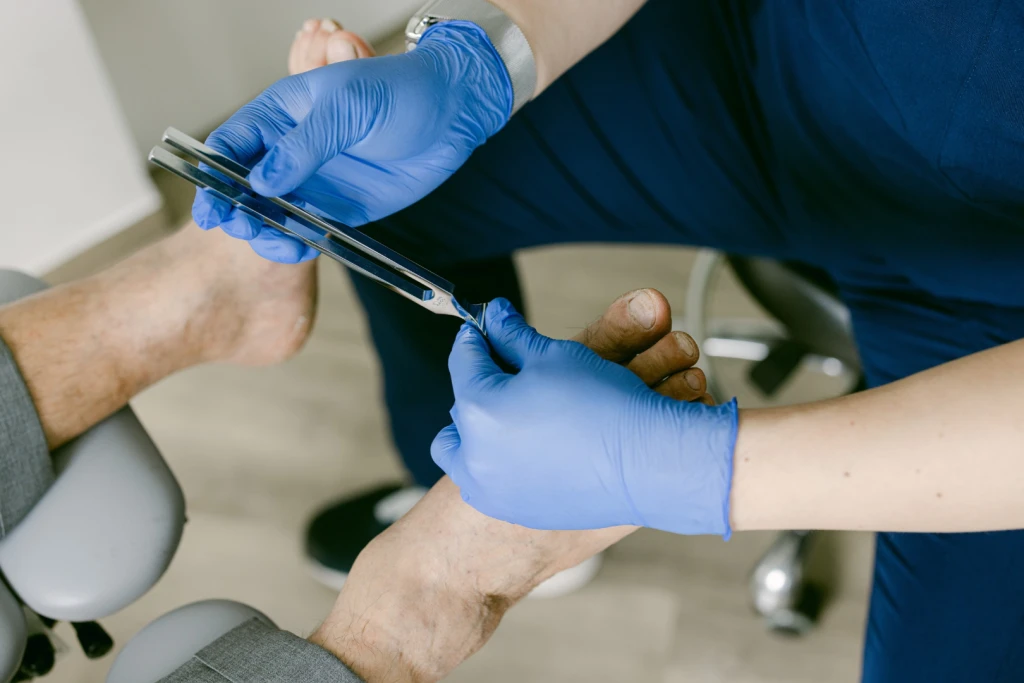
One thing worth clearing up is that numbness is usually not the first sign of diabetic nerve damage. The earliest change is a loss of vibration sense, and that is not something you can feel in yourself, which is the whole problem. We pick it up with a monofilament test and a vibration test that check how well you can sense the foot.
Catching it early matters because it tells me whether your protective sensation is still intact, in other words whether you would feel a cut or a sharp object underfoot. If you cannot feel it, you can pick up a wound without ever knowing, and that is how a small injury turns into a serious infection. If you have diabetes, having that sensation checked is one of the most useful things you can do, long before numbness sets in.
When it is something simpler
Not all of this is serious. In otherwise healthy people, the burning or numbness is most often a neuroma or simply shoes that are too tight, and those have a good outlook. What a proper consultation and physical assessment does is tell me whether yours is one of the straightforward ones or whether it needs imaging or further investigation. Where the diagnosis is clear and mechanical, most people improve with a change of footwear and a customised insole built to take the pressure off the irritated nerve.
How I assess it, and what actually helps
My assessment follows the same order as my thinking. I start with the thorough history, then examine the area where you feel the numbness or burning, and run sensation tests or clinical tests designed to reproduce the feeling, which usually settles the diagnosis. Then I look at your foot posture, your gait and your shoes to work out what is driving it in the first place.
From there the plan is practical. I can advise on the footwear that will take the pressure off, and where it is needed, a customised orthosis designed to reduce the compression on the nerve. Insoles are not the only tool, though. Targeted exercises, shoe changes, and in some cases shockwave therapy all have a role depending on what is actually causing the problem.
The misconception that costs people time
The belief I correct most often is that numb or burning feet must mean “not enough circulation”, or that it is all coming from an existing back problem. People act on that assumption, reaching for warm foot baths, electrical stimulation machines or frequent massages, and in doing so they put off getting it properly looked at while the real cause carries on.
The other one is about insoles. People worry that an insole will only make the shoe tighter and the burning worse, which is not how a well-made orthosis works, and they assume insoles are the only thing we would offer, which is also not true. The honest answer is that numb and burning feet have many causes, and the right help depends entirely on which one is yours.
Get your numb or burning feet properly assessed
If your feet have been going numb, tingling or burning and you are not sure why, it is worth having it assessed properly rather than guessing or waiting it out. Book a consultation with any of our podiatrists in Singapore, and we will work out what is behind it and what will actually help, and point you to the right care if it needs more than a podiatrist.
Frequently Asked Questions About Numbness and Burning in the Feet
What causes numbness or burning in the feet?
There are several common causes, and where the feeling sits helps separate them. A trapped nerve such as a Morton’s neuroma in the toes, tarsal tunnel syndrome or Baxter’s nerve entrapment in the arch and heel, nerve conditions affecting the whole body such as diabetic neuropathy, and poor circulation can all cause it, as can something as simple as shoes that are too tight. What triggers the feeling and what relieves it are often as telling as where it is, which is why a proper assessment matters.
Should I worry about pins and needles in my feet?
Usually not, especially when it is clearly linked to tight shoes and eases off once you change them. But some signs do mean you should be seen urgently rather than waiting, including weakness or loss of control in the foot, a cold or discoloured limb, a wound that will not heal, or sudden one-sided symptoms with facial drooping or slurred speech. If any of those are present, treat it as urgent and get medical care straight away.
Why do my toes go numb after wearing tight shoes?
This is often a transient compression neuropathy, where a nerve to the toe has been squeezed, or an irritated Morton’s neuroma. The numbness tends to ease once you go back to wider shoes, but it can take months to fully settle, and it does not always hurt. If it lingers or keeps coming back, it is worth having it checked so the cause can be confirmed and the pressure taken off properly.
Can a podiatrist help with numb or burning feet?
Yes. The first job is to find the cause through a history and physical assessment, including sensation tests and a look at your foot posture, gait and footwear. From there, help can include footwear advice, customised insoles to reduce the compression on the nerve, targeted exercises, and in some cases shockwave therapy. If diabetes is part of the picture, a podiatrist can also check whether your protective sensation is still intact, which is important for preventing injuries you cannot feel.